Edith Maxwell: Delivering the Truth Friday, Apr 8 2016 

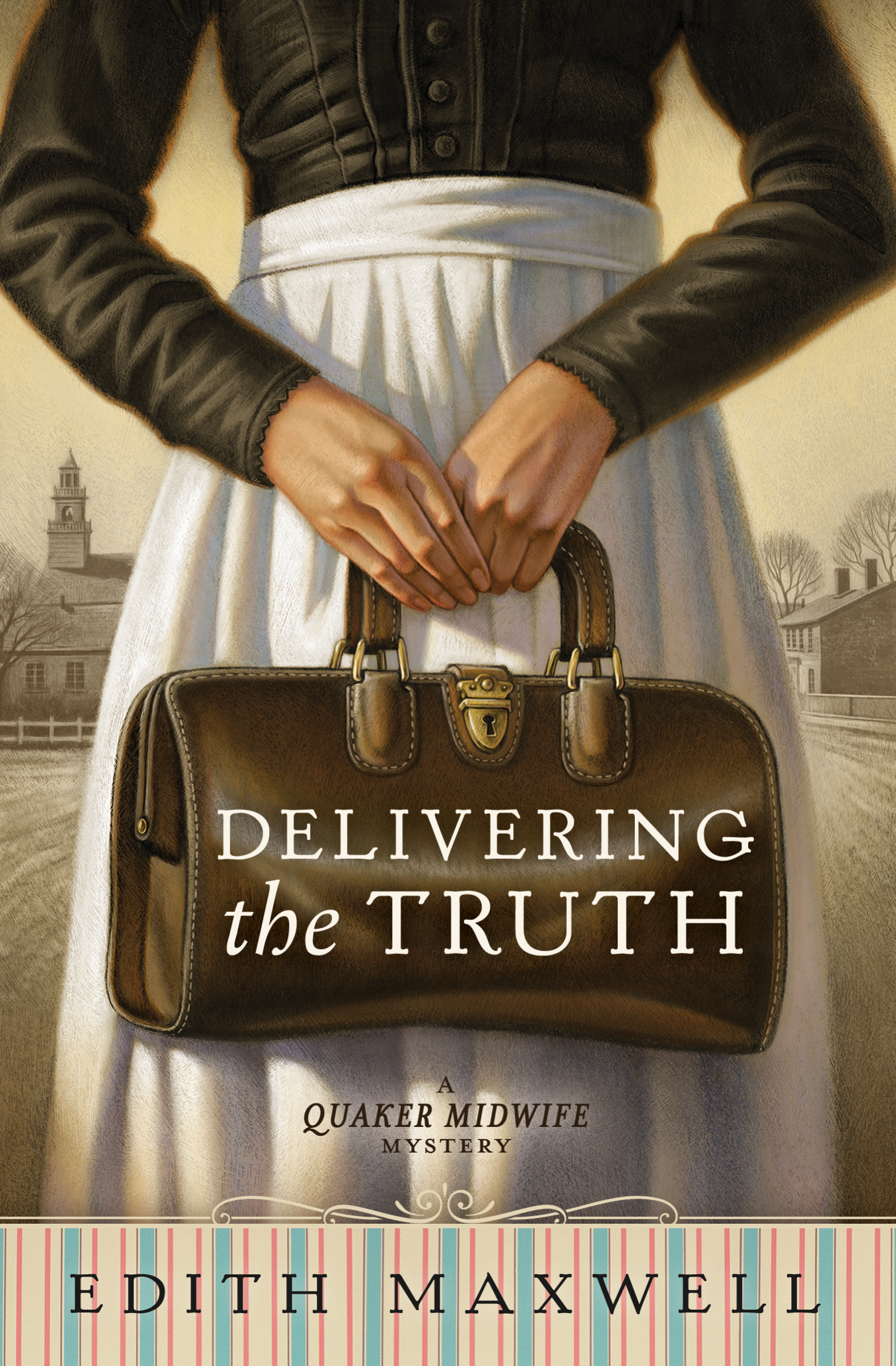
Edith Maxwell is one of the hardest working authors Auntie M knows, juggling now four series and bringing out books that have a wide readership. Today she’s talking about her new historical mystery, Delivering the Truth, the first in her Quaker Midwife Mysteries. Check out that neat cover and discover the mystery inside.

Delivering the TruthCover

Learning about the Past

Thanks for having me back, Auntie M!

My latest venture – historical mystery – involves a level of research I don’t need to do when I write my contemporary mysteries. I had so much to learn about the late 1800s. And there’s nobody still alive to ask.

How would a Quaker speak and act? What did women wear under their outer clothes? Did a modest New England home have indoor plumbing, gas lamps, a coal stove? What were matches like?
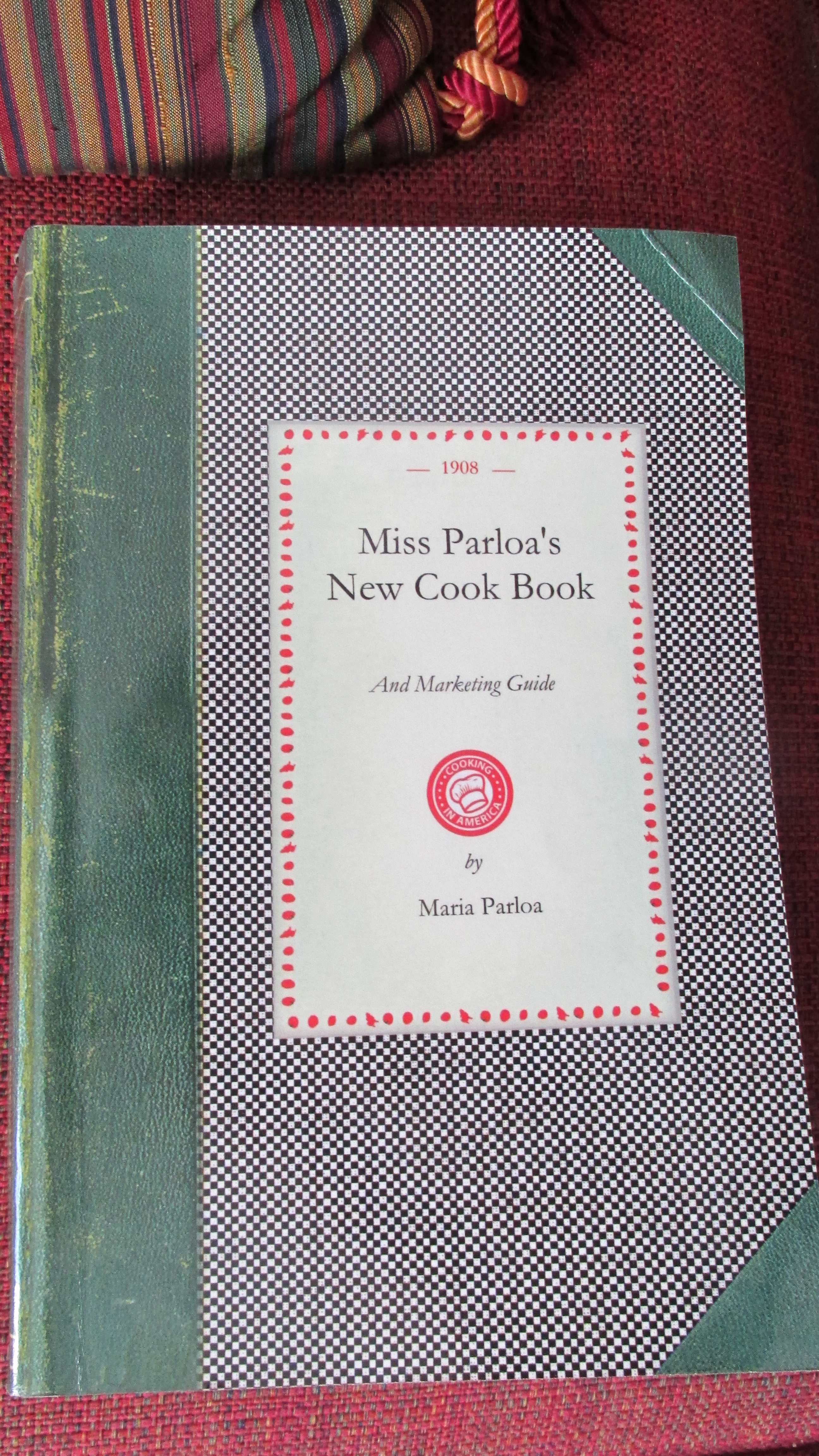
MissParloas-2

I’ve found a couple of good reference books for everyday life. Ruth Goodman’s How to Be a Victorian describes everything from toothbrushes to underwear. Miss Parloa’s New Cookbook and Marketing Guide from 1890 has all kinds of handy tips about the kitchen and foods available in the end of the century. Pinterest provides images of clothing. And then there’s Sarah Chrisman – who lives like someone in 1888 and writes about it! http://www.thisvictorianlife.com/

MontWardCarriages
I needed to learn about all the different types of horse-drawn vehicles. Carriages, wagons, buggies, drays, runabouts, broughtons, phaetons, surries – and so many more. Luckily for me, the town where the series is set, Amesbury, Massachusetts, is where I live and it was world-famed for its carriage manufacturing. There are antique carriages all over town, a thriving Carriage Museum, and many enthusiastic history buffs to call on.

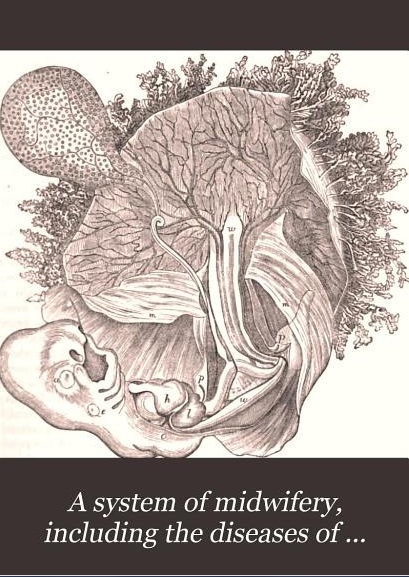
MidwiferyBookLeish
Because my protagonist is a midwife, I delved into medical care of the time. Basic uncomplicated childbirth hasn’t changed that much. But did they know about the importance of washing hands yet? I learned that the germ theory of infection was known. Was there a hospital nearby in case of emergency? Yes, the hospital in the next town was eight years old at the time of Delivering the Truth. I found a midwifery textbook from the era. I learned that blood typing wasn’t yet used but that a lab could find out from a snip of hair if arsenic had been ingested.

Reading local newspapers from a hundred and thirty years ago provide much detail about both news and the prices of goods and services, as do the Sear & Roebuck catalog and the Montgomery Ward catalog, both of which are available on Amazon as reproductions. For example, you could buy a two-spring Phaeton (a single-horse kind of buggy with a roof) for $70, a drop-leaf desk for $9.50, and a pair of Irish lace curtains for $2.35. My midwife Rose bought a new bicycle for $45.
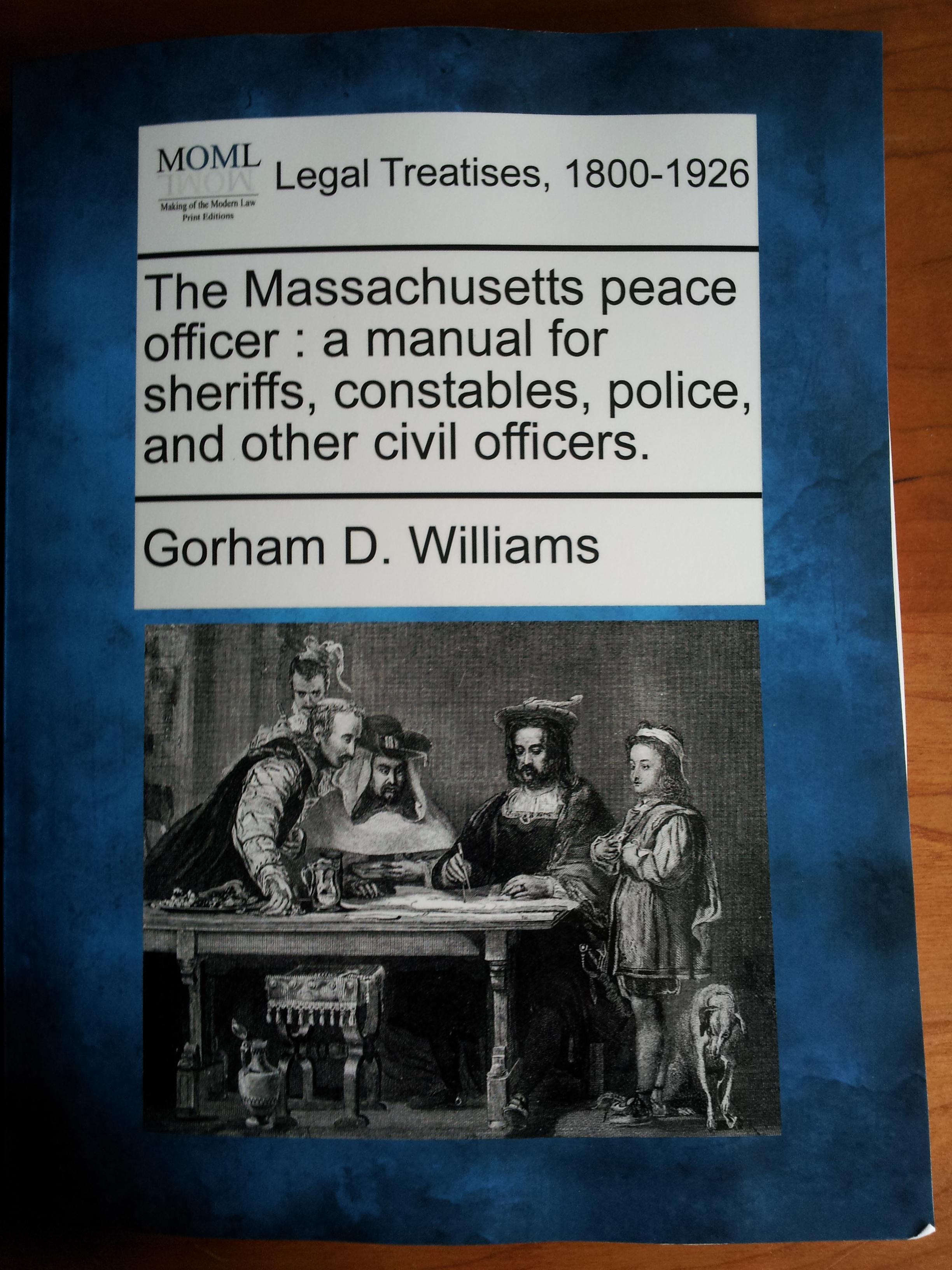
PoliceManualCover
And because I write mysteries, there’s the all-important question of police procedure. I’ve found pictures of the local police force in town, and dug up The Massachusetts Peace Officer: A Manual for Sheriffs, Constables, Police, and other Civil Officers from 1890. An officer had to lay a hand on the shoulder of someone he was arresting, for example. I also learned that they didn’t yet use fingerprinting.

There’s more, of course. Local historical societies and museums are a rich resource. But at some point you just have to write the book!

Readers, do you like doing research? Where do you find resources to learn about the past, or about your current passion, whatever it is?

MaxwellCrop

Edith Maxwell writes the Quaker Midwife Mysteries and the Local Foods Mysteries, the Country Store Mysteries (as Maddie Day), and the Lauren Rousseau Mysteries (as Tace Baker), as well as award-winning short crime fiction. Her short story, “A Questionable Death,” is nominated for a 2016 Agatha Award for Best Short Story. The tale features the 1888 setting and characters from her Quaker Midwife Mysteries series, which debuts with Delivering the Truth on April 8.

Maxwell is Vice-President of Sisters in Crime New England and Clerk of Amesbury Friends Meeting. She lives north of Boston with her beau and three cats, and blogs with the other Wicked Cozy Authors. You can find her on Facebook, twitter, Pinterest, and at her web site, edithmaxwell.com.

Thom Satterlee: The Stages Wednesday, Mar 9 2016 

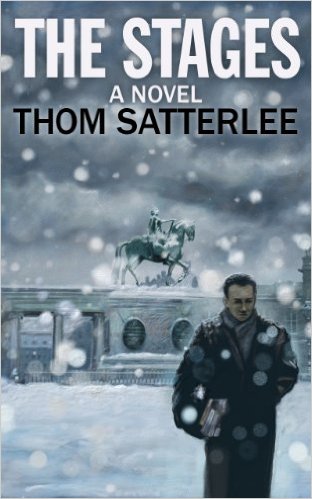
The Stages

One of Auntie M’s favorite books in past years was Mark Haddon’s The Curious Incident of the Dog in the Night-time. So when she was offered a chance to read Thom Satterlees’ The Stages, she knew she would enjoy the chance to follow an adult character with Asperger’s Syndrome.

Daniel Peters is an American translator living in Copenhagen and working at the Soren Kierkegaard Research Center. He’s become known as one of the philosopher’s best translators, and frequently lapses into interior monologues with the reader about what Kierkegaard has to say on a particular subject. His mentor and friend, and former love, Metta Rasmussen, is also his supervisor, who has diagnosed correctly, helped him learn techniques to handle living in a world where he doesn’t ‘get’ social clues, facial tics or body language. There’s a defined rhythm to his days and habits, including a propensity for eating danishes, and where better to find them?

Then the unthinkable happens: Mette is found murdered, and a new manuscript he’d been translating has been taken. Daniel was the last person to see her alive, but although he comes under suspicion, he thinks he’s able to persuade a female detective that he’s innocent. But it means she needs him to help with her investigation, if only to help him clear his name. And as he does that, he needs to learn how to express his grief for the friend he’s loved and lost.

Stepping outside his comfort zone is a mild way of describing how Daniel must act and react in this compelling mystery set inside a totally different world to most readers. It’s a satisfying read and one that brings Copenhagen alive on the pages.

Satterlee speaks Danish, and lived with a family in Denmark for his junior year in high school. The informs the novel with a vast sense of reality. Reading and understanding Kierkegaard is an entirely different matter, yet it’s obvious Satterlee has more than a grasp of the iconic philosopher’s life and work. Who would have thought an author could create a mystery surrounding Soren Kierkegaard and make it compelling and highly entertaining at the same time–Thom Satterlee did, and it’s a worthy accomplishment.

Nicholas Searle: The Good Liar Thursday, Feb 4 2016 

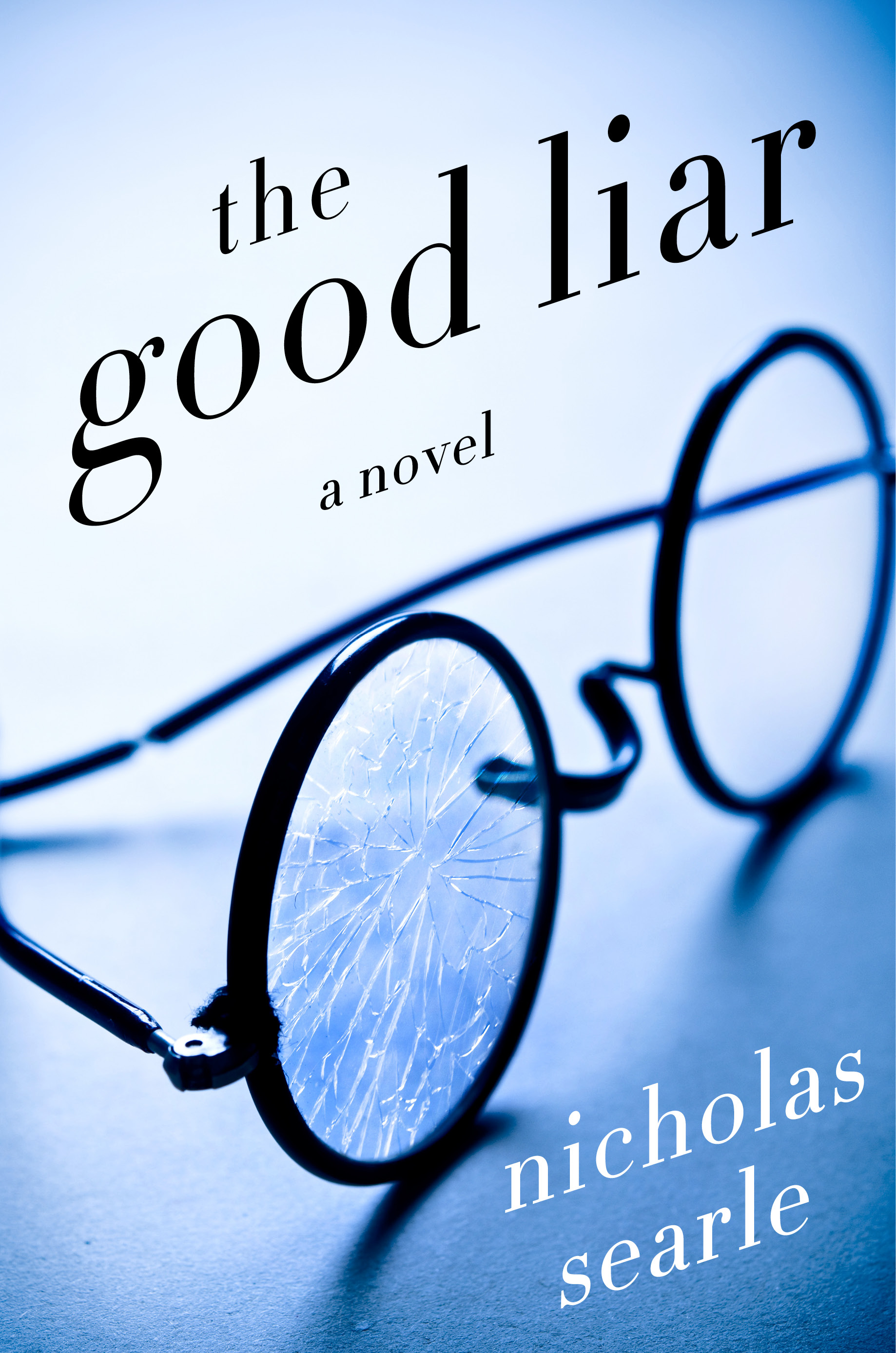
Good Liar hc c
The Good Liar is Nicholas Searle’s debut novel, yet it reads as if from an experienced literary hand. Mr. Searle graciously agreed to answer a few of Auntie M’s questions about this unusual novel and you’ll find them at the end of this review.

Meet Roy, a con man extraordinaire who is looking for one last big con. He thinks he’s found it in Betty, a comely widow in a nice little cottage who is placed well to take good care of him as he arranges his one last big con.

But things are not as they seem for any of the characters in this highly original and literate novel which almost defies description. It’s been called a psychological thriller akin to the best of Patricia Highsmith, and that will have to do, but it’s not your typical crime novel, for certain, it’s far more than that.

The story unfolds in a backwards stance over many decades as Roy’s story is spooled out. All of the supporting characters are finely drawn no matter the era, and the settings spring to life. It is to Mr. Searle’s credit that not once does the reader lose interest as the past alternates with the current situation occurring between Roy and Betty.

In fact, the deliberate pacing, like layers being peeled away from an onion, only heighten the tension and the race to the finish, and what a finish it is, with a twisted elegance that is most fitting. It would be difficult for Auntie M to reveal more about this story without ruining the plot, but suffice it to say that it has earned her coveted “highly recommended” rating and she urges you to find your copy.

Now to hear from Mr. Searle in his own words:

Nicolas Searle, cr John Rice

Auntie M: You touch on the rise in elderly people finding relationships on the internet and how those outcomes run the gamut from providing companionship to exploitation. After your personal brush with a relative’s less-than-successful experience, what’s your personal feeling about vulnerable elders searching for someone to share their last years?

Nicholas Searle: I think it’s great that people should seek companionship late in life, but there are risks. On the good side, it’s wonderful that people should have the energy and chutzpah to go out there and live life to the full, and not give up. On the other hand the process of finding a new partner can unleash a whole range of emotions, some of them troubling – guilt (about one’s previous, departed partner), fear (will I end up making a fool of myself?) and desperation (will I ever find anyone?). They can add up to a powerful cocktail of vulnerability that the less scrupulous can exploit. And this is, I think, magnified by modern online technologies that can make the prospective con-merchant that much more convincing. So I applaud the positivity of the elderly seeking to ride on into the sunset with someone new but at the same time I fear for their safety. It’s an issue that possibly deserves greater debate.

AM: The design of the book has you telling the main protagonist’s story in the present, alternating with chapters into his past life, delving into episodes that go earlier and earlier into his life. Did you know this would be the design of the book, or did it happen as you were writing?

NS: I knew pretty soon that the book would be structured this way. The way the book came into being was this: Roy cried out to me as a main character and I crafted the first chapter around him, finding Betty and Stephen coming out of the woodwork as I wrote. Then it was decision time, and I decided that we’d need to discover Roy’s history in order to find out what made him the way that he is. At the same time I wanted forward momentum as I was intrigued by Betty; and from that moment on the alternating chapter and present/past structure just seemed natural. I had it all worked out in my head – nothing on paper apart from the first chapter – within a couple of weeks. I was acutely aware that a narrative going backwards and forwards at the same time could end up being too complex and foxing the reader, which is part of the reason why I decided to hold the whole plot in my head rather than planning the novel with charts and so forth on paper. I rationalised that if I couldn’t keep the thread in my head then there’s no chance a reader could. Only at the end, part way through editing, did I draw up what I call a ‘map’ of the book, mainly so that I could check for continuity and plot consistency, as well as spoilers and dropping a few well-hidden (I hope) hints.

AM: I know you studied languages in England and in Germany, so the German connection was there for you, as well as the familiarity with that setting. Did that knowledge in some way lead you to the plot?

NS: I have had a long connection with Germany and German which started at school. I love the country and its people, and find both fascinating and far from the stereotypes the British have of them. There’s much more complexity and texture to both German history and – I hate generalisations but here’s a big one – the German tradition and way of thinking. So embedded in me was a strong sense of Germany and certainly what had gone on there in the 20th century. But when I started the novel in early 2014 I didn’t know (until I’d plotted the book in my head) that Germany would feature. I guess a wonderful trip to Berlin the previous summer – with the object of seeing the Berlin Philharmonic perform Beethoven’s Ninth Symphony in all its glorious pomp but also to re-acquaint myself with a city I know well – was the stimulus closest to the front of brain when I began writing. The concert was a magical evening and the weekend brought home to me forcefully how in Berlin all those layers of history, from the divided city of the Berlin Wall, through the Third Reich, Döblin’s Alexanderplatz of the 1930s, the decadent Twenties, the deprivation of Germany after the First World War and the Prussian grandeur of the late nineteenth century, exist at the same time, like whispers in the air. So in a way Germany, and Berlin particularly, had to be centre stage, though I didn’t know it at the time.

AM: Roy, your protagonist, has led a carefully constructed life and taken the time to develop his stories with great skill. You’ve also given him the ability to read people to a great degree. This lets him anticipate other’s actions and wear the right mask in any situation. You describe someone you met who would choose to lie when given the opportunity but was not good at it. Have you ever known someone who was a truly great liar?

NS: Roy was based on an individual I knew in real life – more closely in the first chapter I suppose; and from there I built him and no doubt embellished him shamelessly! I have no idea, for instance, whether the real ‘Roy’ ever was a con man. The real individual was someone a distant relative of mine, to whom however I remain close, befriended some years ago. It was if you like a whirlwind romance, if a geriatric one. He moved in with her within a matter of weeks and it wasn’t until afterwards that I went down to Wiltshire and met him. And disliked him. And discovered that virtually everything he said was a lie. And that he wasn’t particularly good at lying… I think it was these last two elements that intrigued me. It’s pretty normal, if you’re not very good at something to give it up, not to keep trying and failing. As it is I don’t think that the real ‘Roy’ was out to swindle my relative of her savings (she didn’t have any!) but that he was looking for the easy life, someone to look after him and to glare at over the Daily Telegraph in the morning. In answer to your question: I’m not sure. I pride myself at being pretty good at winkling out lies. But if someone was that good a liar I wouldn’t know, would I?

AM: Readers are always interested in a writer’s process. This is a thriller with a deliberate pace and increasing tension that leads to the complex ending. Was it difficult to keep this controlled pace as you wrote or did it come to you as you revised?

NS: It wasn’t difficult, I found. I’ve explained that I didn’t go in for elaborate planning methods and had the plot inside my head. From then on I simply concentrated on the chapter in hand. The episodic approach helped, as in a way each segment in time needs to be a self-contained story – but with strong links to the main narrative. I must confess to sowing a few clues into the narrative, both while doing the original draft and when revising. My thought was that readers would happen on what lies beneath at different times. I wanted to avoid the big ‘suspects all gathered in the drawing room’ reveal. It doesn’t actually matter when you twig to what’s going on, so long as you enjoy the journey.

AM: Having been in public service in the UK and New Zealand “more years than you care to remember,” what was the deciding factor that drove you to write fiction?

NS: The deciding factor? I have always wanted to write. Always. As a child I would write stories just for fun. Then when I went to university and later pursued a career it somehow got neglected. Possibly it was my laziness or cowardice, or possibly both. But I do like to quote Heinrich Böll, one of my favourite German writers, who began writing in earnest I think when he was 43: ‘schreiben wollte ich immer, versuchte es schon früh, erst später aber fand ich die Worte’ (from memory, so it could be wrong – ‘I always wanted to write, tried it when I was young but only found the words later.’) Then, with our return from New Zealand to the UK, came the opportunity and the impetus. This was the moment, I decided, when either I did this or lived the rest of my life wondering.

AM: I believe writers must be readers. Who were your early influences?

NS: I agree. I had tremendously undiscerning reading tastes when I was young – a good thing I think. I devoured all of Agatha Christie when I was about twelve or thirteen. And I mean all of what she wrote, in one long summer holiday. At that age I could easily read two books a day. But I also loved – perhaps slightly later – many European writers, such as Camus and Böll, Grass and Sartre, Dürrenmatt and Duras. In the English language one of my biggest regrets is not being able to get into Dickens until I was much older. I was much more interested in the contemporary novel of different genres: Graham Greene, Martin Amis, Ian McEwan, John le Carré, Patricia Highsmith, P.D. James. In my thirties I began to appreciate the American big-hitters and believe that some of the best contemporary fiction emerges from the United States.

AM: Why crime fiction–is that what you enjoy reading? Whose books would I find on your nightstand?

NS: I’ll let you into a secret here: I’m not very keen on genres. I didn’t set out to write a crime novel, or a thriller, or a suspense novel. I just wrote the kind of thing I’d quite like to read – intelligent without being incomprehensible, with twists and turns but not trashy. I’m not even sure now whether The Good Liar fits with the classic thriller/crime novel genre. It seems more publishers and booksellers – rather than writers or readers – who want to apply these labels. But it doesn’t bother me. I’m cool with it all. On my nightstand now you’d certainly find the latest Kate Atkinson, Richard Ford, John le Carré, William Boyd, Sarah Waters and Howard Jacobson, as well probably as a selection of Nicci French and Patricia Cornwell. And it’s such a shame that there will be no more books by P.D. James or Kent Haruf (to name just two).

AM: Have you started another writing project? Anything about it you can share with readers?

NS: Yes, I have started on the next project, but I’m not going to tell you anything about it! At the moment I’m focusing completely on The Good Liar.

David McCallum: Once A Crooked Man Tuesday, Jan 12 2016 

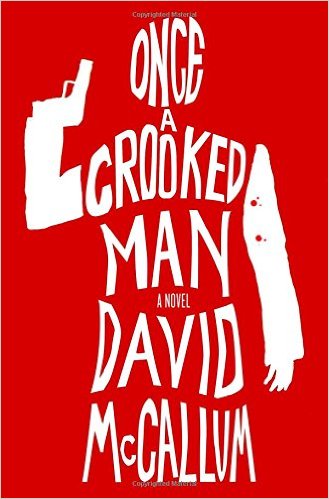
OnceCrooked

Actor David McCallum, yes thatMcCallum, of The Man from U.N.C.L.E. and now Ducky on NCIS, debuts a crime and espionage caper with just enough wry humor to let you know he had a ball writing it.

New York actor Harry Murphy could never imagine the consequences peeing in an alley against a building could bring. When he overhears the Bruschetti brothers plan their retirement, which includes the murder of their British connection, his conscience won’t allow him to forget what he’s overheard.

In true comedy of errors fashion, Harry decides to fly to England to warn the unlucky victim, but he’s mistaken for one of the mobsters’ associates and finds himself with a load of cash, fleeing from the bad guys. British authorities save him, but in order to clear himself, he’s soon on his way back to the US with the cleverly hidden cash and a comely British undercover agent accompanying him to flush out the brothers and put an end to their activities.

But that’s the crux: the brothers have decided to retire and go straight. Well, at least as straight as they possibly can. There will be shootouts, high speed chases, a probable drowning . . . and Harry really hoping he gets the voiceover for a mayonnaise commercial.

There’s plenty of action, along with the sly humor and impossible get-out-of-trouble adventures that remind readers of a bumbling James Bond.

With a surprising depth to the characters motivations, this is a clever and fun debut. Auntie M hopes McCallum will continue Harry’s adventures now that he’s had a taste for the wild life and plumbed his own plucky resolve.

Favorite Reads of 2015 Tuesday, Jan 5 2016 

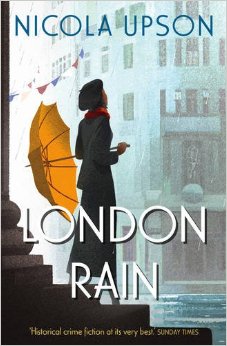
London Rain
My Favorite Reads of 2015

Last year Auntie M reviewed around 145 books in 85 posts plus hosting guests. Those don’t include the books she reads for herself, like the one her grand-daughter loved and insisted she read (Doerr’s All the Light We Cannot See—she loved it, too!); or for sheer delight, like the Judi Dench photo-autobiography Behind the Scenes (huge Dench fan).

Out of all of those books, there are always those that remain firmly in her mind as ones where she’s looking forward to more from these authors. They impress her for their creativity, their characters, their storytelling. In no particular order, she went through her posts and pulled out these highlights, most of which received her “highly recommended” citation. There could have been even more . . .

Series continuations:
London Rain by Nicola Upson: Her Josephine Tey series continues with a strong entry, set in 1927 London at the time the BBC ruled the radio and broadcasting. Well-researched and written, with absorbing characters and a few twists you won’t see coming, set against the backdrop of the Coronation of George VI. An accomplished series.

The Strange Death of Fiona Griffiths and This Thing of Darkness by Harry Bingham: One of the most unusual and compelling characters to head a series, Griffiths remains a feisty detective in search of her past and herself whilst she figures out how to be human. The second was not formally reviewed so let Auntie M add here that Fiona’s story continues with a punch that proves Bingham deserves to be more widely known in the US.

The Kill and After the Fire by Jane Casey: The Maeve Kerrigan series just keeps getting stronger with each installment. With irascible DI Josh Derwent as her partner, the duo are working together like a well-oiled machine, despite the occasional dig. Could grudging respect be far behind?

Behind Closed Doors by Elizabeth Haynes: DCI Lou Smith heads a team investigating when a young woman missing for a decade suddenly reappears. Haynes uses primary policing source materials reproduced for the reader: police reports, interviews, analyst research, even phone messages, which add a depth and texture to the books.

The Ghost Fields and The Zig-Zag Girl by Elly Griffiths: The next Ruth Galloway installment is a grand mix of the kind of ancient mystery only working mum Ruth could solve, coupled with tremors in her personal life. A satisfying series with original characters. Griffiths also debuted a second period series, and Brighton of the 1950’s comes to life with two unlikely friends, a detective and his magician friend, who need to stop a killer.

The Nature of the Beast by Louise Penny: Inspt. Gamache and his lovely wife try to settle down to retirement in Three Pines, until a young boy prone to telling tall tales turns out to be telling the truth. All the eccentric regulars appear to help solve the mystery, a bit different from Penny’s usual but just as engaging, a mix of bittersweet and heartwarming.

Banquet of Consequences by Elizabeth George: After taking time to introduce the family who feature largely in the case to follow, Lynley manages to have Havers and Nkata assigned to investigate a poisoning case. A piece of bacon figures here. Just read it. The plot is as complex as the players involved, and will leave readers thinking about what constitutes justice.

The Slaughter Man by Tony Parsons: A slaughtered family and a missing child prove a tough case for DI Max Wolfe, juggling his young daughter and personable dog, Stan. The weapon used fits the MO of an earlier murder years ago, and that man is now out of jail. Could this be history repeating itself?

The Secret Place by Tana French: With a few characters you’ll recognize if you’ve read her others, and you should, detectives investigate the murder of a young man at a private school. You hardly realize until it’s over that the action takes place all in one day—she’s that good.

Deadly Measures by Jo Bannister: Policewoman Hazel Best and her friend, Gabriel Ash, face their most dangerous and upsetting period together when arms pirates who have kidnapped Ash’s family agree to return them—if he’ll kill himself online for all to see. And yes, Patience, the dog who talks to Ash, is along for the ride.

A Song for Drowned Souls by Bernard Minier: Minier’s second French crime novel finds Commandant Servaz trying to prove his former lover’s son is not a murderer while he protects his own daughter. A rich tale of history and emotion mixed up in murder and secrets from the past.

The Storm Murders by John Farrow: Newly-retired detective Emile Cinq-Mars is known as the Poirot of Canada and can’t get used to not working. Then murders inside a snowed-in house in his neighborhood catch his eye—there are no footsteps in the snow. And he’s asked to intervene and finds himself in New Orleans and his own wife kidnapped.

Winter Foundlings by Kate Rhodes: The psychologist with interesting friends and family returns, working short-term at a hospital for the criminally insane. A taut plot, a compelling story and a protagonist you can’t help but admire in Alice Quentin who should have it all and keeps getting very close.

Run You Down by Julia Dahl: Journalist Rebekah Roberts finds herself investigating the possible murder of a young ultra-Orthodox woman whose contacts might just put Rebekah in touch with the mother she’s not sure she wants to find. Dahl’s first, Invisible City, won multiple awards this year, with good reason. An equally impressive follow-up.

Debuts:
The Unquiet Dead by Ausma Zehanat Khan: An undeniably strong debut, backed with meticulous and absorbing research, this Toronto mystery introduces a Muslim detective working with his Canadian female partner to unravel if a dead man fell, committed suicide, or was pushed off a cliff. A series to watch for, with a sequel out soon that’s every bit as good as the first, and will be reviewed shortly.

Recipes for Love and Murder by Sally Andrew: The South African Klein Karoo landscape, nature, food, language and habits of the area come alive through the eyes of Tannie (Auntie) Maria, a widow who happens to be a brillant cook. Mevrou van Harten knows that her food works magic in people’s hearts, not just their stomachs, and uses her knowledge to help solve the murder of an abused woman. Recipes included.

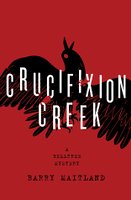
Crucifixion Creek by Barry Maitland: Anyone who reads Maitland’s English Brock and Kolla series know he’s far from a debut novelist, but this marks the debut of a new series set in Australia, Maitland’s home. He introduces detective Harry Belltree, suddenly overwhelmed with three homicides to investigate: a woman shot during a meth-addict biker siege; an elderly couple who commit apparent suicide at their favorite outdoor cafe’; and a white male stabbed to death in the street, who turns out to be his brother-in-law. A strong start to a new and absorbing series.

Five by Ursula Archer: The Austrian children’s lit author tries her hand at mystery and writes an absorbing police procedural with geo-caching at its heart and a realistic, harried, divorced mother of two as the detective.

A Murder of Magpies by Judith Flanders: A wry inside look at London publishing with the protagonist an editor who fears one of her favorite authors has been murdered and becomes drawn into the investigation. With humor and a hint of romance, book two arrives soon.

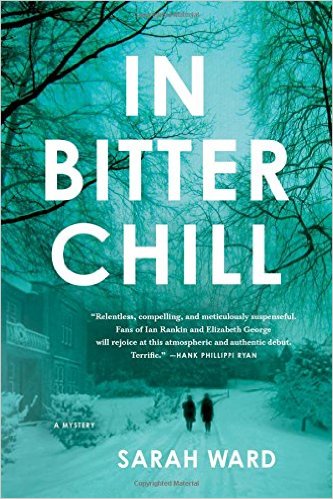
In Bitter Chill by Sarah Ward: Accomplished debut procedural finds detectives looking into a cold-case murder of a young girl when her mother suddenly commits suicide over thirty years later. Absorbing and well-developed characters. First in a series.

Disclaimer by Renee Knight: A most unusual premise explores a family torn apart when a woman’s hidden secret appears suddenly as the plot of a book in her own home. Original and creative.

Stand-Alones:
Everything She Forgot by Lisa Ballantyne: Ballantyne masterfully connects two threads: a young girl’s kidnapping, and a grown woman traumatized in a car accident, to show how secrets buried in the past have come full circle. Creative and compelling.

Sheer Delight:
The No. 2 Feline Detective Agency by Mandy Morton: Of all the humorous novels Auntie M read, this one stands out for its sheer ingenuity and creative premise: a world of cats, peopled and run by cats, who sometimes resemble humans we might recognize. PI Hettie Bagshot and her sidekick Tilly, their team of friends and their world are filled with Morton’s wry humor. Sales help find homes for less fortunate cats. CCat Amongst the Pumpkins coming soon.

Barry Maitland: Crucifixion Creek Sunday, Dec 27 2015 

CruxCreek
Auntie M is a huge fan of Aussie Barry Maitland’s England series featuring DCI Brick and DI Kolla. Now he’s on his home turf, premiering a new series with a most unusual protagonist, Sydney’s homicide detective Harry Belltree in Crucifixion Creek.

With echoes of his Afghanistan military experience haunting his dreams, Belltree is suddenly overwhelmed with three homicides to investigate: a woman shot during a meth-addict biker siege; an elderly couple who commit apparent suicide at their favorite outdoor cafe’; and a white male stabbed to death in the street.

Then he’s shocked when the stabbing victim turns out to be his brother-in-law Greg, his wife’s sister’s husband, who owned a contracting business.

Journalist Kelly Poole will become far too involved for Belltree’ liking, but does she have a point when she insists these three incidents are all connected? She’s uncovered ties between Greg and the elderly couple to a corrupt money man who has influential friends.

While Belltree can’t officially be a part of Greg’s investigation, the links to the others allow him some latitude and he wants to be the one to brig the person responsible to justice for his wife’s sister and her family. And in doing so, he will bring danger to himself and his family.

With his blind wife becoming his unofficial sidekick, this is an intriguing and suspenseful mystery by a master at work. Highly recommended.

More Holiday Joy: The US edition Wednesday, Dec 9 2015 

Auntie M divided her recommendations into Holiday Joy for other sites across the pond on Dec, 8th, and this version where the settings are all in the US. While you’re shopping for the readers on your list, don’t forget you deserve one, too!

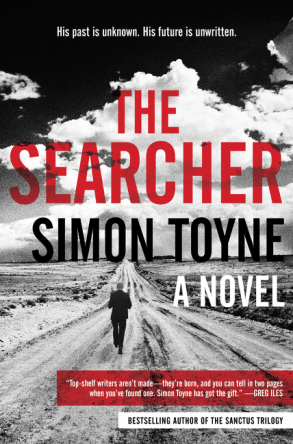
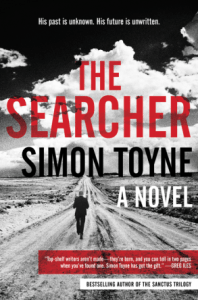
Up first is a thriller writer Auntie M met at Thrillerfest a few years when she was meeting favorite UK author Peter James. “Come and meet my tennis friend,” James said, and I was introduced to the tall and charming Simon Toyne, whose Santus trilogy Auntie M has previously reviewed.
Searcher

Readers familiar with that Trilogy will be more than pleased with his new thriller, The Searcher, set in Arizona this time, the first in his new Solomon Creed series. The white-haired albino is just the kind of Jason Bourne-like character who can sustain several books with ease.

A funeral in the town of Redemption is interrupted by a plane crash, and the man running away from the site not only has no shoes, he has no memory of how he got there–or who he is. His clothes provide minimal clues and his name: Solomon Creed.

Creed understands he’s in Redemption for a reason, and his questions will lead him to the town’s secrets, filled with people who have something to hide. There are lines drawn between good and evil and a touch of the supernatural. Two main points of view of Creed and the town’s founder in the form of diary entries allow the story to keep the reader knowing more than Creed. A strong start to a new series with a complex character, great images, and a vivid story.
UntimelyDeath

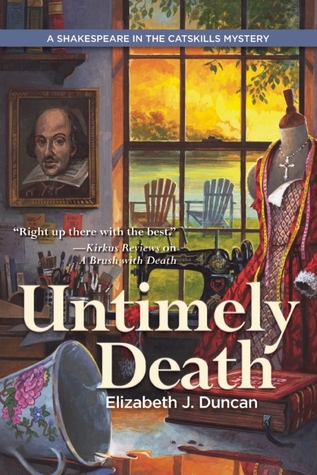
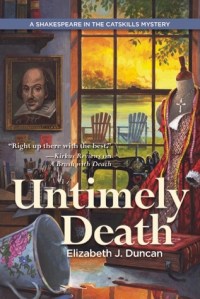
Canadian author Elizabeth Duncan’s Penny Brannigan series, set in the North Welsh countryside, have been previously reviewed by Auntie M. Now Duncan’s turned to a new setting to debut the first in her second series, the Shakespeare in the Catskills Mysteries, kicking it off with Untimely Death.

Duncan takes readers to a Catskill resort, the Jacobs Grand Hotel, whose production of Romeo and Juliet starts off with a bad turn when the leading lady is poisoned. Lauren Richmond is later stabbed and it seems there are far too many suspects who would have wanted the thespian out of their way.

At the center is Charlotte Fairfax, the costume designer who was formerly mistress for the Royal Shakespeare Company and whose shears have been used to commit the murder. The Catskills may not be London, but Charlotte remains Queen of her domain and inserts herself into the lives of her cast and crew as the investigation commences.

There is a nephew of the owner of the hotel who has fingers pointed at him. The aging actor who was the victim’s lover has his own near-death experience, and it turns out he was Charlotte’s former fiancee. Lots of reasons for her to find herself pushed into the middle of the muddle, not the least of which is that she is dating the Chief of Police. An interesting setup for future installments.
RedLine
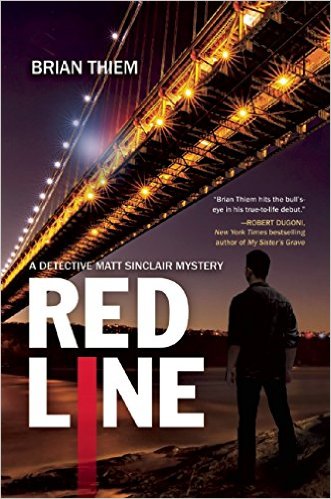
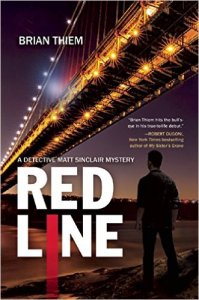
At NE Crimebake this year, Auntie M took a police class from Brian Thiem, a former Oakland Homicide Detective Commander with years of Army experience, too. So it was a pleasure after listening to his expertise, designed for writers to ‘get it right’ about police actions, guns, and forensics, to come home and read his debut crime novel featuring Detective Matt Sinclair, Red Line.

RED LINE is an excellent police procedural with an engaging main character who comes across as real, someone readers can identify with and will want to follow, and that extends to his new partner, Cathy Braddock. Catching his first case after desk duty for a series of incidents that have stained his reputation, Sinclair needs a good case to get back into action.

A teenage boy has been found dead at a bus stop outside a hospital, the son of surgeon at that hospital who lives in an affluent neighborhood. Then a second body is dumped at the same bus stop, and Sinclair and Braddock try to find the connection between the victims.

It doesn’t help that the cases bring back an old case of Sinclair’s from two years ago, when two girls were left at that same bus stop. One in a dazed state wandered into the line of traffic and died as a result of being hit by cars. Sinclair realizes he was too deep into his alcoholism at the time to devote as much time to the case as he should have and works even harder to do them justice.

The daily routine of police work is recreated in perfect detail: the interviews, the reports, the way small bits of information come together to build a case. And as Sinclair works this case he must deal with superiors who want to force him out of homicide.

With a girl friend who is a television reporter whose job often puts them in conflict, readers will come to understand the grueling long hours and high stress of a murder investigation, all as Sincalir struggles with his desire to take to the bottle again. Chapters from the murderer’s point of view add to the well-plotted mystery. A strong debut which will leave readers looking for a sequel, from someone who knows the drill inside out.
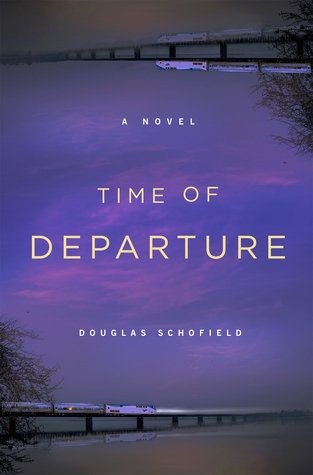
TimeDeparture
Douglas Schofield has crafted a most unusual police procedural in Time of Departure. Drawing on his own legal experience, he introduces Claire Talbot, a Florida State prosecutor trying to prove herself to her colleagues in her new post a head of their Felony Division.

The action kicks off when a highway construction crew find two skeletons sharing a grave, and Claire is forced to reopen a cold case investigation into a series of abductions. Perusing the case file, she comes across retired fellow cop Marc Hastings, who becomes too close for comfort with some aspects of Claire’s life and this case.

Is his interest more than affection? And what does Hastings know about Claire’s life that she doesn’t?

A compelling debut that shows a clever mind behind it all, mixing genre expectations.
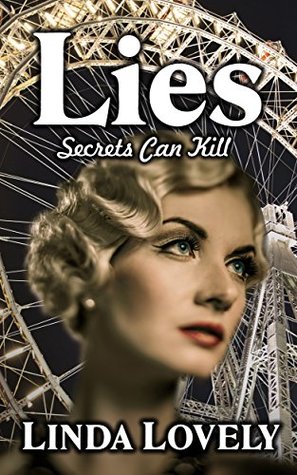
Lies
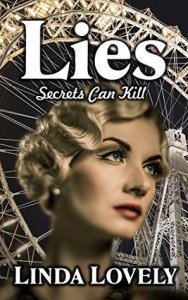
Linda Lovely takes readers to her hometown of Keokuk, Iowa, in the year 1938 for Lies. Using real landmarks and historical happenings mixed with her fictional story and elements, this is a strong showing from a great storyteller. The period leading up to WWII comes alive under Lovely’s talented hand.

Catherine Reedy Black knows she needs to leave her abusive husband, a swindler and con man, in order to have a reasonable future for her two-year old son, Jay. With her family’s support, she just might be able to do it, too, until Dirk Black’s corpse is pulled out of the river, and Cat becomes the prime suspect.

New to the police department, Ed Nelson knows Cat from school, and remembers the bright girl he was attracted to. But he’s hiding his own secrets, and even as he tries his best to help clear Cat, he’s fighting the corrupt police chief who wants nothing more than to see Cat convicted of murder.

With the annual Street Fair in town, the glitzy lights and rides will prove a scary setting as Cat tries to clear her name and almost dies in the effort. It seems there are many in town who are hiding secrets, and among them is the killer with a motive Cat needs to unearth.

A perfect mix of compelling mystery and love story in a well-drawn setting. And a great gift for any reader who enjoys this period.
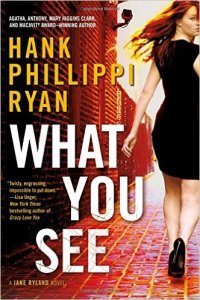
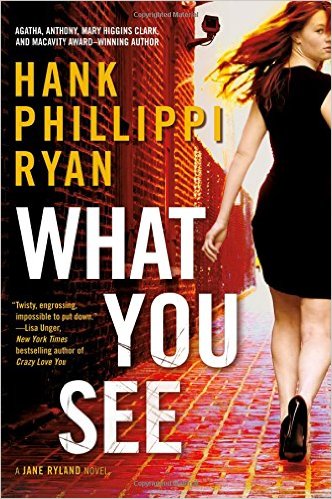
WhatYouSee
Multi-award winner Hank Phillipi Ryan returns with her fourth Jane Ryland thriller, What You See.

The journalist and her detective boyfriend, Jake Brogan, are in the midst of still trying to figure out how to handle their conflicts of interest in their jobs. She’s interviewing with a new channel, and rushes to the site of a big story: the stabbing death of a man at historic Faneuil Hall–and it’s Jake’s case.

You would think with multiple tourists capturing the murder on their cell phones that this would be one case that’s an easy solve, but Jake and his partner Paul find this investigation isn’t at all what they’d predicted. There’s an injured man in addition to the victim to consider, too.

In the midst of this, Jane’s sister is about to be married, what should be a joyous occasion–until her fiancé’s daughter, the young flower girl, is abducted by her stepfather. Nine-year-old Gracie’s disappearance is just the tip of the iceberg as this story overlaps with the case Jake is following, with fingers leading to dark places.

It gets more and more complicated. Neither the murder victim or the injured man in the alley have any ID on them, making motive and solving the case difficult. Jane is juggling with trying to establish a new place at Channel 2 when her family situation takes precedence. Jake is finding that a murder in broad daylight in front multiple witnesses is full of challenges and directions of interest that have far reaching connections and consequences.

It all places Jake and Jane in a position to test their loyalties to each other and to their jobs.

Ryan does a bang-up job of showing how even in this digital age, looks can still deceive. Filled with family secrets, merciless ambition, and deceitful maneuverings. JT Ellison says, “This is Ryan at the top of her game.” A perfect mix of mystery and romance.
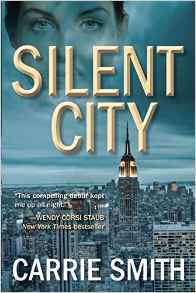
Silent City
Carrie Smith’s first Manhattan police procedural, Silent City, features protagonist Claire Codella, a detective just back on the case after grueling chemotherapy for an aggressive lymphoma. Still dealing with its after-effects, which Smith details accurately, Codella’ first murder case turns out to a well-liked school principal. And Codella must prove to her colleagues, and to herself, that she’s up to the task.

Hector Sanchez’s murder investigation hands Codella a new partner to break in, newly promoted Eduardo Munoz. They, along with Codella’s former partner, Brian Haggerty, follow numerous leads in their search for Sanchez’s killer. The staging of his body makes it appear that his murder is connected to his job as principal at PS 777 and the three investigators quickly learn there are far too many suspects with a motive to kill him.

Codella is an intelligent detective who follows where the evidence leads her, and whose new boss is not exactly her biggest fan. Yet despite his attempts to undermine her authority, Codella relentlessly pursues all the of the leads in the case, despite battling her cancer treatment’s side effects.

Munoz and Haggerty, also excellent investigators, know they must be loyal to Codella. Munoz must also prove himself worthy of his promotion; Haggerty and Codella are trying to put to bed an old rift that came between them.

This mystery has an engaging storyline and appealing characters. With plenty of suspects, no clear cut motive for the crime and stunning plot twists, Carrie Smith skillfully conceals the killer’s identity until the novel’s climax. A strong series debut.
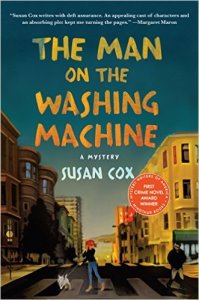
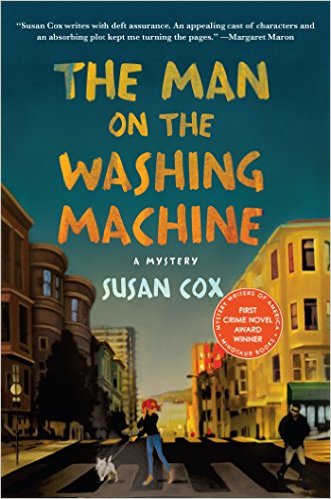
ManWashingMachine
Susan Cox won Minotaur Books/Mystery Writers of America First Crime Novel award. The Man on the Washing Machine is a delightful mix of humor and murder, taking place in San Francisco, and introducing a most unusual sleuth, former party girl and society photographer Theophania Bogart, who hides her own family secrets.

Theo unfortunately sees her neighbor, Tim Callahan, fall from his apartment window, plunging her right into the middle of his murder investigation. Her already complicated new life comes under intense scrutiny. Surrounded by neighbors and friends, Theo is the owner of a small bath and body shop as well as the building housing it, but she is constantly afraid her sordid past will be unearthed.

What will a police investigation do to her carefully crafted identity?

When the police detective suspects murder, not suicide, she lists the entire neighborhood as suspects and that includes Theo. Then another body with direct ties to Theo turns up, making her the number one suspect.

Filled with eccentric characters, this fast-paced mystery is filled with humor and action. A perfect gift for those readers who enjoy a dose of humor with their mystery.

That’s it for the gift listing, folks. Remember that books make wonderful presents for anyone on your holiday list. And enjoy yours, with a few for your stocking as well~

Sarah Ward: In Bitter Chill Tuesday, Oct 13 2015 

InBitterChill

England’s rural Derbyshire is the setting for Sarah Ward’s debut mystery, In Bitter Chill, introducing introspective DI Francis Sadler, DC Connie Childs and their team. It promises to be the best of police procedurals, where the mystery is strong and setting as stark as the killings being investigated.

Thirty years ago two young children were kidnapped on their way to school. Rachel Jones was found wandering hours later, but her companion, Sophie Jenkins, never surfaced and no trace of her body was ever found.

On the 30th anniversary of what is surely Sophie’s death, her mother commits suicide, which reopens the cold case in hopes the original team overlooked something that might lead to resolution of the case.

Rachel has become a genealogist and a local history expert who lives quietly and would continue to do so but this reopening of the case on the heels of Mrs. Jenkins suicide disrupts the peace Rachel has created, bringing reporters at her door. Worst of all are her efforts to remember details of that horrific day, when the girls were coaxed by a woman into a car with disastrous results.

Then a former teacher of Rachel’s is found strangled in the same woods where the girls went missing, and suddenly no one in the area feels safe, least of all, Rachel Jones. As Sadler and Connie investigate the new and old cases, they uncover secrets long kept buried as the threat rises.

Ward does a nice job of letting the setting become another character, and gives us enough of the inner lives of Sadler and Connie, as well as Connie’s closest competition in the team, the almost-married Palmer, to make readers look for the next installment of this team. Destined to be a series readers will seek out.

Auntie M had the pleasure this past week to meet with Sarah Ward at the Bouchercon Mystery Convention. A blogger for Crimepieces, Ward’s love of crime fiction kept us talking about our favorites and how In Bitter Chill came to be written:

Sarah Ward: I was living and Greece at the time I wrote the book and having a bout of homesickness. It was incredibly hot, and I kept myself cool by thinking of the Derbyshire winter. It seemed natural to use that area, but Stephen Booth has stolen a lot of the popular places! So I made up a fictional town surrounded by the real ones and that’s worked well. I think being at some remove helped me write it, too, although having lived there I obviously know the area well. In the winter the tourists have gone and it’s deserted and feels isolated but very beautiful.

Auntie M: That certainly comes through, the majesty of the area as well as its bleak isolation. What about the sequel, which I hear is written and will be out next year? What it easier or tougher to write?

SW: I was back in Derbyshire by then and it seemed a bit harder to remove myself from the area as I wrote. It’s such a lovely area, with the Peak District National Park owned by private landowners. I’m quite proud of the fact that it was the first national park, this jewel of nature surrounded by South Manchester, Sheffield and Nottingham, great industrial areas.

AM: After you chose the setting, what prompted this particular storyline?

SW: I had a very similar incident happen to me when I was twelve and walking to school. A woman stopped and asked me to post a letter for her, which I did, and then wanted to drive me the rest of the way to school. I didn’t get in her car, but she was persistent until she finally drove off. I never told my parents about it, either. But years later I wondered what would have happened if I HAD gotten into that car . . . so I made the story revolve around two younger girls who had gotten into the car with the woman.

AM: Was there a kind of release in writing it down, exploring that episode?

SW: To a degree, but the most surprising thing about exposing secrets, which the book revolves around, is that people come up to me all the time at signings and tell me their secrets, completely without prompting. It’s usually family secrets of some kind, so I suppose the book has struck a chord with them.

AM: What about the relationships of Sadler, Connie and Palmer?

SW: I have a story arc planned, oh yes, but I’m not giving away secrets except to say there’s a surprise there–you’ll just have to read the next one to see what’s happening!

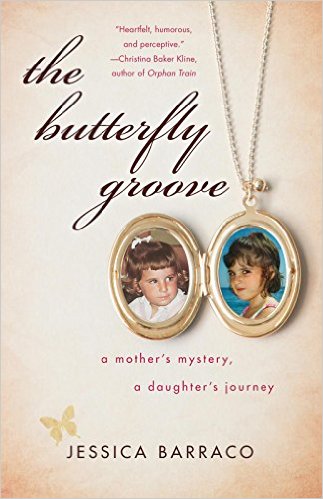
Jessica Barraco: The Butterfly Groove: A Mother’s Mystery, A Daughter’s Journey Wednesday, Aug 12 2015 

From time to time Auntie M sneaks off the crime fiction curve and brings you something different. This time it’s a mystery of sorts, revolving around a real life events belonging to journalist and former HarperCollins publicist Jessica Barraco, which she recounts in The Butterfly Groove:

51wM75Cm-ML._SX321_BO1,204,203,200_

The Reasoning Behind My Research for The Butterfly Groove: A Mother’s Mystery, A Daughter’s Journey
By Jessica Barraco

As a journalist, my training has revolved around knowing the truth. A lot of people like to say that journalists are too curious, that they like to expose people or situations, they can’t let sleeping dogs lie. A true journalist will counter: “But that is what life is about: facing the music.” If you are afraid to see reality, evolving as a person will prove to be very difficult.

My mother passed away when I was 12 years old after an almost 20-year long battle with cancer and its devastating complications. In her life, she was a very private person, and when she died, many rumors came up, mostly all negative about her childhood and teenage years. She wanted to be a writer, but never had the opportunity to receive a proper education. On so many levels: spiritually, emotionally and professionally, I felt it was only fair to my mom to find out the truth about her life; the life she had before she was sick. I was the only one in my family who was interested in learning my mother’s truths, and that made it a lonely journey. Until I researched, found and met all of the wonderfully open strangers who helped me create this book, and ultimately, to put the pieces together of the mystery that was my mom.

I did for my mom what I hope anyone would do for me. I chose to not believe whatever distorted memories and passed down information her relatives claimed to know about her. I chose not to believe anything at face value. Believing gossip is the easy thing to do. I chose the harder path – the path that leads to the truth.

I hope you’ll join me on my journey and get to know both me and my mom a little better in The Butterfly Groove.

Comments/questions? Interested in having your book club read my book? Feel free to reach me at thebutterflygroove@gmail.com and I will be happy to help in any way.

Amazon: http://www.amazon.com/The-Butterfly-Groove-Mothers-Daughters/dp/1631528009
B&N: http://www.barnesandnoble.com/w/the-butterfly-groove-jessica-barraco/1121116558?ean=9781631528002
Indie Bound is available too.

BIO
Journalist by heart, marketing professional by day, and writer by moonlight, Jessica Barraco is a graduate of the University of Colorado, Boulder’s School of Journalism and Mass Communication. She published her first newspaper article at nineteen years old, after which she wrote for 944 magazine and The Denver Post. She also spent three years working at HarperCollins Publishers across all of its imprints, working on both nonfiction and fiction books. A contributor to EliteDaily and marketing professional, Barraco resides in California.

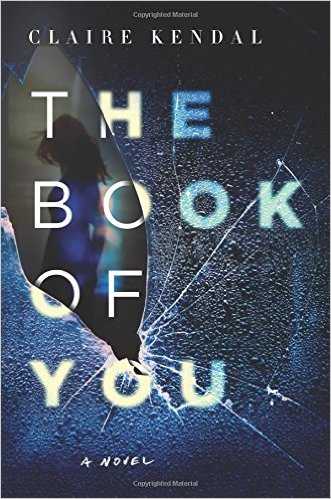
The Book of You: Claire Kendal Sunday, Aug 9 2015 

Book of You

If you read and enjoyed Elizabeth Haynes Into the Darkest Corner then you will definitely want to read Claire Kendal’s The Book of You.

University administrator Clarissa, getting used to a painful split from her partner, can’t wait for her jury duty to begin. She’s thrilled when she’s assigned to a case where she will have to be off work for at least seven weeks. Every day in the protected courtroom means a day out of sight of the man whose stalking is ruining her life and haunting her dreams on the rare nights she’s able to sleep.

Rafe is the academic who turned one night’s encounter with her into his obsession. An expert on fairy tales, especially those of a dark nature, Rafe uses these to add chilling texture to the terror that has become Clarissa’s life. She’s unable to walk home from the train station or leave her home without seeing his shadow. Even a walk in a nearby park becomes the stuff of nightmares until a stranger walking his dog interrupts what she increasingly fears could have been her murder, after researching Rafe’s personal history and learning that a young woman he’d stalked previously has disappeared.

He is ever present in her life, showing up at her house with gifts she must save as evidence of his stalking and harassment to go to the police with enough incidents that they will take her seriously. A talented sewer, Clarissa uses her this sideline to keep hold of her sanity, as her physical health deteriorates and she must detail the conversations and presence of this sick man in her life in a small black book she calls the Book of You.

Now as she takes solace in the jury room, making a few friends, attracted to a fireman in particular, Clarissa can’t help but notice the case they are trying of a young woman raped and brutalized mirrors her worst fears if Rafe should ever get in close contact with her again. The defendant’s grueling days on the witness stand point out that Rafe will try to twist her story around to his benefit, and Clarissa must have enough proof before going to the police of the seriousness of his intent.

The power of the book comes from illustrating how much psychological damage an obsessive like Rafe can incur simply by his continued and annoying presence. And when his threats escalate, so does the horror that Clarissa feels and what she ultimately faces.

This well-written thriller will have readers hearts beating as hard and fast as Clarissa’s does on a regular basis. A harrowing story of the ability to enact cruelty on another human being with Kendal’s knack bringing the reader right into Clarissa’s churning anxiety.

« Previous PageNext Page »