Perfect Sins: Jo Bannister Wednesday, Jan 28 2015 

Perfect Sins

Jo Bannister departed from her Brodie Farrell mysteries in Deadly Virtues, when she introduced a new series featuring young police constable Hazel Best, and the “Rambles with Dog” character of Gabriel Ash, a former government employee whose life has been turned upside down.

The two return in this compelling sequel, Perfect Sins, along with Ash’s dog, Patience, whose thoughts only Ash can hear, but who makes the kind of measured and sometimes snarky comments that add to the tone. Bannister doesn’t overdo Patience’s comments, either, keeping them to a minimum, but they lighten up what could be a somber tone, as Ash is trying to find out if his wife or two sons, kidnapped by pirates, could possibly still be alive.

Four years have past since their disappearance but Ash remains committed to following up any lead he possibly can in order to keep his fragile sanity and continues to follow his own path of questions. With Hazel still on leave after the shooting that ends Deadly Virtues, they finds themselves visiting Hazel’s father at the gatehouse of Byrfield House, an estate that has been in the aristocracy for generations.

The plot revolves around a mound near the ice house on the grounds belonging to Pete, Lord Byrfield, that is opened by a local archeologist, David Sperrin. Hazel has known Pete for years and considers him a friend, so it’s no surprise she becomes involved when the mound turns out not to be an ancient burial mound, but the more contemporary resting place for a little boy from about thirty years ago. Just who those bones belong to bring up more secrets kept than any of the participants can possibly imagine.

As Hazel is drawn back into the police work she loves, Ash finds his own questioning has stirred up some very nasty consequences for them both that put their lives in danger. One of the nicest things is that Hazel values friendship. Hers with Ash is not a sexually charged relationship, but one that shows that men and women can truly care about each other and remain caring friends without becoming romantically involved.

Intricately plotted, and with a nice touch for the vagaries of family life and relationships, this complex plot has a few surprises to reveal and its ending packs a wallop that will have readers searching for the next installment.

Nele Neuhaus: The Ice Queen Sunday, Jan 25 2015 

IceQueen

German author Nele Neuhaus’ series with Pia Kirchhoff and Oliver Bodenstein is almost a prequel of sorts to the other books that have been translated in the series, Snow White Must Die, and Bad Wolf, the latter now in paperback.

But nothing is lost in reading them in this order as the stories are so interesting and this one is no exception. The body of a Holocaust survivor, American citizen Jossi Goldberg, is found shoat to death in his home with a five-digit number scrawled nearby in his blood.

Why would anyone bother to murder a 92 yr old man near the end of his life? Then the autopsy reveals an old tattoo on his arm, a blood marker used for Hitler’s SS. Who was Jossi Goldberg after all? A survivor of the Holocaust, as he’d lived his life, or was he really a Nazi?

While investigation his murder, two more execution-style murders of elderly people occur. The only connection between these people turns out to be that they were lifelong friends of Vera von Kaltensee, a baroness and the well-respected head of a philanthropic family.

With Oliver and Pia treading a fine line of political correctness as they try to investigate the Baroness, their trail leads them all the way to Prussia and secrets of long ago. They will encounter secrets, lies, and treachery reaching back decades as they find their way to the heart of the mess that started so very long ago.

There is an excellent mystery at the heart of this novel, one that will startle the reader as the story reaches its conclusion. A continued series well worth reading. Highly recommended.

Ursula Archer: FIVE Sunday, Jan 18 2015 

FIVE

Austrian writer Ursula Archer is a science journalist who has previously published YA and children’s books. Now she turns her hand to police procedural thriller in FIVE and readers will be very happy with her decision.

The book starts out with a bang: “The place where his left ear used to be was throbbing to the rhythm of his heartbeat. Fast and panicked.”

And the pace never lets up as police detectives Beatrice Kaspary and Florin Wenninger become involved in solving a series of increasingly confusing murders. First is the body of a woman who fell from a cliff who turns out to have GPS coordinates tattooed on the soles of her feet.

When the detectives trace the spot of these coordinates, they find a severed hand and more taunts that lead them to yet another site and more body parts. It soon becomes clear they are on the trail of a murderer who is using the sport of geocaching in a far more sinister way than usual.

The clues they are given are frustrating and obtuse, sometimes leading to a witness who then disappears, and all the time the two detectives feel the killer is playing with them. Then he starts to leave Beatrice text messages on her phone and the tension, never abated, ratchets up.

This is a clever and well-plotted mystery with the puzzle at its heart that grabs you and doesn’t let go. That the detectives are compelling figures adds to the mix. Let’s hope this is the first of a series from Archer. Auntie M will be lining up to read the next translation.

Across the Pond for the Holidays Tuesday, Dec 23 2014 

This will be Auntie M’s last post for 2014. She’ll be back on January 4th in 2015 with a whole new slew of great books for your reading pleasure.

But before the year ends, consider this: Many of Auntie M’s readers enjoy their mysteries set in England and here are a few of the best. Last minute shopperlooking for gifts for readers? Or just in the mood for a darn good mystery for yourself? Don’t forget to gift yourself this year! Enjoy your holidays and all the new books waiting to be read~ Happy New Year!

UK_Monogram_Murders_jacket
Award-winning writer Sophie Hannah was chosen by Agatha Christie’s estate to write a new Hercule Poirot mystery. The Monogram Murders is a glorious legacy to the Poirot stories, with the Belgian detective in fine form as he investigates the murders of three people at a fashionable London hotel. All have had a cufflink placed in their mouths. What is their connection to the young woman who has interrupted his meal at a local coffee house he’s been frequenting? For she has told him she is about to be murdered and that this will service justice.

1920’s London is accurately represented here, and Hannah gets Poirot’s dialogue just right. Fans will picture David Suchet, the very embodiment of Poirot, mincing his way through the locked room mystery with the aid of Edward Catchpool, a young Scotland Yard policeman sharing a lodging house with Poirot. It is Catchpool who has decided to write down what the calls “the Jennie story” and who learns quickly from the great detective, as the two visit the countryside to unravel the tendrils of this murder plot that has its beginnings in machinations from long ago.
And Then

An interesting gift would be this volume and Willam Morrow’s 75th Anniversary Edition of Chrisit’es timeless murder And Then There Were None, which The York Times has called ” …the most baffling mystery Agatha Christie has ever written.” And The New Statesman chimes in with: ” …The most colossal achievement of a colossal career.” Forget the movie; read the original!

Soul Discretion

Susan Hill returns with the eighth Simon Serrailler case in The Soul of Discretion.
One of there reasons Auntie M enjoys this series so much is the risks Hill takes with her plots and action. There are unexpected and haunting consequences for her characters that follow real life, which sometimes hits us with unexpected happenings, and this is certainly true of Serrailler and his family.

In this outing, Serrailler’s family, who readers of the series have come to know and follow, will be shocked by events that envelop his father, just his sister, Cat, a widow with three young children to raise, is facing her own choices about work. Cat will be left to pick up the pieces as Simon accepts his most difficult case yet: he must leave town to go undercover without disclosing the details to anyone in his family, or to his love, Rachel, who has just moved in with him.

The case will lead him into a prison to befriend to the son of a lord, there because of his involvement with a ring who film children in the throes of sexual abuse. It is Serrailler’s brief to find the head behind the ring to bring it to a close. What he finds will do more than disgust him; it will almost cost him his life.

Hill knows how to wring emotion and capture reader’s attention and bring them to the brink of tears. Highly recommended.

The_Corpse_Bridge
Stephen Booth’s fourteenth in his Ben Cooper/Diane Fry series holds up well to longevity in The Corpse Bridge. Still grieving over the losses from a horrific previous case, Cooper is back at work and finding it difficult to concentrate on what is real and what is an overlay from his grief.

The one thing he knows clearly is the local history and that included the route taken by mourners for centuries to bury their dead across the River Dove, crossing by the old Corpse Bridge, to a cemetery on land now part of the stately home of Earl Manby.

When bodies start to appear on the road to the Corpse Bridge, the case will fall to Cooper, and to a reluctant Fry, helping him to sort out what is the death’s connection to the Earl’s plans to deconsecrate the burial ground for planned holiday cottages whose income will preserve his home, the majestic Knowle Abbey. As Cooper uses the resources of his team, combined with his local knowledge, he will learn that not everyone who offers information is telling the truth. A few surprising twists along the way add interest for readers of the series.

Race to Death

Leigh Russell’s second Ian Peterson mystery, Race To Death, follows the newly-promoted Detective Inspector on his move to York. With his new female DCI seeming to disapprove of most of his decisions, he’s facing pressure on the home front from his wife, Bev, bored and at odds. She finally agrees to take pressure off Peterson and find herself a job, and even though it seems to be beneath her qualifications, it gets her out of the house where Peterson hopes she will make new friends.

And it’s none too soon, as Peterson finds himself saddled with an unusual case with shades of Dick Francis: a young man falls to his death at the races off a balcony. Was it suicide or an accident? There with is brother and his attractive wife, both ideas are disproved by the pathologist, who finds the man was injected prior to his death with a paralyzing agent that would make it impossible to hurl himself over the barrier and off the balcony.

False witnesses abound, as the deaths start to mount up using the same method and Peterson races to find the link between the victims before there can be another death.

Friends to Die For

A British friend recommended Hilary Bonner and I’ve started with her newest, Friends to Die For. What starts as a fairly simple premise soon turns quite complicates: A group of friends meet on Sunday evenings for diner at a Covent Garden restaurant. The Sunday Club group spans varied members: there is the gay club bouncer, Tim and his partner, city lawyer, Billy; the actor, George; a married couple, Greg and Karen; senior waiter at a tony restaurant, Alfonso; Ari, a wealthy entrepreneur; Marlena, an older, highly made-up woman with a mysterious past; and even a policewoman, Michelle.

What do these have in common that would lead to them suddenly being picked on as a series of pranks and tricks occur? But when these incidents escalate to murder, it soon becomes clear that one of the group who is privy to the secrets of the others is the culprit.

The group starts to turn on each other as the fear increases–but will they find out who the murderer is before another has to die?

Dead Men's Bones
Oswald’s DI McLean series are a new favorite of Auntie M and Dead Men’s Bones continues in the strong vein the author has established for this series set in Edinburgh and its vicinities.

In northeast Fife, an influential politician kills his wife and two young daughters before turning the gun on himself. Why would prompt Andrew Weatherly to commit such an horrendous act?

It’s bitterly cold in Scotland, and McLean isn’t dressed warmly enough when he’s called to the site of a man’s body found in the River North. That the man was naked isn’t the most surprising thing noted when his corpse is brought to the shore. His body is covered head to foot, extremities and even genitals, in tattoos, some of them very recent.

This will be a strange case for McLean and his team. Is Super. Duguid starting to thaw towards McLean? With Gumpy Bob Laird as his DS and DC Stuart MacBride on board, McLean must sort through the evidence even as DS Ritchie falls ill to a serious ailment that seems to infect others who come into contact with one of their witnesses.

There will be evidence and clues from a variety of sources, including homeless Gordy and even the wealthy, influential and undeniably sexy Mrs. Saifre before McLean is able to unravel a mystery reaching back decades that will have Special Branch breaking into his house to leave him clues and photographs that spur on is investigation.

With its usual hint of otherworldliness, this complex mystery writer manages to enthrall readers once again. Discover this series if you haven’t yet, or better yet, turn a reader friend on to Oswald and his detective.

** New in Paperback: Moriarty
Michael Robertson’s Baker Street series’ fourth installment, Moriarty Returns a Letter
, is now available in paperback from Minotaur. Enjoy the Heath brothers as they sift through the mail that arrives at their law offices at 221B Baker Street addressed to Sherlock Holmes. Enchanting with deadpan comedic touches and that host of Sherlockian influences.

Emma Jameson: Marriage Can Be Murder Sunday, Dec 21 2014 

British author Emma Jameson has a new series premiering. The Dr. Benjamin Bones mysteries start out with Marriage Can Be Murder. MCBM Cover

On the eve of World War II, Dr. Benjamin Bones is at war with himself.

While most young men are being sent away to fight the Germans, Ben is chosen to serve on English soil. Ordered to move to wild, beautiful Cornwall, he must trade his posh London office and stylish city life for the tiny village of Birdswing, population 1,221 souls.

But leaving his home and shelving his career ambitions aren’t the only sacrifices facing Ben. His unfaithful wife, Penny, is accompanying him to Cornwall in a last-ditch effort to save their marriage. But moments after their arrival, Penny is run down in the street, and Ben is almost fatally injured. And while the villagers assume Penny’s death to be an accident, Ben quickly deduces it was murder.

As he convalesces in Fenton House, which the locals call haunted, Ben meets Birdswing’s eccentric inhabitants. Mr. Gaston, the volunteer air warden, obsessed with defending his remote village against Nazi spies; Mrs. Cobblepot, a thoroughly practical housekeeper who believes in fairies; and Lady Juliet Linton, a prickly, headstrong aristocrat who won’t take no for an answer.

While adapting to life during Britain’s “War at Home,” a time of ration books, victory gardens, bomb shelters, and the Blackout, Ben sets about solving the mystery of Penny’s murder—with a little help from Lady Juliet and the Fenton House ghost.

As a special treat for Auntie M readers, Jameson has provided an excerpt of the new book:

10 October, 1939

Ben didn’t need to leave his room over the Sheared Sheep to know it was getting colder; he felt it every time a southeaster blew through, penetrating the late Victorian heap as easily as a torn mack. Downstairs, raucous laughter and pint-fueled rows started in midafternoon and carried straight through till closing. After the issuing of the Call-Up Proclamation, it seemed most of the village’s young men were heading into the pub a little earlier each day, either to drown their fears or enjoy what might be a final pint with friends. Ben often overheard long snatches of conversation, provincial and circular in nature, that did nothing to entice him downstairs. And if not for the insistence of his nurse, a curt sister with very definite views on the curative power of sunlight, he would have kept his blackout screens in place night and day. What difference did it make?
The words of the publican, Angus Foss, floated up from the barroom. That is, if the perpetually aggrieved tones of a perpetually aggrieved Scot can ever be said to “float.”
“Aye, I’ll fetch him for ye. Just what my poor spine needs, another wee traipse down the stairs with a full-grown man in my arms. Devil of a way to start the day. And me due to unlock the doors in a quarter hour….”
Ben checked the alarm clock beside his bed. Was it really not yet three o’clock? Dawn was trundling toward dusk even slower than usual.
“… but ye know my temperament. Man o’ the people. Live to serve,” Foss continued morosely. “Still, martyrs and saints have their limits. The Council—meaning your ladyship’s mother, ye ken—had best make restitution for all I’m out in lost rent. That includes meals, housekeeping, and electric current. If I’m not assured payment by tomorrow morning, I’ll put him out, I swear by God I will.”
Foss’s threat didn’t trouble Ben. He’d overheard it many times during his slow convalescence, though never attached to a twenty-four hour deadline. The insistence of some unseen visitor to have him brought downstairs was what bothered him. Foss found the process inconvenient; Ben found it downright humiliating. As for whatever the visitor wished to discuss, it didn’t matter. Unless the person asking represented the British army, Ben would say what he always said: no.
Easing his Edwardian wheelchair, a ghastly contraption fashioned of blond wood and rattan, out of his room, Ben maneuvered onto the landing. There, near the top of the stairs, he couldn’t see the bar, where Foss and his visitor were standing, but he could hear her voice quite clearly.
“I understand he’s lodged here six weeks. So lost rent is fair enough,” she said in the flowing tones of an educated woman. “But surely you customarily provide meals to your guests? I’ve always pitied those souls unfortunate enough to squat in this hovel, but I refuse to believe even you would bill them separately for electric lights. Or what you call housekeeping, which amounts to Edith Hoovering twice a month and linens changed once per solstice?”
Foss cleared his throat. “Now, that’s verra hard—”
“Nonsense. I was being kind to Edith. If I were the sort of woman who engaged in gossip, and I assure you I am not, I would add that outside Birdswing, ‘Hoovering’ is not the common term for Edith’s primary occupation. I might also remark that you virtually never let that room upstairs, except for the sort of exchange that doesn’t require a hot meal to sizzle.”
“That’s a lie!” Foss thundered. “No immoral congress takes place within these walls.”
“Of course there’s no immoral congress. A physician with two broken legs occupies the requisite space.” As the woman laughed, Ben leaned forward, trying to get a look at her. “Mind you, I make no accusations. I never repeat gossip and would prefer not to hear the rumors about poor Edith and your tawdry little room. No doubt she’s a nearly adequate maid, and it’s a nearly bearable cell. So please believe me, my dear Mr. Foss, when I say I perceive your discontent. My mother perceives your discontent. Far away, nestled amongst the most distant stars, advanced life forms perceive your—”
“Dinna ken what you’re on about,” Foss said peevishly.
“Of course not. Being met with slack jaws and faintly suspicious eyes is both my blessing and my curse. But if you could just sublimate your habitual disgruntlement long enough to fetch down—”
“Blessing?” Foss cut in again. “How the deuce is it a blessing that regular folk can’t make heads nor tails o’ what ye say?”
“It reduces the volume of complaints directed toward my mother.” The visitor sounded cheerful. “She’s not a well woman, you know, and heaven knows my childhood travails contributed to her condition. How fortuitous that as I matured, I acquired sufficient vocabulary to speak my mind without ruining her day. Now. Mr. Foss. I’ve very much enjoyed our little talk, but the time draws nigh for you to ply your unsavory trade, and Edith to ply hers. So will you fetch down Dr. Bones, please?”
“Aye, Lady Juliet.” The cantankerous Scot sounded defeated.
Ben wheeled back into his room. Somewhere in the midst of listening to that acid-tongued woman, he’d lost his resolve to say no, at least without hearing her out. But what could she possibly want? Everyone in Birdswing knew of his injuries. His right leg, broken below the knee, was mostly healed, but his left leg had been shattered. During that titanic smack of impact, the moment his torso struck the lorry’s bonnet, his legs had connected with its iron grille, breaking the tibia and fibula in two places each. Moreover, his femur had snapped, either when the lorry hit him or when he struck the ground. Now Ben knew firsthand the truth of the medical school saying: a broken femur was the worst pain a man could experience. Its corollary, that childbirth was the worst pain a human being could experience, made him devoutly glad to be male.
Hearing the stairs creak under Foss’s heavy tread, Ben gripped the arms of his chair and slowly, carefully, tried to rise. His right leg trembled. It had grown weak during the long recuperation. Two seconds later, his left buckled, dropping him back in the wheelchair with a stab of agony.
Perspiration broke out across his forehead. Sighing, he wiped it away. There was no more morphine for him: since the declaration of war, narcotics and other essential medications were strictly rationed. As a result, he’d been undermedicated, at least by London hospital standards, but that was probably a blessing. Morphine didn’t eliminate pain, it just created detachment, placing the patient on a billowy cloud from which discomfort could be ignored. No other substance came close; not even single malt whiskey could compete with an injectable opioid. And Ben, who during his internship had struggled to comprehend the nature of morphine addiction, understood it now all too well. He’d survived the accident. Penny had not. The chance for them to repair their union, or at least face its dissolution together, had been snuffed out without amends or even goodbyes. When real physical pain was entwined with amorphous demons like heartbreak, guilt, or misery, and a substance existed that artificially detached the sufferer for a few precious hours, who on earth wouldn’t be tempted?
He looked around the little room. The books and magazines his mum and dad had brought were long read; the condolence cards and letters from the extended Bones family were tucked away. His last visitor had been an aunt on holiday who’d dropped by out of morbid curiosity; his last telegram, from Penny’s brother George, asking if Penny had any life insurance money due. A fresh distraction might be worth the price of venturing downstairs.
“Dr. Bones! Are ye decent?” Foss bellowed outside the door.
“Yes.” Only due to the efforts of his nurse, who insisted her patients be fully dressed by breakfast, no lazing about in pajamas or dressing gown. Most days, Ben didn’t see the point, any more than he saw the point of looking out the window at this sad little village he refused to call home. But defying such a grimly resolved sister wasn’t worth the wear and tear on his vocal cords. So not only was he decent, he was properly attired to meet this backwater aristocrat, from his silk necktie to his Oxford dress shoes. “Do come in.”
“Do come in,” Foss mimicked. As usual, his hair was wild, his shirt was stained, and a bit of egg clung to his bushy mustache. “I’ve not come to take tea with ye. Here to break me back again in service to her ladyship.”
“You sound like you don’t fancy the task. Shame. Being carried by you is the highlight of my week.” Ben kept his tone light. “So tomorrow morning I’m out on my ear, is that right?”
Foss had the decency to look abashed. “Ye heard?”
“As my mystery visitor put it, beings on faraway planets heard. Never mind, Foss, think nothing of it. If the government hasn’t paid you yet for my room and board, I don’t blame you for feeling ill-used. Tell me about that woman. What does she want?”
“Like anyone kens the answer to that. Beat down me door while I was at lunch and prattled on till I gave in. Her and her mother, Lady Victoria, come from people who once owned every acre of Birdswing. Reckon they still do, or near as makes no difference. I told her you’re fit for nowt, but she wouldn’t listen. That’s how she wound up married to a bounder—not listening.”
“Married to a bounder?” The revelation didn’t surprise Ben; Birdswing brimmed with gossip. Everyone, even his nurse, seemed incapable of simple discourse without tossing in a few nuggets of personal information about someone not present to defend themselves.
“Aye, and not just any bounder, the prince o’ the lot. As flamboyant as Valentino and as phony as they come, stuffed with lies and promises. Made off with half the family fortune, from what I hear. Course Lady Juliet and her mum are close-mouthed about it, but care to wager how it ended?” Foss lifted his eyebrows so high, small eyes gleamed within their narrow sockets. “The ‘d’ word.”
Ben knew he was supposed to respond with disapproval and chose to depart from the script. “Good on her.”
“There’s no call for sarcasm.” Foss adopted a tone of virtuous sorrow. “It’s a stain on Birdswing. All the manor staff deny it—high-minded and high-handed, the lot o’ them. But he’s gone, isn’t he, and Lady Juliet only wears her ring on formal occasions. Still, she’s Mrs. Bolivar, not Miss Linton. Remember that.” Taking a deep breath, he bent over the wheelchair. “Ready?”
“Ready.” Ben steeled himself. Foss, stringy but remarkably strong, slid one arm around his shoulders and another beneath his knees, lifting him out of the chair. Bad enough to be held close by another man, particularly one like Foss, but the mere experience of being carried downstairs set Ben’s left knee on fire. His thigh ached, too. By the time Foss deposited him on the pub’s lone sofa, a red velvet affair long past its prime, fresh perspiration stood out on Ben’s forehead and tears stung his eyes. Fortunately, Foss was too occupied with his own resentment to notice.
“You look like a slender wee lad, but you weigh more than a keg o’ me best. At least when I shift one o’ those, I’m padding me pocket while I strain me back.” Foss sighed theatrically. “Let me fill my lungs and I’ll fetch down your bloody chair.”
It was a bumpy transit via wheelchair down the pub’s front steps, beneath two elms, and into the dazzling afternoon sun. Parked by the curb was a Crossley 20/30, gleaming ebony and clean as a whistle. Its driver leaned against the bonnet, six foot two if she stood an inch, clad in what looked like waterproof trousers, a man’s green Macintosh, and galoshes. Dull brown hair was scraped back in a bun, exposing what seemed like too much face: a vast expanse of forehead and chin and cheeks, all of it sunburned. Ben, aware that during the war, unmarried women would temporarily fill the positions vacated by able-bodied men, thought this she-behemoth was better suited to farm or factory labor. Perhaps when it came to hiring drivers, Lady Juliet’s judgment was as questionable as her taste in men.
“Good heavens, it’s the man himself!” she called. “After such a long wait, I’d nearly succumbed to despair.”
Ben gaped at her. He hadn’t expected that smooth, educated voice to issue from those lips.
His expression must have amused the woman, who laughed. “Don’t look so frightened, Dr. Bones. I don’t eat injured men for lunch. Nor do I dress for dinner, as it were, to run midday errands. Unlike you.” She eyed him critically, as if his London wardrobe were wildly inappropriate. “If my arrival had been foretold, would you have received me in top hat and tails? Mr. Foss, I fear our new village physician is the achingly formal sort. Introduce us properly, would you please?”
Slightly overwhelmed by the torrent of words, Ben tried to frame a rebuttal, but Foss was already speaking.
“Lady Juliet Bolivar, this is—”
“Linton. I’ve taken back my family name,” she cut across him.
Foss’s bushy eyebrows lifted, tiny eyes gleaming again. That new kernel of information would soon take root in his pub’s fertile ground. “Lady Juliet Linton, this is Dr. Benjamin Bones. Old Sully says we ought to call him ‘Broken Bones’ on account of the accident.”
“Ah, yes. An accident which killed his wife.” Lady Juliet’s smile disappeared. “Has Old Sully produced a clever nickname for that aspect of the tragedy, too? ‘Wrecked Widower’? ‘Heartsick Husband’?”
“Come now, Lady Juliet. The lads were just having a bit o’ fun. No need to—”
“Dr. Bones, I see once again why it’s folly to rely on others for introductions or, indeed, almost anything else,” she said. “They omit what you care about, sprinkle in what you don’t, and tie up the package with a ribbon of indifference. Best speak for yourself. I’m Juliet. It’s a terrible name—curse of my life, next to my height—but there it is.” Looming over the chair, she stuck a large hand in his face. The thumbnail was torn off to the quick; the palm was crisscrossed with scratches.
“I’m Ben.” Quickly, aware he might be cut off if he gave her an opening, he continued, “You should know, my knee hurts like the devil and I have no idea why you insisted I come down to meet you. I don’t suppose you’ve received a message from the Army?” More hopefully, he asked, “Are they ready to transfer me to a small hospital or sanatorium where I can continue my convalescence?”
She gave an unladylike snort. “No. I did hear from the Army a week ago—or my mother heard, which is the same thing. They’re under the impression you’re fit to begin work in the village. Still, the Council elected to give you a bit more recuperation time, what with the magnitude of your loss.” She fixed him with light brown eyes. “My deepest condolences.” For the first time, the words weren’t tinged with acid.
“Thank you. But fit? I can’t even walk.”
“Must you walk to attend the sick?” From her great height, Lady Juliet studied him like a blue heron surveying a fish. “Old Dr. Egon was seventy-four. In the end he couldn’t hear, couldn’t see, and most assuredly couldn’t walk, at least more than a few yards, without assistance. Also, he was drunk by eight o’clock every night. Nevertheless, in his final year he delivered eight babies, set eleven broken limbs, and treated any number of fevers and coughs. If the scotch hadn’t killed him, he’d be staggering toward me now, peering through his thick specs and asking me to repeat every third word.” She sighed. “Surely you can do better, even from a wheelchair. I have a—well, a delicate case, a situation that calls for a physician. Someone with discretion and a glimmer of human empathy,” she added, pitching her voice toward Foss. “Are you willing, Dr. Bones?”
It was on his lips to say no. The sun beat down with summer-like intensity, his knee throbbed, and even if Foss helped him into Lady Juliet’s car, heaven knew how much more pain a drive over rutted country roads would bring.
She stared at him, arms folded across her chest.
“Very well.” He heaved a great sigh calculated to let this bossy, ill-dressed woman know how far she’d overstepped. It was drowned out by her crow of delight.
“Capital! Mr. Foss, please help the good doctor into my car before he changes his mind. Yes, there’s room for his chair in back. This heap seats seven, don’t you know.”
“Wheels are a wee bit muddy,” Foss warned after depositing Ben on the front passenger seat’s threadbare upholstery.
“Never mind that.” Climbing behind the wheel, Lady Juliet slammed her door with gusto. “Do I look like the sort who’s afraid of a little mud?”
He struggled to come up with an answer. From this close, he noticed two things: her brown eyes were surprisingly soft, and there was a slender twig in her hair. It stood up, just atop her severe bun, like an intrepid climber who’d scaled a mountain.
“Oh, Dr. Bones, don’t be so taken aback. I wasn’t fishing for a compliment.”
“I know, it’s only… you have a stick in your hair. Now that I mention it—a walking stick. Insect, I mean.”
He expected a shriek. Instead, Lady Juliet looked mildly intrigued. “Do I? It’s a wonder I can’t feel it. Relieve me of this uninvited passenger, there’s a good man.”
Gently, he plucked the stick-insect from her hair. Lady Juliet grinned at it. “I suppose you think you’re terribly clever, catching a ride with me. Come on, then. Step this way,” she ordered the bug, linking her finger with Ben’s until the insect obeyed. “Let’s get you sorted.”
Ben watched her climb out of the Crossley, stride across the meadow opposite the pub, and deposit the insect on a tree stump. He heard her telling it something—parting advice, no doubt—and then she returned to the 20/30, leaving a swath of trampled grass in her wake.
“Now. Keys. Front pocket? Right,” she muttered as she got behind the wheel again. Apparently even she wasn’t exempt from her own constant stream of commands. “Sorry for the delay, Dr. Bones, but I couldn’t drop him too close to the pub. Wouldn’t that be a terribly ignominious end, flattened by Mr. Foss’s heel?”
“I suppose. But my wife, Penny, would have squashed that bug without a second thought.”
“Wrong. She would have screamed for you to do it.”
Ben chuckled. It was his first genuine laugh in ages. “You knew her?”
“Oh, my dear Dr. Bones.” Those soft brown eyes veered away as the car’s engine roared to life. “Everyone in this village knew Penny.”
“Yes, of course. I should have realized.” Ben groped for something more. Penny had mentioned Birdswing many times; she’d relied on it as a punchline while entertaining their metropolitan friends. Her only fond memory of the village, she’d often said, was watching it shrink into oblivion as the train chugged away. “Were you friends?”
For once, Lady Juliet didn’t soliloquize. She shook her head.
They were probably about the same age, Ben thought. They must have been thrown together constantly, at least at school.
“Did you have a falling out?”
“Oh. Well. You know what they say.” Another sidelong glance, quicker this time. “Nothing but good of the dead.” And to Ben’s surprise, she spoke not another word the entire way to Belsham Manor.

MARRIAGE CAN BE MURDER (Dr. Benjamin Bones Mysteries #1) is the new cozy mystery series from New York Times and USA Today bestselling author Emma Jameson. Blog Link: http://emmajamesonbooks.com/ Facebook Author Page: https://www.facebook.com/emmajamesonbooks?ref=bookmarks Buy Links: Amazon: http://amzn.to/10SMu6m BN: http://bit.ly/1xa1kiS Apple Store: https://itunes.apple.com/us/book/marriage-can-be-murder/id936762241?mt=11&uo=4 Kobo Books: http://bit.ly/1ureZoB

Author Photo-2 Emma Jameson is the New York Times and USA Today bestselling author of the Lord & Lady Hetheridge cozy mystery series. Book #1, ICE BLUE, Book #2, BLUE MURDER, and Book #3, SOMETHING BLUE, are available now. She is at work on Book #4, BLACK & BLUE, and also DIVORCE CAN BE DEADLY, the second of her new series starring amateur sleuth Dr. Benjamin Bones.

Helen Smith: Emily Castle, Alison Wonderland and The Miracle Inspector Sunday, Dec 7 2014 

Please welcome UK author Helen Smith, who will describe a most unusual approach to her Emily Castle mysteries.

Three Sisters 225 pixels
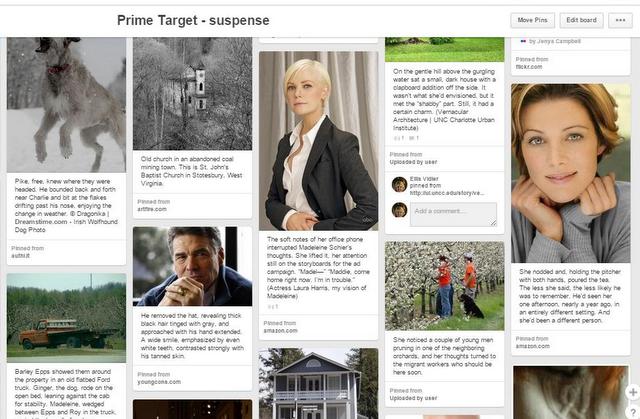
Are you on Pinterest? I joined a while ago and wasn’t quite sure what to do on there. I saw lovely recipes from friends. I saw interesting ideas for interior decoration and gardens. I saw clever craft projects and gorgeous book covers. I looked and admired and did nothing with the boards I had set up.

Then one day, after talking about who could play the main characters in my Emily Castles mystery series if it ever got made for TV, I got busy on Pinterest. I realized that Pinterest would be the perfect place to play the “what if” game.

I set up boards with bonus material for my books, including fantasy casting and locations. It’s a brilliant procrastination tool! But it’s fun, too. I have put the links to the Pinterest boards in the back of my books, hoping that readers who have enjoyed my stories and want to know a little bit more about the characters will visit and follow me there.

It’s an ongoing project but so far I have fantasy casting for Emily Castles, my twenty-six-year-old amateur sleuth, and her side-kick Dr. Muriel. They are the main characters in a contemporary British mystery series that starts with Emily’s visit to a party hosted by a mysterious troupe of circus performers in Three Sisters.
Alison Wonderland
I also have casting ideas for my two Alison Wonderland books, including Alison and her boss at the private detective agency where she works in London. I also have casting ideas for my dystopian novel, The Miracle Inspector.
9780956517043

It’s great fun. The only problem? Finding male actors to play the younger main characters in my books. All my fantasy casting ideas – except for Ben Wishaw as Lucas in The Miracle Inspector – are horribly out of date. I need someone like John Corbett in his Northern Exposure days but twenty years younger to play Alison’s love interest in Alison Wonderland and Being Light.

If you have any fantasy casting ideas for any of my characters, they will be gratefully received!

helensmith

You can find Helen Smith here:

Helen Smith’s blog: http://www.emperorsclothes.co.uk
Helen Smith’s website: http://helensmithbooks.com
Helen Smith on Twitter: http://twitter.com/emperorsclothes
Helen Smith’s books on Amazon: http://smarturl.it/helensmithbooks
Helen Smith on Pinterest: http://pinterest.com/emperorsclothes

For the Boys: Great Holiday Gift Reads Wednesday, Dec 3 2014 

Auntie M enjoyed the Bette Midler movie “For the Boys” and decided to title this post after that as these books all have suspense and action in common, popular with male readers. This is NOT to say that women don’t read these books–of course they do! But if you’re looking for a gift for a male reader, try one of these.

white lies
Stephen Leather’s Spider Shepherd series are among top sellers in the UK. This year’s White Lies brings Shepherd back for his 11th outing with MI5. When a former trainee is presumed kidnapped in the wilds of Pakistan, he joins the rescue mission with disastrous results. With Shepherd tortured by al-Qeda terrorist, it will be up to MI5 Controller Charlotte Button to rescue him in the most unorthodox way. Fast-paced and action-filled.

Hounded
For the dog lovers on your list, you can’t go wrong with David Rosenfelt’s Andy Carpenter series. The newest, Hounded
,finds Andy and girlfriend Laurie Collins arriving at a crime scene discovered by his good friend, policeman Pete Stanton. When the body of ex-con Danny Balfour is found, the victim’s four-year old son and basset hound need care and Pete asks the couple to assume to prevent both boy and dog from going into the system. But once Pete comes under suspicion in the death, he will need Andy to put on his lawyer cap to clear him. A nice mix of humor and sleuthing. Why not get the entire series?

Darkest Hour
Tony Schumacher brings a different ending to World War II in The Darkest Hour
, as he the imagines London of 1946 and how it would be if the Nazis won the war and occupied Great Britain. John Henry Rossett is an unlikely hero: a former war hero and policeman whose family died during the attacks on England and has become an alcoholic. Depressed, with little future before him, Rossett works for the SS in the Office of Jewish Affairs, seemingly unaffected by rounding up Jews for deportation–until he finds an 8 yr-old boy hidden in the chimney of a house he raids. Will Jacob be Rossett’s salvation or his downfall? That remains to be seen as the unlikely duo struggle to stay alive and one step ahead of every group after them as Rossett comes to understand he can trust no one. Intriguing and original, an imaginative thriller.

desert god
South African writer Wilbur Smith’s newest entry in his ancient Egypt series, Desert God , is perfect for the reader who enjoys historical epic novels. Focusing on the character Taita, this slave and advisor to the pharaoh finds himself caught up in a quest to destroy the army of Hyksos and for an alliance with Crete. This takes him on a journey up the Nile through Arabia and over the vast seas of ancient times. With shifting loyalties and never knowing whom can be trusted, Taita’s struggle is as action-packed as any present day novel, as it describes the customs and culture of a time from long ago.

And in Paperback:
Lastnight-by-Stephen-Leather

We return to Stephen Leather and his Nightingale series for Lastnight. The newest in his supernatural detective series find Nightingale searching for the killer of Goths who all have a tattoo connecting them to a Satanic child-sacrificing cult. Called the Order of Nine Angles, the Order soon has Nightingale himself in its sights and will do anything to stop him bringing them to earth. His solution is unorthodox and will have readers flipping pages to find the resolution.

Wash Stratagem
Adam LeBor’s new novel, The Washington Stratagem
, is the sequel to The Geneva Option, which introduced UN covert negotiator Yael Azoulay. Having a strong and sexy woman at the center of the action is a nice twist, as Yael is tasked with confronting a lobbying and asset management group in Washington, DC, about extensive links to US involvement in Middle Eastern wars. Treading a delicate line, Yael must combine international politics and her life as a spy as she races to root out the corruption she finds. Both novels would make a great gift together.

going-dark
James W. Hall has written 13 Thorn novels, all featuring the fly-tying investigator and his sidekick, and returns with Going Dark,a strong entry in the suspense genre. His nemesis this time is ELF, the Earth Liberation Front, an extremist environmental group whose usual means of damage is arson. This time the stakes are raised when they target Florida’s largest nuclear plant, and they’ve managed to involve Thorn’s newly-discovered son, Flynn. Helping Flynn escape from remote Prince Key while at the same time foiling their attempts will lead Thorn to his craziest idea yet. Look for the newest Thorn, Big Finish, later this month.

Runner
Runner follows Patrick Lee’s strong thriller debut, The Breach, featuring former black-ops soldier Sam Dryden. Running at 3 AM has never been so dangerous for Dryden once he encounters 12-yr old Rachel, who only recalls her last two months in a secret prison. Soon it’s obvious protecting Rachel will be more of a chore than he’d expected, as heavily armed crews drive them both across the nation to find answers to whom is pursing her, and why–and all as Dryden suspects that running into Rachel may not have been a coincidence. Warner Brothers has film rights and this action-packed suspense novel will easily translate to the screen.

Vendetta-hi-res
It’s easy to see why Lee Child calls Dreda Say Mitchell’s first John MacDonagh novel “Breathless from the first word and thrilling to the last.” Mac wakes up in a trashed hotel room without any memory of how it got that way, bloodied and in pain. He soon discovers his lover’s body in the bathroom, and with evidence pointing to him as her killer, Mac must find the real killer even as he races against time and his grief to clear himself. Tracking him down is none other than DI Rio Wray,an ambitious black female detective on her way to the top, even if it means proving her close friend Mac is a killer. Fascinating look at the world of undercover cops and first of a new series destined to be a winner by this award-winning crime writer.

Catriona McPherson: A Deadly Measure of Brimstone Sunday, Nov 30 2014 

Deadly Measure
Auntie M loves the cover art of Catriona McPherson’s newest Dandy Gilver Scottish mystery, A Deadly Measure of Brimstone. The strong series, among other awards, won the Bruce Alexander Memorial Historical Mystery Award in 2013 and 2014.

But she liked the inside even more, as Dandy moves her two sons and husband, all recovering from a bout of the nasty chest illnesses which reach to the staff, to the spa town of Moffat to recuperate. Dandy has her own agenda to install central heating when the family is gone, and has neglected to mention this to her husband, Hugh.

Of course, with Dandy it’s never that simple. She and her partner Alec agree to take on a case to investigate the death of a woman who died suddenly at Laidlaw’s Hydropathic Establishment. Mrs. Addie’s grown children have written to ask Gilver and Osborne to look into their mother’s death, termed heart failue, which her children insist was not Mrs. Addie’s health issue before this visit.

It seems fairly simple: have Hugh and the boys treated and give them time to recover whilst investigating the death. Even aging dog Bunty comes along for the trip. But nothing is ever that straightforward with Dandy,
who soon finds herself disrobing to take saunas, cold baths, and salt rub massages all in the name of finding the evidence they seek.

With Alec also at the Hydro, the duo will find spirits, mediums, an even an after-hours establishment at the Hydro, run by Dr. Dorothea Laidlaw and her brother Thomas, who inherited the spa from their father.

McPherson gets the period details just right, from clothing and manners to the way people spoke in 1929. And Dandy’s humorous and slightly irreverent thoughts are on full display, as when Dandy and Alec endeavor to describe Mrs. Addie: “Thrashing out a description which honored her memory – one could not simply say she looked like a piglet in tweeds …”

Great fun that encapsulates the bygone Golden Age era from this award-winning author.

D. E. Ireland: Wouldn’t It Be Deadly? Thursday, Nov 20 2014 

wouldntdeadly
D. E. Ireland is the pen name of two Michigan authors and friends who’ve hit upon a wonderful device: continuing the story of Eliza Doolitte and Henry Higgins in their first mystery, Wouldn’t It Be Deadly?

With all the original players here, including Colonel Pickering, Freddie Eynsford-Hill, and even Mrs. Pearce, the action opens just after Eliza’s appearance at the Embassy Ball which cemented her transformation from a Covent Garden flower girl to a duchess.

Eliza is living with Higgins’ mother, dating Freddie, and still nursing her annoyances against Higgins, while working as the assistant to his rival elocution expert, Emil Nepommuck. When her boss makes the unfortunate mistake of taking public credit for Eliza’s transformation, Higgins’ publishes a damning article that exposes Nepommuck as the fraud he is–until he’s murdered, and the most obvious suspect is, of course, Henry Higgins.

The only way to clear Henry is for Eliza to help him sleuth the many enemies Nepommuck has gathered, and what a crew it turns out to be: elderly dowagers, Americans, actresses–all have been tutored by the charlatan to lose their accents and upgrade their vowels and consonants. There are secrets being kept, and Higgins has his own surprising one to hide as the investigation heats up and it soon becomes clear that he is on the verge of being arrested.

The author’s are to be credited for maintaining the tone and the personality of all of the players, down to using dialogue you can believe these characters would say. There is humor and exasperation, and the final scene rivals anything yet to be seen on Drury Lane. All of the period details are spot on. A wonderful debut of pure brain candy and one can only feel G. B. Shaw would be best pleased.

Maia Chance: Snow White Red-Handed Sunday, Nov 16 2014 

Please welcome author Maia Chance. To be entered to win a copy of SNOW WHITE RED-HANDED, leave a comment~
snow white red handed

Bit Part Firecrackers

A reader recently asked me, “How do you create your secondary characters?”

This isn’t talked about much—we writers adore rhapsodizing about our fierce/vulnerable/dauntless/altogether fascinating sleuths and sidekicks instead. But cozy mysteries are character-driven stories, and that refers to all of the characters.

Snow White Red-Handed, my newly-released historical cozy mystery, trots out an eclectic cast of secondary characters, from castle servants and a casino owner to a mysterious Russian princess and an ungainly stepsister. And so—in answer to my Gentle Reader’s question—here is my checklist for secondary characters.

1. They are Fleshed Out.

This applies even to secondary characters who have only one speaking line. Why? Here’s something special about a whodunnit-style mystery: since many of the secondary characters are murder suspects, that means that one of them is really a primary character: the villain. Trippy, right? So, every one of the suspects must have enough punch and intrigue not to seem like a random killer when the truth comes out at the end. My rule of thumb is that everyone has a secret even if it’s not THE secret.

2. They Provide Variety.

Secondary characters can create dimension not provided by the main characters. In Snow White Red-Handed, for instance, I explore class and nationality not only through my sleuth Ophelia Flax (American variety hall actress) and her romantic interest (privileged British professor); I also have a family of American upstarts with a fortune made in the railroad and down-at-heel German servants. And I was able to explore varied settings through secondary characters, too. Because of a couple of sinister guards, the protagonists are lured into a horseback chase through the forest, while my bombastic lady naturalist leads the sleuths to a luxurious health sanatorium. What is more, each of these characters is distinctive in appearance, dress, and mode of speech. Mr. Smith, the American millionaire’s private secretary, speaks like this:

“Like California? Haw! The Black Forest is about as much like California as one of them Arabian racehorses is like a Mexico donkey. Oh, that’s a hoot! No, one thing’s certain, and it’s that I’ve got to get myself back to some real wilderness. That durned police-man, Schubert, has forbidden us all to leave until he gets to the bottom of the murders, but I figure that’ll take about as much time as for him to learn to be a ballerina.”

3. They Provide Absurd (Comic?) Relief.

I admit, Snow White Red-Handed isn’t exactly a serious story. Early readers have called it “fun,” and I can more than live with that. Because even though I will never, alas, be as witty as P. G. Wodehouse (secret fantasy of mine), I do want my books to be at least mildly amusing. I find that my secondary characters, behind my back, tiptoe again and again over the threshold into Absurd Territory. Here is one of the descriptions of the lady naturalist and her elderly, consumptive employer, two characters I immensely enjoyed writing:

“Miss Gertie posed like one of those Viking ladies at the opera, all blond braids and magnificent bosom, in an arched doorway at the far end of the dining room. All that was missing was one of those helmets with horns. She gripped the handles of a wicker wheelchair, which was occupied by what appeared to be a heap of black wool with a white wig.”

4. They Provide Historical Dimension.

Here’s something people have been asking a lot about: how I came up with the attitudes of my German fairy tale scholar, Professor Winkler. His snotty belief that fairy tales are merely the product of debased “peasant” minds is derived from an actual historical essay written by James Russell Lowell (a Harvard professor) in 1870. There was no way I could’ve made it up; Lowell’s assertions have that special outlandish-yet-real flavor. (This is why I compulsively read Wikipedia articles: truth is way, way weirder than fiction.)

5. They Enhance Themes and Motifs.

In Snow White Red-Handed, secondary characters embody or enact themes and motifs from the fairy tale “Snow White and the Seven Dwarves.” For instance, from the fairy tale I pulled the theme of beauty tied to a mother-daughter relationship. Next, I explored that theme through the avenue of the secondary character Prudence Bright, whose actress-and-courtesan mom taught her to value her looks and feminine wiles above all else. As another example, “Snow White” has that little detail about the Wicked Queen wanting to eat Snow White’s liver (or lungs, or heart, depending on the version), so in Snow White Red-Handed I HAD to go there:

“Luncheon, by the by,” Winkler said to Mr. Coop, “was superb. The sautéed liver! Your cook is a sorceress. Did you bring her from America?”

Truthfully, there are lots of writing days when my secondary characters are vastly more amusing to play with than my main characters. On those days I feel like I should, like a theater manager, pull the exuberant bit part actor offstage with a cane. Yet sometimes I indulge, and let them bask in the limelight a moment or two longer.

BIO: FEM_0463 web

Maia Chance writes historical mystery novels that are rife with absurd predicaments and romantic adventure. She is the author of the Fairy Tale Fatal and The Discreet Retrieval Agency series, and her first mystery, Snow White Red-Handed, is available now from Berkley Prime Crime.

Maia is a candidate for a Ph.D. in English at the University of Washington. This means that the exploits of Fairy Tale Fatal’s heroine, variety hall actress Ophelia Flax, were dreamt up while Maia was purportedly researching 19th-century American literature and fairy tale criticism. The Discreet Retrieval Agency series was born of Maia’s fascination with vintage shoes, automobiles, and cocktails combined with an adoration of P. G. Wodehouse and chocolate.

Upcoming titles include Come Hell or Highball (St. Martin’s Press, 2015) and Cinderella Six Feet Under (Berkley Prime Crime, 2015). Maia lives in Seattle, where she shakes a killer martini, grows a mean radish, and bakes mocha bundts to die for.

LINKS:

WEBSITE: maiachance.com
FACEBOOK: facebook.com/MaiaChance
TWITTER: twitter.com/maiachance
GOODREADS: https://www.goodreads.com/author/show/8127322.Maia_Chance

« Previous PageNext Page »