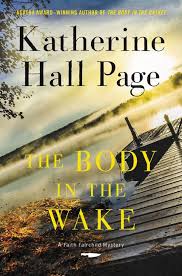
Katherine Hall Page is having a silver anniversary! The publication of her 25th Faith Fairchild mystery this week brings a new release to the well-loved series with The Body in the Wake. Don’t miss this addition, set in Maine, where the catering sleuth is supposed to be on vacation and helping to plan the wedding of her friend’s daughter.
Relaxing goes out the window when Faith finds a body while swimming. Caught in the reeds in the Lily Pond, the strange tattoo on the victim her first clue that something shocking has invaded her little corner of the world at Sanpere Island.
Addressing a real issue in our country on a smaller level brings home the drama and distress of the nationwide opiod crisis, while Faith ends up digging into what’s behind it all. There will be time for cooking and recipes, too, in another delightful installment from the double Agatha Award winner and recipient of the Lifetime Achievement Award from Malice Domestic.
Auntie M recently had a chance to ask Page about her books and the long-running series:
Auntie M: Congratulations on THE BODY IN THE WAKE, number 25 in this popular series. How do you keep Faith Fairchild as a series character fresh?
Katherine Hall Page: One of the joys of writing this long ongoing series—something that continues to amaze me—is the opportunity to follow Faith and family across many years, a lifetime in effect. As in our own lives, what happens, both good and bad, creates a fresh dynamic in each book. When it became apparent that this was going to be a series, I alternated the locales every other book as a way to keep the series fresh as well. There are the Aleford books, as is the first, The Body in the Belfry, set in Faith’s hometown west of Boston and then the “Someplace Else” books, set in Maine, Vermont, Savannah, New York City, Norway, and France.
AM: You chose your Maine setting for this one, Sanpere Island where the Fairchild’s have their summer home. It’s obvious that you have a deep affection for the area. Can you explain to readers why this setting has such significance for you?
KHP: I grew up in northern New Jersey, but starting in 1958 my parents decided that it made sense to drive north for twelve + hours with three kids for Dad’s precious vacation to Deer Isle, Maine despite living a short drive from the very beautiful Jersey shore! Before the war they had been camp counselors near Camden, Maine and fell in love with Penobscot Bay. They bought a small piece of land on a cove in the early 1960s and built a cottage. I’ve been on the island for part of every summer, and since my parents are buried there in a lovely cemetery with room for the rest of us, plan to be there a long time. As native Mainers say, “Just because a cat has kittens in the oven, doesn’t make them biscuits”, I will never be a “native”, but it’s where my heart is and I’m now living in our cottage for 4 months of the year. As a setting, the island is not only stunning, but abounds with tales!
AM: You’re not afraid to tackle the deepening drug crisis in this book. What made you decide to have that theme when there’s also the anticipation of a summer wedding in the action?
KHP: First of all, I have a deep seated dislike for what I call “Soapbox Mysteries” in which the author has a point of view, social, political or otherwise, that gets rammed down the reader’s throat to the detriment of all else such as plot, setting characters etc. I wanted to write about the drug crisis on the island and by extension everywhere else, but did not want to preach or have it get in the way of the story.
But it is the story today and a grim one growing worse. We all have friends and family who have fallen victim to various addictions. By telling just one I wanted to put a face on the problem. In this book, a young woman, Arlene, becomes dependent as a result of prescription medicine she was legally given for pain after a car accident. I also did want to slip in information about medically assisted treatment and also the fact that there are no simple turnarounds. Addicts relapse. This doesn’t make them bad people or criminals. It makes them human and we need to cherish them. And weddings are times of great emotion, plus so much fun to write about!
AM: Your characters are your extended family by now, as you’ve carved lives for them and written of their growth. Do you plot this growth ahead or as you start each book? Do you have an over-arching story arc for any of them for their futures that you envision?
KHP: I think about the Fairchild family even when I am not looking at a computer screen. They have become very real to me. Now I wish I were one of those writers who say their characters take on lives of their own and write themselves, but I did not receive a draught of that potion. That said I ask myself that essential for all writers question, “What if?” and think about it in regard to this family.
What if Tom and Faith start to have problems in their marriage? What form would it take? What if son Ben is not the target of a bully, but joins the bullying group? What if daughter Amy fails to recognize the obvious signs that something more than an allergy is causing her employer’s stuffed up nose? Much of what I think about the Fairchilds never makes it into any of the books, but informs all of them. Not perfect people, thank goodness, but people I think we’d like to know. The story, the essential part of each book, grows from the characters and I have to make sure they don’t get in the way with too much detail—or not enough.
AM: Close friends are important to the Fairchilds and have become repeat characters. Yet you seamlessly weave in the ones we probably won’t see again, such as the Childs and the Cranes, with several surprises there. How much outlining do you do before plunging into the writing?
KHP: In the past I outlined extensively, but found I wasn’t using them so much as other methods. I think it’s Harlan Coben who answered one of his children with “Daddy’s working” when he was just sitting and staring out the window. Before I write a single word there’s much walking around, thinking in the shower, and especially during that time just before sleep. I know it doesn’t look like I am working, but I am.
I know where the book will take place since I alternate locales and always write a very lengthy synopsis that goes to my editor who may make a suggestion or two. Then I write the book. I use those notebooks from France with the small grids to keep my messy handwriting legible and start with a list of characters. I think of them as a kind of ensemble troupe with the leads, the Fairchilds, permanently cast and then others come and go. Some never cross the stage again, but the Millers, Ursula Rowe and Millicent Revere McKinley almost always make an appearance. That’s why the wedding was such a joy to include. Everyone was invited.
Last word: the villains in the story, the alive ones, never return for an encore!
AM: What forms the germ of a plot idea for a new story?
KHP: Back to process. The synopsis forms the skeleton of the book and it may, and does, change over the course of writing it (always the hard part). I keep lists of characters with a few words describing them on that first page of the notebook, followed by pages of a timeline and list of chapters with brief descriptions about what is happening in them as I go along. The timeline helps me keep the days straight, so if a week has passed, Faith doesn’t say, “Yesterday, I….”
I also keep a list of first and last lines by chapter so each does not start with “Faith woke up.” and end with “She heard a mysterious noise…” However, that last line has to make the reader keep turning to the next chapter and stay up all night. Plot ideas come from all sorts of sources, especially eavesdropping (I have no shame and my husband is used to being shushed in restaurants if there is something juicy being said at the next table. Also women say fascinating things in restrooms to each other when they think all the stalls are empty!).
My favorite description of the writing process comes from Madeleine L’Engle: “It’s like taking dictation from one’s imagination.”
AM: The recipes included at the back are a hallmark of your stories. Do you taste test them all? (I’m trying the Blueberry Buckle soon!)
KHP: The recipes are the most difficult parts of the books to write. I start them often a book ahead, knowing where the setting will be. They must all be original—can’t just open Julia and copy—and they need to be easy—not caterer types—require no expensive or exotic ingredients, and most all off taste delicious. The recipes in the Body in the Wake are summer ones, most Down East favorites with Faith’s spin on them. Fortunately I love to cook.
AM: Can you give readers a clue as to what lies ahead for Faith and her family?
KHP: Observant readers will have noted that Faith and Tom are aging much more slowly than their children (joy of fiction-I can do this, unlike one’s own march through the years). When the first book came out, a dear friend, the late William Deeck, who knew more about the genre than anyone I’ve ever known, advised keeping the children in the wings and avoid cuteness. I’ve stuck by this, but now that they are older, they are jumping in more, as in Amy in this book. So that’s a direction. And I do love Sophie Maxwell who was introduced in The Body in the Birches and now appears in a third book.
AM: -Whose books would we find on your nightstand? Which of your colleagues books you eagerly anticipate reading?
KHP: First my colleagues. I have always been a fan of Margaret Maron’s and was devastated when she stopped the Deborah Knott series. Also Dorothy Cannell—The Thin Woman is reread often to keep me from getting too depressed by world events. I also read Peter Robinson, Charles Todd, Harlan Coben, Ian Rankin, all the Scandinavians. Very different books from the kind I write. I also go back to vintage mysteries—Christie, Sayers, Mary Stewart, Rex Stout, Patricia Moyes, people like Joan Coggin, reprinted by Rue Morgue Press and all their other titles.
I read a great deal outside the genre as well. Right now, Maeve Brennan’s The Springs of Affection Dublin Stories. I enjoy Irish fiction, old and new, plus all the titles from Persephone Books, which reprints neglected fiction and nonfiction, mostly by women starting in the mid-twentieth century https://www.persephonebooks.co.uk/
Also YA- Hey, Kiddo by Jarrett Krosoczko is an amazing new discovery. Love Lois Lowry, Cynthia Voigt, Angie Thomas. And always delve into a Neil Gaiman and Gregory Maguire. There is usually a thick biography in the stack, right now The Chief by David Nasaw (William Randolph Hearst). I read cookbooks with no intent on having to make the food, but just to read them for pleasure. Also food memoirs. Oh, and I totally need frequent doses of British chicklit—Sophie Kinsella, Katie Ffjorde and on our shores, the incomparable Mary Kay Andrews (great mysteries as Kathy Trocheck too). And cannot forget my most favorite— Nancy Mitford! Phew!
AM: Thank you, Katherine, for this enlightening look into your world. Readers will certainly enjoy The Body in the Wake
Leave a Response »