Elly Griffiths: A Dying Fall review and brief interview Sunday, Nov 3 2013 

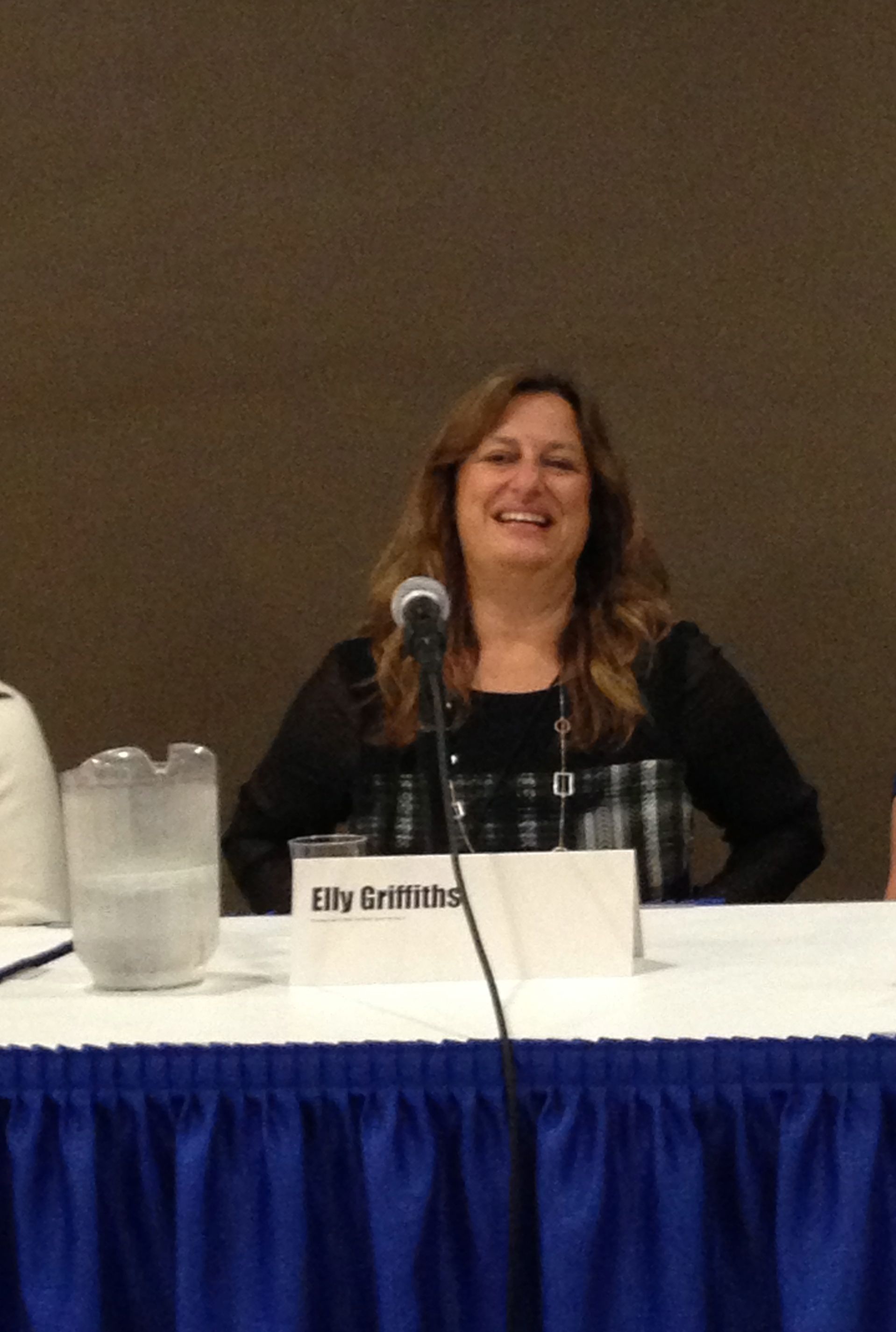
EllyGriffithAuntie M had the pleasure of meeting and talking with Elly Griffiths at Bouchercon, Albany.

The author of the Ruth Galloway series and winner of the Mary Higgins Clark award has a lively sense of humor and a warm personality.

She talked about the origins of her series, featuring the down-to-earth forensic archeologist whose independence and intelligence make her a delightful character readers are eager to follow.

Auntie M: Tell readers how you came up with the idea for the series.

Elly Griffiths: My husband was a lawyer who came to me one day and said he wanted to go back to school to be an archaeologist. I became interested in his studies and his work, and the idea was born.

AM: And Ruth?

EG: With my husband in school, we took a family vacation back to the Norfolk coast where I’d spent summers in my youth. I was thinking about a series as we walked along the beach by the marsh on a foggy day. Out of the mist, Ruth literally came walking to me, fully realized. I saw what she looked like, what she wore, down to knowing  what kind of cracker she would eat!

AM: Ruth is such a realistic, well-rounded person–smart, stubborn, still anxious about her role as a mother. You’ve handled Ruth’s relationship with Harry Nelson, the father of her child, with a great aching tenderness.

EG: They find themselves in an unusual situation. Harry is Catholic, so there’s that to consider, and he loves his wife. Can you love two people at the same time? I’m still working that one out . . .

AM: And readers will be waiting to see what you and Ruth have decided!                                            15814458

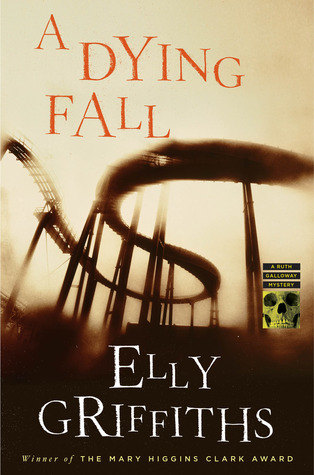
A Dying Fall is book five in the Ruth Galloway series.

Ruth is surprising herself by juggling motherhood of an 18-month old with the demands of her teaching and the annual university dig.

A call from a former classmate with news that one of their circle from university days has died in a fire brings Ruth memories of their time together: shared secrets, drinking bouts, sharing a flat.

Her memories take on a golden light and she rues she hasn’t stayed in touch Dan Golding. “Now she will never hear from him again.”

But the very next day after years of silence, Ruth receives a letter from Dan that changes everything. When Ruth asks Harry to look into Dan’s death, he asks an old colleague’s help–only to find the professor’s death was anything but an accident: the man’s door had been locked from the inside.

Then Ruth receives a call from Pendle University in Lancashire to consult on an important finding of Dan’s just before his death. She packs up toddler Kate and heads north with her friend, the Druid Cathbad, to Lytham, far too near where DCI Harry Nelson and his family are taking vacation with Harry’s family in Blackheath. Cathbad’s presence will lend its own surprising connection.

Dan was on the verge of a major announcement based on his discovery, which intrigues Ruth in her professional capacity as much as she longs to unearth the truth about the link between Dan’s theories and his murder.

What follows is a brew of old bones, neo-Nazis and New Age hippies mixed with trips to Blackpool Pleasure Beach and the archaeology of early Britain. The plot has enough twists and turns to keep the mystery alive, while Harry’s extended family are on the scene and their interactions add to the texture, at Harry’s obvious discomfort.

Griffiths weaves the archaeology into a compelling plot while she manages to update the characters’ private lives and move those forward. It makes for an intriguing crime story that will have readers looking forward to the next mystery featuring Ruth Galloway.


Continued Series Winners: James, Mays, Cleeves, Toyne, Rhodes, Billingham & Haddam Sunday, Oct 27 2013 

Auntie M is reading a ton of great series and wants to suggest you check out these continued winners.

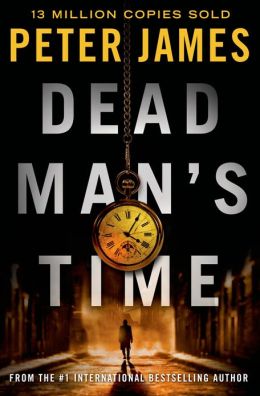
dead man's time by peter james Peter James’ Roy Grace novels have captivated readers in the millions and he continues his powerful series with Dead Man’s Time. Set in Brighton, these police thrillers follow the Detective Superintendent and his relationship. The newest has the unusual premise of a prologue from 1922, when five-year-old Gavin Daly and his sister board a ship for Dublin after the death of their parents.

At the dock in New York, a messenger carries two things that will haunt Gavin for the rest of his life: his father’s pocket watch, and a paper with four names and eleven numbers written on it. Gavin pledges to find out the meaning of these things and spends a lifetime searching.

Fast forward to current time, and Grace is getting used to being a new father and the lack of sleep that brings. A string of burglaries have captured the attention of Brighton’s residents.

When an old woman is murdered and a huge cache of antiques she kept stolen, he is surprised when her family are only interested in one item: a vintage pocket watch. The victim’s brother is none other than an aged Gavin Daly, still on the hunt having amassed incredible wealth as the years have passed.

What Grace will find as he probes is a mixed bag of old revenge and new hatreds. He will become mired in the machinations of several trails, leading to the antiques world of Brighton, to Marbella and its crime world, and back in time to the crime families of New York.

And all the time he seeks to unravel this twisted scheme, a madman plots against his beloved Cleo and their infant son. A wonderful addition to the series, meticulously researched and intricately plotted.

Auntie M had the pleasure of meeting with Peter James this summer and found him warm and likeable, with a wicked sense of humor not unlike his protagonist.


Peter Mays’ Lewis trilogy captures the remoteness of the Outer Hebrides area and its stark beauty in his award-winning series that serves up the complexity of human relationships.

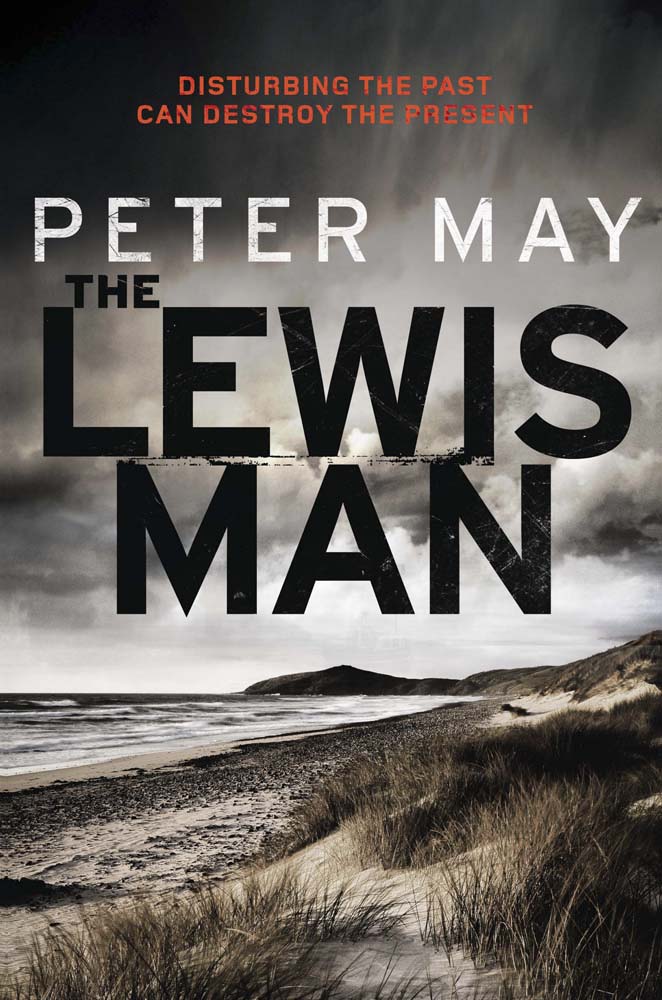
After the success of The Blackhouse, Mays second offering, lewisman300The Lewis Man, finds his protagonist, former DI Fin Macleod, bound by his past to help the family of islanders he is linked to by history and familial ties.

The father of his lover, Marsaili, has always maintained he was an only child, and enters a care home suffering from dementia when Marsaili’s mother has her fill of taking care of him.

Then a corpse is found in a peat bog, and far from being the historic body it is first thought, it is quickly ascertained that this body is far more recent–and is a DNA match to Tormod Macdonald, Marsaili’s father.

This winning novel shows the plot through Fin’s eyes and through the remembrances and clouded memory of Tormod, an interesting device that allows the story of Tormod’s upbringing to unfold, while explaining why he felt it necessary to claim he had no family at all. The climax will keep you reading well past lights out time to seek the improbable resolution to this complicated novel.

43627_TheLewisMan_TPB-Red.indd The Chessmen completes the trilogy. With his divorce final, Fin Macleod has moved back to Lewis and is working as a private investigator.

He is putting his life in Edinburgh and his police skills behind him. Or so he thinks.

He takes an assignment as head of security to track down poachers working a huge island estate, and finds himself reunited with old friends including Whistler Macaskill. Their history and that of their friends form the basis for the action that follows when a body is found in a crashed plane at the bottom of a loch.

May’s uses the device again of showing the past in episodes, this time through Fin’s remembrances. The 1919 tragedy of the Iolaire is recounted and haunts the action.

That loch discovery will change the very foundation upon which Macleod’s memories are built, for a secret being kept for decades by people Macleod thought he knew. At stake will be lives, his and others, and a girl who needs to be saved.

This gritty series has given readers surprising plot twists and brilliant characterizations throughout.

Readers can only hope May will take a page from Ann Cleeves, whose Shetland trilogy so thoroughly engaged readers that she decided to bring out a fourth volume.


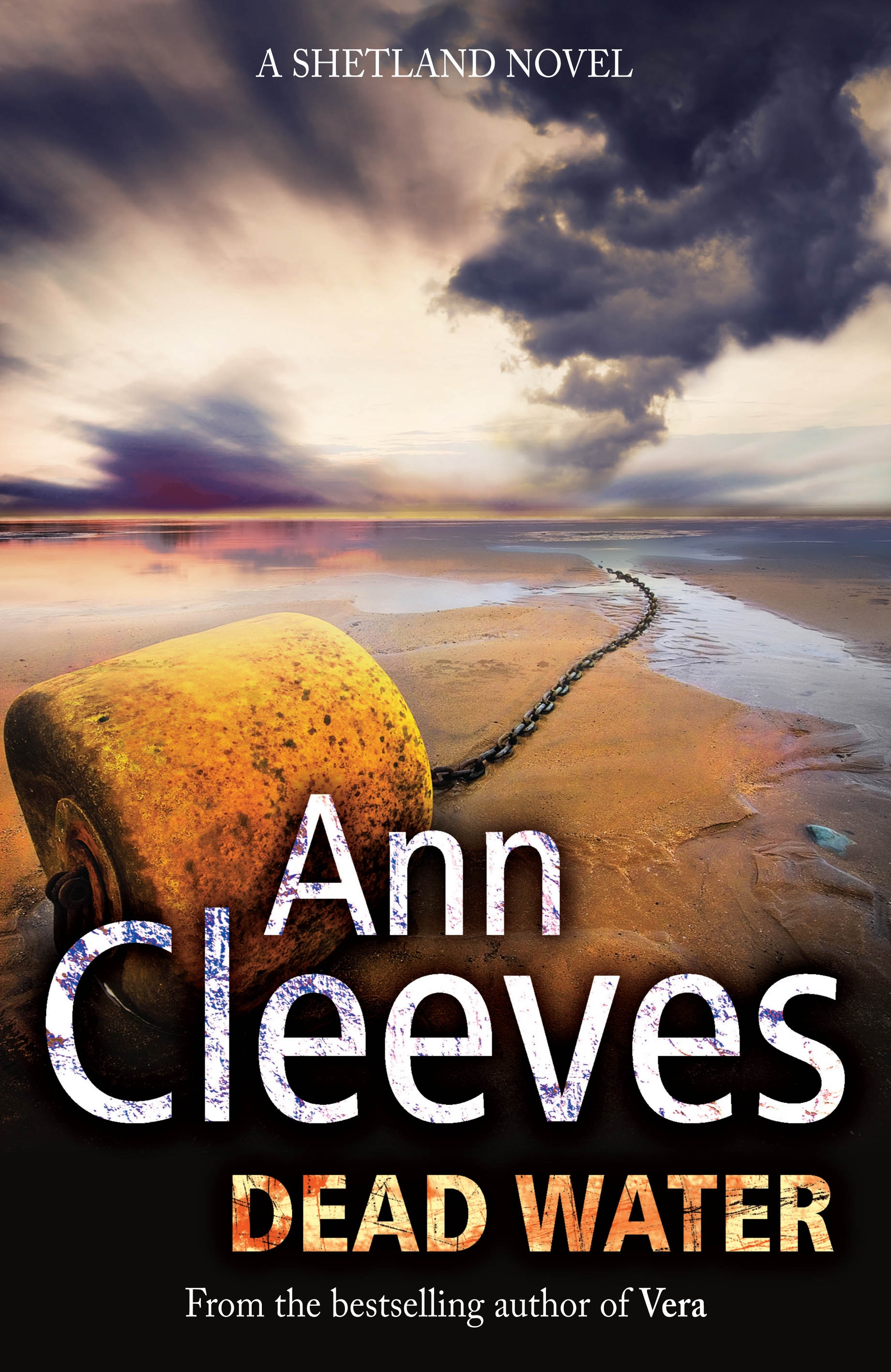
Dead Water continues the story of Shetland Island detective inspector Jimmy Perez. Blue Lightning Spoiler alert: In a shocking twist in the third volume, Perez’s fiancee was murdered, Dead_Water_HB_fc_and the detective is still struggling with that loss as he shares custody of her daughter with the girl’s biological father.

Jerry Markham is a journalist from Shetland whose family run a pricey hotel and restaurant in the area. The young man had left the island for London and work on a bigger and more important paper.

He left in his wake a scandal involving a young woman he made pregnant, who has gone on to make a life for herself on the island and whose impending marriage to an older seaman nears.

Then Markham’s body is found in a boat right outside the home of the Procurator Fiscal, Rhona Laing, a contained woman with a tidy, bleak house, who outlet in a crew team marks an otherwise lonely existence, one she prefers on her road to political advancement.

With Perez on leave, a young DI from the Hebrides is called in to conduct the investigation. Willow Reeves represents an unusual character and she’s able to bring Perez into the case by using his local knowledge. She also gets him to start to look past his grief, as his detecting skills are brought into play.

The case seems to revolve around Sullum Voe, where Shetland’s oil and gas industry are centered, and the big story Markham was following that brought him home.

Then a second death occurs, muddying the waters, and Perez and Reeves will team up to unmask a killer. Readers will hope Cleeves, who also writes the wonderful Vera Stanhope series, will keep Perez afloat.


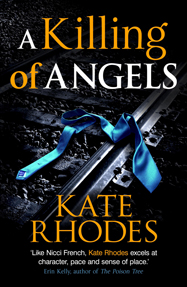
a-killing-of-angels-by-kate-rhodesKate Rhodes knocked our socks off with her first Alice Quentin novel, Crossbones Yard, a complex mystery whose shocking ending resounded with readers.

In this second installment, A Killing of Angels, the behavioral psychologist is back with a new case that finds her assisting the police again, despite her reservations after the nightmare of the first book.

Fiercely independent Alice is training for a marathon, despite London’s hottest summer on record. Her specialty in personality disorders makes her an expert at character analysis and an enormous help to the police.

The body in question was a suspected suicide, until a picture of an angel and a few white feathers are found stuffed into the victim’s pocket.

The killings continue and it’s obvious that the Square Mile and the banking world is the locus for the crimes. As Alice tries to help detective Don Burns with the case, she finds herself dragged deeper into the intrigue and the lives of the people involved.

Complicating matters are the journalists who keep the murders high profile, suggesting the killings are retribution for the banking world and its self-absorption.

Readers can’t help but be engaged with Alice and her complicated history, with Rhodes’ intricate plotting, and with her facility for choosing prose that matters, echoing her poetry background. This is a thumping good read.


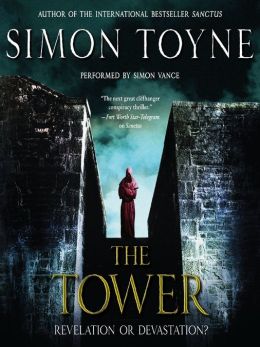
Simon Toyne’s Ruin trilogy has captivated readers with the world he created in his series of a haunting conspiracy thrillers. Tower-2 p0_v2_s260x420Nonstop action and breakneck twists continue in The Tower.

Santus introduced readers to Liv Adamson and the prophecy that caused her brother’s death and changed her life.

The Key left Liv trapped in the Syrian Desert, with her erstwhile savior, ex-special forces Gabriel Mann, suffering from the deadly virus that originated in the Citadel, an ancient monastery at the center of the conspiracy.

Enter new FBI agent Joe Shepherd, at first glance an unlikely choice to work the case after a cyber-attack at the Goddard Space Center that disables the Hubbard telescope and the subsequent disappearance of the prize-winning scientist in charge, who has left behind a cryptic and chilling message.

But Shepherd’s background with degrees in astrophysics and computer science make him the perfect choice. Despite the secrets he is hiding, Shepherd’s investigation leads him to connect these new incidents with the explosion months ago at the Citadel and the viral outbreak that ensued.

Readers will be engrossed in Shepherd’s journey with the added pressure of the device ofa  countdown clock dogging his heels. Then unusual things start to happen around the globe, and it remains to be seen if humanity can be saved.

Things will come full circle, but what is that meaning of that phrase? It it the ending of everything known before, or an entire new beginning?

For the woman at the heart of it all, Liv and her destiny will change the way the world survives–if it can. This third novel successfully answers all the questions raised in the other two, while providing a meaning and reason for the episodes of the others.

Auntie M met with Simon Toyne this summer and his outrageous good looks and charm belie the complicated mind needed to create this new world and the roller-coaster ride his readers will find.


Hearts Sandp0_v2_s114x166 Jane Haddam’s Gregor Demarkain novels continue to entertain. In this 28th installment, Hearts of Sand takes the investigator to the old-monied town of Alwych, Connecticut.

Although Chapin Waring disappeared thirty years ago, the quarter of a million dollars she had with her from a series of bank robberies was never recovered. There have been no sightings of the woman and she’s rumored to be dead.

Then new rumors fill the town: that Chapin has been seen on the beach or in a store, and these prove true when her body is found in the family’s vacant home, a knife sticking out of her back.

As a retired profiler, Demarkian excels at reading people and this kind of situation is right up his alley. With the local police stumped, he’s asked to help them narrow their field of suspects, and there are far too many of them.

Research into Chapin’s life shows her to have been a manipulative girl within an inner circle, whose attraction to danger led to the bank robberies and a car crash that killed her accomplice. The remaining people of her inner circle are just as delectable suspects as are the victim’s own sisters. Haddam gets small town snobbery just right.


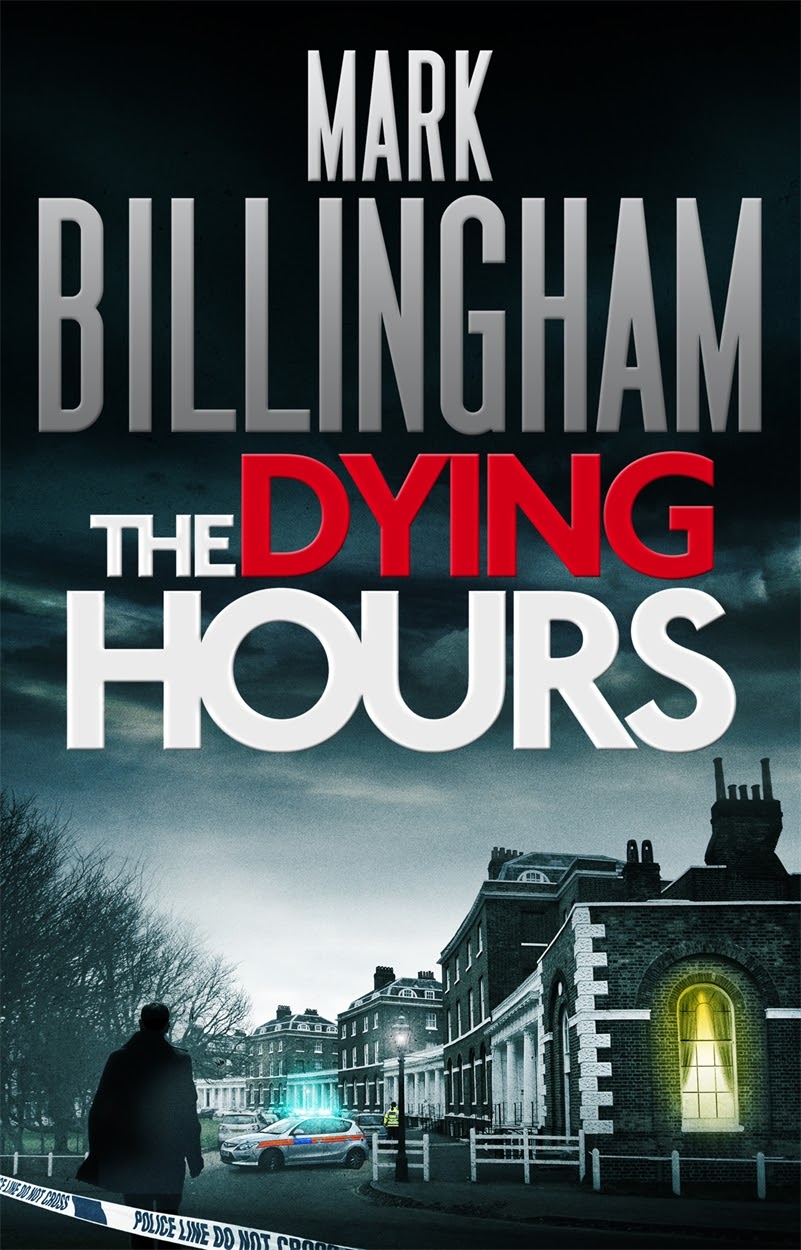
We’re back across the pond with Mark Billingham’s wonderful DI Tom Thorne series. Number eleven doesn’t disappoint: it’s vintage Thorne  The Dying Hoursat his crankiest and most recalcitrant in The Dying Hours.

Busted back to uniform after the horrific events in Good as Dead  and losing the title ‘detective’ while remaining an inspector hasn’t changed the way Thorne’s analytical mind works. Despite his demotion, and putting his budding relationship in jeopardy, Thorne’s instincts run true when he’s called to the scene of a suicide that doesn’t feel right to him.

Unable at first to pinpoint his unease, it soon becomes apparent, at least to Thorne, that a series of suicides of elderly people don’t ring true. One thing they all have in common is a lack of depression or sadness other suicides exhibit.

Try convincing the Murder Squad of that, though. The new head of the very team he once ran refuses to accept these might be the killings of a sick mind.

But any Thorne reader knows he will not take dismissal well, and he plunges into his own parallel investigation, calling on his former colleagues and few remaining friends to help out, despite that they must put their own careers on the line, and jeopardizing any sliver of career he might have left of his own.

This is vintage Thorne, from his predilection for country music to his doggedness once he becomes convinced he’s right.

Adding to the texture is Billingham’s ability to get inside the mind of the creepy villain, bent on revenge and justifying his horrific actions. By adding in the point of the view of the perpetrator, Billingham creates a wily adversary and gives readers a chilling glimpse inside the mind of a murderer.


Elizabeth George: Just One Evil Act Sunday, Oct 20 2013 

Don’t let the length of over seven hundred pages deter you from plunging into Elizabeth George’s new novel, Just One Evil Act. The eighteenth Inspector Lynley novel will leave readers knowing much more than a few Italian phrases once they’ve finished this tome.    images_012

The action centers on the reaction of Lynley’s sergeant, Barbara Havers, to the news her handsome neighbor’s daughter has disappeared.

Havers’ friendship with the girl, Hadiyyah Upman, and her father, microbiolgist Taymullah Azhar, has grown over the two years the duo were the detective’s neighbors.  In the last installment, Believing the Lie, Hadiyyah’s mother had waltzed back into her daughter’s life, surprising the girl, her father, and Havers, all seduced by the woman’s easy manner and ability to fabricate a believable friendship. Angelina Upman is a complicated woman keeping multiple secrets, a beauty whose family has disowned her for having a child with the married Pakistani scientist.

Months pass with no word on the child’s whereabouts, despite Havers’ digging and helping Azhar hire a private detective.

Then Hadiyyah is kidnapped from a market in Lucca, Italy, where she’s been with her mother and Angelina’s fiance. Desperate to help Azhar, worried for the child, Havers makes the fatal mistake of enlisting a tabloid journalist to force the British police to become involved in the British citizen’s abduction. To her dismay, it is Lynley who is sent to Italy to liaise with the British family.

This splendidly plotted novel takes readers to Italy, introducing their very different policing system, and the wily detective Salvatore Lo Bianco. While Italian phrases liberally dot these scenes, George cleverly manages to convey their meaning without direct translations. The intriguing setting is well-described and adds another layer to this complex novel.

In London, Havers finds herself embroiled deeper and deeper into career-killing choices. On the personal front, Lynley is trying to convince himself he is starting to put his wife’s death behind him, and finds himself drawn to an unsuitable zoo veterinarian. His past fling with Superintendent Isabelle Ardery confuses everything, and will impact heavily on Havers’ future.

At one point readers will think the novel has reached its climax right in its middle, only to find that what would have been an ending for another writer is merely a step into the convoluted story that continues to branch off and have fingers reaching right into the lives of all these characters on different levels. At one point a resolution will appear completely out of sight, yet there is an ending that will satisfy readers, even as it does not satisfy every character.

This is a multi-layered story of love and betrayal, and what lengths we will choose when the heart is involved.

Elizabeth Haynes: Interview/ Human Remains: Review Sunday, Oct 13 2013 

One of the goals Auntie M has in writing this blog is introducing US writers to great UK authors they may be missing. Elizabeth Haynes (Into the Darkest Corner; Dark Tide) writes quality crime novels you’ll want to seek out. Auntie M had the privilege at Bouchercon of interviewing Haynes about her newest thriller Human Remains. The first photo is of Elizabeth charming the audience as she moderates a panel. She is warm and personable with a wicked sense of humor, and we shared a delightful time together. Here are her thoughts on her work; the review follows.

IMG_2517HaynesAuntie M: Your first two books drew on your experience as a police intelligence analyst, yet Human Remains is the first to give your protagonist that actual job, a real glimpse into a civilian working for the police. Tell us how your job sparked this book’s storyline.

Elizabeth Haynes: Every morning we received a bland document, the Chief Constable’s report of all reported incidents for the last 24 hours. “Human remains found” is often noted with no name or details or identifier.  It’s an incident but not necessarily a crime if these people appear to have died from natural causes, yet it happens more often than you’d think and I wondered about these forgotten people.

Then I saw a documentary called Dreams of a Life, about 38 yr-old Joyce Vincent, whose decayed body was found in her flat three years after her death.  She was sitting on her sofa surrounded by Christmas presents she was wrapping and the telly was still on! No one had missed her, no had checked on her–she had no “key layer” of people who would have raised the alarm. I started to think: what if someone out there was responsible for these seeming natural deaths, how would I search for this to find a pattern? I gave that job to my character, Annabel.

AM: You have created some really creepy bad guys. How do you get close to them?

EH: The first two books were concerned with relationships and it felt easier to write them. This one differs significantly. Both Annabel and Colin are unsocial people, but for vastly different reasons. I see my books as a snapshot of my characters, a window to them. I love them all, even the baddies. At first Colin didn’t want to talk to me, and I suspect he’s more intelligent than I am. He does hideous things but he sees the beauty in what he does and believes in it.

AM: Whether it’s OCD, pole dancing, or neuro-linguistic programming, you do extensive research. It’s one of the bits I enjoy most in my mystery series–do you?

EH: I do enjoy research but I’ve learned there’s a fine line for me between what’s productive and getting track-tracked on something else that catches my fancy. For this book, I was comfortable with the analyst side of it but less so with the NLP and hypnosis. The forensics of decomposition were the hardest. I was sitting in a coffee shop with this huge book on decomposing bodies and after the first picture, I slapped Post-It notes over them all. I could read the text and absorb the words but that photo was disturbing and still haunts me.

AM: With a husband and young son, how do you fit writing into your personal life?

EH: I have a very good husband who gives me space to write when I’m in the thrall of it, although I’m very good at procrastination. I’m not predictable in my writing habits; it seems to come to me in waves or with the pressure of a deadline. I write in my hut with my dog, Bea, a Portuguese rescued podenco, sleeping on a bed next to me.

AM: When you read for pleasure, whose books are on your nightstand? And what writer influence you?

Elizabeth Haynes, cr Ryan Cox                                                                                                                                      Photo courtesy of Ryan Cox

EH: I receive free books all the time and have found some gems, but the authors I look for and read consistently are Ruth Rendell/Barbara Vine, John Harvey and Mark Billingham, amongst others. I’m going to start Michael Robotham’s in order soon. I’d say Alison Lurie’s Love and Friendship was a big influence on my wanting to write.

AM: What’s up for fans of your writing after Human Remains?

EH: Next spring’s Under a Silent Moon will be a police procedural with a twist: the appendix contains actual flow charts that are used by the police analyst for the DCI, Louisa Smith. There are multiple narrators, and in the next few in this series, several characters from previous novels will appear.

AM: Thanks to Elizabeth for sharing her thoughts with readers. Now on to the review of her latest thriller, Human Remains.  

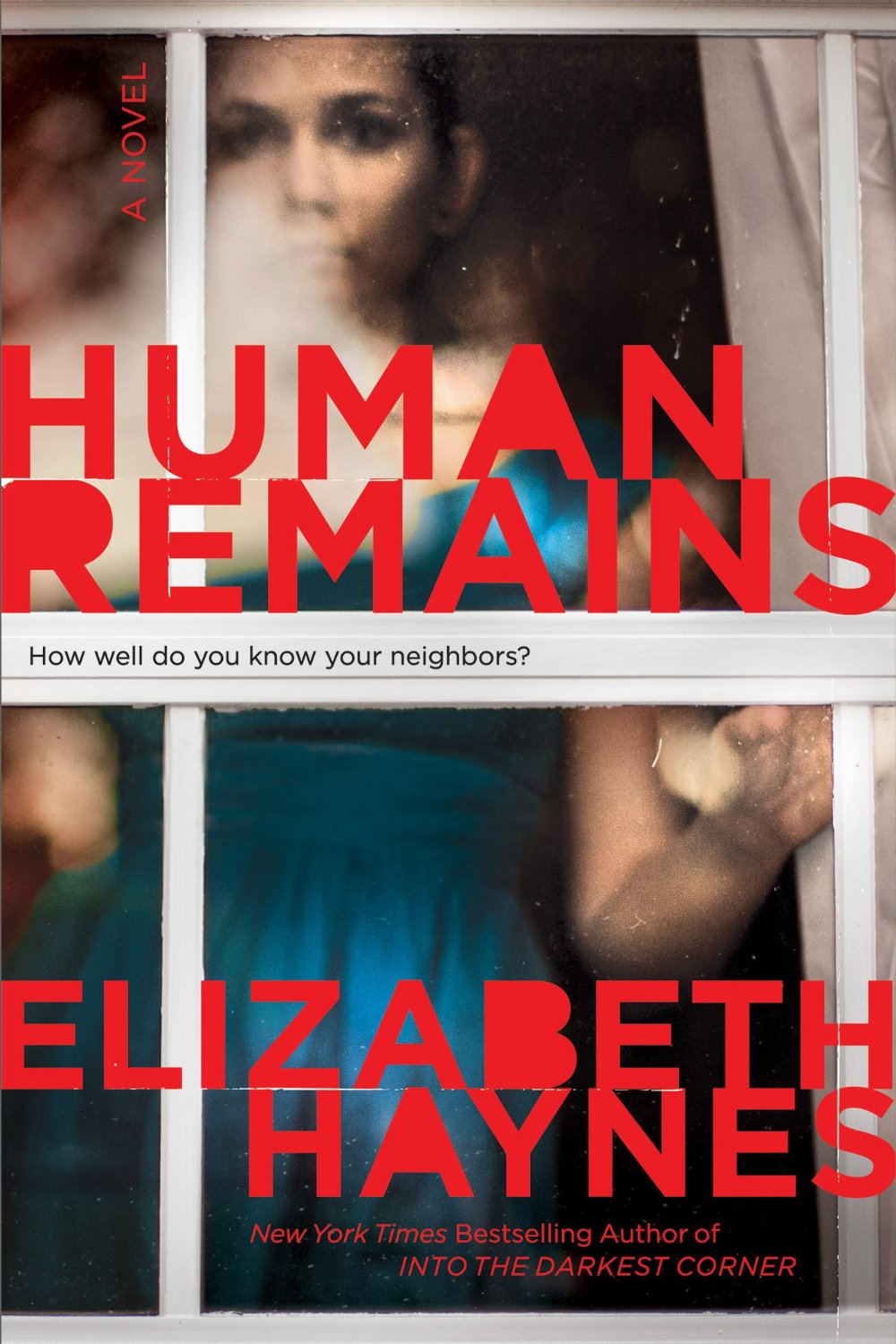
          HUMAN REMAINS00_Annabel is a police analyst who keeps herself busy with work, her cat and her aging mother, while trying  to persuade herself she’s not lonely. When her cat investigates the next door neighbor’s house with shocking results, its Annabel who discovers the woman’s decomposing body. The woman’s absence was not noted, least of all by Annabel, who is disturbed to the point of paying attention to the other cases of “human remains found” in her area. Her talents at investigation soon lead her to find a surge in such cases, but she’s unable to convince her police colleagues to pay attention.

Colin is also a loner, but more by choice. His one friend invites him to meet the woman he’s interested in, with disastrous results. Colin is fastidious and highly intelligent, stuck in a mind-numbing job that pays the bills, and he takes multiple courses at night in subjects all related to the human mind. He has his own study of the human psyche in progress with appalling results, yet he’s convinced he has embarked on a wondrous experiment.

How the paths of these characters intersect, and the devastating results, form the basis for Haynes’ most chilling thriller yet. Readers will find themselves compelled  to trace the trajectory of this story that weaves several threads expertly. One of the hallmarks of all of Haynes books is the level of research she does that adds multiple layers of plausibility to her stories.

The story is told in first person by both narrators, bringing the reader right into their minds and emotions. Sprinkled in between are newspaper articles of the discovery of these bodies, and in a specially insightful twist, chapters from the victims point of view. How these ordinary people living ordinary lives fall prey to Colin through circumstances that could happen to any of us adds to the book’s harrowing tone.

This is an all-too-believable story of what can happen to people who live alone. Highly recommended.

Michael Robotham: Say You’re Sorry Sunday, Mar 24 2013 

The incomparable Michael Robotham is back with my favorite psychologist, Joe O’Loughlin, in his newest addition to this stunning series. 13528436

The book opens with the musings of one of the two Bingham girls, two teens who went missing one night three years ago. It is Piper who talks to readers throughout the novel as she writes in her journal. Through her they learn of the horrors the girls have lived through for years. until one of them risks a daring escape.

Joe struggles with broken marriage and his relationship with his two daughters, most notably the older, Charlotte, a teen who prefers “Charlie,” and whom Joe describes as having “a smart mouth and a dozen different moods.”

Despite the heavy snow, Charlie is on her way up to London to spend four days with her father in Oxford. He’s to counsel her on a doubtful boyfriend and her behavior with the boy;  they will spend time together after his talk at a mental health symposium.

From the train window just outside Oxford, the train slows with the weather. Joe and Charlies glimpse a line of policemen moving across a snowy field. As their train moves slowly forward, they sees white-clothed crime scene officers struggling in the wind, trying to erect a canvas tent over the edge of a lake. They see what they are trying to shield: a body, trapped beneath the ice.

Their first full day together is interrupted by the sudden appearance of detectives, looking for Joe to consult on the ghastly murder of a couple in nearby farmhouse. Joe is not inclined to cooperate; this kind of thing has gotten him into trouble before. But Charlie, bored with the ancient town after one shopping spree, wants to see her dad at work, and soon Joe agrees to help with the case.

As he investigates, it soon becomes clear that these murders and the disappeared girls are related.

But will Joe figure out the murderer in time to save one of the missing girls?

The device Robotham uses of having Piper document her past and current habitats is chilling; her thoughts, so controlled and matter-of-fact to reality, show readers a young woman who was barely seen before, but will never be forgotten again.

For readers of the series who understand the struggle Joe has endured over several books, the ending will move you to tears.

Well-written, compelling, with complex characters, Say You’re Sorry‘s layered title will show readers its true meaning.


P M Terrell: Dylan’s Song Sunday, Mar 17 2013 

dylans-song With past clients ranging from the CIA, Secret Service and Department of Defense, it’s no wonder that author P. M. Terrell uses her computer expertise and technical knowledge to highlight the drama in the fourth book in her Black Swamp Mystery series. Dylan’s Song is a romantic suspense novel with just a hint of the paranormal.

The book is a rousing good read. Suspense Magazine calls Terrell’s books “powerfully written and masterfully suspenseful; you have to hang on for the ride of your life.”

Terrell brings the reader to the Irish homeland of Dylan Macquire, whose character was first introduced in Vicki’s Key, a finalist in the 2012 International Book Awards and 2012 Best Book Awards in mystery/suspense.The charming Irishman is running from secrets in his homeland, secrets which will be laid bare in this latest episode.

Vicki Boyd is a psychic who uses her abilities in conjunction with the CIA. Able to travel to remote locations in her mind, Vicki provides startlingly realistic information for her boss Sam. Rounding out the main characters is Brenda Carnegie, a brilliant computer hacker related to Vicki and the best traveling companion Vicki could have when Sam sends the trio to Ireland on a dangerous retrieval mission.

Vicki and Dylan are a couple, which tangles Dylan’s proposed mission on several levels. She’s withholding important information from him, and the stubborn Dylan doesn’t want to go anywhere near his home town. Then a call from Father Rowan, who had been like a brother to Dylan, draws him back reluctantly to the village. The grandmother who raised him is dying and wants to see him one more time.

Suddenly, retrieving operative Stephen Anders seems more urgent. But a tricky complication exists: Vicki’s images show Anders has been kept in the cells of a former castle, one that now exists under one of Ireland’s famous peat bogs.

Dylan is a charmer and his love for Vicki is a big as it can be exasperating. Brenda proves herself to be a necessary compatriot, and Father Rowan in Ireland comes to the trios aid in several important ways. The spy angle is tinged with the sadness of Dylan’s last visit with his Mam, while the local traditions and customs are winningly described.

There will be local intrigue, too, as Dylan returns to the village he escaped from years ago, after hoping his past and its secrets would never catch up with him. All this raises the tension and the hurdles Dylan and the women will have to conquer: to rescue Anders, and to save their own lives.

Terrell does a fine job of getting inside each character while she transports readers from the small southern town of Lumberton, NC, where Vicki and Dylan have been living, to the rolling, fertile countryside of Ireland and the small village where they stay. The tension mounts as the retrieval operation for Anders goes horribly wrong, and just when it seems there’s time for readers to catch their collective breath, terror and danger strike again.

NC author Terrell has written fifteen books, including the historical suspense novel River Passage, which won the 2012 Best Book Award. Her original manuscript is so accurate it is now housed in the Nashville Metropolitan Government Archives for future use by researchers and historians in Tennessee. She is also the co-founder of The Book’Em Foundation, committed to raising public awareness of the correlation between high crime and illiteracy rates. You can read more about the yearly NC wing of Book’Em North Carolina, held in the town of Lumberton that features in her series, by visiting www.bookemnc.org.


Deborah Crombie: The Sound of Broken Glass Sunday, Feb 24 2013 

One of the delights of Deborah Crombie’s novels are the British neighborhoods and environs she explores for her murder mysteries. images_067

In this 15th outing between her now-married detective pair of Gemma James and Duncan Kincaid, The Sound of Broken Glass remains firmly rooted in foggy London in the Crystal Palace area. Chapter epigraphs, a device Auntie M highly enjoys, all pertain to the history and destruction of the Crystal Palace building that gave the area its name.

Crombie has kept the series fresh and humanizing by moving along the personal relationships in the Kincaid household and allowing for the growth of the marriage between the main characters. With the addition to their family of a three year-old foster daughter, Charlotte, it is Duncan’s turn to be at home to assist the traumatized little girl through her integration into their family and a more normal life. These moments remind us that police men and women have families of their own, whose absences are noted when normal routines must be adjusted around the demands of a murder investigation.

The main case belongs to Gemma this time, aided by DS Melody Talbot. They investigate the murder of a barrister who has been taking sole care of his wife, suffering from increasing dementia. The body of Vincent Arnott is found in a seedy hotel in the Crystal Palace area, naked, trussed and strangled. The contrast between the man’s public and private faces becomes immediately apparent and startling.

Then a second barrister is killed in the same way and additional evidence ties the cases together. The deaths tie in with a band playing in the area, and especially their talented guitarist, perched on the edge of fame. Is a serial killer at work?

Gemma and Melody must unravel connections going back over fifteen years to tie these murders together. At the heart they will find a bullied and lonely thirteen year-old boy and his relationship with a recently widowed teacher and neighbor. Duncan’s fears rise when a personal connection ties him to one of the suspects and provides the thread between the two murder victims.

When the past and the present collide, Gemma and Melody find themselves in the middle of an ice storm, racing through the steep streets of Crystal Palace to prevent more deaths.

Consistent and compelling, fans of the series won’t be disappointed with Crombie’s latest offering.


Charles Todd: Proof of Guilt Sunday, Feb 10 2013 

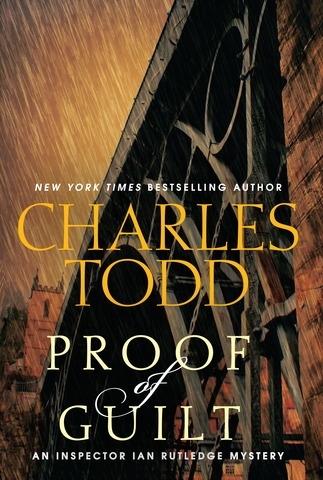
000290326In their fifteenth outing together, mother-and-son team Caroline and Charles Todd follow Scotland Yard Inspector Ian Rutledge into the countryside in search of a murderer in Proof of Guilt.

Those new to the series learn enough of his back-story and WWI experience to understand his personal demons and the reason for the ever-present Hamish, the voice who alternately guides and chides the detective, just over his shoulder and always out of sight.

Readers familiar with the series will enjoy Rutledge’s careful but frustrating investigation. His sister Frances, whom Rutledge has come to depend upon for companionship in his darker days, has her own surprising news.

This time Rutledge is dealing with getting to know his new Acting Chief Superintendent, a man who decides on a course based on reading reports and refuses to listen to Rutledge’s instinctual alternate theories. At times it seems the Super is deliberately thwarting Rutledge in his investigation.

When a car runs over the body of young man, the heirloom pocket watch found on him is the only clue to his identity. It soon becomes apparent the man did not die on the quiet but dignified street where he was found, but was dumped there.

Is this a clue to who he is, or a warning to someone living on that street?

The search for the man’s identity leads Rutledge to the co-owner of a Madeira wine company. Lewis French has gone missing, but it’s not his body on the slab in the morgue. Then how did the dead man end up with French’s watch?

And where is Lewis French?

Rutledge finds French’s sister to be an angry and jealous person who had quarreled with her brother just before his disappearance; his fiancee` seems less concerned than she might be. He also finds himself drawn to the man’s former jilted fiancee`. There seem to be plenty of people who might want French dead.

But if French is dead, where is his body? And how does a second disappearance of a war veteran tie in?

The time period necessitates a slower pace, as Rutledge must navigate by his own motor car to the various country villages outside London that eat into his precious time to follow the slender threads he uncovers.

This is not a fast-paced thriller but more the deliberate and tenacious unraveling of a plot with fingers lasting decades. Rutledge must find evidence to trap the killer before he becomes the latest victim.


Brad Parks: The Girl Next Door Sunday, Jan 20 2013 

Parks’ third mystery featuring journalist Carter Ross is a filled with the wry humor of the protagonist that makes The Girl Next Door a delight to read.9781250013408

Set in the neighborhoods of northern New Jersey, Parks shows the dichotomy of the different areas he has Ross visit in his tenure on Newark’s Eagle-Examiner,  and the different attributes and customs that go along with each one.


Here’s Ross describing his personal attitude after years of experience : “As a newspaper reporter, I’m required to move in all strata of society. I get to observe human behavior everywhere, from the meanest housing projects to the gilded symphony hall. And what always strikes me is that when you strip away the superficial differences in clothing, setting, and dialect, groups of people everywhere are more or less the same . . . most of us are just trying to find a way to fit in.”

Reading the paper’s obituaries leads Ross to come across the death of Nancy Marino, a “girl next door” forties-something carrier for his own paper. When he decides to write a feature story about an everyday woman who dies too young, Ross naturally heads to her wake to meet her family and to hear the stories of this common woman.

So he’s more than surprised and quickly intrigued when one of Nancy’s sisters insists that the hit-and-run accident that claimed Nancy’s life was not an accident at all, but a cold-blooded murder. Adding to his interest is the appearance at the wake of his own newspapers publisher, the smarmy Gary Jackman, who refuses to give him an interview but has an arugment  with another man attending the wake that Ross overhears.

The reporter’s investigation reveals the never-married Nancy held down two jobs while caring for her elderly mother, who lived a few blocks away. Besides being a paper carrier, she worked part-time as a waitress at a local diner and was shop steward for her carrier’s union.

Ross digs into the case, convinced he’s on the right road to find Nancy’s murderer. He’ll get in trouble in far too many places at once, including with his boss and editor, who is his infrequent girlfriend, Tina Thompon. He’ll also become saddled with an intern who reads Emerson and Thoreau and is planning a thesis on Philip Roth, one of New Jersey’s hometown boys.

Parks’ creation is articulate and a pleasure to read; his characters are quirky and colorful. And best of all, his plotting twists and turns as it delves into the gritty world of some of the not-too nicest characters and neighborhoods of New Jersey. And some of those are the friends Carter Ross will depend on when he needs a helping hand.

Filled with action and unexpected turns, it’s difficult at one point to figure out how Ross will come out on top of this one. Keep reading.

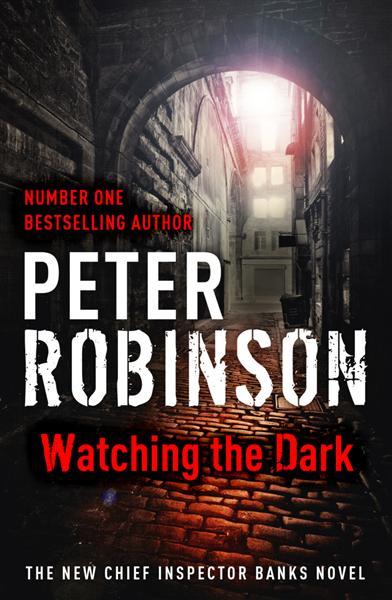
Peter Robinson: Watching the Dark Sunday, Jan 13 2013 

Robinson’s twentieth Chief Inspector Banks novel starts off in an unlikely place: St. Peter’s Police Convalescent Treatment Centre, just north of Eastvale, his stomping grounds. watching-the-dark

Watching the Dark opens with the introduction of DI Lorraine Jensen, recovering from multiple leg fractures, the result of a fall from a second-story tower block chasing drug dealers. Awakened early one morning by the pain her leg, she moves outside to watch the sunrise and wait for her painkillers to kick in.

As she sips her tea she notices a bundle of clothes on the far side of the lake. Using her crutch to get closer, she realizes the bundle is really a very dead man, kneeling forward with his head touching the ground.

When the team arrives and the police surgeon turns the body over, everyone is shocked to see a crossbow bolt sticking out of the man’s chest. A recent widower, DI Bill Quinn was a patient at St. Peter’s for issues with his neck.

When Banks decides to search the victim’s room himself, it appears there is little joy to be found. Quinn’s room sports a series of fishing and gardening magazines and only one book: Practical Homicide Investigation.

The well-practiced team swing into action. Interviews of the twelve resident patients and staff, as well as room searches, are carried out quickly and efficiently. That the Centre pays lip service to security is immediately apparent. The thing left to resolve: was Quinn’s murder revenge from a former convict? Or something more deep and sinister.

Then Banks takes a closer look at the book found in Quinn’s room. Under the endpapers, the detective has secreted a thin envelope containing three photographs of himself and a young woman in compromising positions.

But what do these photos have to do with the man’s murder? And how to they tie in with a dead migrant worker found in an abandoned Yorkshire farmhouse?

Then a cold case appears connected.  19 year-old Rachel Hewitt had disappeared on a hen party in Estonia several years ago and was Quinn’s biggest regret, a case he considered his only failure. Would her case provide the key to unlocking why DI Quinn had to die?

Complicating Banks investigation are two women. DI Annie Cabbot, Banks’ former lover and longtime colleague, due back after six months rehab from a shooting incident, is due to return to work in two days. Will she be up to the task or will her demons prevent her from doing her job?

Then Banks’ ACC throws him a curve ball in the form of a Professional Standards Inspector who is assigned to investigate Quinn’s death alongside Banks. Joanna Passero has her own agenda, and finding out if Quinn was a bent copper is just her surface assignment. She painfully dogs Banks’ steps, hampering his quest.

Robinson moves Banks around to Europe and the change of scenery keeps Banks on his toes and readers turning pages. Not all policemen have the same scruples, he will be quick to learn. But how does that tie in with people trafficking, migrant labor scams, and most importantly, murder?

Fans will be delighted to see Banks in action in this highly readable and compelling new novel from a master at the top of his game.

« Previous Page — Next Page »

Chick Lit Book Café

CLBC Multi-Genre Book Reviews

Miss Demeanors

A Blog for Readers and Writers of Mystery, Crime, and Suspense Fiction

Mysteries To Die For

For Mystery Listeners and Readers

Chick Lit Book Café

CLBC Multi-Genre Book Reviews

Miss Demeanors

A Blog for Readers and Writers of Mystery, Crime, and Suspense Fiction

Mysteries To Die For

For Mystery Listeners and Readers

Amazing Family Books

Featuring The Very Best in Fiction & Nonfiction Books For Children, Parents & The Entire Family

Book Review Magazine

Incredible Books & Authors

Book Sparks News

Writing, Books & Authors News

Bookish Trends

Subscribe - Free List of the Top Reads of the Month

Book Bug Out

KIDS CLUB

Writer Beware

Shining a small, bright light in a wilderness of writing scams

authorplatforms.wordpress.com/

Books, Reviews & Author Spotlights

DESTINATION PROPERTIES

The preview before the visit.<ins class="bookingaff" data-aid="1815574" data-target_aid="1815574" data-prod="map" data-width="400" data-height="300" data-lang="xu" data-currency="USD" data-dest_id="0" data-dest_type="landmark" data-latitude="40.7127753" data-longitude="-74.0059728" data-landmark_name="New York City" data-mwhsb="0"> <!-- Anything inside will go away once widget is loaded. --> <a href="//www.booking.com?aid=1815574">Booking.com</a> </ins> <script type="text/javascript"> (function(d, sc, u) { var s = d.createElement(sc), p = d.getElementsByTagName(sc)[0]; s.type = 'text/javascript'; s.async = true; s.src = u + '?v=' + (+new Date()); p.parentNode.insertBefore(s,p); })(document, 'script', '//aff.bstatic.com/static/affiliate_base/js/flexiproduct.js'); </script>

Auntiemwrites Crime-Mystery Author M K Graff

Award-winning Mystery Author on books, reading and life: If proofreading is wrong, I don't wanna be right!

Lee Lofland

The Graveyard Shift

Sherri Lupton Hollister, author

Romance, mystery, suspense, & small town humor...

The Life of Guppy

the care and feeding of our little fish

My train of thoughts on...

Smile! Don't look back in anger.