Jeanette DeBeauvoir: Deadly Jewels Sunday, Apr 10 2016 

deadly jewels_MECH_01.indd

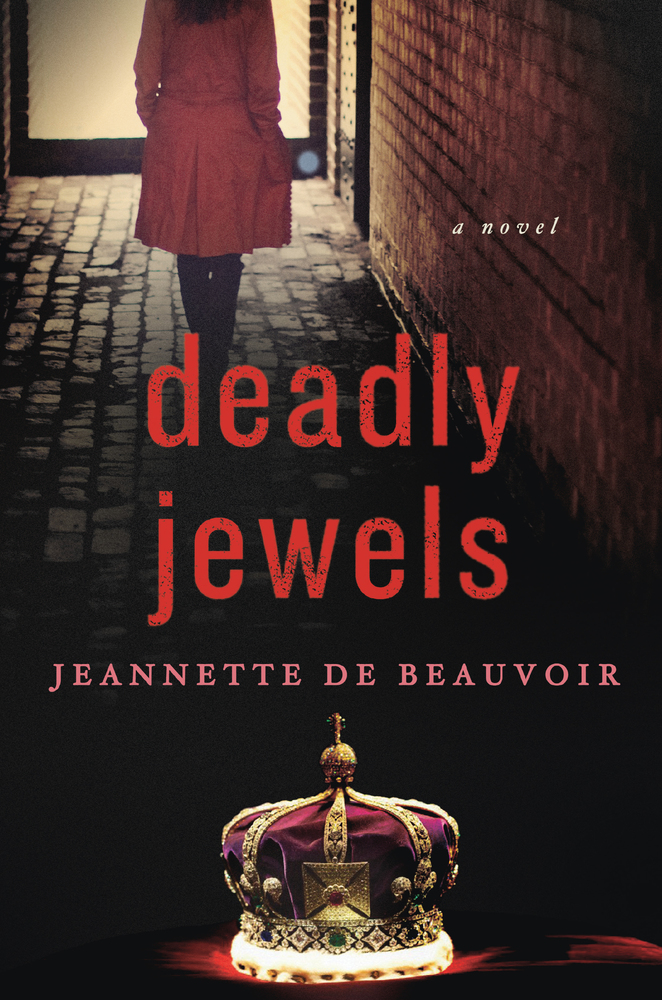
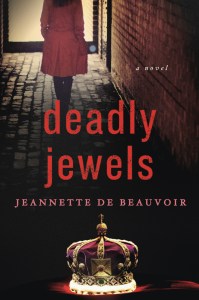
One of Auntie M’s favorite novels last year was Jeannette DeBeauvoir’s debut Asylum, a chilling and often terrifying mystery that introduced Martine LeDuc, the engaging protagonist who is publicity director for the city of Montreal.

Auntie M recently had the opportunity to ask the author a few questions about her work:

Auntie M: You have developed a backdoor to these crime investigations for your protagonist, PR director Martine LeDuc. What made you choose her position and that approach?

Jeannette de Beauvoir: I was looking for someone whose work would, first of all, allow access to a range of different situations, and secondly, be flexible in terms of how the protagonist spent her time. Public relations could arguably have its hand in a lot of different problems, and the person at the top of the department can come and go with staff to cover day-to-day operations if she needs to be elsewhere.

AM: Everyone’s family has a story, and Martine’s home life is grounding, yet it feels very realistic. How important do you feel it is for readers to see that there are other forces pulling at her that require her attention?

JDB: It’s truly about making her a whole person. We’re all made up of mosaics, aren’t we—no one is *only* their job, or *only* their family life, or *only* anything… so it is always important to me to give characters a backstory and a personal life. Doing that offers so many opportunities, especially for a series such as this one, for the character to grow and change, to make mistakes and learn from them… in other words, to develop fully as a human being. The Martine of Deadly Jewels is different from the Martine of Asylum, and will be different from the Martine of the next book should there be one. If the books were *just* about the mysteries, I think they’d be a lot less interesting.

AM: After growing up in Angers, France, you now divide your time between Montreal and Cape Cod. Do you see a difference between the Canadian mind and the American mind when it comes to readers of crime novels and their questions for you? Between the French and the American?

JDB: I’m half-French and half-American, and I often think that if I were a city, I’d be Montréal… with part of me reflecting each culture. But we’re really talking about three different cultures, and three different ways of approaching literature. Readers from the U.S. tend to want to be plunged directly into the story, whereas French readers are looking for more depth—more philosophy, if that makes sense. Neither book has been translated (yet) so it would be interesting to see people’s reactions to them.

AM: A consistent thread is Martine’s love of Montreal, and a highlight for me as a reader is exploring the city through her eyes. The research you’ve done for both Asylum, a first-rate novel, and Deadly Jewels, another winner, adds so many layers to the books. Have you found it easy to obtain access to what might otherwise be off-limits areas for these projects? I’ve found assuring a contact’s name will appear in the Acknowledgments is often a great enticement. Have you had a similar response to your requests?

JDB: I have found people to be amazingly generous with their time and expertise in every project I’ve undertaken. I’ve asked difficult questions and I have never had anyone refuse to help. And people really are the best resource. One of the classes I teach online is writing historical fiction, and I tell students two things: do your research before you talk to people (so that you are suitably immersed in the subject and you don’t ask the questions whose answers you could have Googled), but then find the experts and ask them. Someone who has lived through an era can give so much more information than just reading secondary sources about it. And the same goes for mystery writing: find the experts, be respectful of their time, and you will be astonished at the results.

AM: Your background includes poetry and plays. What made you decide to write a crime series?

JDB: Ah, the poetry and plays are pretty much accidents: I’m really a novelist. I wrote historical fiction for quite a while but realized at some point that what I love to read most is mystery fiction, and I wasn’t writing it—there was a disconnect there. So I co-authored my first mystery novel (mostly because I didn’t think I was terribly good at plots!), got braver and wrote one on my own, then finally discovered what works for me: combining mystery and historical fiction. Not in the same way that an Ellis Peters does, with a character in the past solving a crime from the past—but rather with someone in the present-day finding that the past doesn’t in fact really go away. I think it makes for good storytelling and has the added advantage of teaching a little history as well.

AM: When you have precious down time, whose books would readers find waiting to be read on your nightstand?

Phil Rickman: he’s a brilliant writer, his stories are intricately plotted, his characters are haunting, and he’s just spooky enough to keep your heart rate up. He writes a series about a female Anglican priest who’s also an exorcist, but also has wonderful standalone books that borrow characters from the series, so that you can follow them from book to book. He is one of the authors I admire most for making the *geography* as much a character as the people: he writes about the border between England and Wales and makes the liminality of such a place intrinsic to the plot.

AM: Thank you for that recommendation. I’ve just ordered his first in the series to try. Now on to the review of DEADLY JEWELS:

De Beauvoir’s sequel brings Martine LeDub back for another adventure that has the same chilling suspense as her first, yet manages to be a different book entirely. It still pivots on moral questions, and she shows her love for the city in its exploration by the main characters as they try to stop what amounts to a cult operation from decades ago that has reached fingers into present day Montreal.

Martine has a mutual dislike relationship with the Mayor who serves as her boss. But this time when she’s called to his office, it’s not to be rebuked, but to be introduced to an graduate student who just may have pulled off a PR coup: she’s found proof that long-held rumors are true and that proof has been found during underground excavations taking place under the city. The British crown jewels were once housed there in Montreal during WWII and then returned to London.

It promises to be a grand revelation for all, until Martine accompanies Patricia Mason to the excavation site. Sure, they do find several diamonds, left behind from the original cache. But they also find the skeleton of man shot execution-style decided ago. It appears he swallowed these remaining jewels.

Now it’s a job of containment, as Martine and her colleagues in several places determine how to handle the scandal. And this won’t be great PR for Montreal or for her job.

But then Mason is shot, and she turns to her detective friend from the first book, Julian Fletcher, to help her out with the cold case. And just as things heat up, her stepchildren arrive for a visit and her husband disappears that same weekend to have a meeting with his ex-wife.

There will be several twists and turns along the way as the case unravels, with surprising results. Along the way, Martine will be introduced to and interview Nazi survivors and their families, and those trying to resurrect that regime in a startling way.

As the action heats up, it’s not just Martine who will find herself in jeopardy.
One of the things that set this apart from the usual series is the way De Beauvoir skillfully weaves the modern with the historical. Flashbacks to two key characters explain the historic journey of the jewels and the men involved with them and add substance and key clues to the action.

The author bio for De Beauvoir states in part: “. . . She finds that the past always has some hold on the present and writes mysteries and historical fiction that reflect that resonance.”
You’ll understand the meaning of that line once you read this fine mystery that evaluates many sides of a situation. Highly recommended.

Judith Flanders: A Bed of Scorpions Wednesday, Apr 6 2016 

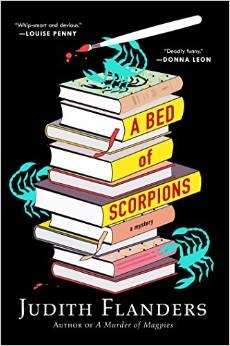
Auntie M enjoyed Judith Flanders first mystery, A Murder of Magpies, and was happy to receive the ARC of her second, A Bed of Scorpions, featuring the smart and savvy London editor, Sam Clair. There’s a nice balance of humor in the series, with Sam’s first person point of view providing a running commentary on the people she runs across, too.
BedScorpions

Fast forward to the summer after the happenings in “Magpie” and Sam is happy in her routine: work, the occasional drink or lunch out, and many evenings spent with her Scotland Yard detective boyfriend, who now has a key to Sam’s flat.

Summer also means Sam is busy setting up her schedule for the Frankfurt Book Fair in October, and one can’t help but wonder if the next installment will take us there . . . but in the meantime, Sam has enough on her plate with the personalities at work. And a long-planned lunch with an old friend, Aidan Merriam, an art dealer, who is an old ex of Sam’s.

But lunch takes a sour note when Aiden tells her that he had the great misfortune to be the one to find his business partner dead of a gunshot wound. Is this an apparent suicide by Frank or his murder? Aiden needs Sam’s help, both to clear himself and to find out if anyone else would want Frank dead. And guess who is the one of the detective’s on the case from Scotland Yard? And who was on the from the night before–a night he spent with Sam, when he neglected to tell her about the death of her friend’s business partner: None other than that same detective, Jake Field.

What’s a girl to do? Sam calls the person she nows who knows the law, and is straight up and business-like to a fault without turning a hair: her mother, Helena, who rushed in to defend Aiden and sort this case out.

Now Sam finds herself stuck between her mother, Aiden, and Jake, and soon after realizes she’s put herself right in the sights of a murderer who assumes she knows more than she really does.

A few of the characters from the first installment return with welcome scenes. There are her upstairs neighbors, including the delightful Mr. Rudiger. There is talk of where Jake and Sam are headed in their relationship, which is clearly not well defined. And then there’s also the pretty big matter of a killer to be caught.

The mixed worlds of books and art are sharply and cleverly defined with Flanders’ trademark humor spiking the pages as the action speeds along. The author’s work as an editor stands her well here, especially her work for the publications department of the National Portrait Gallery in London. That knowledge infuses these books with the kind of inside look readers love, a way to see inside a different world. Wrap that up with a darn good mystery, a hint of romance, and a believable protagonist you wish was your friend, and you’ll surely enjoy A Bed of Scorpions as much as Auntie M did.

Barbara Ross: Fogged In, A Maine Clambake Mystery Sunday, Mar 20 2016 

FoggedInnfrontcoveryellow

Please welcome author Barbara Ross, speaking about the influences on her writing and her newest Maine Clambake Mystery, Fogged In.

The Twists and Turns in the Mystery Road

Recently my colleague on the Wicked Cozy Authors blog, Julie Hennrikus, wrote about book-to-movie and book-to-TV adaptations, particularly mystery adaptations. In the comments, people wrote about their favorites and the ones they just couldn’t watch.

It didn’t take me but a second to identify the book-to-movie adaptation that had the most profound impact on my life. On a rainy day at the beach, my grandmother, desperate to keep me entertained, took me to see Murder She Said, the first Miss Marple mystery starring Margaret Rutherford. I was eight and I loved it. In fact, I think I still remember some of the visuals from it. (I haven’t seen it since then, so I must, right?)

Agatha Christie’s novels gave me a natural place to “graduate to” as I outgrew Nancy Drew and kept me in the mystery fold. From there, I discovered Dorothy L. Sayers and a whole host of others.

There followed a long hiatus through college and young adulthood, until I discovered P.D. James and Ruth Rendell and once again became a mystery fan. All these women are the reason I love mysteries and read and write mysteries. Rendell had another impact. She got me reading mystery short stories, which I also write. I spent six years as a co-editor/co-publisher at Level Best Books working on the Best New England Crime Stories series.

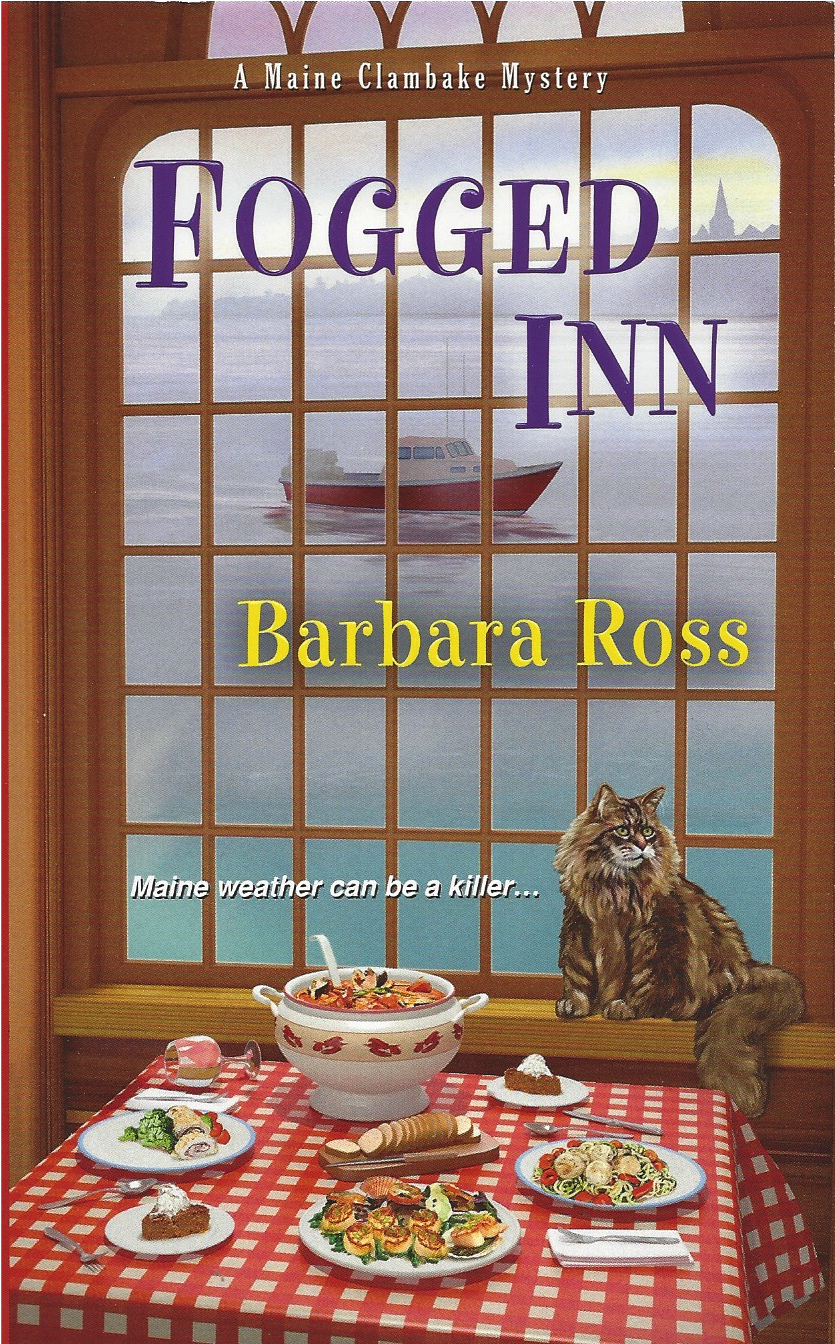
What if I’d never seen that movie or discovered these authors? My life would be profoundly different. I’ve pondered that many times recently because my latest Maine Clambake Mystery, Fogged Inn, is about a group of retirees. What twists and turns did their lives take that led them all to a fogbound restaurant in Maine on the night a man was murdered? If any one of them had done one thing differently, would all they have been there on that fateful night?

That’s the question I enjoyed finding an answer to as I wrote, and I hope my readers enjoy discovering as they read.

Barbara Ross is the author of the Maine Clambake Mysteries: Clammed Up, Boiled Over, Musseled Out and Fogged Inn. Clammed Up was nominated for an Agatha Award for Best Contemporary Novel and was a finalist for the Maine Literary Award for Crime Fiction. Barbara blogs with a wonderful group of Maine mystery authors at Maine Crime Writers and with a group of writers of New England-based cozy mysteries at Wicked Cozy Authors.

She is always thrilled to hear from readers. You can find her via her website at http://www.maineclambakemysteries.com, or on Facebook at http://www.facebook.com/barbaraannross, on Twitter @barbross, or on Pinterest at http://www.pinterest.com/barbaraannross.

Arnaldur Indridason: Into Oblivion Wednesday, Mar 16 2016 

IntoOblivion
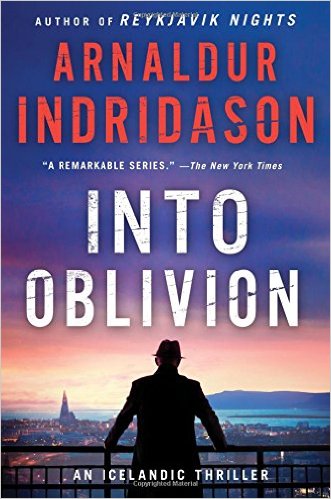
Arnaldur Indirdason’s Icelandic thriller series, featuring Inspector Erlendur, continues with this look into his early days as a detective in Into Oblivion, an aspect first explored in last year’s acclaimed Reykjavik Nights. The CWA Gold Dagger Award winner is the only author to win the Glass Key Award for Best Nordic Crime Novel two years in a row, and with good reason.

The book opens a few years after Erlandur decides he wants to be a detective. It’s 1979 and the year springs to life, the mood set by the music, clothing and social mores of the era. The detective is working with Marion Briem, an older, more experienced detective, when the body of man is found in a blue lagoon known for its healing waters.

Examination reveals that the man has fallen from a great height and died before his body was moved to the lagoon. Could he have fallen from a plane? The only immense height in the area is an aircraft hanger on the grounds of the controversial US military base nearby.

When it becomes apparent the base is involved, Erlandur and Briem find themselves tiptoeing around the base to investigate after the US powers that be have stalled their investigation and denied them access to the hanger. It will take an unlikely accomplice to help them get to the bottom of the man’s death, thwarted by a rogue CIA agent.

As the action unfolds, Erlandur also takes it upon himself to run a parallel cold case investigation. A young teen went missing on her way to school, her body never found, and as both cases heat up, the young detective finds himself in his element, conducting interviews and following slender leads to find resolution.

Another hit that gives insight into what made Erlandur the detective he becomes.

Paula Brackston: The Return of the Witch Monday, Mar 14 2016 

ReturnWitch

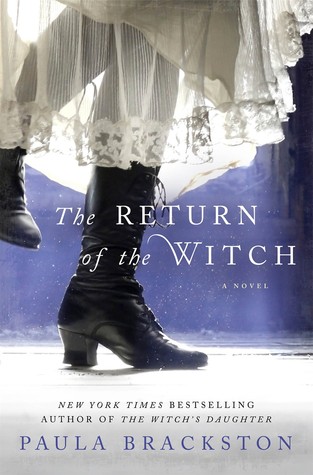
Readers, I’m in cahoots with St. Martin’s to offer you THREE giveaway copies of Paula Brackston’s sequel to last year’s debut novel The Witch’s Daughter. This was the little book that could–with a captivating story, remarkable heroine, and eye-catching package, it has now netted over 200,000 copies in all formats.

Now Paula returns with its sequel The Return of the Witch, another bewitching tale of love and magic, featuring her signature blend of gorgeous writing, a fabulous and intriguing historical backdrop, and a headstrong and relatable heroine readers will cheer for.

After five years in the Summerlands, Gideon has gained his freedom. Elizabeth knows he will go straight for Tegan, and that she must protect the girl she had come to regard as her own daughter. In the time since the dramatic night in Batchcombe woods, Tegan has traveled the world learning from all manner of witches, and she is no longer the awkward teenager and novice spellcaster she once was.

However, her skills are no match for Gideon’s dark, vengeful power, and he succeeds in capturing her. Will Elizabeth be able to find her? Will they be able to defeat their nemesis once and for all?

In a breathless journey that takes them through history to the 17th and 19th centuries, witch pursues warlock. Three people steeped in magic weave a new story, but not all will survive until the end. Crime of a different kind here, with suspense and action.

In case you missed The Witch’s Daughter, this is its synopsis:

My name is Elizabeth Anne Hawksmith, and my age is three hundred and eighty-four years. If you will listen, I will tell you a tale of witches. A tale of magic and love and loss. A story of how simple ignorance breeds fear, and how deadly that fear can be. Let me tell you what it means to be a witch.

In the spring of 1628, the Witchfinder of Wessex finds himself a true Witch. As Bess Hawksmith watches her mother swing from the Hanging Tree she knows that only one man can save her from the same fate: the Warlock Gideon Masters.

Secluded at his cottage, Gideon instructs Bess, awakening formidable powers she didn’t know she had. She couldn’t have foreseen that even now, centuries later, he would be hunting her across time, determined to claim payment for saving her life.

In present-day England, Elizabeth has built a quiet life. She has spent the centuries in solitude, moving from place to place, surviving plagues, wars, and the heartbreak that comes with immortality. Her loneliness comes to an abrupt end when she is befriended by a teenage girl called Tegan.

Against her better judgment, Elizabeth opens her heart to Tegan and begins teaching her the ways of the Hedge Witch. But will she be able to stand against Gideon—who will stop at nothing to reclaim her soul—in order to protect the girl who has become the daughter she never had?

THREE lucky winners who leave a comment will be sent copies of the sequel directly from the publisher. To enter the drawing, leave a comment and we’ll use an impartial draw to find the lucky winners. Good luck!!

The Narrow Bed: Sophie Hannah Sunday, Feb 28 2016 

gallery-1452871629-the-narrow-bed

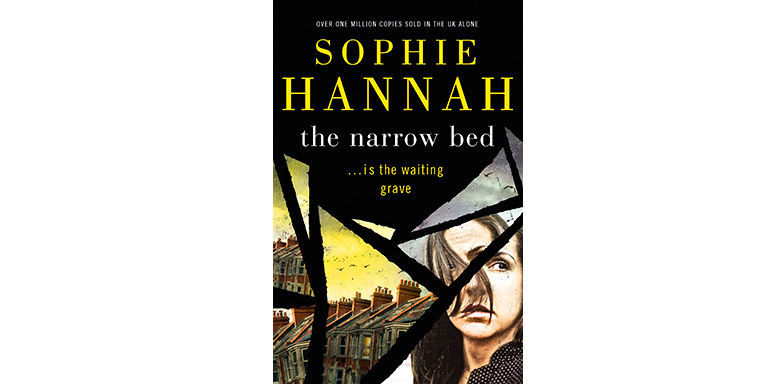
The multi-faceted Sophie Hannah does it all: compelling stand-alones, resurrecting Hercule Poirot for Agatha Christie’s estate, and her Culver Valley police procedural series. But she doesn’t stop there–the hallmark of this series is that the protagonist of each book is a character involved in the action, not the detectives, centered on Simon Waterhouse and his wife, Charlie Zailer.

We learn of the continuing saga of the married duo as a secondary plot, insinuating itself into the main plot of the newest in the series, The Narrow Bed. And a strong feminist will muddy the waters by insisting the killer being sought is a misogynist pig, as three of the four victims are women. Could she be right?

There’s more than a bit of sly humor when your protagonist is a professional stand-up comedian. Kim Tribbeck has received a little white book, mostly blank, with a few lines of poetry inside. She’s tossed it away, but she does remember receiving it.

The importance of this becomes clear when a murderer takes to killing pairs of best friends, four in all over the last four months. In each case he’s given the victim one of these same hand-made books before killing them. Each contains a line of poetry. Each poet was a woman whose name started with an E. So where does that lead them?

Dubbed “Billy Dead Mates” by the police, the detectives have exhausted ways to link the victims. It becomes clear the case revolves around books, but in what way? And if these are truly killings of best friends, why was Kim Tribbeck given a copy and left to live? Could it be that the fact she hasn’t had a best friend in years has saved her life?

At once convoluted yet sharply intelligent, the plot wraps around itself until the mind of Simon Waterhouse is the one who can see beyond the obvious and pull the case together. There’s an almost gothic feel to the book, as the story unfolds by way of excerpts from a book Kim writes after the case is over, added to by conventional chapters of interviews and the thoughts of the various detectives on the team searching for this killer.

The characters are true to themselves, with distinctly-drawn personalities that show Hannah’s expertise at describing the psychology of different people with that wry edge that smacks of verisimilitude until they seem to leap off the page. The Independent has compared Hannah to Patricia Highsmith and Ruth Rendall with good reason.

Jerrye Sumrall: The Bayshore Mysteries Saturday, Feb 27 2016 

Something different for readers today: Children’s author Jerrye Sumrall, author of The Bayshore Mysteries, will explain how her middle-school series began and how she gets her ideas. With five in this series, they’re certain to be winners for young readers.

Intruders

How The Bayshore Mysteries began: Although my idea of doing a children’s mystery series didn’t come to me until later in life, the framework started when I was a child. I grew up in a small southern town with lots of freedom to play and explore my surroundings. As with all childhoods, there were ups and downs, but these experiences along with a vivid imagination and fascination with the unknown served as a springboard for my writing. In my adult years, my experience as a teacher and counselor further developed the writing framework that later grew into a unique children’s series, The Bayshore Mysteries.
SecretGraveyard

Why I chose to write for the middle grade audience and how I got my ideas: I decided to write for the middle-grade audience because I’ve had the most experience with that group of children, and it was the age I remember so fondly as a child. I think my ideas came naturally from my fascination with mystery, adventure and the unknown, even into adulthood.

WraggSwamp

I have always been intrigued with horror flicks, mystery books, and any entertainment venue with a mysterious setting and plot. I have also been fascinated with local historical settings that could easily be transformed into a mystery plot. That is actually how all of my books began. I would pick the historical location, choose the characters, and devise a mystery plot that would fit the characters and setting.

MoundIsland

What are the historical settings for my books: The historical settings in my books are ones that I could easily research and visit. I am fortunate to live in an area that is full of history and suspense, wrapped up in unique settings. The Eastern Shore region of Mobile Bay, an area rich in Civil War history and small town culture, serves as a springboard for my first book, Intruders on Battleship Island. The Beatrice and Monroeville, AL, setting found in The Secret Graveyard brings to life new mysteries and secrets from that area. Mobile, Al, with its festive Mardi Gras celebration and spooky swamp setting serves as the backdrop for The Mystery of Wragg Swamp. Mound Island, located deep in the delta region of Baldwin county, AL, serves as the setting for the fourth book in the series, Mystery on Mound Island. Historic Blakeley State park in Spanish Fort, Al, the site of the old town of Blakeley, Fort Blakeley, and the last Civil War battle, serves as the setting for the fifth book in the series, The Ghost of Blakeley Past.

GhostBlakelyPast

My emphasis on relationships and understanding others: For the character relationship aspect of the stories, I wanted to emphasize getting along and understanding others. In addition to the main characters that appear in each of my books, I have also included at least one new character who was either annoying, disliked, or very misunderstood. Through the course of each story, the characters all learned important lessons in friendship, courage, and determination. That idea came from my own childhood and from my experience as a teacher and counselor.

In each one of my books, I’ve tried to incorporate mystery, action and adventure, local history, and enduring characters who learn lessons in friendship, courage, and self-awareness. I feel that my choice of unusual settings, my use of historical fact, my presentation of age-appropriate mystery, and my focus on lessons in self-reliance and respect for others has made The Bayshore Mysteries a unique middle grade series.

Jerrye-300x199

Jerrye Sumrall lives in Spanish Fort, Alabama with her husband. Formerly an elementary schoolteacher and counselor, she is now a full-time writer, homemaker, amateur photographer and office manager for the couple’s business. She is the author of five middle grade books: Intruders on Battleship Island, The Secret Graveyard, The Mystery of Wragg Swamp, Mystery on Mound Island, and The Ghost of Blakeley Past, all part of a mystery series called, The Bayshore Mysteries.

*For more information about Jerrye Sumrall, visit her websites at http://jerrye35.wordpress.com/ https://www.facebook.com/jerryewrites?fref=ts https://twitter.com/JerryeSumrall and https://www.pinterest.com/jerryesumrall/all-things-reading-writing-teaching-and-homeschool/

*All five books in The Bayshore Mysteries can be purchased in print and e-book format at Amazon.com http://amzn.to/1ji9HE9

Frederick Wysocki: On careers, lessons and sagas Sunday, Feb 21 2016 

Please welcome thriller writer Frederick Wysocki, who will explain to Auntie M’s readers how he changed careers, the lessons he’s learned, and how he gets his inspiration for new books~

Startup
A NEW CAREER
My wife has always called me a storyteller, as if it were a bad thing. However, I never thought I could muster the patience to write a hundred-thousand word novel. Now I have written five within in just over two years and I’m currently working on number 6. (My imaginary friends keep telling me more of their secrets.)

In my first career, I was in high technology having started my first company in 1975. It involved constantly flying somewhere. During those trips, I always packed a thriller or two to read.

I retired early and was finally inspired to start my second career of writing while sharing a golf cart with a movie producer. It turned out he was playing slow because he was finalizing the writing of a novel. We talked. I told him some stories about the tech industry and he told me they were fascinating and to write them down.

I decided to try it and started to learn the craft by going to writer’s groups I found on meetup.com. I am now a Mister with the Sisters in Crime and DesertSleuths.
I still find I’m drawn to writing crime fiction novels inspired by real events.

LESSONS
The most important lessons I’ve come to learn are:
• That one should only write something you truly enjoy, as you will have to reread the darn thing a hundred times before it’s ready.
• That readers love obstacles, suspense and twists.

INSPIRATION
I find myself inspired daily by what I hear on the news and read about in technology blogs. I start by doing research then writing out a rough plot. Then I layer in subplots and decide how my characters will change. I avoid lengthy descriptions. I tend to write short chapters that are heavy on dialogue.

THE START-UP for example, started with a news headline about a still ongoing FBI investigation.
I was curious. How does someone (Anthony Rizzo) start a computer software company and sell it months later for billions of dollars? Then the buyer finds out that it was all a scam and calls in the FBI. With a diverse Board of Directors and countless lawyers and investment bankers, how does a large tech company get duped? How does the FBI deal with it? And yes, it is still in the news today. That was the plot behind THE START-UP.

BloodRivals

Against that backdrop I layered in a ‘Hero’s Quest’ character arc of a young man (Frank) facing increasingly ruthless tasks in order to make his share and how it changed him and his girlfriend.
Upon publishing, I discovered eighty percent of my readers of THE START-UP were women and they wanted to know what happened to Frank. The answer came in the form of books 3 & 4. (More on them in a minute.)

TimelyRevenge
Reader feedback also gets my creative juices flowing. Two examples of reader feedback:
• A former FBI agent told me that his first undercover job with the Bureau was similar to my plot for A Timely Revenge. He told me I got the era, events and motives of the crooks just right.
• A relative of a mob family told me she recommended my books to her family as they were the best portrayal of modern Mafia white collar crime she had ever read.

It seems every reader that meets me thinks they know each books’ inspiration and are asking me things like: is Anthony Rizzo (insert name of major CEO)?

NoTime

What happened to Frank and his girlfriend? That was the question I explored in BLOOD RIVALS and NO TIME FOR FOOLS.
The inspiration behind BLOOD RIVALS came from an interview I did with Fiona Quinn of ThrillWriting.com. I told her about a case where the FBI had mistakenly focused on the wrong suspect from an inconclusive fingerprint.

Naomi Dolphin was introduced in BLOOD RIVALS as a young female bodyguard who Frank hires.
My next novel – THE ARABIAN CLIENT – should be out in a few months and is a prequel of how Naomi went from being a maid and nanny on the island of Anguilla to becoming the bodyguard for a Saudi princess in Saudi Arabia. She struggles to overcome the Islamic culture and terrorists, as well as her clients.

THE ARABIAN CLIENT is very different for me since it’s a psychological thriller and is written from a female point of view. It goes behind the headlines and answers the questions about what is really happening in the Middle East. I’ve had Middle Eastern Muslim women review it for accuracy.

A critical part of my process is reaching out to friends who seem to know unique ways to kill someone.
For example in NO TIME FOR FOOLS:
• A doctor from Florida gave me three methods of killing someone with a cigar lighter.
• The former helicopter pilot for a USA President explained the best way to crash a jet plane without using a bomb.

FROM STAND ALONE, TO SERIES, TO SAGA
I did not start out to write more than one book, nor did I want to do a series. Now with prequels and sequels, I find myself in the midst of writing a saga.

At first, I thought I was writing a single novel, THE START-UP. Readers were all asking me what happens next for the main characters. I had already started on a prequel of Anthony Rizzo – the family crook. That became A TIMELY REVENGE.
Readers were unanimous in asking me what happened to Anthony’s nephew – Frank Moretti. Thus were born BLOOD RIVALS and NO TIME FOR FOOLS. Both those books feature a female bodyguard – Naomi – for Frank.
Readers asked me how she became a bodyguard and that is why I am currently finishing THE ARABIAN CLIENT. It chronicles Naomi, her time in Israel and her first assignment in Saudi Arabia.

Book 6 (takes place in Russia) will pick up where NO TIME FOR FOOLS left off.
As long as my real world readers keep asking me about my imaginary friends, I’ll keep writing.

Thanks very much for hosting me!

RickWysocki

My novels are available on Amazon in print and ebook.
THE START-UP – http://amzn.com/0991375602
A TIMELY REVENGE – http://amzn.com/B00OQH20U6
BLOOD RIVALS – http://amzn.com/B00SOZYCW0
NO TIME FOR FOOLS – http://amzn.com/B014E9FFAW

Website Links:
Website: http://www.frederickwysocki.com
Facebook: https://www.facebook.com/FrederickWysocki
Twitter: @FredWysocki

Alison Bruce: The Promise, DC Gary Goodhew #6 Wednesday, Feb 17 2016 

The-Promise-194x300

Auntie M is a huge fan of Alison Bruce’s DC Gary Goodhew series. She’s back with the sixth in the series, The Promise, and found it as compelling a read as the others in this series with the unusual protagonist, still recovering from injuries suffered in the sad and dramatic ending of The Backs, which has left him and several colleagues still reeling.

Whether Gary is up to returning yet is somewhat beside the point when the body of a homeless man who knew is found on Market Hill. The unusual signature of the murderer has the team scouring local haunts and reviewing CCTV tapes for witnesses, but as usual Gary has his own unique way of working a case.

Kyle Davidson, undoubtedly suffering from PTSD from the Afghan War, has a wife he barely tolerates and a baby boy he adores. The marriage is over, but an action by his wife sends him spiraling into a desperate scramble to protect his son, his sister and his mother. Does he tell what he knows and hope to save them all, or will that put him squarely into the bulls eye of a merciless killer?

The the investigation twists with a rented garage is found to have only one thing inside: a freezer containing the body of a murdered young woman, bearing the same signature as the homeless man. Suddenly the hunt is on for a serial killer and no one, it seems will be safe.

In Gary’s personal life, his grandmother and his police mentor have both been keeping a secret from Gary, one that happened when he was a small boy, and one that threatens now to destroy him unless they can tell him before he founds out from someone else. Although there were good reasons for keeping this secret at the time, it’s unclear how Gary will feel once he finds out he’s been lied to all these years by the very people he thought he could trust most.

Bruce’s menacing plot keep increasing as the tensions rises, all against the backdrop of Cambridge and the very different mind of a young man with incredible instincts who runs against the pack. Steve Mosby calls Bruce: “A superb writer,” and Auntie M heartily agrees.

Maia Chance: Beauty, Beast and Belladonna Wednesday, Feb 10 2016 

Auntie M has hosted and reviewed author Maia Chance before. She likes to mix fairy tales with mystery in a smart and intriguing way. For her new release, we decided to shake things up: Here’s a Q/A from the author, followed by an excerpt from her new book, Beauty, Beast and Belladonna.

Beauty, Beast

1) Describe Beauty, Beast, and Belladonna in 140 characters or less.

Beauty, Beast, and Belladonna is a fun, adventurous, and romantic historical mystery set in a secret-riddled French chateau in 1867.

2.) What is your idea of perfect happiness?

Happiness for me is spending time outside somewhere beautiful, with my husband, kids, and dog.

3.) What’s your favorite part of Ophelia’s quirky personality?

I like the way Ophelia compensates in creative and gutsy ways for her lack of a good formal education. She’s smart and resourceful and she uses her unusual skill set—farm girl, circus performer, actress—to help solve the mystery.

4.) Which living person do you most admire?

My husband, actually. He is an unusually gifted person who overcame significant disadvantages and obstacles to get where he is today. And he gives the best pep-talks!

5.) What inspired you to marry fairytales and mystery?

I was searching for something that hadn’t been done yet, and I was reading a lot of fairy tale criticism for school at the time. It sounded like a deliciously fun project, so I plunged in.

6.) Is there a type of scene that’s harder for you to write than others? Love? Action? Racy?

Dialogue definitely comes more easily for me. I find action scenes more challenging—I’m paranoid that they’ll get bogged down. (So if I can, I add dialogue to my action scenes!)

7.) What do you consider the most overrated virtue?
Sticking to strict schedules. I don’t like to keep people waiting, but there is something to be said for giving yourself creative or restful wiggle-room during the day.

8.) Which of the characters in this novel do you feel the most drawn to?

I became more attached to Professor Penrose in this book. He’s more vulnerable and at a loss than in the previous two books—and more deeply in love.

9.) Which words or phrases do you most overuse?

Oh, my. Probably dozens. I seem to like “buzz” a lot for some reason. I’m deleting it all the time.

10.) Can you describe for us your process for naming characters?

For historical American characters I use census records. I collect names from cemeteries whenever I visit one, and I often borrow names from literature. Since my books have lots of characters, I try to give them all distinctive names that hint at their personalities, to help the reader keep everyone sorted in their mind.

11.) Who are your favorite writers?

Agatha Christie, P.G. Wodehouse, Edith Wharton and Theodor Adorno.

12.) Who is your most loved hero of fiction?

Indiana Jones.

13.) Which talent would you most like to have?

It would be ecstasy to be a really, really great opera singer.

14.) You’re hosting a dinner party, which five authors (dead or alive) would you invite?

P. G. Wodehouse would probably be the life of any party. Also, Agatha Christie, Edgar Allan Poe, Shakespeare, and F. Scott Fitzgerald. There would be lots of drinking at this party. Maybe some arguments. No strip poker though.

15.) Do you have a favorite time period in literature?

Not really. Because of my English degrees I have read very widely, and I have favorites from every era. And every era has its stultifyingly boring authors, too.

16.) What is your motto?
Keep trying.

17.) What is the best reaction over a book that you’ve ever gotten from a fan?

Fans who say my book gave them pure pleasure—that’s happened a few times—make me so happy. It’s my aim to give people something to read that’s a pleasurable and absorbing diversion from Real Life. Real Life is hard.

18.) Where would you most like to live?

A place with lots of trees where I could do all my daily activities and errands on foot. I’m working on it.

19.) Which historical figure do you most identify with?

No one specific, but I often think of the female writers over the centuries who kept at their stories even when they had screaming kids and the dinner to cook and a really messy house piling up around them. They did it, and so can I.

20.) What are you working on next?

I just completed a humorous contemporary mystery that does not yet have a publisher, and I’m working on a historical fantasy adventure with a co-author. After that, the next thing will be book #3 of the Discreet Retrieval Agency series.

And now for that promised excerpt:

“What’s this?” Ophelia had almost stepped on something at the base of the cave wall.
Penrose crouched and held the lantern over it. “Good God,” he muttered. “Is it . . . a shrine?”
Small earthenware dishes held what appeared to be chocolate drops, purple berries, and loose pearls. A clay vase held a red and white striped rose.
Churches in New England didn’t have shrines. They didn’t even have stained glass windows or statues.
“Pearls,” Ophelia said. “Madame Dieudonné was missing a pearl necklace.” But—she looked carefully at the shrine—no ruby ring. Still, the pearls connected the shrine, very loosely, to the missing ring. There was hope yet.
“This resembles the offerings people of the Orient assemble for their gods or ancestors,” Penrose said.
“Those are belladonna berries, professor.” The skin of Ophelia’s back felt all itchy and crawly, and she stole a glance to the black gap where the cave continued into the earth. Someone could be back there. Watching.
“Miss Flax,” Penrose said slowly. “Look at this.” He lifted the lantern, illuminating the picture on the wall above the shrine.
Heavens to Betsy. A carved, black-painted beast, half-man, half-boar, undulated in the light.
The body of the beast was like a man’s, although the feet seemed—Gabriel squinted—yes, they seemed to have hooves. But the head! It was unmistakably that of a furry boar, with large pointed tusks and tiny round ears.
A slight crunching sound made Gabriel and Miss Flax freeze. Their eyes met.
Silence.
Gabriel knew that somewhere in the shadows, someone or something lay in wait.
Miss Flax, wide-eyed, in those awful trousers, seemed at once horribly vulnerable and dear beyond measure. The pistol tucked into Gabriel waistband felt newly heavy. He picked up the lantern and slowly stood, willing himself not to exude the essence of fear in case whatever was watching was an animal.
“Come,” he mouthed to Miss Flax, wrapping his free hand around her wrist. “Slowly.”
She stayed very close to him as they walked steadily out of the cave.
They emerged into the cold, damp night. The moon glowed whitely above. The air tasted of soil and rot.
“Shouldn’t you extinguish the lamp?” Miss Flax whispered as they started down the rocky, ice-slicked slope. “So they can’t see us?” She tugged her wrist free of his hand so she could climb.
“Wild animals are afraid of light.” Gabriel longed to grab her wrist again, to enfold her, keep her safe. If something were to befall her—
“It wasn’t an animal in there,” Miss Flax said. “It was a human being. I could feel it. Animals don’t make one feel so frightened.”
“Not any animals?”
“No. Animals never seem evil, and I felt something evil up there in the cave.”

BEAUTY, BEAST and BELLADONNA

Beware of allowing yourself to be prejudiced by appearances. –Gabrielle-Suzanne Barbot de Villeneuve, “Beauty and the Beast” (1756)

1

The day had arrived. Miss Ophelia Flax’s last day in Paris, her last day in Artemis Stunt’s gilt-edged apartment choked with woody perfumes and cigarette haze. Ophelia had chosen December 12th, 1867, at eleven o’clock in the morning as the precise time she would make a clean breast of it. And now it was half past ten.
Ophelia swept aside brocade curtains and shoved a window open. Rain spattered her face. She leaned out and squinted up the street. Boulevard Saint-Michel was a valley of stone buildings with iron balconies and steep slate roofs. Beyond carriages and bobbling umbrellas, a horse-drawn omnibus splashed closer.
“Time to go,” she said, and latched the window shut. She turned. “Good-bye, Henrietta. You will write to me—telegraph me, even—if Prue changes her mind about the convent?”
“Of course, darling.” Henrietta Bright sat at the vanity table, still in her frothy dressing gown. “But where shall I send a letter?” She shrugged a half-bare shoulder in the looking glass. Reassuring herself, no doubt, that at forty-odd years of age she was still just as dazzling as the New York theater critics used to say.
“I’ll let the clerk at Howard DeLuxe’s Varieties know my forwarding address,” Ophelia said. “Once I have one.” She pulled on cheap gloves with twice-darned fingertips.
“What will you do in New England?” Henrietta asked. “Besides getting buried under snowdrifts and puritans? I’ve been to Boston. The entire city is like a mortuary. No drinking on Sundays, either.” She sipped her glass of poison-green cordial. “Although, all that knuckle-rapping does make the gentlemen more generous with actresses like us when they get the chance.”
“Actresses like us?” Ophelia went to her carpetbag, packed and ready on the opulent bed that might’ve suited the Princess on the Pea. Ladies born and raised on New Hampshire farmsteads did not sleep in such beds. Not without prickles of guilt, at least. “I’m no longer an actress, Henrietta. Neither are you.” And they were never the same kind of actress. Or so Ophelia fervently wished to believe.
“No? Then what precisely do you call tricking the Count Griffe into believing you are a wealthy soap heiress from Cleveland, Ohio? Sunday school lessons?”
“I had to do it.” Ophelia dug in her carpetbag and pulled out a bonnet with crusty patches of glue where ribbon flowers once had been. She clamped it on her head. “I’m calling upon the Count Griffe at eleven o’clock, on my way to the steamship ticket office. I told you. He scarpered to England so soon after his proposal, I never had a chance to confess. He’s in Paris only today before he goes to his country château, so today is my last chance to tell him everything.”
“It’s horribly selfish of you not to wait two more weeks, Ophelia—two measly weeks.”
Not this old song and dance again. “Wait two more weeks so that you might accompany me to the hunting party at Griffe’s château? Stand around and twiddle my thumbs for two whole weeks while you hornswoggle some poor old gent into marrying you? Money and love don’t mix, you know.”
“What? They mix beautifully. And not hornswoggle, darling. Seduce. And Mr. Larsen isn’t a poor gentleman. He’s as rich as Midas. Artemis confirmed as much.”
“You know what I meant. Helpless.”
“Mr. Larsen is a widower, yes.” Henrietta smiled. “Deliciously helpless.”
“I must go now, Henrietta. Best of luck to you.”
“I’m certain Artemis would loan you her carriage—oh, wait. Principled Miss Ophelia Flax must forge her own path. Miss Ophelia Flax never accepts hand-outs or—”
“Artemis has been ever so kind, allowing me to stay here the last three weeks, and I couldn’t impose any more.” Artemis Stunt was Henrietta’s friend, a wealthy lady authoress. “I’ll miss my omnibus.” Ophelia pawed through the carpetbag, past her battered theatrical case and a patched petticoat, and drew out a small box. The box, shiny black with painted roses, had been a twenty-sixth birthday gift from Henrietta last week. It was richer than the rest of Ophelia’s possessions by miles, but it served a purpose: a place to hide her little nest egg.
The omnibus fare, she well knew from her month in Paris, was thirty centimes. She opened the box. Her lungs emptied like a bellows. A slip of paper curled around the ruby ring Griffe had given her. But her money—all of her hard-won money she’d scraped together working as a lady’s maid in Germany a few months back—was gone. Gone.
She swung toward Henrietta. “Where did you hide it?”
“Hide what?”
“My money!”
“Scowling like that will only give you wrinkles.”
“I don’t even have enough for the omnibus fare now.” Ophelia’s plans suddenly seemed vaporously fragile. “Now isn’t the time for jests, Henrietta. I must get to Griffe’s house so I might go to the steamship ticket office before it closes, and then on to the train station. The Cherbourg-New York ship leaves only once a fortnight.”
“Why don’t you simply keep that ring? You’ll be in the middle of the Atlantic before he even knows you’ve gone. If it’s a farm you desire, why, that ring will pay for five farms and two hundred cows.”
Ophelia wasn’t the smelling salts kind of lady, but her fingers shook as she replaced the box’s lid. “Never. I would never steal this ring—”
“He gave it to you. It wouldn’t be stealing.”
“—and I will never, ever become. . . .” Ophelia pressed her lips together.
“Become like me, darling?”
If Ophelia fleeced rich fellows to pay her way instead of working like honest folks, then she couldn’t live with herself. What would become of her? Would she find herself at forty in dressing gowns at midday and absinthe on her breath?
“You must realize I didn’t take your money, Ophelia. I’ve got my sights set rather higher than your pitiful little field mouse hoard. But I see how unhappy you are, so I’ll make you an offer.”
Ophelia knew the animal glint in Henrietta’s whiskey-colored eyes. “You wish to pay to accompany me to Griffe’s hunting party so that you might pursue Mr. Larsen. Is that it?
“Clever girl. You ought to set yourself up in a tent with a crystal ball. Yes. I’ll pay you whatever it was the servants stole—and I’ve no doubt it was one of those horrid Spanish maids that Artemis hired who pinched your money. Only keep up the Cleveland soap heiress ruse for two weeks longer, Ophelia, until I hook that Norwegian fish.”
Ophelia pictured the green fields and white-painted buildings of rural New England, and her throat ached with frustration. The trouble was, it was awfully difficult to forge your own path when you were always flat broke. “Pay me double or nothing,” she said.
“Deal. Forthwith will be so pleased.”
“Forthwith?” Ophelia frowned. “Forthwith Golden, conjurer of the stage? Do you mean to say he’ll be tagging along with us?”
“Mm.” Henrietta leaned close to the mirror and picked something from her teeth with her little fingernail. “He’s ever so keen for a jaunt in the country, and he adores blasting at beasts with guns.”
Saints preserve us.

* * *

Ophelia meant to cling to her purpose like a barnacle to a rock. It wasn’t easy. Simply gritting her teeth and enduring the next two weeks was not really her way. But Henrietta had her up a stump.
First, there had been the two-day flurry of activity in Artemis Stunt’s apartment, getting a wardrobe ready for Ophelia to play the part of a fashionable heiress at a hunting party. Artemis was over fifty years of age but, luckily, a bohemian and so with youthful tastes in clothing. She was also tall, beanstalkish and large-footed, just like Ophelia, and very enthusiastic about the entire deception. “It would make a marvelous novelette, I think,” she said to Ophelia. But this was exactly what Ophelia wished to avoid: behaving like a ninny in a novelette.
And now, this interminable journey.
“Where are we now?” Henrietta, bundled in furs, stared dully out the coach window. “The sixth tier of hell?”
Ophelia consulted the Baedeker on her knees, opened to a map of the Périgord region. “Almost there.”
“There being the French version of the Middle of Nowhere,” Forthwith Golden said, propping his boots on the seat next to Henrietta. “Why do these Europeans insist upon living in these Godforsaken pockets? What’s wrong with Paris, anyway?”
“You said you missed the country air.” Henrietta shoved his boots off the seat.
“Did I?” Forthwith had now and then performed conjuring tricks in Howard DeLuxe’s Varieties back in New York, so Ophelia knew more of him than she cared to. He was dark-haired, too handsome, and skilled at making things disappear. Especially money.
“You insisted upon coming along,” Henrietta said to Forthwith, “and don’t try to deny it.”
“Ah, yes, but Henny, you neglected to tell me that your purpose for this hunting excursion was to ensnare some doddering old corpse into matrimony. I’ve seen that performance of yours a dozen times, precious, and it’s gotten a bit boring.”
“Oh, do shut up. You’re only envious because you spent your last penny on hair pomade.”
“I hoped you’d notice. Does Mr. Larsen have any hair at all? Or does he attempt to fool the world by combing two long hairs over a liver-spotted dome?”
“He’s an avid sportsman, Artemis says, and a crack shot. So I’d watch my tongue if I were you.”
“Oh dear God. A codger with a shotgun.”
“He wishes to go hunting in the American West. Shoot buffalos from the train and all that.”
“One of those Continentals who have glamorized the whole Westward Ho business, not realizing that it’s all freezing to death and eating Aunt Emily’s thighbone in the mountains?”
Ophelia sighed. Oh, for a couple wads of cotton wool to stop up her ears. Henrietta and Forthwith had been bickering for the entire journey, first in the train compartment between Paris and Limoges and then, since there wasn’t a train station within 50 miles of Château Vézère, in this bone-rattling coach. Outside, hills, hills, and more hills. Bare, scrubby trees and meandering vineyards. Farmhouses of sulpherous yellow stone.
A tiny orange sun sank over a murky river. Each time a draft swept through the coach, Ophelia tasted the minerals that foretold snow.
“Ophelia,” Forthwith said, nudging her.
“What is it?”
Forthwith made series of fluid motions with his hands, and a green and yellow parakeet fluttered out of his cuff and landed on his finger.
“That’s horrible. How long has that critter been stuffed up your sleeve?” Ophelia poked out a finger and the parakeet hopped on. Feathers tufted on the side of its head and its eyes were possibly glazed. It was hard to say with a parakeet. “Poor thing.”
“It hasn’t got feelings, silly.” Forthwith yawned.
“Finally,” Henrietta said, sitting up straighter. “We’ve arrived.”
The coach passed through ornate gates. Naked trees cast shadows across a long avenue. They clattered to a stop before the huge front door. Château Vézère was three stories, rectangular, and built of yellow stone, with six chimneys, white-painted shutters, and dozens of tall, glimmering windows. Bare black vegetation encroached on either side, and Ophelia saw some smaller stone buildings to the side.
“Looks like a costly doll’s house,” Henrietta said.
“I rather thought it looked like a mental asylum,” Forthwith said.
Ophelia slid Griffe’s ruby ring on her hand, the hand that wasn’t holding a parakeet. Someone swung the coach door open.
“Let the show begin, darlings,” Henrietta murmured.

A footman in green livery helped Ophelia down first. Garon Gavage, the Count Griffe, bounded forward to greet her. “Mademoiselle Stonewall, I have been restless, sleepless, in anticipation of your arrival—ah, how belle you look.” His dark gold mane of hair wafted in the breeze. “How I have longed for your presence—what is this? A petit bird?”
“What? Oh. Yes.” Ophelia couldn’t even begin to explain the parakeet. “It’s very nice to see you, Count. How long has it been? Three weeks?”
Griffe’s burly chest rose and fell. “Nineteen days, twenty hours, and thirty-two minutes.”
Right.
Forthwith was out of the coach and pumping Griffe’s hand. “Count Griffe,” he said with a toothy white smile, “pleased to meet you. My sister has told me all about you.”
Ophelia’s belly lurched.
“Sister?” Griffe knit his brow.
“I beg your pardon,” Forthwith said. “I’m Forthwith Stonewall, Ophelia’s brother. Didn’t my sister tell you I was coming along?”
The rat.
“Ah!” Griffe clapped Forthwith on the shoulder. “Monsieur Stonewall. Perhaps your sister did mention it—I have been most distracted by business matters in England, très forgetful . . . And who is this?” Griffe nodded to Henrietta as she stepped down from the coach. “Another delightful American relation, eh?”
It had better not be. Ophelia said, “This is—”
“Mrs. Henrietta Brighton,” Henrietta said quickly, and then gave a sad smile.
Precisely when had Miss Henrietta Bright become Mrs. Henrietta Brighton? And . . . oh, merciful heavens. How could Ophelia have been so blind? Henrietta was in black. All in black.
“Did Miss Stonewall neglect to mention that I would chaperone her on this visit?” Henrietta asked Griffe. “I am a dear friend of the Stonewall family, and I have been on a Grand Tour in order to take my mind away from my poor darling—darling . . . oh.” She dabbed her eyes with a hankie.
Griffe took Henrietta’s arm and patted it as he led her through the front door. “A widow, oui? My most profound condolences, Madame Brighton. You are very welcome here.”
Ophelia and Forthwith followed. The parakeet’s feet clung to Ophelia’s finger, and tiny snowflakes fell from the darkening sky.
“You’re shameless,” Ophelia said to Forthwith in a hot whisper.
Forthwith grinned. “Aren’t I, though?”

« Previous PageNext Page »