Nele Neuhaus: I Am Your Judge Sunday, Feb 7 2016 

German author Nele Neuhaus’ police procedurals featuring Oliver von Bodenstein and Pia Kirchhoff and their team have now been published in fifteen countries with over FIVE million copies in print. Last year’s The Ice Queen is now in paperback, for those who missed the third installment. Each case is solved in a book so you can start anywhere but for readers who like to follow the personal lives of the two main detectives, the first is Snow White Must Die, followed by Bad Wolf.

I+Am+Your+Judge

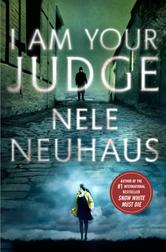
I Am Your Judge is the newest and the team will face it toughest case yet. With many out sick with the flu as the holidays approach, Pia is packing to leave for her honeymoon when a phone call will change her plans. An elderly woman out walking her dog has been shot, sniper style. Then a second woman is killed in the same way, this time standing in her own kitchen talking to her grand-daughter. Neither one had enemies and no motive can be found, nor a link between the two victims.

Is this sniper out killing indiscriminate people, or are they targeted?

Then two more murders follow in rapid succession just as Pia and Oliver discover a most unlikely connection–and the sniper starts leaving cryptic messages. It seems the victims are chosen for their relation to some other person the sniper wants to hurt deeply for an issue that happened years ago.

There will be unreliable witnesses, messages sent to the newspaper, and one of the victim’s daughters who starts her own investigation, determined to find out who killed her mother and why. Tightly plotted, with a sense of real police work and frustrations, conflicting personalities, and interfering and sometimes unhelpful consultants.

Meanwhile, Pia’s new husband has gone off on their honeymoon alone, the holidays occur, and Oliver has his own familial and relationship issues. One of the highlights of Neuhaus’ writing is how the lives of this duo overlap with their work and thoughts in a realistic manner that has them one of Auntie M’s favorite series.

It should be mentioned that the book is translated by Steven T. Murray. Highly recommended.

Ausma Zehanat Khan: The Language of Secrets Sunday, Jan 31 2016 

LangSecrets
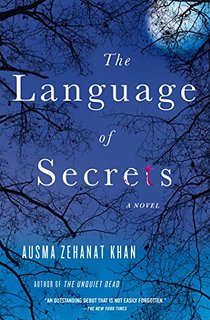
Khan’s debut The Unquiet Dead was one of Auntie M’s favorite debuts last year, introducing the unusual team of Toronto detectives Esa Khattak and Rachel Getty. Khan’s sequel, The Language of Secrets, is every bit as well done, a compelling and original plot with a timely topic handled with exquisite delicacy and precision. Instead of a formal review, Auntie M will let the author describe her book.

Auntie M had the pleasure of having lunch and a lively discussion about her work with British-born Canadian Ausma Zehanat Khan at Bouchercon last October. The author met her husband, a University of Denver professor and author who is regarded as a leading expert on Middle East affairs, when they were students at university in Ottowa, the country’s capital, and both became activists in protests against Bosnian war crimes. Her PhD research informed much of The Unquiet Dead, and her husband, Nader Hashemi, Director for the Center of Middle East Studies, became a patient and valuable resource in her research for this second book, which has her detectives investigating a Muslim terrorist cell planning an attack on New Year’s Day.

Auntie M: After all of your PhD research, why the decision to document stories and try to bring understanding through crime novels?

Ausma Zehanat Khan: I’m a lifelong crime fiction reader, which led to this series, and I chose the Canadian setting to write about my Toronto home from a distance. That distance allows me to recreate the setting for readers, who may not understand the very accepting multicultural attitudes prevalent in Toronto. So that was how I grounded my detectives. I wanted to write about the Bosnian genocide because I thought it was a war most people knew little about, and whose terrible crimes have been largely forgotten. I thought a mystery that explored the war would be a more accessible, but still compelling, entry point into that story, a story that has stayed with me as the struggle for justice continues.

AM: Your first book was based on real events; does this sequel follow that pattern?

AZK: Yes, “Secrets” is based on a case where the Royal Canadian Mounted Police and the Canadian Security Intelligence Service carried out a major anti-terrorism operation that resulted in the arrest of eighteen jihadists, influenced by a charismatic ideologue, who had planned to attack several sites in downtown Toronoto, as well as discussing other targets. A Muslim police agent infiltrated the terror cell’s operation and together with a second informant, helped bring about a successful sting operation that led to arrests before the plot could be carried out. My Author’s Note at the end of the book gives the full story.

AM: You do a great job of explaining how everyone feels accepted in Toronto.

AZK: Of course, I don’t want to idealize my city because I know no matter how multicultural, there are always probles within and between different groups that must be grappled with. And there can be issues of systemic discrimination, as with the over-policing of Toronto’s black communities. But I will say that Toronto is an inclusive, welcoming, multicultural city that a wide variety of groups not only call home but feel completely at home in, just as I do. Just recently, the mayor of Toronto and the Prime Minister of Canada personally welcomed Syrian refugees to the country. To me, that kind of open-hearted multiculturalism is ingrained in the idea of what Canada stands for. So it can be all the more shocking to realize there are still those who feel disenfranchised, alienated–who actively wish to do harm. I wanted to explore how, given that context, young men become radicalized to the point of disastrous action.

AM: So you decided to have Rachel Getty, the native Canadian, go undercover into a mosque! This one is filled with intrigue and Esa’s struggles with his family, while Rachel is tasting independence and a major change in her own family.

AZK: Rachel has to play a sensitive role and do it well. Esa has been told he cannot be seen to be investigating the murder of an old friend, an undercover Muslim agent, from this mosque, for fear of getting in the way of the sting operation underway. He’s hamstrung by his own colleagues and decides sending Rachel undercover may be the best way to infiltrate the cell and investigate the murder.

AM: Rachel has her work cut out for her, becoming involved in the mosque and learning the different personalities of those attending, trying to separate out the members from the terrorist cell while appearing just an interested new party.

AZK: There’s a lot at stake and it becomes personal to them when Esa’s sister becomes engaged, against his wishes, to a member of the mosque, the leader of the cell. I tried to show that passion and zeal take many forms in religion, and people turn to the comfort of belonging to a group for various, personal reasons. As she subtly investigated the congregants, Rachel is the one who arrives at these conclusions.

AM: I won’t give the ending away except to say that both Esa and Rachel come across as fully realized characters who can sustain a series. Esa is the thinker, the more reserved Muslim who is comfortable with his faith in a modern world; Rachel is the younger, hockey-playing partner trying to learn from him while they each learn to trust the other. You said you’ve always loved crime fiction. Who were your early influences?

AZK: When I was 13, my father gave me a leather-bound set of Sherlock Holmes stories and I was hooked by the master, Sir Arthur Conan Doyle. I also greatly enjoyed Ngaio Marsh, and later Reginald Hill became one of my favorites. His Dialogues of the Dead is what I consider a perfect crime novel.

AM: I agree. It’s one of my own favorites, too. So for reading today, who’s books would I find on your nightstand?

AZK: I enjoy series, and like Louise Penny, Charles Finch, Alan Bradley, Charles Todd, and Tasha Alexander off the top of my head. Ashley Weaver is a terrific new find. Also Martha Grimes and Elizabeth George. Morag Joss has a way with a lovely turn of phrase, and I enjoy Susan Hill’s Simon Serrailler series and the dilemmas of his family very much.

AM: All good choices and some of my own are amongst those. Good luck with this new book.

Auntie M will end here except to add that The Unquiet Dead is now available in paperback. The Language of Secrets, which Kirkus Reviews describes as a “smart, measured, immersive dive into a poorly understood, terrifyingly relevant subculture of violent extremism,” debuts Feb. 2nd and earns Auntie M’s “highly recommended” rating.

Favorite Reads of 2015 Tuesday, Jan 5 2016 

London Rain
My Favorite Reads of 2015

Last year Auntie M reviewed around 145 books in 85 posts plus hosting guests. Those don’t include the books she reads for herself, like the one her grand-daughter loved and insisted she read (Doerr’s All the Light We Cannot See—she loved it, too!); or for sheer delight, like the Judi Dench photo-autobiography Behind the Scenes (huge Dench fan).

Out of all of those books, there are always those that remain firmly in her mind as ones where she’s looking forward to more from these authors. They impress her for their creativity, their characters, their storytelling. In no particular order, she went through her posts and pulled out these highlights, most of which received her “highly recommended” citation. There could have been even more . . .

Series continuations:
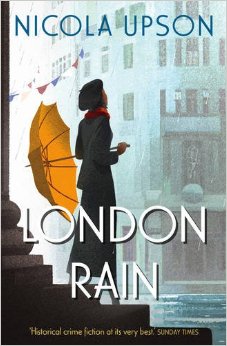
London Rain by Nicola Upson: Her Josephine Tey series continues with a strong entry, set in 1927 London at the time the BBC ruled the radio and broadcasting. Well-researched and written, with absorbing characters and a few twists you won’t see coming, set against the backdrop of the Coronation of George VI. An accomplished series.

The Strange Death of Fiona Griffiths and This Thing of Darkness by Harry Bingham: One of the most unusual and compelling characters to head a series, Griffiths remains a feisty detective in search of her past and herself whilst she figures out how to be human. The second was not formally reviewed so let Auntie M add here that Fiona’s story continues with a punch that proves Bingham deserves to be more widely known in the US.

The Kill and After the Fire by Jane Casey: The Maeve Kerrigan series just keeps getting stronger with each installment. With irascible DI Josh Derwent as her partner, the duo are working together like a well-oiled machine, despite the occasional dig. Could grudging respect be far behind?

Behind Closed Doors by Elizabeth Haynes: DCI Lou Smith heads a team investigating when a young woman missing for a decade suddenly reappears. Haynes uses primary policing source materials reproduced for the reader: police reports, interviews, analyst research, even phone messages, which add a depth and texture to the books.

The Ghost Fields and The Zig-Zag Girl by Elly Griffiths: The next Ruth Galloway installment is a grand mix of the kind of ancient mystery only working mum Ruth could solve, coupled with tremors in her personal life. A satisfying series with original characters. Griffiths also debuted a second period series, and Brighton of the 1950’s comes to life with two unlikely friends, a detective and his magician friend, who need to stop a killer.

The Nature of the Beast by Louise Penny: Inspt. Gamache and his lovely wife try to settle down to retirement in Three Pines, until a young boy prone to telling tall tales turns out to be telling the truth. All the eccentric regulars appear to help solve the mystery, a bit different from Penny’s usual but just as engaging, a mix of bittersweet and heartwarming.

Banquet of Consequences by Elizabeth George: After taking time to introduce the family who feature largely in the case to follow, Lynley manages to have Havers and Nkata assigned to investigate a poisoning case. A piece of bacon figures here. Just read it. The plot is as complex as the players involved, and will leave readers thinking about what constitutes justice.

The Slaughter Man by Tony Parsons: A slaughtered family and a missing child prove a tough case for DI Max Wolfe, juggling his young daughter and personable dog, Stan. The weapon used fits the MO of an earlier murder years ago, and that man is now out of jail. Could this be history repeating itself?

The Secret Place by Tana French: With a few characters you’ll recognize if you’ve read her others, and you should, detectives investigate the murder of a young man at a private school. You hardly realize until it’s over that the action takes place all in one day—she’s that good.

Deadly Measures by Jo Bannister: Policewoman Hazel Best and her friend, Gabriel Ash, face their most dangerous and upsetting period together when arms pirates who have kidnapped Ash’s family agree to return them—if he’ll kill himself online for all to see. And yes, Patience, the dog who talks to Ash, is along for the ride.

A Song for Drowned Souls by Bernard Minier: Minier’s second French crime novel finds Commandant Servaz trying to prove his former lover’s son is not a murderer while he protects his own daughter. A rich tale of history and emotion mixed up in murder and secrets from the past.

The Storm Murders by John Farrow: Newly-retired detective Emile Cinq-Mars is known as the Poirot of Canada and can’t get used to not working. Then murders inside a snowed-in house in his neighborhood catch his eye—there are no footsteps in the snow. And he’s asked to intervene and finds himself in New Orleans and his own wife kidnapped.

Winter Foundlings by Kate Rhodes: The psychologist with interesting friends and family returns, working short-term at a hospital for the criminally insane. A taut plot, a compelling story and a protagonist you can’t help but admire in Alice Quentin who should have it all and keeps getting very close.

Run You Down by Julia Dahl: Journalist Rebekah Roberts finds herself investigating the possible murder of a young ultra-Orthodox woman whose contacts might just put Rebekah in touch with the mother she’s not sure she wants to find. Dahl’s first, Invisible City, won multiple awards this year, with good reason. An equally impressive follow-up.

Debuts:
The Unquiet Dead by Ausma Zehanat Khan: An undeniably strong debut, backed with meticulous and absorbing research, this Toronto mystery introduces a Muslim detective working with his Canadian female partner to unravel if a dead man fell, committed suicide, or was pushed off a cliff. A series to watch for, with a sequel out soon that’s every bit as good as the first, and will be reviewed shortly.

Recipes for Love and Murder by Sally Andrew: The South African Klein Karoo landscape, nature, food, language and habits of the area come alive through the eyes of Tannie (Auntie) Maria, a widow who happens to be a brillant cook. Mevrou van Harten knows that her food works magic in people’s hearts, not just their stomachs, and uses her knowledge to help solve the murder of an abused woman. Recipes included.

Crucifixion Creek by Barry Maitland: Anyone who reads Maitland’s English Brock and Kolla series know he’s far from a debut novelist, but this marks the debut of a new series set in Australia, Maitland’s home. He introduces detective Harry Belltree, suddenly overwhelmed with three homicides to investigate: a woman shot during a meth-addict biker siege; an elderly couple who commit apparent suicide at their favorite outdoor cafe’; and a white male stabbed to death in the street, who turns out to be his brother-in-law. A strong start to a new and absorbing series.

Five by Ursula Archer: The Austrian children’s lit author tries her hand at mystery and writes an absorbing police procedural with geo-caching at its heart and a realistic, harried, divorced mother of two as the detective.

A Murder of Magpies by Judith Flanders: A wry inside look at London publishing with the protagonist an editor who fears one of her favorite authors has been murdered and becomes drawn into the investigation. With humor and a hint of romance, book two arrives soon.

In Bitter Chill by Sarah Ward: Accomplished debut procedural finds detectives looking into a cold-case murder of a young girl when her mother suddenly commits suicide over thirty years later. Absorbing and well-developed characters. First in a series.

Disclaimer by Renee Knight: A most unusual premise explores a family torn apart when a woman’s hidden secret appears suddenly as the plot of a book in her own home. Original and creative.

Stand-Alones:
Everything She Forgot by Lisa Ballantyne: Ballantyne masterfully connects two threads: a young girl’s kidnapping, and a grown woman traumatized in a car accident, to show how secrets buried in the past have come full circle. Creative and compelling.

Sheer Delight:
The No. 2 Feline Detective Agency by Mandy Morton: Of all the humorous novels Auntie M read, this one stands out for its sheer ingenuity and creative premise: a world of cats, peopled and run by cats, who sometimes resemble humans we might recognize. PI Hettie Bagshot and her sidekick Tilly, their team of friends and their world are filled with Morton’s wry humor. Sales help find homes for less fortunate cats. CCat Amongst the Pumpkins coming soon.

Kathy Lynn Emerson/Kaitlyn Dunnett: Keeping More Than One Book in the Air! Wednesday, Dec 30 2015 

Please welcome Kathy, er…Kaitlyn, who will try to explain how she juggles so many fine books!
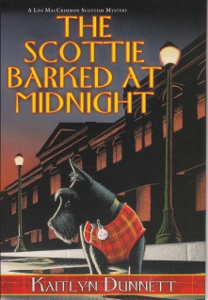
The Scottie Barked at Midnight (208x300)

Keeping More Than One Book in the Air
(or, How to Juggle)

byKathy Lynn Emerson (aka Kaitlyn Dunnett)

It isn’t at all uncommon for writers of genre fiction to produce more than one novel a year, nor is it all that rare for the same person to write more than one series.

Sometimes they do so under more than one name, but not always. I’ve been juggling two or three books a year for a long time now, going way back to the late 1990s, when I alternated category romances with historical mysteries.

How do I keep more than one book in the air? By not trying to do everything at once. By that I mean that I focus on Book One but never completely lose sight of Book Two. I write myself notes about Two and let my subconscious noodle plot problems. I can see Two out of the corner of my eye even as I’m spending my actual writing time on Book One.

Inevitably, the day comes when I need a break. Perhaps I’ve hit a snag and don’t know what comes next. Maybe I’ve completed a draft and just want a little time to pass before I try to revise it.

Whatever the reason, by then I’m more than ready to tackle Book Two and, because I took a break from it, my enthusiasm for that project is high. I’m brimming with fresh ideas that occurred to me while I concentrated on Book One, so I’ll work on Book Two until, as with Book One, I come to a point where I need a break. That’s when I go back to Book One, armed with a fresh perspective and renewed enthusiasm.

All that sounds fairly simple and if I was completely in charge of my writing time, it would be. It’s both good news and bad news that I currently write for two different publishers. They set the deadlines. Despite my best efforts, those deadlines can end up being uncomfortably close together.

Then, too, time has to be budgeted for revisions an editor asks for, line edits, copy edits, and reading page proofs. When each book is published, add in blogs, interviews, and other publicity-related tasks. Some of that is ongoing. I also chime in twice a month at http://www.MaineCrimeWriters.com and maintain a presence on Facebook (as Kaitlyn Dunnett) and at Goodreads.

I admit there are times when all the books and book-related tasks I have in the air threaten to fall and land squarely on my head. It can be downright dangerous to juggle too many things at once. I have been asked to write faster and produce more than one book in a series in the same year. I resist. That way lies potential disaster. Yes, I could come up with 75,000 words in three months, but they wouldn’t be the best words. I firmly believe that any manuscript needs time to rest before it is revised. Without a break, I’d skim right past trouble spots without noticing them. Ideally, I’d like a year to write each book. I produce two a year by alternating between them. Each manuscript undergoes several complete revisions before I’m satisfied with it. The end result is the best novel I am capable of writing.
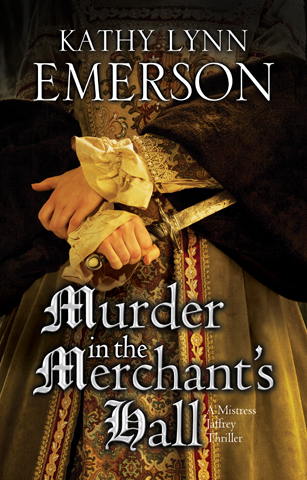
Murder in the Merchant's Hall
What am I juggling right now? Book One is the third Mistress Jaffrey mystery set in Elizabethan England. It’s due in June. Book Two is a proposal for a new contemporary mystery series—synopsis, first three chapters, and brief pitches for future books. Kilt at the Highland Games, the tenth Liss MacCrimmon mystery will be published at the end of July, so it is in production with assorted edits and page proofs still to come. And I’m still doing publicity for the second Mistress Jaffrey mystery, Murder in the Merchant’s Hall, which came out in ebook earlier this month. That’s four books in the air.

Maybe, if I’m very careful, I can add that short story I’ve been meaning to revise . . .

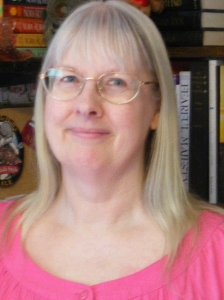
Kathy Lynn Emerson (224x300)
Kathy Lynn Emerson/Kaitlyn Dunnett is the author of over fifty books written under several names. She won the Agatha Award in 2008 for best mystery nonfiction for How to Write Killer Historical Mysteries and was an Agatha Award finalist in 2014 in the best mystery short story category for “The Blessing Witch.” Currently she writes the contemporary Liss MacCrimmon Mysteries (The Scottie Barked at Midnight) as Kaitlyn and the historical Mistress Jaffrey Mysteries (Murder in the Merchant’s Hall) as Kathy. The latter series is a spin-off from her earlier “Face Down” series and is set in Elizabethan England. Her websites are http://www.KaitlynDunnett.com and http://www.KathyLynnEmerson.com

Merry Christmas! Friday, Dec 25 2015 

Yes, it’s Christmas, and despite being mostly in a recliner with an ice pack on her operated back, Auntie M has found her holiday spirit. And to that end, she’s sharing two books with you that are perfect for the season.

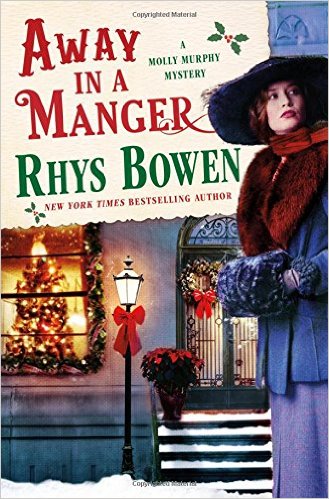
AwayManger
Rhys Bowen’s new Molly Murphy Mystery, Away in a Manger, is filled with Bowen’s usual knack for historical details that bring Manhattan in 1905 to life.

Molly has her own family: her husband, Daniel, a police captain whose business Molly would greatly like to become involved in; their baby son, Liam, and their 12 yr-old ward, Bridie, so Molly is looking forward to these holidays, even with Daniel’s mother there helping out.

A visit to see FAO Schwartz sets the tone for the little family. Then a set of carolers in their New York City neighborhood adds to the festiveness, and one young girl with the voice of an angel catches Bridie’s attention. The family try to help by giving the girl a quarter, which an older boy immediately takes from her.

This is her older brother, and they’ve emigrated with their mother from England, only to have their mother disappear. The aunt they are staying with mistreats them, yet Molly soon sees these children are educated and have been given a proper upbringing before coming to America. So what has happened to their mother?

Molly’s efforts to find the children’s mother soon leads to a tale of family intrigue and probably murder, with more planned unless Molly can stop the villain and save the two children in time to be home to celebrate Christmas. Vintage Bowen, nicely plotted and atmospheric.

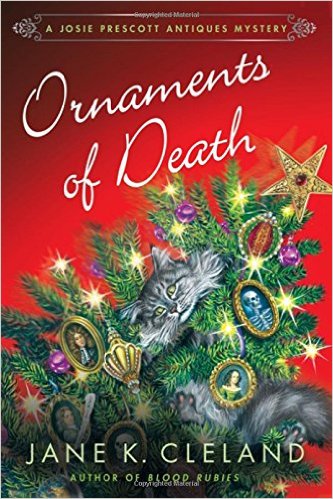
OrnamentsDeath

Jane Cleland’s Ornaments of Death is the next offering perfect for the holidays. The tenth Josie Prescott Antiques Mystery blends her own knowledge of antiques with a mystery during the Christmas season.

Josie’s New Hampshire Antique shop in the coastal town of Rocky Point is dressed as a winter wonderland for her annual holiday party. Josie is excited as Ian Bennington, her distant relative, will be there for the holiday. The recently discovered descendent is the hit of Josie’s party and gives her ties to a royal mistress.

And then Ian suddenly vanishes, and it’s soon discovered that he’s not the only thing that’s missing: two valuable watercolor miniatures Ian had given his daughter are also missing.

It will take Josies’ knowledge of antiques to track the miniatures and wend her way to Ian and solve the dual mystery. A perfect holiday treat for cozy readers who enjoy antiques and New England.

Happy Holidays and Merry Christmas from Auntie M to all of you! Enjoy your celebrations and take time to read a good book~

Connie Hambley: On writing, law and how to construct a captivating thriller Tuesday, Dec 22 2015 

Auntie M met author Connie Hambley at New England Crimebake. As a nice bookend to the year’s posts, and we decided to do an interview as we had something in common in our backgrounds, a change of profession. Happy Holidays to all, Merry Christmas, too, and Auntie M will see you in 2016!

Here’s Connie’s story on how being a lawyer makes her a great writer:

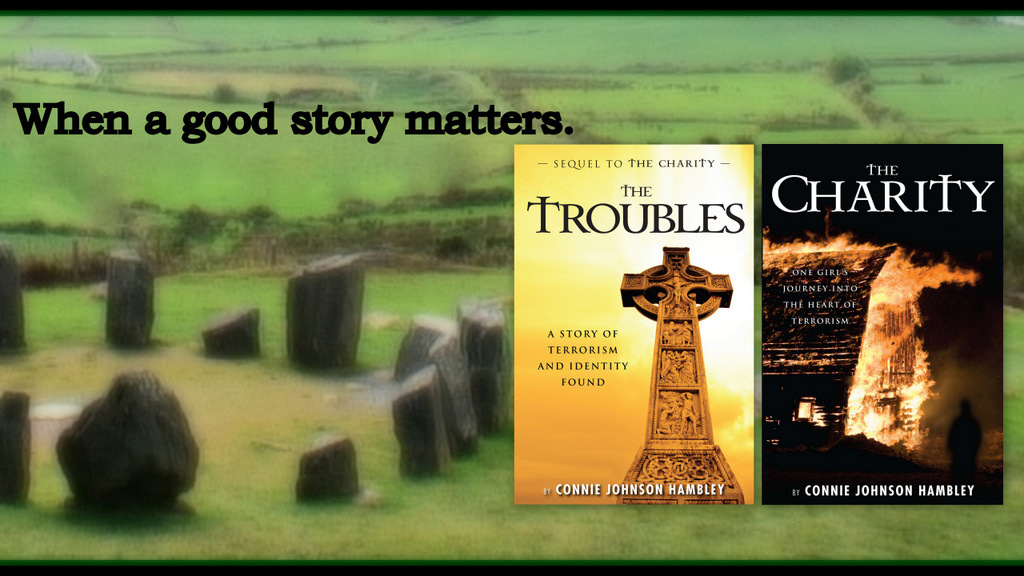
Collages3-001

Auntie M: I was a nurse who wrote on the side until I could write full time. You were a lawyer who now writes. Was it always your intention to write, too, or did you fall into it sideways?

Connie Hambley: Definitely a sideways freefall. My DNA is coded to communicate via the written word and I thought becoming a lawyer was a perfect fit. Words? Clear expression of nuanced meanings? Boo Yeah! The hitch was I also hate conflict. An epically bad career choice turned around when I applied the lessons learned in law school to writing.

Lawyers are trained to inhale vast amounts of information then distill the concepts down to their essence. In constructing a legal argument, a position is taken –think ‘guilty’ or ‘innocent’ – and each word written leads to that conclusion. A well-written thriller or mystery does the same thing. From the very first word on the page, authors construct a world to manipulate readers’ beliefs and emotions with the ending goal in mind–to have the readers completely engaged in the story and believe the conclusion. The best books –just like the best legal arguments–change readers’ perspectives on the world around them. Once I started writing fiction, I knew I found my home.

Storytellers are consummate communicators. When I construct a story, I think of my readers as a first-rate opposing counsel. If I let a detail slip or if my characters’ motivations don’t ring true, readers will find reasons to disengage–or worse, critically attack. When I find a compelling question, I construct a story in a three-dimensional world filled with facts, motivations, and conflicts–just like a legal brief, but my outcome is fiction. (I will refrain from telling any lawyer jokes here, but the restraint is killing me.)

I write to an intelligent and discerning reader in the same way I would write to crafty opposing counsel. Resolving the conflicts into a satisfying and solid climax is a job well done. Oh, and the journey has to be nerve-racking for the readers.

AM: So why crime novels in particular?

CH: My thrillers take a crime to the larger stage. My family was the target of an arsonist who burned our farm down simply because he had an ax to grind. The repercussions of this act reverberated for decades. I learned that people who look like you and me can do reprehensible things yet still be loved by a spouse and children. For me, that crime opened my eyes to layers and shades of good and evil.

I explore crimes within the theme of terrorism because one man’s terrorist is another man’s freedom fighter. Readers’ natural repulsion for terrorist acts is a tool I use to ratchet up tension.

I use pacing similar to crime novels to breed suspense. You know the Alfred Hitchcock technique of showing the bomb to the viewer but hiding it from the characters? The viewer is nerved up, but the characters are going about their day. I use the same technique. A discarded backpack on a crowded street signals volumes to the reader, but the characters stand beside it. Horrible!

Vivid and compelling characters also propel my thrillers. Understanding motivation, or at least articulating it, invites the readers to stand in the characters’ shoes. Giving my characters the heft of a strong narrative invites the readers deeper into my web, er, story. A crime is more compelling when the reader asks, “Could I do that?” “Would I make the same decision?”

Inside the international crime story of The Troubles, I answer how a biological mother can live with her child for a decade and never say the words, “I’m your mother.” What powered that decision? The psychology of the characters is just as important as their actions, if not more.

AM: When we met during costume night at NE Crimebake, you were wearing authentic riding silks. I assumed you were Sid Halley, one of Dick Francis’ protagonist jockeys. Who else were your influences in writing crime?

CH: Ha! I channeled my inner “Chick Francis” for Crimebake! The main character in my books is Jessica Wyeth, a world-class equestrian who witnessed, and then was framed for, a murder. I seasoned my first book, The Charity, with John Grisham as Jessica tries to clear her name. That book has a strong legal thriller aspect to it, but also has the dark thriller tone of Jo Nesbo. In The Troubles, Jessica is drawn into an organization some folks refer to as the Irish Mafia. The unfolding layers and expanding world is definitely inspired by Stieg Larsson and the multi-generational story-telling is capturing Ken Follett’s spirit. Book three, with a working title of The Wake, has a pinch of Colleen Mccullough and another smattering of Grisham!

AM: Who is on your nightstand waiting to be read when you have rare down time?

CH: An essential part of a writer’s career is always to be reading! Lined up is Hank Phillippi Ryan’s newest book, What You See, and Susan Elia MacNeal’s fifth Maggie Hope book, Mrs. Roosevelt’s Confidante, is underway. Kate Flora’s Death Dealer is in the queue, too.

AM: And what about those beautiful silks–were they yours?
CH: Those cringe-worthy neon silks are mine! I grew up riding horses so Jessica’s backstory is richly detailed with the sights, sounds, and feel of riding. The breeches, helmet, and boots are my ‘real’ riding clothes and the silks have a long and storied history of being a family gag gift for Yankee Swaps at Christmastime! You know how one picture or scent can trigger a wealth of memories? If I ever need a little inspiration, I just open my closet.

Business Headshots2a
Connie Johnson Hambley weaves stories from real-life experiences with a passion for exposing history with a fresh twist.
Hambley was a lawyer before turning her attention to writing, and she freely admits to having much more fun now. Her writing pursuits include being a featured columnist for Bloomberg Businessweek, an invited contributor to Nature, and a featured writer for Massachusetts HighTech. International money flow and laundering schemes were learned during her tenure as a Vice President at a major Boston bank and investment house–not that she ever directly uses that experience. Hambley creates worlds that leave readers feeling like eye-witnesses to international crime.

Hambley is a member of the Speakers Bureau of the Sisters in Crime, a professional organization supporting women mystery writers, and frequently speaks on the joy of writing mysteries and insights into the publishing process.

The Troubles, a sequel to The Charity, continues to explore the unseen impact of terrorism through the people and the organizations that fund it. Boston’s ties to the Irish Republican Army, Northern Ireland’s history, money laundering schemes with legal loopholes, and family secrets populate her books if not her real life.

Follow Connie on Twitter @conniehambley
Her blog is here: http://bit.ly/outofthefog
Facebook is here: http://bit.ly/facebookcjhambley
. . . and website: http://www.conniejohnsonhambley.com
She’s on Google+ too, but who uses that anyway?
In a crazy tradition of professionalism, Connie promises to personally respond to you. . . eventually

Sharon Buchbinder: Kiss of the Virgin Queen Tuesday, Dec 22 2015 

It’s time for the holidays and here’s something a bit different to mix it up with a paranormal bent. Enjoy your time with family and friends and keep reading!

KissOfTheVirginQueen_w9945_Hi Res

Here’s Sharon Buchbinder with a different twist on a thriller, Kiss of the Virgin Queen~

Homeland Security Special Agent Eliana Solomon is on a mission to prevent terrorist attacks. Hard enough to do when the threats are human, almost impossible when it’s an evil, shape shifting jinni.

Eliana needs help, so she calls the sexy and beguiling psychiatrist, Arta Shahani. However, no matter how good he is at his job, the man is on her blacklist. On their last case together, the guy left her for dead. Arta is stunned when he receives Eliana’s call.

Forced to abandon the woman he loves, he now fears she won’t accept his shape-shifting skills as a Persian Lion. Eliana, in the meantime discovers she is a direct descendant of King Solomon and the Queen of Sheba with special powers of her own. But will her skill and Arta’s be enough to defeat the jinni, or will they lose the love history decreed for them as well as their lives in this battle of good versus evil?

This full length novel is the second in the enthralling new Jinni Hunter series from award-winning author, Sharon Buchbinder. Edgy and suspenseful, this paranormal romance series explores diverse cultures and an array of supernatural beings. Join the Special Agents of the Anomaly Defense Division as they race to save humanity—and the people they love.

No matter how far we are in the future, everything connects us to our past.
Forced to work with sexy and secretive Dr. Arta Shahani, Homeland Security Special Agent Eliana Solomon isn’t sure she can trust him—or her heart. Will Eliana’s skill and Arta’s be enough to defeat the evil jinni—or will they lose the love history decreed for them as well as their lives?

Book Trailer https://youtu.be/4ONWBeBZXlw
World-wide Release Date: October 14, 2015 ISBN(s): 978-1-5092-0392-5 Paperback 978-1-5092-0393-2 Digital Digital Price: 4.99 Print Price: 16.99

Pre-Order/Buy Links: All Romance Ebooks Amazon Bookstrand B&N KOBO The Wild Rose Press https://www.allromanceebooks.com/product-kissofthevirginqueen-1885337-143.html

http://www.bookstrand.com/kiss-of-the-virgin-queen
http://www.barnesandnoble.com/w/kiss-of-the-virgin-queen-sharon- buchbinder/1122626572?ean=2940151181921
https://store.kobobooks.com/en-US/ebook/kiss-of-the-virgin-queen http://www.wildrosepublishing.com/maincatalog_v151/index.php?main_page=product_info &cPath=195&products_id=6415

sharonbuchbinder

Sharon Buchbinder has been writing fiction since middle school and has the rejection slips to prove it. An RN, she provided health care delivery, became a researcher, association executive, and obtained a PhD in Public Health. When not teaching or writing, she can be found fishing, walking her dogs, or breaking bread and laughing with family and friends in Baltimore, MD and Punta Gorda, FL.
Author Links: Facebook: Sharon Buchbinder Romance Author https://www.facebook.com/sharon.buchbinder.romanceauthor
Twitter ID @sbuchbinder https://twitter.com/sbuchbinder
Instagram: https://instagram.com/sharon_buchbinder/
Pinterest: https://www.pinterest.com/sbuchbinder/
Blog http://sharonbuchbinder.blogspot.com/
Website http://www.sharonbuchbinder.com/index.html
Goodreads author page https://www.goodreads.com/author/show/4417344.

Sharon_Buchbinder Link to sign up for Newsletter http://www.sharonbuchbinder.com/contact.html#newsletter

Triss Stein: The Erica Donato Mysteries and Brooklyn Secrets Sunday, Dec 20 2015 

Please welcome Triss Stein, who’s talking today about the importance of setting, something Auntie M always starts with and the newest in her series, Brooklyn Secrets:

Brooklyn Secrets Cover

Choosing a Setting

A mystery series where the place is part of the story is great fun to read and to write. My fascination with Brooklyn, where the diverse neighborhoods often seem like a collection of small (well, small-ish), towns has lasted a long time. Since change is the only constant in any big city, I don’t think that fascination will go away before I run out of stories to tell.

Choosing the exact setting for each book takes some thought, or perhaps a flash of inspiration. The neighborhood, now, is where and when the story takes place, but my heroine, Erica Donato, is a graduate student in urban history and so there is always a mystery from the past, too. The neighborhood setting needs to have scope for both.

Brooklyn Bones, the first in the series, was easy. I just looked outside my front door. Park Slope, where I live, is a lively and beautiful corner of Brooklyn which has gone through a couple of decades of steady gentrification, (for good or ill). However, it was not always the center of chic it has become (Seriously! They think this in Paris!) and I was here just as it was changing. It was not hard to find a story from that darker time.

Brooklyn Graves was directly inspired by a place, beautiful and historic Green-Wood Cemetery, and a series of news stories about priceless stained glass windows being stolen from now neglected, but once affluent, churches and mausoleums. I think any mystery writer, especially one of with a taste for history, would clip those articles. And ponder.

The setting of the new book, Brooklyn Secrets, has raised more questions. It is Brownsville, a remote corner of Brooklyn that is now, and always was, unlovely, uninspiring, and poor. It was built as an extension of the overcrowded, immigrant Manhattan neighborhood the Lower East Side. The shoddy housing of years ago has been long replaced by projects, perhaps equally shoddy; the color of the skin and the accents of the immigrants is now different and guns have changed the nature of everyday crime, but in many ways it is not different at all. Crime, boxing and education remain the roads out and often, the best choice is not even clear.

I started with Erica writing a chapter of her dissertation about crime in Brownsville’s history. In mid-20th century America, it became famous as the home of Murder, Inc, enforcers for organized crime in its heyday. She sort of overlooked the point that in writing about how neighborhoods change, she would also have to deal with Brownsville now. I overlooked it, too, for a while. The challenge became finding a reason for Erica to continue to be involved in the present day mystery I was trying to create.

Did I solve it? Did I weave together the parallel stories of how young people, now and back then, try to find their way when there is no way? Did I write about a place as an outsider and get it right?

Readers, your thoughts will be most welcome.

photo15
Triss Stein is a small–town girl from New York farm country who has spent most of her adult life in New York the city. This gives her the useful double vision of a stranger and a resident for writing mysteries about Brooklyn neighborhoods in her ever-fascinating, ever-changing, ever-challenging adopted home. In the new book, Brooklyn Secrets,s Erica find herself immersed in the old and new stories of tough Brownsville, and the choices its young people make.

Kate Charles on The Detection Club Wednesday, Dec 16 2015 

The wonderful Kate Charles, mover and shaker with Eileen Roberts at St. Hilda’s Mystery and Crime Conference each year, brings readers a view inside the glorified Detection Club. Here is her report on their latest meeting:

I was immensely privileged, in mid-November, to be present for an historic moment in the annals of crime fiction, when the eighth President of the prestigious Detection Club took over the capacious red robe of office – a robe which has been worn by G.K. Chesterton, Dorothy L. Sayers and Agatha Christie in their time, and most recently by Simon Brett.

The new President is Martin Edwards, a writer who is passionately interested in the history of the Detection Club, serving as its archivist for the past few years and recently publishing a non-fiction book on the subject, The Golden Age of Murder.DC 7Martin Edwards with Simon Brett: the torch and the red robe is passed.

As Martin would tell us, the Detection Club was founded in 1930 (or perhaps 1932!) as a dining club for the prominent crime writers of the Golden Age. Its rituals, including an arcane initiation rite, date from those early days, and were once cloaked in secrecy.

Now, though, in this age of openness (and Wikipedia!), anyone with a bit of curiosity can delve into its mysteries. I don’t think I’ll be struck off as a member for revealing that, in a solemn candle-lit ceremony, new initiates promise that their detectives will not resort to ‘Divine Revelation, Excessive Sanguinity, Lucky Guesses, Mumbo Jumbo, Jiggery Pokery, Coincidence or Act of God’, and that they swear their loyalty to the club on Eric the Skull, with ‘terrible penalties’ threatened for breaking their oath.Kate Charles with Eric the skullKate at her initiation with Eric the Skull.

Members of the Detection Club gather three times a year for congenial dinners in London, as the club continues to fulfil its original function of providing a social outlet for solitary crime writers. These days, though, the writers are far more diverse than those of the Golden Age, as the genre has expanded beyond its cosy beginnings.

This diversity presented a challenge recently, when the club embarked on a project of creating a serial novel in the grand tradition of the original Detection Club’s The Floating Admiral. As in the original project, fourteen writers contributed, and a good time was had by all. Having read (and loved) The Floating Admiral in my youth, I felt it a huge privilege to be involved in this. The Sinking Admiral (inevitably!) will be published in 2016 – another milestone in the ongoing history of a fascinating institution.floatingadmiral

Kate-Charles
Kate Charles is best known for her ecclesiastical mysteries. These include the Book of Psalms series and the Callie Anson series. Her latest book is False Tongues. False-Tongues-cover
She is a former Chairman of the Crime Writers’ Association and the Barbara Pym Society.

Leslie Budewitz: Guilty as Cinnamon Monday, Dec 14 2015 

Auntie M had the pleasure of meeting Leslie Budewitz at NE Crimebake recently. Leslie is the current President of Sisters in Crime, too, and has a wonderful sense of humor. Welcome her as she talks about what led to her new mystery, Guilty as Cinnamon, Book Two in her Spice Shop Mysteries.

Untitled-5

In 1968, “Here Come the Brides” made TV stars of Bobby Sherman and David Soul—and the city of Seattle. Sherman, Soul, and Robert Brown (I admit, I had to look him up) play three brothers who run a logging company and import potential brides to keep their lumberjacks happy. It’s loosely based on the movie Seven Brides for Seven Brothers, and inspired by the real-life story of pioneer Asa Mercer and his “Mercer Girls.” I loved it. I even believed the theme song: “The bluest skies you’ve ever seen are in Seattle, and the hills the greenest green are in Seattle.”
Ten years later when I left Montana for Seattle University, my first few days on the campus were bright and sunny. And then, those famous rains began. About six months later, when the rain stopped and I was still there, I counted myself a true Seattleite. I’d learned. You pull on your rain coat, leave the umbrella your mother gave you in the closet, and go on doing whatever it is you want to do.
And when the sun comes out—well, those are the days the songwriter was talking about.
I remember watching Richard Dreyfus and Marsha Mason in The Goodbye Girl, in a huge theater in downtown Seattle. Dreyfus is packing for a trip to Seattle, where he’s been promised a part in a play. He’ll be back, he promises, and she struggles to believe him. “Do you know they have wolves out there?” he asks, and the whole theater erupted in howls of laughter.
I’d already moved back to Montana when Sleepless in Seattle came out in 1993. Tom Hanks’ houseboat, right? That’s what you remember about Seattle: the gigantic glass windows, the dark, shimmering lake waters, the sparkling lights. And the wonderful connection between Hanks and Meg Ryan, and the cute kid, and all the romantic comedy repartee that makes us feel warm and fuzzy.
These images and more—the Space Needle, Pike Place Market, Mount Rainier, the Seahawks’ offensive line—scrolled through my mind as I created Seattle on the page in my Spice Shop Mysteries. These are the pictures readers who’ve never lived in the Northwest hold of the Emerald City. They’re iconic. They provide a framework for how we view the place, much as the Empire State Building, the Macy’s Thanksgiving Day Parade, and Central Park pop into mind when we picture New York City.

Cities are so much more, of course, but I loved calling on those images and the fond memories they evoke when picturing Pepper, my main character, and her friends and staff going about their days under blue skies and gray. Her friend Laurel’s houseboat isn’t Tom Hanks’ houseboat, but I hope a reader who remembers the movie will smile in recognition when the Flick Chicks gather on the roof for dinner, then settle in to the cozy sunken living room to watch a movie. I hope they’ll think of Richard Dreyfus worrying about wolves, and remember that while Seattle is urban, it’s also nestled between wild waters and wild mountains. And I hope they’ll think of those blue skies and white peaks, those green trees and steep hills, when they follow Pepper through the Market to Pioneer Square and back again.

Because a city comes alive on the page when the author creates a place we can see and feel, and our memories of a place—whether we’ve been there or not—are part of the equation.

Do you have a fond memory of Seattle—on the page, the screen, or on a visit?


GUILTY AS CINNAMON (Spice Shop Mystery #2, December 1, Berkley Prime Crime)
Pepper Reece knows that fiery flavors are the spice of life. But when a customer dies of a chili overdose, she finds herself in hot pursuit of a murderer…

From the cover …

Murder heats up Seattle’s Pike Place Market in the next Spice Shop mystery from the national bestselling author of Assault and Pepper.

Springtime in Seattle’s Pike Place Market means tasty foods and wide-eyed tourists, and Pepper’s Seattle Spice Shop is ready for the crowds. With flavorful combinations and a fresh approach, she’s sure to win over the public. Even better, she’s working with several local restaurants as their chief herb and spice supplier. Business is cooking, until one of Pepper’s potential clients, a young chef named Tamara Langston, is found dead, her life extinguished by the dangerously hot ghost chili—a spice Pepper carries in her shop.

Now stuck in the middle of a heated police investigation, Pepper must use all her senses to find out who wanted to keep Tamara’s new café from opening—before someone else gets burned…

Leslie-WEB-Color

Leslie Budewitz is the author of the Food Lovers’ Village Mysteries and the Spice Shop Mysteries—and the first author to win Agatha Awards for both fiction and nonfiction. She fell in love with the Pike Place Market as a college student in Seattle, and still makes regular pilgrimages. The president of Sisters in Crime, she lives in northwest Montana with her husband, a musician and doctor of natural medicine, and their cat Ruff, a cover model and avid bird-watcher. Connect with her through her website and blog, http://www.LeslieBudewitz.com, or on Facebook, http://www.Facebook.com/LeslieBudewitzAuthor

Series: Spice Shop Mysteries (Book 2)
Mass Market Paperback: 304 pages
Publisher: Berkley (December 1, 2015)
ISBN-10: 042527179X
ISBN-13: 978-0425271797

« Previous PageNext Page »