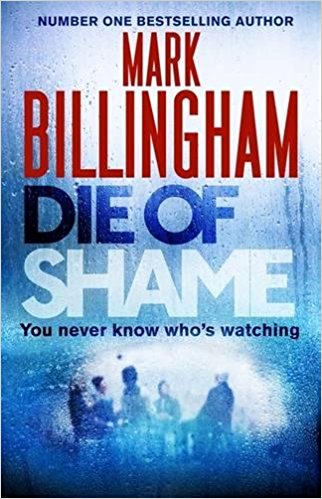
Readers of Auntie M Writes know that Mark Billingham is one of her favorites. So it was frustrating that she’d missed reading Die of Shame, which starts out as a stand-alone featuring Detective Inspector Nicola Tanner and has a tie-in to Tom Thorn at its end.
It starts with six people, all addicts of some kind, in a group therapy session held by their therapist in his home. With his wife and teen daughter on the periphery, the six speak of their secrets and tell their stories of the life they’ve tried to leave. The object is to reveal their deepest shame.
It’s an intriguing setup, as each of these characters has something to hide. When one of them is murdered, it will fall to DI Tanner to ferret out the murderer. Readers will learn of the addict’s ability to obfuscate and explain away any situation. As Tanner’s investigation advances, it soon becomes clear that one of the six is responsible for the victim’s death.
That’s where Tom Thorne comes in at the end, working undercover as the newest member of the group.
While this one can definitely be read as a stand-alone, and it’s new in paperback for those like Auntie M who missed it last year, Billingham’s newest, Love Like Blood, follows the thread. Not with the group, which is tied up easily, but with DI Nicola Tanner as Thorne’s off-the-books newest partner.
It opens with a grissly home invasion that becomes a ghastly murder. At first, readers assume it Tanner who’s the victim, but although she was probably the proposed victim, Tanner’s partner Susan has borrowed her car that day and is brutally murdered in her stead.
Due to her closeness to the victim, policy dictates Tanner must be off the case. She enlists Thorne to take the case on, with her aiding him unofficially. When a young couple from different cultures go missing, they soon realize their targets are a pair of contracted killers, performing so-called ‘honor’ killings for families.
It’s a set-up that has nothing good about it. Thorne worming his way into a community where he’s despised just for being a cop; Tanner continuing to investigate when she shouldn’t. There’s Tom’s home with Helen and her son, Alfie, to consider, too, with Helen dealing with her own bad case.
A sobering Author’s note describes the statistics of increasing honor killings in the UK, and details one particular heartbreaking case. Leave it to Mark Billingham to sensitively explore this issue. Highly recommended, both of them. Do yourself a favor and read them both.
At the opening of David Bell’s newest suspenseful novel, Bring Her Home, readers may think they know where this is headed.
Eighteen months after the accidental death of his wife, Julie, Bill Price’s teenaged daughter and her best friend disappear. Summer Price and her friend Haley have been almost inseparable for years. It’s a father’s worst nightmare and intensifies when the two girls are found, badly beaten, in a Kentucky city park. Haley is dead and Summer is so badly beaten, her face is unrecognizable. She might have brain or vision damage. She might not remember who did this to her.
As Bill’s sister drives in from her Ohio home, she brings a voice of reason and support to Bill, whose legendary temper often gets the best of him. As the pair keep vigil over Summer in Intensive Care, the investigation heats up and unwelcome stories about the girls and their behavior and company surface. Bill starts asking questions of his own to uncover the truth.
But the surprises keep coming, in twists and plot turns that elevate this to a gripping crime novel. Bill Price will have to adjust his thinking about his dead wife, his friends and neighbors, and his own daughter.
A layered mystery, filled with emotions that strike as realistic and keep pace with the surprises, this is one of those thrillers that will have readers flipping pages long after the light should have been turned out.
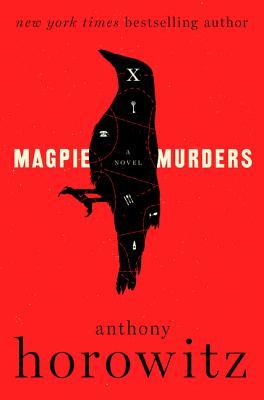
If the name Anthony Horowitz sounds familiar to you, it’s probably because you’ve seen it in the credits for Midsomer Murders or Foyle’s War, amongst other television works. Or because you’ve read his Holmes novels, Moriarty and The House of Silk; or Trigger Mortis, which contained original material from Ian Fleming; or perhaps his YA Alex Rider series.
Yes, quite the prolific and successful author in multiple genres. Yet Horowitz manages to pull off a coup quite unlike any other with his newest mystery, Magpie Murders.
This is a clever and compelling romp, paying homage to the writers of the Golden Age with a mystery novel-within-a-novel. Readers are introduced to editor Susan Ryeland, whose client Alan Conway’s Atticus Pund series has kept her publishing house afloat. There should be an umlaut over that “u” in Pund, but Auntie M’s keyboard doesn’t have that diacritical mark. It’s another way that Conway plays with his readers. And play he does, with increasing contempt, for Conway could be snarky, and as Susan soon discovers, not just to her.
Susan is delivered Conway’s newest and last manuscript, where he’s decided to kill his detective off. Over the weekend as she reads it, so do we, becoming submerged into 1950s England outside Bath, and we and she are presented with a period-perfect murder mystery, complete with many references to classic works. But as Susan reaches the end of the manuscript, she finds to her dismay–and ours–that the denouement chapter is missing. When Susan returns to work Monday, searching for that last chapter, she finds that Conway has committed suicide.
The novel turns into a contemporary mystery, as Susan takes on the detecting of issues surrounding Conway’s death, trying to find the missing chapter, and soon becomes convinced his death could be murder. As she travels to his home and his funeral, meeting those in Conway’s circle, she connects many of the devices Conway used in the book with his real life. It’s not a pretty picture that emerges, and there are far too many candidates for the role of murderer. And where is that missing chapter?
This is a hugely satisfying read, containing puzzles, anagrams, literary motifs and more, including a gentle send-up of today’s publishing world. It’s garnered wonderful enthusiastic reviews and this is one more. Highly recommended.
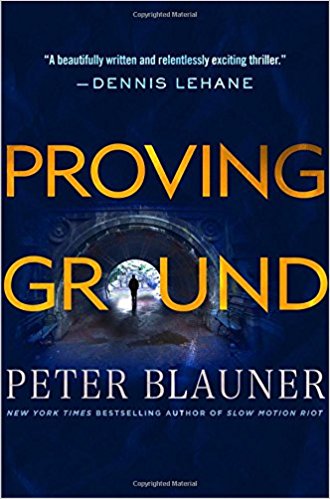
Author Peter Blauner took time off from novels to write for television, including co-executive producing Blue Bloods, but he’s returned to crime novels with Proving Ground, an urban crime drama where Brooklyn springs to life as do the characters he’d drawn.
Nathaniel Dresden’s law career can’t wipe out the memories and effects of his time in the Iraq War. He feels like he’s returned to a world he no longer recognizes.
Then Nathaniel’s father is shot and killed in Prospect Park. When he returns to Brooklyn, Natty sifts through his father’s papers, and finds in his records troubling evidence of a plot against his father.
David Dresden defended too many criminals to make NYPD happy, with his controversial activist stance adding to their ire. There are almost too many suspects who might have wanted him dead.
The detective investigating David’s murder is Lourdes Robles, working in her own shadow of disgrace. Trying to save her career, Lourdes is determined to figure out who murdered David, and who wants to keep that knowledge secret, knowing that even her colleagues are against her investigation.
The juxtaposition, and jostling against each other, between the wounded Iraqi war veteran and the brash Latina detective–two “mongrels”– make for some interesting reading and keep this successful novel character driven, even as the plot intensifies and ratchets up. The ending will surprise readers as some things will come full circe, while other do not.
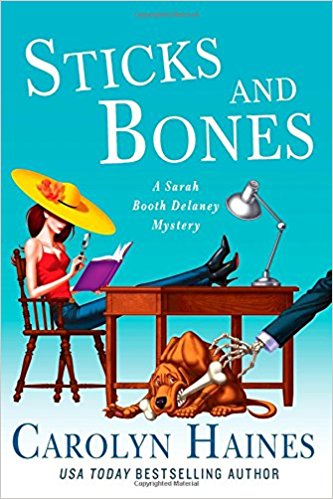
Carolyn Haines returns with her next Sarah Booth Delaney cozy, Sticks and Bones. This time the southern sleuth examines a cold case that comes to light in a most unexpected way.
An old acquaintance comes back into Sarah’s life in the form of Frangelica McFee, known as Sister. Now a bestselling author who lives in New York, she woman is still as arrogant and downright cruel as Sarah remembered.
So she’s doubly dismayed when it seems Sister’s memoir is being filmed on location right in Zinnia Mississippi, and the film crew decides to hire Sarah to dig out the truth about he deaths of Sister’s mother and brother decades ago.
Of course, digging into deeply buried dirt is bound to upset the real perpetrator, whose secrets have lain undisturbed until Sarah gets involved. With her trademark humor and strong protagonist, it’s another wild ride with Sarah Booth and her cohorts around.
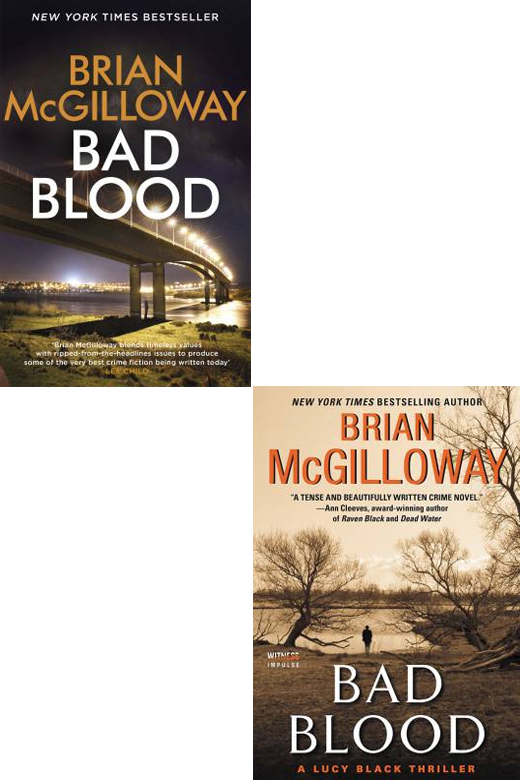
Brian McGilloway’s Lucy Black series, set in Northern Ireland, returns with the compelling Bad Blood.
Not one to shy from controversial topics, McGilloway tackles Lucy’s latest case head on, when a community becomes overwhelmed with tragedy.
A young man is found in a park, dead from head wounds, and with a stamp from a gay club on his hand. Concurrently, a hate-speech pastor was heard spouting the advocacy of stoning gay people. Could the death be connected to his talks?
At the same time as Lucy and her boss, DI Tom Fleming, try to cool things off, a Gay Rights group become involved, showing up and demonstrating at the pastor’s talks, while a far-right group target new immigrants who’ve moved into the area.
There will be vandalism that escalates to assault, arson, and more deaths before Lucy and her team, who are undergoing their own stresses, can figure out who is behind the various issues. There are turf wars within the community, and an escalating drug problem that adds to the tension.
Set against the days leading up to the Brexit vote, this highly current and compelling thriller will have readers flipping pages as Lucy and her team try to figure out who is responsible for what, when she finds herself on the receiving end of some of the ugliness.
The complex plot all makes sense in this end in this enjoyable read that will have readers searching for others in the Lucy Black series.
Kristen Lepionka’s debut mystery, The Last Place You Look, introduces PI Roxanne Weary, daughter of a police detective who’s inherited her father’s keen instincts along with his affinity for alcohol.
This is not your typical, sweet protagonist, but a hard-drinking, sexually active woman who’s learning to deal with her grief after her father’s death on duty. When her brother Matt sends her a new client, she finds herself drawn to look for Sarah Cook, a young woman who vanished the same day her parents were murdered.
The man accused of those murders languishes in jail, and with his execution scheduled for two months down the road, time is of the essence to find the young woman who would know who really killed her parents. Brad Stockton has always claimed he’s innocent and refused to put any blame on Sarah.
Then Brad’s sister swears she sees Sarah at a local gas station, although police have long maintained Sarah was also one of Brad’s victims when something went wrong between the two young lovers. This prompts her to hire Roxanne in a last-ditch effort to prove her brother’s innocence.
It seems like a cold case destined to go nowhere, until Roxanne links Sarah’s disappearance to another of her father’s cold cases. And then a third body is found, and Roxanne is scrambling to get ahead of a serial killer, while the local police thwart her every move.
Readers will feel Roxanne’s frustration and her grief as she tries to sort out her own tumbled emotions at the same time as she solves a decades-old crime. Readers will look forward to a sequel featuring the gritty PI.
A tense and suspenseful thriller, Lori Rader-Day says of Lepionka: “A talented new voice and a character worth following anywhere she trespasses.”
Please welcome Canadian author Joanne Guidoccio, whose mystery Too Many Women in the Room has the tag line: Eight women–eight motives to kill a lecherous photographer! Don’t miss her special giveaway at the end of her discussion.
Joanne is going to share what she’s learned about prologues:
To Prologue or Not to Prologue
Whenever I’ve asked a writing instructor or workshop facilitator about prologues, I’ve encountered a variety of negative facial expressions—everything from a wince to a frown to a quick shake of the head. And the following responses: Agents hate prologues; Readers will skip to the first chapter; Prologues = Information Dumps.
One instructor offered a ray of hope: Use only if the prologue adds an interesting and integral layer to the narrative.
Interesting and Integral…Definitely a challenge and one I decided to tackle in my new release, Too Many Women in the Room.
But first, I needed to get more information about the Uses and Misuses of Prologues. Here’s what I discovered:
Use a Prologue to…
• Provide information that is crucial to understanding the rest of the story. In Too Many Women in the Room, I needed to introduce the victim’s voice. Having written the rest of the novel in the first-person POV, I wanted the reader to be privy to the thoughts and feelings of the victim in his final hour.
• Provide clues. Red herrings are an important component of cozy mysteries. In Too Many Women in the Room, the initial crime scene contains vital details that form the basis for these red herrings.
• Hook the reader. If the actual crime doesn’t occur for several chapters, it is a good idea to whet the reader’s appetite with a prologue. But—and a big but—the interim chapters also need hooks to keep the reader engaged.
Don’t Use a Prologue to…
• Introduce a voice or tone that is not as engaging as the rest of the novel.
• Dispose of the entire back story. Much better to incorporate bits and pieces throughout the novel.
• Introduce an overly-dramatic voice and then switch to a much quieter voice.
Here’s the idea of Too Many Women in the Room:
When Gilda Greco invites her closest friends to a VIP dinner, she plans to share David Korba’s signature dishes and launch their joint venture— Xenia, an innovative Greek restaurant near Sudbury, Ontario. Unknown to Gilda, David has also invited Michael Taylor, a lecherous photographer who has throughout the past three decades managed to annoy all the women in the room. One woman follows Michael to a deserted field for his midnight run and stabs him in the jugular.
Gilda’s life is awash with complications as she wrestles with a certain detective’s commitment issues and growing doubts about her risky investment in Xenia. Frustrated, Gilda launches her own investigation and uncovers decades-old secrets and resentments that have festered until they explode into untimely death. Can Gilda outwit a killer bent on killing again?
And here’s some of that opening prologue:
He couldn’t believe he was following his wife’s advice. After twelve years of paying lip service to deep yoga breaths, mindfulness, and all the other New Age crap she espoused, he had finally found a use for it. His midnight run usually sorted out all the stress, but tonight was different. He still couldn’t shake the venom that had been directed his way.
To make matters worse, it had come from eight women, eight very different and very annoying women. He had bedded four, but right now he couldn’t imagine having sex with any of them. As for the untouched four, well, only one interested him, and it had nothing to do with her feminine wiles and everything to do with her healthy bank account.
He would have to take something to get through the night, something a lot stronger than his wife’s herbal teas. The remnants of an old Percocet prescription came to mind. Two capsules might do the trick. The thought of a panacea, albeit a chemical one, calmed his racing thoughts. A good night’s sleep would make a world of difference. And tomorrow, he would sort it out.
The light patter of feet distracted him. Definitely a woman’s gait. Her breath was even, neither shallow nor panting. Younger, maybe in her thirties. His pulse quickened, and a smile spread over his features. A welcome distraction. Just what he needed to erase the built-up stress. To hell with deep breathing, affirmations, and Percocet.
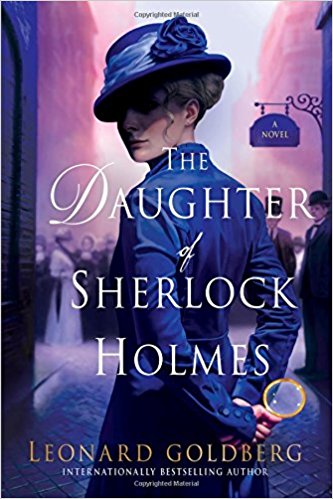
Leonard Goldberg is a physician whose name readers might recognize from his many medical thrillers. In this newest outing, Goldberg ventures into the past of 1910 and Edwardian London, and brings a twist to the Sherlock Holmes canon with The Daughter of Sherlock Holmes.
It’s a winning combination of an elderly Dr. Watson, his physician son, also John, and a young woman who assists them in unraveling the supposed suicide of a young man after she and her young son witness the death.
The brilliant mind of Joanna Blalock soon leads Watson to confide in his son that she is none other than the daughter of the late Sherlock Holmes and the only woman who ever outwitted the great mind, Irene Adler. Watson is entrusted with that knowledge, and now John, Jr. is the second person who knows the truth of the young widow’s lineage.
It’s a fine setup as the book moves along, and fans of anything Sherlock will be captivated. This time it’s a female who has the brains to observe and deduce, which Joanna does in fine fashion in a compelling and readable storyline.
That she also happens to be beautiful and captivates John’s heart is an aside that adds to the texture and gladdens Watson’s heart.
The mystery surrounding the death ties into hidden treasure stolen during the Second Afghan War. As the body count rises, it will be up to this trio to figure out how the culprit is managing to kill the members of a special quartet, and how they can protect the remaining member.
It’s a fast-paced story, containing a cipher, a secret room, and enough Sherlockian ties to make readers flip pages fast. A quick, entertaining read, Auntie M hopes Mr. Goldberg plans to bring readers more of this new detecting team.
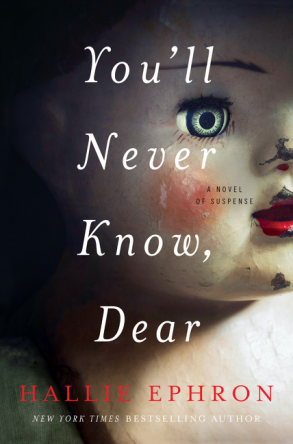
Hallie Ephron’s fifth suspense novel show how a talented writer can find an unusual premise and make it work. You’ll Never Know, Dear brings three generations of strong women in the Woodham family together to solve a decades-old mystery.
When Lissie and her sister Janey were outside their South Carolina low-country home when Lissie’s attention is diverted by a puppy. When she returns, Janey has disappeared, and remains so for forty years. Despite the length of time, their mother, Miss Sorrel, places an ad every year in the paper that shows the doll she made for Janey, and offers a cash reward for its return, hoping this will be the clue that finds Janey.
Miss Sorrel is Lisse and Janey’s mother. Aided now by her neighbor, nurse Evelyn Dumont, the duo repair dolls, after a career of making hand-painted one-of-a-kind dolls that bear the face of the child who becomes their owners. She’s hoping even after all these years that the doll will be returned and be the key to Janey. And then suddenly, a young woman shows up with what Miss Sorrel is convinced is Janey’s doll.
Then a horrid accident put Miss Sorrel and Lissie in the hospital, and Lissie’s daughter, Vanessa, leaves her research project on dreams to help out. The three women will bind together, despite their differences, to try to solve the cold case and find out if Janey could possibly be alive. The women will need all of their smarts when they face evil.
The setting is definitely a character here, with small-town secrets and lazy warm days leaping off the page and adding to the southern gothic feel. Along with a realistic portrait of differing personalties within one family, readers will be delighted to learn the ins and outs of doll making and restoration, too, an added bonus to the suspense.













 Auntiemwrites Crime-Mystery Author M K Graff