Emma Jameson: Marriage Can Be Murder Sunday, Dec 21 2014 

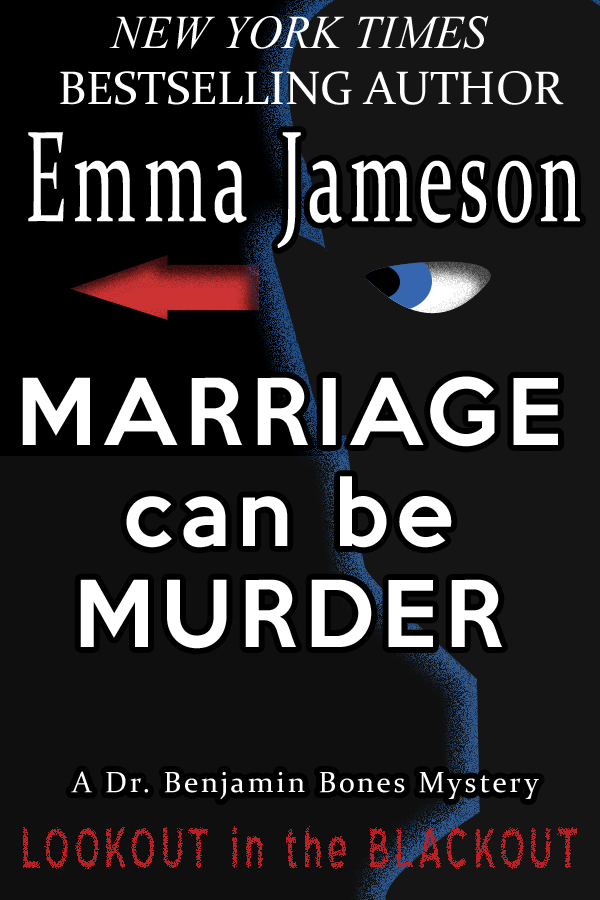
British author Emma Jameson has a new series premiering. The Dr. Benjamin Bones mysteries start out with Marriage Can Be Murder. MCBM Cover

On the eve of World War II, Dr. Benjamin Bones is at war with himself.

While most young men are being sent away to fight the Germans, Ben is chosen to serve on English soil. Ordered to move to wild, beautiful Cornwall, he must trade his posh London office and stylish city life for the tiny village of Birdswing, population 1,221 souls.

But leaving his home and shelving his career ambitions aren’t the only sacrifices facing Ben. His unfaithful wife, Penny, is accompanying him to Cornwall in a last-ditch effort to save their marriage. But moments after their arrival, Penny is run down in the street, and Ben is almost fatally injured. And while the villagers assume Penny’s death to be an accident, Ben quickly deduces it was murder.

As he convalesces in Fenton House, which the locals call haunted, Ben meets Birdswing’s eccentric inhabitants. Mr. Gaston, the volunteer air warden, obsessed with defending his remote village against Nazi spies; Mrs. Cobblepot, a thoroughly practical housekeeper who believes in fairies; and Lady Juliet Linton, a prickly, headstrong aristocrat who won’t take no for an answer.

While adapting to life during Britain’s “War at Home,” a time of ration books, victory gardens, bomb shelters, and the Blackout, Ben sets about solving the mystery of Penny’s murder—with a little help from Lady Juliet and the Fenton House ghost.

As a special treat for Auntie M readers, Jameson has provided an excerpt of the new book:

10 October, 1939

Ben didn’t need to leave his room over the Sheared Sheep to know it was getting colder; he felt it every time a southeaster blew through, penetrating the late Victorian heap as easily as a torn mack. Downstairs, raucous laughter and pint-fueled rows started in midafternoon and carried straight through till closing. After the issuing of the Call-Up Proclamation, it seemed most of the village’s young men were heading into the pub a little earlier each day, either to drown their fears or enjoy what might be a final pint with friends. Ben often overheard long snatches of conversation, provincial and circular in nature, that did nothing to entice him downstairs. And if not for the insistence of his nurse, a curt sister with very definite views on the curative power of sunlight, he would have kept his blackout screens in place night and day. What difference did it make?
The words of the publican, Angus Foss, floated up from the barroom. That is, if the perpetually aggrieved tones of a perpetually aggrieved Scot can ever be said to “float.”
“Aye, I’ll fetch him for ye. Just what my poor spine needs, another wee traipse down the stairs with a full-grown man in my arms. Devil of a way to start the day. And me due to unlock the doors in a quarter hour….”
Ben checked the alarm clock beside his bed. Was it really not yet three o’clock? Dawn was trundling toward dusk even slower than usual.
“… but ye know my temperament. Man o’ the people. Live to serve,” Foss continued morosely. “Still, martyrs and saints have their limits. The Council—meaning your ladyship’s mother, ye ken—had best make restitution for all I’m out in lost rent. That includes meals, housekeeping, and electric current. If I’m not assured payment by tomorrow morning, I’ll put him out, I swear by God I will.”
Foss’s threat didn’t trouble Ben. He’d overheard it many times during his slow convalescence, though never attached to a twenty-four hour deadline. The insistence of some unseen visitor to have him brought downstairs was what bothered him. Foss found the process inconvenient; Ben found it downright humiliating. As for whatever the visitor wished to discuss, it didn’t matter. Unless the person asking represented the British army, Ben would say what he always said: no.
Easing his Edwardian wheelchair, a ghastly contraption fashioned of blond wood and rattan, out of his room, Ben maneuvered onto the landing. There, near the top of the stairs, he couldn’t see the bar, where Foss and his visitor were standing, but he could hear her voice quite clearly.
“I understand he’s lodged here six weeks. So lost rent is fair enough,” she said in the flowing tones of an educated woman. “But surely you customarily provide meals to your guests? I’ve always pitied those souls unfortunate enough to squat in this hovel, but I refuse to believe even you would bill them separately for electric lights. Or what you call housekeeping, which amounts to Edith Hoovering twice a month and linens changed once per solstice?”
Foss cleared his throat. “Now, that’s verra hard—”
“Nonsense. I was being kind to Edith. If I were the sort of woman who engaged in gossip, and I assure you I am not, I would add that outside Birdswing, ‘Hoovering’ is not the common term for Edith’s primary occupation. I might also remark that you virtually never let that room upstairs, except for the sort of exchange that doesn’t require a hot meal to sizzle.”
“That’s a lie!” Foss thundered. “No immoral congress takes place within these walls.”
“Of course there’s no immoral congress. A physician with two broken legs occupies the requisite space.” As the woman laughed, Ben leaned forward, trying to get a look at her. “Mind you, I make no accusations. I never repeat gossip and would prefer not to hear the rumors about poor Edith and your tawdry little room. No doubt she’s a nearly adequate maid, and it’s a nearly bearable cell. So please believe me, my dear Mr. Foss, when I say I perceive your discontent. My mother perceives your discontent. Far away, nestled amongst the most distant stars, advanced life forms perceive your—”
“Dinna ken what you’re on about,” Foss said peevishly.
“Of course not. Being met with slack jaws and faintly suspicious eyes is both my blessing and my curse. But if you could just sublimate your habitual disgruntlement long enough to fetch down—”
“Blessing?” Foss cut in again. “How the deuce is it a blessing that regular folk can’t make heads nor tails o’ what ye say?”
“It reduces the volume of complaints directed toward my mother.” The visitor sounded cheerful. “She’s not a well woman, you know, and heaven knows my childhood travails contributed to her condition. How fortuitous that as I matured, I acquired sufficient vocabulary to speak my mind without ruining her day. Now. Mr. Foss. I’ve very much enjoyed our little talk, but the time draws nigh for you to ply your unsavory trade, and Edith to ply hers. So will you fetch down Dr. Bones, please?”
“Aye, Lady Juliet.” The cantankerous Scot sounded defeated.
Ben wheeled back into his room. Somewhere in the midst of listening to that acid-tongued woman, he’d lost his resolve to say no, at least without hearing her out. But what could she possibly want? Everyone in Birdswing knew of his injuries. His right leg, broken below the knee, was mostly healed, but his left leg had been shattered. During that titanic smack of impact, the moment his torso struck the lorry’s bonnet, his legs had connected with its iron grille, breaking the tibia and fibula in two places each. Moreover, his femur had snapped, either when the lorry hit him or when he struck the ground. Now Ben knew firsthand the truth of the medical school saying: a broken femur was the worst pain a man could experience. Its corollary, that childbirth was the worst pain a human being could experience, made him devoutly glad to be male.
Hearing the stairs creak under Foss’s heavy tread, Ben gripped the arms of his chair and slowly, carefully, tried to rise. His right leg trembled. It had grown weak during the long recuperation. Two seconds later, his left buckled, dropping him back in the wheelchair with a stab of agony.
Perspiration broke out across his forehead. Sighing, he wiped it away. There was no more morphine for him: since the declaration of war, narcotics and other essential medications were strictly rationed. As a result, he’d been undermedicated, at least by London hospital standards, but that was probably a blessing. Morphine didn’t eliminate pain, it just created detachment, placing the patient on a billowy cloud from which discomfort could be ignored. No other substance came close; not even single malt whiskey could compete with an injectable opioid. And Ben, who during his internship had struggled to comprehend the nature of morphine addiction, understood it now all too well. He’d survived the accident. Penny had not. The chance for them to repair their union, or at least face its dissolution together, had been snuffed out without amends or even goodbyes. When real physical pain was entwined with amorphous demons like heartbreak, guilt, or misery, and a substance existed that artificially detached the sufferer for a few precious hours, who on earth wouldn’t be tempted?
He looked around the little room. The books and magazines his mum and dad had brought were long read; the condolence cards and letters from the extended Bones family were tucked away. His last visitor had been an aunt on holiday who’d dropped by out of morbid curiosity; his last telegram, from Penny’s brother George, asking if Penny had any life insurance money due. A fresh distraction might be worth the price of venturing downstairs.
“Dr. Bones! Are ye decent?” Foss bellowed outside the door.
“Yes.” Only due to the efforts of his nurse, who insisted her patients be fully dressed by breakfast, no lazing about in pajamas or dressing gown. Most days, Ben didn’t see the point, any more than he saw the point of looking out the window at this sad little village he refused to call home. But defying such a grimly resolved sister wasn’t worth the wear and tear on his vocal cords. So not only was he decent, he was properly attired to meet this backwater aristocrat, from his silk necktie to his Oxford dress shoes. “Do come in.”
“Do come in,” Foss mimicked. As usual, his hair was wild, his shirt was stained, and a bit of egg clung to his bushy mustache. “I’ve not come to take tea with ye. Here to break me back again in service to her ladyship.”
“You sound like you don’t fancy the task. Shame. Being carried by you is the highlight of my week.” Ben kept his tone light. “So tomorrow morning I’m out on my ear, is that right?”
Foss had the decency to look abashed. “Ye heard?”
“As my mystery visitor put it, beings on faraway planets heard. Never mind, Foss, think nothing of it. If the government hasn’t paid you yet for my room and board, I don’t blame you for feeling ill-used. Tell me about that woman. What does she want?”
“Like anyone kens the answer to that. Beat down me door while I was at lunch and prattled on till I gave in. Her and her mother, Lady Victoria, come from people who once owned every acre of Birdswing. Reckon they still do, or near as makes no difference. I told her you’re fit for nowt, but she wouldn’t listen. That’s how she wound up married to a bounder—not listening.”
“Married to a bounder?” The revelation didn’t surprise Ben; Birdswing brimmed with gossip. Everyone, even his nurse, seemed incapable of simple discourse without tossing in a few nuggets of personal information about someone not present to defend themselves.
“Aye, and not just any bounder, the prince o’ the lot. As flamboyant as Valentino and as phony as they come, stuffed with lies and promises. Made off with half the family fortune, from what I hear. Course Lady Juliet and her mum are close-mouthed about it, but care to wager how it ended?” Foss lifted his eyebrows so high, small eyes gleamed within their narrow sockets. “The ‘d’ word.”
Ben knew he was supposed to respond with disapproval and chose to depart from the script. “Good on her.”
“There’s no call for sarcasm.” Foss adopted a tone of virtuous sorrow. “It’s a stain on Birdswing. All the manor staff deny it—high-minded and high-handed, the lot o’ them. But he’s gone, isn’t he, and Lady Juliet only wears her ring on formal occasions. Still, she’s Mrs. Bolivar, not Miss Linton. Remember that.” Taking a deep breath, he bent over the wheelchair. “Ready?”
“Ready.” Ben steeled himself. Foss, stringy but remarkably strong, slid one arm around his shoulders and another beneath his knees, lifting him out of the chair. Bad enough to be held close by another man, particularly one like Foss, but the mere experience of being carried downstairs set Ben’s left knee on fire. His thigh ached, too. By the time Foss deposited him on the pub’s lone sofa, a red velvet affair long past its prime, fresh perspiration stood out on Ben’s forehead and tears stung his eyes. Fortunately, Foss was too occupied with his own resentment to notice.
“You look like a slender wee lad, but you weigh more than a keg o’ me best. At least when I shift one o’ those, I’m padding me pocket while I strain me back.” Foss sighed theatrically. “Let me fill my lungs and I’ll fetch down your bloody chair.”
It was a bumpy transit via wheelchair down the pub’s front steps, beneath two elms, and into the dazzling afternoon sun. Parked by the curb was a Crossley 20/30, gleaming ebony and clean as a whistle. Its driver leaned against the bonnet, six foot two if she stood an inch, clad in what looked like waterproof trousers, a man’s green Macintosh, and galoshes. Dull brown hair was scraped back in a bun, exposing what seemed like too much face: a vast expanse of forehead and chin and cheeks, all of it sunburned. Ben, aware that during the war, unmarried women would temporarily fill the positions vacated by able-bodied men, thought this she-behemoth was better suited to farm or factory labor. Perhaps when it came to hiring drivers, Lady Juliet’s judgment was as questionable as her taste in men.
“Good heavens, it’s the man himself!” she called. “After such a long wait, I’d nearly succumbed to despair.”
Ben gaped at her. He hadn’t expected that smooth, educated voice to issue from those lips.
His expression must have amused the woman, who laughed. “Don’t look so frightened, Dr. Bones. I don’t eat injured men for lunch. Nor do I dress for dinner, as it were, to run midday errands. Unlike you.” She eyed him critically, as if his London wardrobe were wildly inappropriate. “If my arrival had been foretold, would you have received me in top hat and tails? Mr. Foss, I fear our new village physician is the achingly formal sort. Introduce us properly, would you please?”
Slightly overwhelmed by the torrent of words, Ben tried to frame a rebuttal, but Foss was already speaking.
“Lady Juliet Bolivar, this is—”
“Linton. I’ve taken back my family name,” she cut across him.
Foss’s bushy eyebrows lifted, tiny eyes gleaming again. That new kernel of information would soon take root in his pub’s fertile ground. “Lady Juliet Linton, this is Dr. Benjamin Bones. Old Sully says we ought to call him ‘Broken Bones’ on account of the accident.”
“Ah, yes. An accident which killed his wife.” Lady Juliet’s smile disappeared. “Has Old Sully produced a clever nickname for that aspect of the tragedy, too? ‘Wrecked Widower’? ‘Heartsick Husband’?”
“Come now, Lady Juliet. The lads were just having a bit o’ fun. No need to—”
“Dr. Bones, I see once again why it’s folly to rely on others for introductions or, indeed, almost anything else,” she said. “They omit what you care about, sprinkle in what you don’t, and tie up the package with a ribbon of indifference. Best speak for yourself. I’m Juliet. It’s a terrible name—curse of my life, next to my height—but there it is.” Looming over the chair, she stuck a large hand in his face. The thumbnail was torn off to the quick; the palm was crisscrossed with scratches.
“I’m Ben.” Quickly, aware he might be cut off if he gave her an opening, he continued, “You should know, my knee hurts like the devil and I have no idea why you insisted I come down to meet you. I don’t suppose you’ve received a message from the Army?” More hopefully, he asked, “Are they ready to transfer me to a small hospital or sanatorium where I can continue my convalescence?”
She gave an unladylike snort. “No. I did hear from the Army a week ago—or my mother heard, which is the same thing. They’re under the impression you’re fit to begin work in the village. Still, the Council elected to give you a bit more recuperation time, what with the magnitude of your loss.” She fixed him with light brown eyes. “My deepest condolences.” For the first time, the words weren’t tinged with acid.
“Thank you. But fit? I can’t even walk.”
“Must you walk to attend the sick?” From her great height, Lady Juliet studied him like a blue heron surveying a fish. “Old Dr. Egon was seventy-four. In the end he couldn’t hear, couldn’t see, and most assuredly couldn’t walk, at least more than a few yards, without assistance. Also, he was drunk by eight o’clock every night. Nevertheless, in his final year he delivered eight babies, set eleven broken limbs, and treated any number of fevers and coughs. If the scotch hadn’t killed him, he’d be staggering toward me now, peering through his thick specs and asking me to repeat every third word.” She sighed. “Surely you can do better, even from a wheelchair. I have a—well, a delicate case, a situation that calls for a physician. Someone with discretion and a glimmer of human empathy,” she added, pitching her voice toward Foss. “Are you willing, Dr. Bones?”
It was on his lips to say no. The sun beat down with summer-like intensity, his knee throbbed, and even if Foss helped him into Lady Juliet’s car, heaven knew how much more pain a drive over rutted country roads would bring.
She stared at him, arms folded across her chest.
“Very well.” He heaved a great sigh calculated to let this bossy, ill-dressed woman know how far she’d overstepped. It was drowned out by her crow of delight.
“Capital! Mr. Foss, please help the good doctor into my car before he changes his mind. Yes, there’s room for his chair in back. This heap seats seven, don’t you know.”
“Wheels are a wee bit muddy,” Foss warned after depositing Ben on the front passenger seat’s threadbare upholstery.
“Never mind that.” Climbing behind the wheel, Lady Juliet slammed her door with gusto. “Do I look like the sort who’s afraid of a little mud?”
He struggled to come up with an answer. From this close, he noticed two things: her brown eyes were surprisingly soft, and there was a slender twig in her hair. It stood up, just atop her severe bun, like an intrepid climber who’d scaled a mountain.
“Oh, Dr. Bones, don’t be so taken aback. I wasn’t fishing for a compliment.”
“I know, it’s only… you have a stick in your hair. Now that I mention it—a walking stick. Insect, I mean.”
He expected a shriek. Instead, Lady Juliet looked mildly intrigued. “Do I? It’s a wonder I can’t feel it. Relieve me of this uninvited passenger, there’s a good man.”
Gently, he plucked the stick-insect from her hair. Lady Juliet grinned at it. “I suppose you think you’re terribly clever, catching a ride with me. Come on, then. Step this way,” she ordered the bug, linking her finger with Ben’s until the insect obeyed. “Let’s get you sorted.”
Ben watched her climb out of the Crossley, stride across the meadow opposite the pub, and deposit the insect on a tree stump. He heard her telling it something—parting advice, no doubt—and then she returned to the 20/30, leaving a swath of trampled grass in her wake.
“Now. Keys. Front pocket? Right,” she muttered as she got behind the wheel again. Apparently even she wasn’t exempt from her own constant stream of commands. “Sorry for the delay, Dr. Bones, but I couldn’t drop him too close to the pub. Wouldn’t that be a terribly ignominious end, flattened by Mr. Foss’s heel?”
“I suppose. But my wife, Penny, would have squashed that bug without a second thought.”
“Wrong. She would have screamed for you to do it.”
Ben chuckled. It was his first genuine laugh in ages. “You knew her?”
“Oh, my dear Dr. Bones.” Those soft brown eyes veered away as the car’s engine roared to life. “Everyone in this village knew Penny.”
“Yes, of course. I should have realized.” Ben groped for something more. Penny had mentioned Birdswing many times; she’d relied on it as a punchline while entertaining their metropolitan friends. Her only fond memory of the village, she’d often said, was watching it shrink into oblivion as the train chugged away. “Were you friends?”
For once, Lady Juliet didn’t soliloquize. She shook her head.
They were probably about the same age, Ben thought. They must have been thrown together constantly, at least at school.
“Did you have a falling out?”
“Oh. Well. You know what they say.” Another sidelong glance, quicker this time. “Nothing but good of the dead.” And to Ben’s surprise, she spoke not another word the entire way to Belsham Manor.

MARRIAGE CAN BE MURDER (Dr. Benjamin Bones Mysteries #1) is the new cozy mystery series from New York Times and USA Today bestselling author Emma Jameson. Blog Link: http://emmajamesonbooks.com/ Facebook Author Page: https://www.facebook.com/emmajamesonbooks?ref=bookmarks Buy Links: Amazon: http://amzn.to/10SMu6m BN: http://bit.ly/1xa1kiS Apple Store: https://itunes.apple.com/us/book/marriage-can-be-murder/id936762241?mt=11&uo=4 Kobo Books: http://bit.ly/1ureZoB

Author Photo-2 Emma Jameson is the New York Times and USA Today bestselling author of the Lord & Lady Hetheridge cozy mystery series. Book #1, ICE BLUE, Book #2, BLUE MURDER, and Book #3, SOMETHING BLUE, are available now. She is at work on Book #4, BLACK & BLUE, and also DIVORCE CAN BE DEADLY, the second of her new series starring amateur sleuth Dr. Benjamin Bones.

Helen Smith: Emily Castle, Alison Wonderland and The Miracle Inspector Sunday, Dec 7 2014 

Please welcome UK author Helen Smith, who will describe a most unusual approach to her Emily Castle mysteries.

Three Sisters 225 pixels
Are you on Pinterest? I joined a while ago and wasn’t quite sure what to do on there. I saw lovely recipes from friends. I saw interesting ideas for interior decoration and gardens. I saw clever craft projects and gorgeous book covers. I looked and admired and did nothing with the boards I had set up.

Then one day, after talking about who could play the main characters in my Emily Castles mystery series if it ever got made for TV, I got busy on Pinterest. I realized that Pinterest would be the perfect place to play the “what if” game.

I set up boards with bonus material for my books, including fantasy casting and locations. It’s a brilliant procrastination tool! But it’s fun, too. I have put the links to the Pinterest boards in the back of my books, hoping that readers who have enjoyed my stories and want to know a little bit more about the characters will visit and follow me there.

It’s an ongoing project but so far I have fantasy casting for Emily Castles, my twenty-six-year-old amateur sleuth, and her side-kick Dr. Muriel. They are the main characters in a contemporary British mystery series that starts with Emily’s visit to a party hosted by a mysterious troupe of circus performers in Three Sisters.
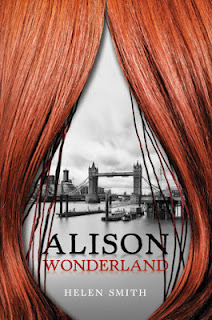
Alison Wonderland
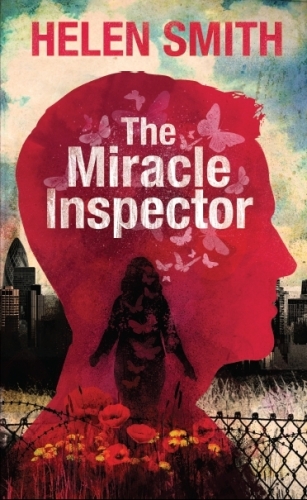
I also have casting ideas for my two Alison Wonderland books, including Alison and her boss at the private detective agency where she works in London. I also have casting ideas for my dystopian novel, The Miracle Inspector.
9780956517043

It’s great fun. The only problem? Finding male actors to play the younger main characters in my books. All my fantasy casting ideas – except for Ben Wishaw as Lucas in The Miracle Inspector – are horribly out of date. I need someone like John Corbett in his Northern Exposure days but twenty years younger to play Alison’s love interest in Alison Wonderland and Being Light.

If you have any fantasy casting ideas for any of my characters, they will be gratefully received!

helensmith

You can find Helen Smith here:

Helen Smith’s blog: http://www.emperorsclothes.co.uk
Helen Smith’s website: http://helensmithbooks.com
Helen Smith on Twitter: http://twitter.com/emperorsclothes
Helen Smith’s books on Amazon: http://smarturl.it/helensmithbooks
Helen Smith on Pinterest: http://pinterest.com/emperorsclothes

Catriona McPherson: A Deadly Measure of Brimstone Sunday, Nov 30 2014 

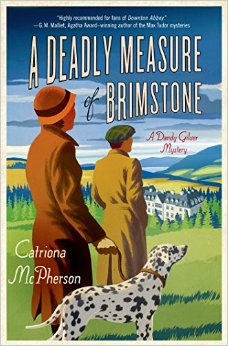
Deadly Measure
Auntie M loves the cover art of Catriona McPherson’s newest Dandy Gilver Scottish mystery, A Deadly Measure of Brimstone. The strong series, among other awards, won the Bruce Alexander Memorial Historical Mystery Award in 2013 and 2014.

But she liked the inside even more, as Dandy moves her two sons and husband, all recovering from a bout of the nasty chest illnesses which reach to the staff, to the spa town of Moffat to recuperate. Dandy has her own agenda to install central heating when the family is gone, and has neglected to mention this to her husband, Hugh.

Of course, with Dandy it’s never that simple. She and her partner Alec agree to take on a case to investigate the death of a woman who died suddenly at Laidlaw’s Hydropathic Establishment. Mrs. Addie’s grown children have written to ask Gilver and Osborne to look into their mother’s death, termed heart failue, which her children insist was not Mrs. Addie’s health issue before this visit.

It seems fairly simple: have Hugh and the boys treated and give them time to recover whilst investigating the death. Even aging dog Bunty comes along for the trip. But nothing is ever that straightforward with Dandy,
who soon finds herself disrobing to take saunas, cold baths, and salt rub massages all in the name of finding the evidence they seek.

With Alec also at the Hydro, the duo will find spirits, mediums, an even an after-hours establishment at the Hydro, run by Dr. Dorothea Laidlaw and her brother Thomas, who inherited the spa from their father.

McPherson gets the period details just right, from clothing and manners to the way people spoke in 1929. And Dandy’s humorous and slightly irreverent thoughts are on full display, as when Dandy and Alec endeavor to describe Mrs. Addie: “Thrashing out a description which honored her memory – one could not simply say she looked like a piglet in tweeds …”

Great fun that encapsulates the bygone Golden Age era from this award-winning author.

Maia Chance: Snow White Red-Handed Sunday, Nov 16 2014 

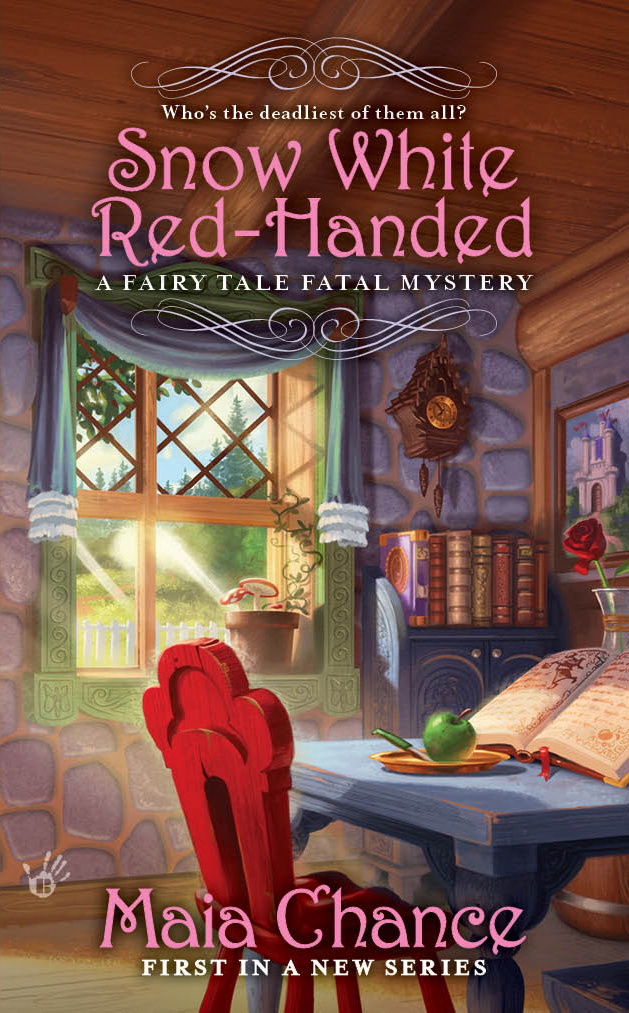
Please welcome author Maia Chance. To be entered to win a copy of SNOW WHITE RED-HANDED, leave a comment~
snow white red handed

Bit Part Firecrackers

A reader recently asked me, “How do you create your secondary characters?”

This isn’t talked about much—we writers adore rhapsodizing about our fierce/vulnerable/dauntless/altogether fascinating sleuths and sidekicks instead. But cozy mysteries are character-driven stories, and that refers to all of the characters.

Snow White Red-Handed, my newly-released historical cozy mystery, trots out an eclectic cast of secondary characters, from castle servants and a casino owner to a mysterious Russian princess and an ungainly stepsister. And so—in answer to my Gentle Reader’s question—here is my checklist for secondary characters.

1. They are Fleshed Out.

This applies even to secondary characters who have only one speaking line. Why? Here’s something special about a whodunnit-style mystery: since many of the secondary characters are murder suspects, that means that one of them is really a primary character: the villain. Trippy, right? So, every one of the suspects must have enough punch and intrigue not to seem like a random killer when the truth comes out at the end. My rule of thumb is that everyone has a secret even if it’s not THE secret.

2. They Provide Variety.

Secondary characters can create dimension not provided by the main characters. In Snow White Red-Handed, for instance, I explore class and nationality not only through my sleuth Ophelia Flax (American variety hall actress) and her romantic interest (privileged British professor); I also have a family of American upstarts with a fortune made in the railroad and down-at-heel German servants. And I was able to explore varied settings through secondary characters, too. Because of a couple of sinister guards, the protagonists are lured into a horseback chase through the forest, while my bombastic lady naturalist leads the sleuths to a luxurious health sanatorium. What is more, each of these characters is distinctive in appearance, dress, and mode of speech. Mr. Smith, the American millionaire’s private secretary, speaks like this:

“Like California? Haw! The Black Forest is about as much like California as one of them Arabian racehorses is like a Mexico donkey. Oh, that’s a hoot! No, one thing’s certain, and it’s that I’ve got to get myself back to some real wilderness. That durned police-man, Schubert, has forbidden us all to leave until he gets to the bottom of the murders, but I figure that’ll take about as much time as for him to learn to be a ballerina.”

3. They Provide Absurd (Comic?) Relief.

I admit, Snow White Red-Handed isn’t exactly a serious story. Early readers have called it “fun,” and I can more than live with that. Because even though I will never, alas, be as witty as P. G. Wodehouse (secret fantasy of mine), I do want my books to be at least mildly amusing. I find that my secondary characters, behind my back, tiptoe again and again over the threshold into Absurd Territory. Here is one of the descriptions of the lady naturalist and her elderly, consumptive employer, two characters I immensely enjoyed writing:

“Miss Gertie posed like one of those Viking ladies at the opera, all blond braids and magnificent bosom, in an arched doorway at the far end of the dining room. All that was missing was one of those helmets with horns. She gripped the handles of a wicker wheelchair, which was occupied by what appeared to be a heap of black wool with a white wig.”

4. They Provide Historical Dimension.

Here’s something people have been asking a lot about: how I came up with the attitudes of my German fairy tale scholar, Professor Winkler. His snotty belief that fairy tales are merely the product of debased “peasant” minds is derived from an actual historical essay written by James Russell Lowell (a Harvard professor) in 1870. There was no way I could’ve made it up; Lowell’s assertions have that special outlandish-yet-real flavor. (This is why I compulsively read Wikipedia articles: truth is way, way weirder than fiction.)

5. They Enhance Themes and Motifs.

In Snow White Red-Handed, secondary characters embody or enact themes and motifs from the fairy tale “Snow White and the Seven Dwarves.” For instance, from the fairy tale I pulled the theme of beauty tied to a mother-daughter relationship. Next, I explored that theme through the avenue of the secondary character Prudence Bright, whose actress-and-courtesan mom taught her to value her looks and feminine wiles above all else. As another example, “Snow White” has that little detail about the Wicked Queen wanting to eat Snow White’s liver (or lungs, or heart, depending on the version), so in Snow White Red-Handed I HAD to go there:

“Luncheon, by the by,” Winkler said to Mr. Coop, “was superb. The sautéed liver! Your cook is a sorceress. Did you bring her from America?”

Truthfully, there are lots of writing days when my secondary characters are vastly more amusing to play with than my main characters. On those days I feel like I should, like a theater manager, pull the exuberant bit part actor offstage with a cane. Yet sometimes I indulge, and let them bask in the limelight a moment or two longer.

BIO: FEM_0463 web

Maia Chance writes historical mystery novels that are rife with absurd predicaments and romantic adventure. She is the author of the Fairy Tale Fatal and The Discreet Retrieval Agency series, and her first mystery, Snow White Red-Handed, is available now from Berkley Prime Crime.

Maia is a candidate for a Ph.D. in English at the University of Washington. This means that the exploits of Fairy Tale Fatal’s heroine, variety hall actress Ophelia Flax, were dreamt up while Maia was purportedly researching 19th-century American literature and fairy tale criticism. The Discreet Retrieval Agency series was born of Maia’s fascination with vintage shoes, automobiles, and cocktails combined with an adoration of P. G. Wodehouse and chocolate.

Upcoming titles include Come Hell or Highball (St. Martin’s Press, 2015) and Cinderella Six Feet Under (Berkley Prime Crime, 2015). Maia lives in Seattle, where she shakes a killer martini, grows a mean radish, and bakes mocha bundts to die for.

LINKS:

WEBSITE: maiachance.com
FACEBOOK: facebook.com/MaiaChance
TWITTER: twitter.com/maiachance
GOODREADS: https://www.goodreads.com/author/show/8127322.Maia_Chance

Tony Parsons: The Murder Man Wednesday, Nov 12 2014 

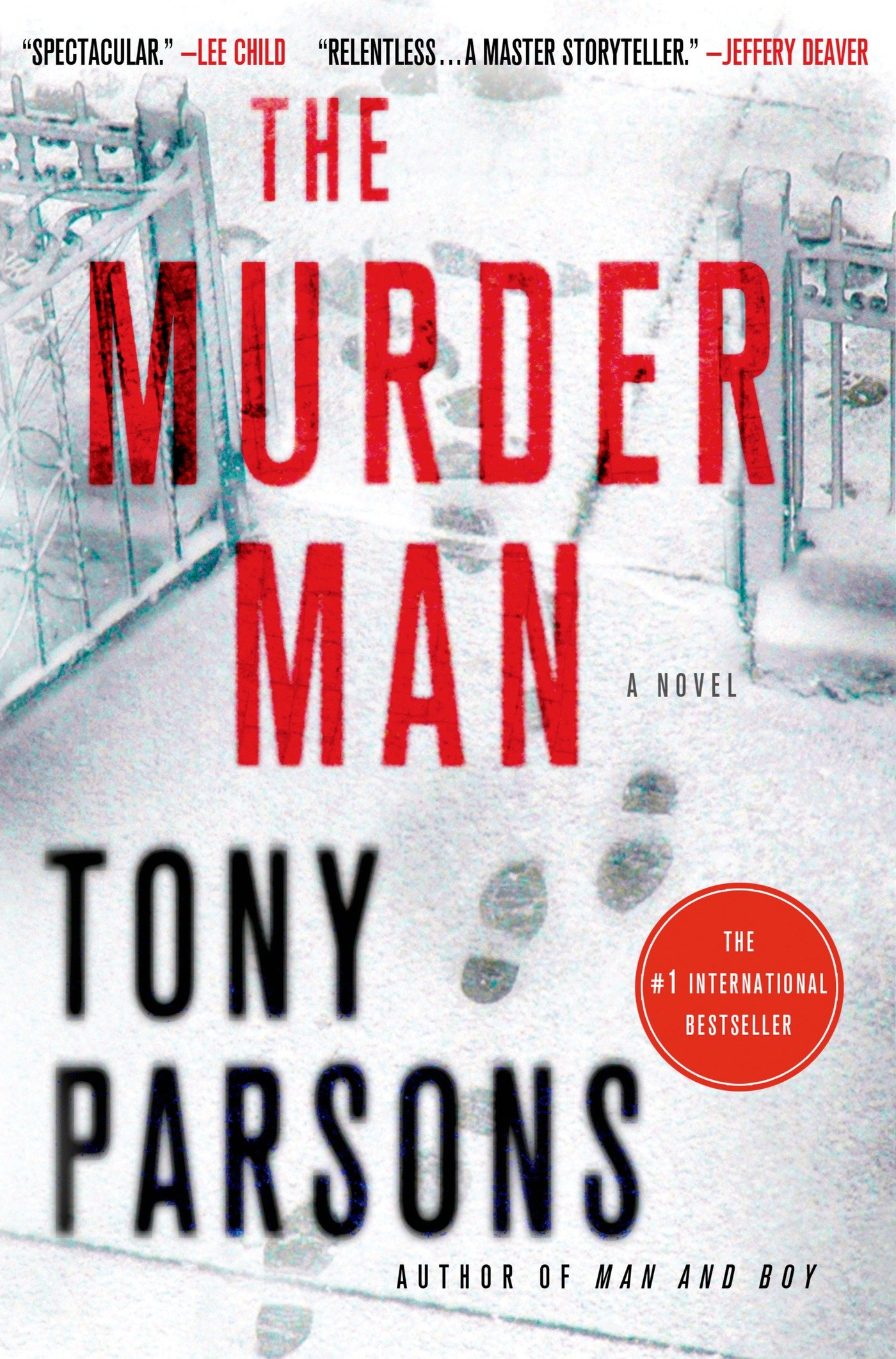
murderman Journalist and internationally-known author Tony Parsons turns to crime, introducing London police detective max Wolfe in The Murder Man.

The book opens with a strong introduction: “I was waiting for a man who was planning to die.” It then recounts Max’s conviction and actions that save the day and become the catalyst for his transfer to the Homicide and Serious Crime Command to work under DCI Victor Mallory.

Despite his love for dogs and coffee, coupled with insistent insomnia, this single parent is tenacious as he tackles the trail of serial killer who cuts throats and gets away without leaving evidence behind. The first victim, investment banker Hugo Buck, has a lovely wife he abuses and a history that is sparked by a photograph he keeps on his desk: what looks like seven young soldiers in the 80’s.

The photograph is a key clue for Max as the killings continue and it becomes obvious that the young men in that photograph are targets. And it’s up to Max to find the perpetrator before they’re all murdered.

With his young daughter, Scout, a reasonable housekeeper in the form of Mrs. Murphy, and that adorable King Charles Cavalier Spaniel, Stan, Max struggles to keep up with this canny killer. But don’t let these domestic details fool you into thinking this is anything resembling a romantic read. There is pathos in Max’s home situation as he struggles to adjust to raising his daughter alone and is determined to do right by her.

There are also some lovely lines in here that add texture to Max: “I tried to look beyond the blood and the horror. I tried to look at what had once been a man.”

This is an auspicious opener for what promises to be one heck of series and Auntie M is looking forward to the next installment. Highly recommended.

Sisters in Crime: Four Mysteries Sunday, Nov 9 2014 

As a member of Sisters in Crime, Auntie M has found a community that sustains her when facing that blank white page that proscribes the daily writing life. A huge part of that organization is the support the members give each other on so many facets of writing, from craft to legal issues, from deadly poisons to process to marketing and blog tours.

So today she’s highlighting four Sisters (and a Mister!) who have books for your reading pleasure.

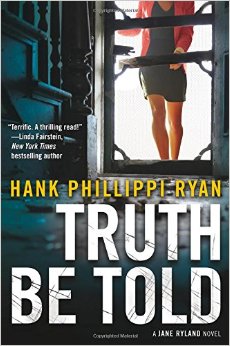
truthbetold Hank Phillippi Ryan’s Jane Ryland series echoes the author’s own history as an investigative reporter. In Truth Be Told, the award-winning author brings her insider’s knowledge to a different kind of case: middle-class families caught in the housing foreclosure debacle who are evicted from their homes.

At the same time, her relationship with Boston police detective Jake Brogan has hit a snag. The long-awaited vacation they’d planned has to be cancelled when someone suddenly confesses to the twenty-year old murder called the Lilac Sunday Killing, the unsolved case that haunted Jake’s grandfather. With evidence mounting that the confession might be phony, Jake delves into his grandfather’s basement files on the original case.

With the strain of keeping their personal lives separate from their jobs, and that line crossing more than either of them expect, things heat up when murders start to occur in the supposedly empty homes of evicted families. Enter the daughter of a bank president, a young woman with her own special accounting system, and the cases take off, each from their own perspective.

Ryan does a nice job of bringing these two story lines together while Jane and Jake struggle to hold onto their relationship in the midst of misunderstandings and the differences of their jobs as they each try to figure out who’s behind the murders, and why someone would confess to a murder they didn’t commit.

demon-3
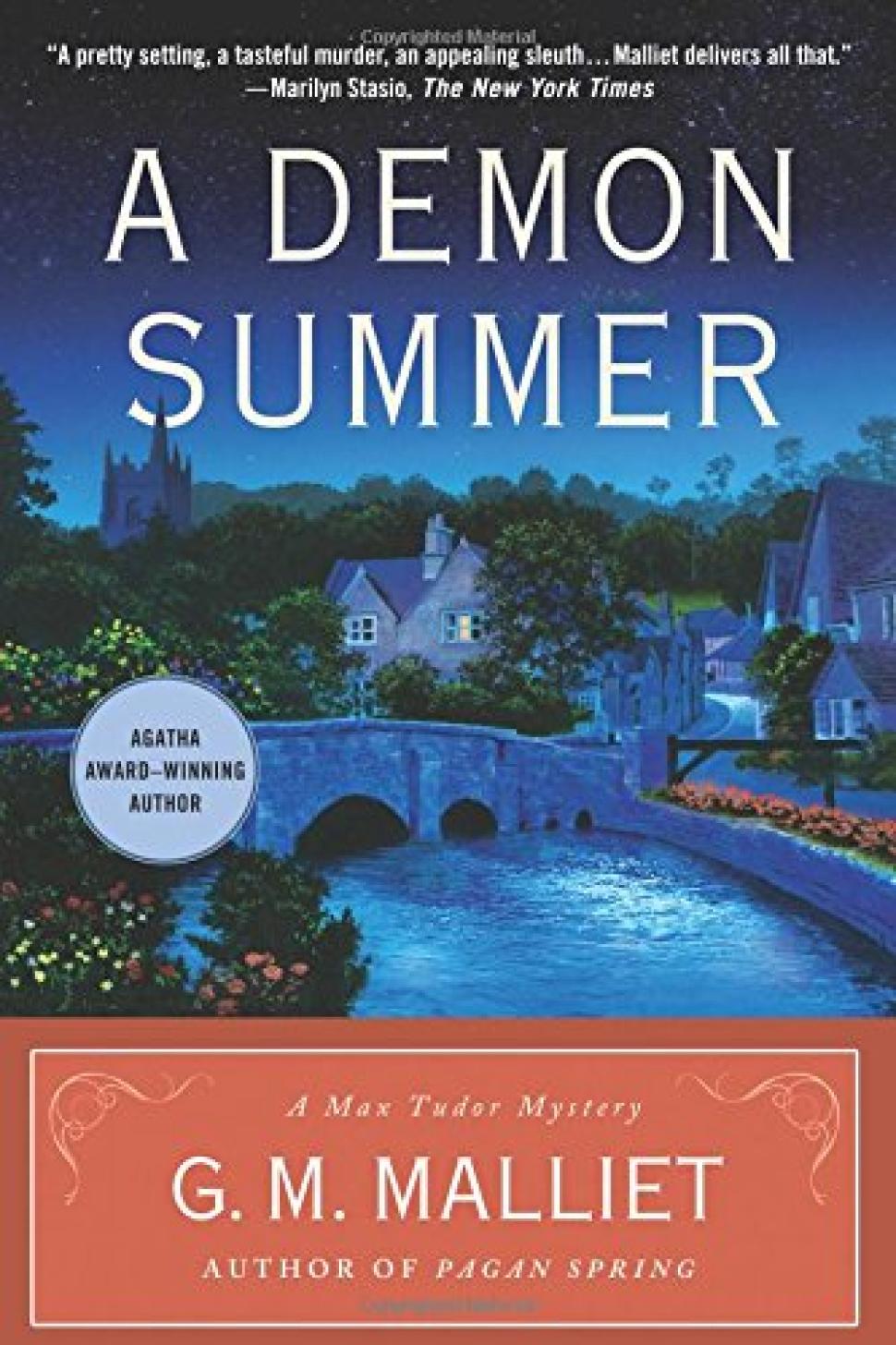
G. M. Malliet’s Max Tudor series takes readers to the charming English village of Nether Monkslip, where the former MI5 agent has carved out a new life for himself. In A Demon Summer, the heat isn’t the only thing that has Max sweating: he’s soon to be a parent with his beloved Awena, and has yet to tell his Bishop of that development.

This is kind of mystery that isn’t built on action but on thoughtful investigation, as Max is sent by the Bishop to Monkbury Abbey after it seems their fruitcake was the vehicle used to try to poison the 15th Earl of Lislelivet. Tasked with discreet inquiries just at the time he’d rather be home and planning his marriage, Max nevertheless takes the job seriously and sets off to the remote abbey, home to nuns who are part of the order of the Handmaids of St. Lucy.

Amidst rumors of buried treasure regaling that of the Holy Grail, Max finds the cloistered order living their lives plainly, bound by rules and bells calling them to prayer. Along with the Lord back for a second visit are a philanthropic American family, an art gallery owner and a photographer, all sharing the guesthouse when Max arrives to begin his investigation.

There will be tales of funds going missing or misappropriated, of poison berries, or family tragedies–and then the Lord’s body is found down the well and Max must kick his investigation into overdrive. A device Malliet uses is chapter epigrams from The Rule of the Order of the Handmaids of St. Lucy. Great fun and with a Poirot-like ending where the little grey cells of Father Max have figured out what’s really happening behind the abbey’s walls.

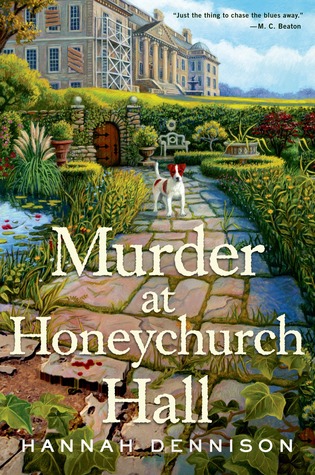
murderhoneychurch Across the pond, Hannah Dennison, author of the Vicky Hill mysteries, debuts a new series with Murder at Honeychurch Hall.

The Devon setting, home to Agatha Christie’s Greenway and where she grew up, seems like a character in this humorous opener featuring Katherine Stanford, known to as Kat, a television celebrity leaving that life behind, who thinks she’s getting ready to launch the antique business she’s always wanted to run. Her partner and newly-widowed mother, Iris, has a huge surprise that throws a wrench in Kat’s plans: instead of going into business in London with Kat, Iris has bought a seriously dilapidated carriage house on the grounds of Honeychurch Hall, hundreds of miles from London.

With her partner David away for the weekend, Kat drives to Devon to see what kind of fix Iris has gotten herself into after breaking her hand, and discovers a host of characters that pale beside the ones Iris has been writing in her racy romances.

This is a modern-day Upstairs, Downstairs in some respects, with a lot of humor thrown into the mix as Kat at arrives at the Honeychurch Hall Estate on the River Dart and becomes involved in a family struggle to keep the estate intact as opposed to selling to developers. Iris’ part in all of this conflict is a puzzle to Kat, and its revelation will let Kat realize she doesn’t really know Iris at all.

The changes extend to Kat, with the vision she had for life after her television show needing to be rewritten. She begins to reconsider her fiancé, still married to Kat’s nemesis, and dragging his feet on the divorce. Devon proves to be anything but the boring out-of-the-way backwater Kat was expecting. There will be ghosts, an older countess and a young girl, the early death of the Lord’s first wife, as well as a Detective Inspector named Shawn who gets thrown into the mix when the manny goes missing– a DI whose phone ring tone is a steam engine. Things heat up with a murder as Iris’ past comes into play, and Kat decides she needs to rethink her future plans. This is the set up for a continued series in a delightful setting.
unwillingaccomplice
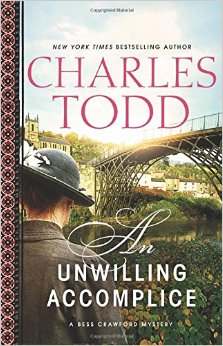
The mother/son writing team of Charles Todd have written their sixth Bess Crawford mystery that marks the 100th anniversary of the start of World War I. An Unwilling Accomplice finds the nurse and sleuth home on leave and assigned to accompany a wounded solder to Buckingham Palace for the King’s award.

Bess is smarting from the apparent loss of a patient, facing an inquiry by the army and her nursing service. But the fact that the hero was wheelchair-bound and shouldn’t have been able to leave his hotel on his own hasn’t seemed to clear her. She was assigned to care for the ailing Sergeant Wilkins when his orderly heads back to the battle lines. What she doesn’t expect is for her patient to go missing when she leaves him at his hotel room for the night. With the mores of the era, it isn’t proper for a woman, even a nurse, to stay in the man’s room overnight. But how and when did Wilkins go missing?

With Bess’ professional credentials being called into question, she faces scrutiny from her boss as well as having to answer to the local police as to why she simply let a man go missing.

Then her lost hero is found: Wilkins has been sighted in Shropshire, with a witness claiming he’s committed murder. Bess swings into action to find Wilkins and tries to get to the bottom of his actions. Constricted by the mores of women traveling alone and hampering her investigation, she enlists family friend Simon Brandon to help solve the mysterious disappearance, restore her reputation, and clear her name. It’s the only way to save her own reputation–before a possible deserter kills again.

The Todd’s bestselling series featuring Ian Rutledge also carries their accurate historical illustration of the era. This latest entry continues that atmospheric and realistic portrayal of this time period with vivid details and a complete grasp of setting.

Holiday Goodies #2 Wednesday, Dec 18 2013 

Auntie M gave you a great listing last time of good books for gifts for readers. Now she’s going to give you a huge compendium of wonderful reads in different categories for those last minute gifts. And then take off between Christmas and New Year’s 🙂 To all a good night and a wonderful holiday season. Here are some great ideas for gifting and don’t forget to gift yourself in the process!

For fans of the Tried and True Series:

crossVal McDermid is one of Auntie M’s favorite authors. Every stand alone, each series, all of the books shine with the craft of a wordsmith who understands people and manages to add complex plots that keep your interest and your mind reeling.

Cross and Burn is the latest in the Tony Hill-Carol Jordan series and you will be shocked and surprised at how she handles the complicated rift in their relationship.

The effects of the last case (The Retribution) has left the two estranged and both blame Tony for the havoc a sick killer brought into Carol’s life. She’s been on extended leave, with no one seeing her for the past three months.

He’s been cut from his service to the police and is working full time at a nearby psych hospital and living on a long boat.

What neither expects is a killer with a penchant for murdering women, and how that case will bring a connection neither Hill or Jordan can ignore. As Paula McIntyre works to adapt to her new position and investigates what soon becomes a series of murders, one thing soon become clear: all the women bear a disturbing resemblance to Carol Jordan.

And then the unthinkable happens when the evidence points to Tony Hill and he finds himself behind bars.

This one will keep you turning pages as all of McDermid’s do and you won’t want it to end but will race to find the conclusion anyway. Somehow McDermid always manages to keep her stories fresh and her ideas intriguing. Highly recommended.

Julia Spencer-Fleming kept fans waiting for the next in her series featuring the Episcopal priest Clare Fergusson and her police chief, Russ Van Alstyne. evil-days-new-lg

Through the Evil Days finds the newly married couple finally stealing away for a honeymoon. With Clare’s pregnancy evidently preceding their marriage, she faces trouble with her diocese for conduct unbecoming a priest.

Although there is an arson case on board, Russ leaves the case to his deputies to take Clare for a week of ice fishing in a lakeside cabin in the Adirondack’s he’s hoping she will agree they should buy.

Running between the couple is the difficulty Russ is having with the idea of Clare’s pregnancy, unplanned and unanticipated after agreeing they would not have children; but now a fact she is willing to accept and which threatens to drive a wedge between the couple.

Trouble comes early in the form of a suspected kidnapping in their vacation neighborhood whose tendrils reach into the arson case.

A snowstorm blankets the area and makes travel impossible, with frigid weather an added element to fight besides the meth heads whose hideout they stumble across.

With officers Hadley Knox and Kevin Flynn struggling to work out the case in the midst of their own relationship issues, there’s plenty of trouble to go around.

Soon the trouble comes too close to their cabin and Russ and Clare will be fighting for not only their own lives, but for that of their unborn child.

The-Ravens-EyeBarry Maitland’s Brock and Kolla series returns with his twelfth entry, The Raven’s Eye.

While Brock as DCI must wrestle with budget cuts and a new Commander at work, DI Kathy Kolla’s instincts kick in when she’s called to investigate what appears to be an accidental death on a narrow boat.

Vicky Hawks lived on the houseboat and is found by one of her neighbors, the apparent victim of carbon monoxide poisoning. The poor ventilation system on the boat supports that and nothing at the crime scene seems out of sort.

Kathy’s patience will be tested as she teases out information about the dead woman from those around her.

There will be doctors and scientists and a case of wrong identity as Kathy follows a trail that keeps doubling back on her. Who was Vicky Hawks and why would anyone have wanted her dead?

This one is well-plotted with dead ends that keep frustrating Kathy as much as the budget cutbacks that ruin Brock’s day. And when it appears Vicky’s death may be related to a previous murder, they know they are facing a shrewd killer who will stop at nothing to keep the status quo.

What adds a deep layer to this one is the world if surveillance and how it can be used to help and to hinder. A fine and shrewd mystery.

Other series winners: M. R. Hall’s Coroner Jenny Cooper returns in The Chosen Dead. Finished with therapy for the debilitating panic attacks she’s had for years, Jenny is trying to salvage her relationship with her son, Ross, and her lover, Michael. Somehow the death of an Arizona research scientist and his Russian counterpart seeking asylum become part of Jenny’s case when a young man leaves his toddler son and leaps to his death off a traffic bridge onto the highway. The dead man’s wife insists her husband would never commit suicide–and Jenny finds herself agreeing.

Inger Ash Wolfe’s A Door in the River brings back the unusual detective Hazel Micallef in the Canadian town of Port Dundas. Struggling with a new commanding officer as the policing is being rearranged, disturbed by her mother Emily’s apparent depression, the death of friend Henry Wiest of a heart attack after a bee sting hits her hard. But what was Henry doing near Queesik Bay outside a smoke shop, because Henry didn’t smoke? What follows is a disturbing tale of human trafficking and a traitor in a most unlikely place.

Alison Bruce brings DC Gary Goodhew and Cambridge to life in The Silence, when a series of  suicides appear to Gary to be much more than they seem on the surface. To make matters worse, one of the deaths is related to an earlier case of his, a gruesome death he’s never forgotten. And then there’s the subject of is inheritance and how he is or is not handling that.

Aline Templeton’s DI Marjory Fleming is a great character, a Scottish detective inspector married to a sheep farmer. She’s back in rare form in Evil for Evil, when murder strikes the little village of Innellan, perched on the Fleet Ba towards a series of small islands. Old scores to settle, soldiers with past secrets and even dead babies all come into play in this satisfying addition to the series.

And don’t forget Barbara Vine (Ruth Rendell) in her book-within-a-book, The Child’s Child, a complex story of siblings, friendship and cultural history from the master of psychological suspense.

For something New and Different:

Carla Norton takes her experience working on a real 1977 kidnapping case, where the victim was held for seven years, and uses it to bring a most unusual 1728neggers6850new protagonist to the page with a high degree of authenticity in The Edge of Normal.

Twenty-two year-old Reeve LeClaire is making a life for herself in San Francisco, working part-time, and seeing psychiatrist Ezra Lerner. Dr. Lerner is an expert on captivity syndromes and has slowly gained Reeve’s trust after her own harrowing experience, which is parsed out in an intriguing manner.

Working as a waitress, she is living in her own apartment and trying to feel normal while repairing her relationship with her family.

Then kidnapped teenager Tilly Cavanaugh is rescued after being locked in a basement for over a year. Tilly asks to speak with Reeve about her own experience and survival, and Lerner feels it may help Reeve to be of help to another teen and asks her consider it.

With the confessed kidnapper in custody, there should be little threat to Reeve. But Tilly is hiding a secret, one she will only share with Reeve. And soon it appears there are at least two other teens who have gone missing in similar circumstances in the past two years. Could either of them still be alive?

Soon Reeve is doing a bit of investigating on her own, assisted by the liaison assigned to Tilly, Deputy Nick Hudson, who works with both the district attorney’s office and the county sheriff’s department.

What they can’t know is that someone with the perfect cover is monitoring her every move, and Reeve is in more danger than she could ever anticipate.

This is a chilling thriller which becomes quickly engrossing as much as it gives insight into kidnap victims. The best aspect is Reeve’s refusal to see herself as a victim, and one can only hope she will reappear in a sequel.

TheRedQueenDies_CoverIn the not-too-distant future of 2019, The Red Queen Dies is the newest novel by author and criminal justice professor Frankie Y. Bailey.

In an all-too believable scenario. she takes a hard look at criminal law and what police work will become, set during a time when there is a drug available that will allow victims of brutal crimes to erase the memory of their attacks. “Lullaby” also takes away evidence as witnesses lose these important points of recall.

This happens to Detective Hannah McCabe, working in Albany, and hits home when a witness is given by the drug. With a killer on the loose, she needs all the witnesses she can find.

Then the killer’s third victim becomes actress Vivian Jessup, nicknamed the Red Queen for her hair color and for her dedication to Alice in Wonderland. Her extensive collection of Lewis Carroll and Wonderland memorabilia is legendary.

Is The Red Queen’s death connected to the first two? Or is there a savvy killer out there trying to tag his murder onto the other two.

Written with a wry sense of humor from Hannah, Bailey succeeds in showing the heat of an Albany September just out of reach of today.

Readers who appreciate a highly original approach will appreciate this fast-paced mystery featuring a biracial detective from a literary family who decides crime is her game.

For Historical Fans:

Award-winner Catriona McPerson brings back aristocratic-turned-detective Dandy Gilver with Dandy Gilver and a Bothersome Number of Corpses. 9Dandy781250030009.340x340-75

For fans of , this series set in 1920’s Scotland continues to charm with the cases of Gilver and Osborne.

This time Dandy responds to the frantic call from an old friend, one of three sisters she has fond memories of, and soon finds herself traveling to a girls school where one of the sisters, Fleur, has been teaching.  It seems teachers are disappearing at an alarming rate.

Soon Dandy finds herself at St. Columba’s in the seaside town of Portpatrick, where Fleur is less than pleased to see her old friend.

It seems Fleur is convinced she’s responsible for four or even five  deaths and it’s up to Dandy and Osborne to get to the bottom of such nonsense.

There are murders and kidnappings and enough secrets to keep the coziest person happy.

This pleasing series has been optioned for television by the BBC, where it will no doubt find a popular home.

dunnCarola Dunn follows  A Colourful Death in her Cornish mystery series with the third installment The Valley of the Shadow.

It’s sometime in the 1960’s or 70’s, before the advent of computer or mobile phones, and Port Mabyn may be a fictional village but the rest of Cornwall as Dunn describes it is real and lovely.

Series regular Eleanor Trewynn has retired in her widowhood after being a world traveler to be near her niece Megan Pencarrow, a detective sergeant with the local police.

But Eleanor is by no means a shy or retiring widow and in the past has helped do more than her fair share of investigating, aided by her dog, Teazle. In this volume, out along the seaside cliffs for a walk with Teazle and her neighbor, artist Nick Gresham, they spot a half-drowned Indian man afloat in the water.

With no identification, saved from the brink of death, the young man is taken to the hospital while Eleanor and Megan try to find out who he is and how he came to in the water in their remote area of Cornwall.

There will be talk of Immigration, of smugglers and caves, of family needing to be rescued, and Eleanor and Megan will be in the thick of it.

The duo Charles Todd became known for the Inspector Ian Rutledge mysteries, but they’ve had equal success with the Bess Crawford mysteries and return with 978Todd0062237170_p0_v2_s260x420A Question of Honor. English nurse Bess manages to find herself in the middle of a criminal investigation in the series which vividly describes the horrors of war.

The time is near the end of WWI and Bess is brought back to memories her childhood in India, where her colonel father was stationed. Despite her happy memories, the dark cloud of that time was the murder of five people by an officer from her father’s regiment who was never brought to trial.

It has remained an issue for Bess and her family because her father had trained this man.

Now tending to the wounded in France, Bess learned from a dying Indian sergeant that this murderer, Lieutenant Wade is alive and indeed, serving at the front.

She’s shocked and determined to find out how he had escaped–and what had driven him in the first place to commit murder when her beloved father had placed such faith in the man.

The bulk of the book concerns Bess taking leave to investigate Wade, and she’s surprised by what she learns from different witnesses.

It will take all of her wiles and intelligence to piece together the reality of the murders from years ago, and she will end up enlisting her mother and father in a fascinating twisted ending that will involve Rudyard Kipling.

97803tremayne12658625Going back to Ireland AD 670, Peter Tremayne has a huge following with his series featuring Fidelmma of Cashel.

This time Fidelma’s brother enlists her aid investigating the murder of a nobleman in The Seventh Trumpet.

For those unfamiliar with the series, the protagonist is not only the sister of a king, but a dailaigh, an advocate of the Brehon Law Courts.

With the help of her companion Eadulf, they try to find out if the murder could be tied to a violent wave running through the western lands.

In those parts a fanatical figure claims to have been summoned by the seventh angel with the express desire to remove those impure of faith.

Despite the number of bodies that begin to pile up, it remains to be seen how they are connected, and why in the midst of this turmoil, an abbot would turn his monastery into a fortress.

When Fidelma becomes abducated, it will be up to Eadult to rescue her while finishing their work and solving the mystery surrounding the deaths.

Tremayne does a fine job of describing a time period so remote to today’s reader, with authenticity and ties to the history of the time.

For Cozy Fans:

Mary Daheim’s newest Bed and Breakfast mystery, Gone with the Win, turns a different spin when Judith McMonigle Flynn actually gets her husband Joe to help in her investigation.This is the 28th in the long-running series and this time when Judith books a reservation for a Mary Smith from New York City, mayhem is sure to follow. And it does, in the form of a cold case “Mary” is determined Judith can help her solve.

The first in a new series, Rosemary and Crime debuts Gail Oust’s charming southern cozy, featuring amateur sleuth Piper Prescott, who owns a spice shop in Georgia’s small town of Brandywine Creek. Divorced and determined to bloom where she’s planted herself, Piper is a Yankee who’s pursuing her dream of owning her own business. But the grand opening takes a dramatic turn when the chef doing a cooking demo is stabbed and Piper finds herself the chief suspect. Filled with humor and a lot of sass, readers will get a kick out of Piper and her outspoken friend Reba Mae Johnson.

For Young Adult Readers:

John Grisham’s Theodore Boone: The Activist stars a 13 year-old whose history includes kidnapping and murder.   This is the fourth in the series starring the young

lawyer whose books can be read by the entire family.

Theo is a loyal friend to Hardie Quinn and gets justifiably upset when he learns the Quinn family home is about to be bulldozed for a bypass. This will affect other homes and businesses and even a school that lie in the path of the proposed bypass.

It’s tough for Theo to explain to Hardie that the law is not on his friend’s side and there’s not much that can be done.

Despite this, Theo joins in the campaign organized to stop the bypass and that’s when things gets really interesting. Theo finds corruption, but he’s learned it in an illegal way. How can he keep the developers from going ahead with his plan while exposing the corruption without breaking the law himself.

Any in this series provide thoughtful, engaging stories for young readers in the tween category.

images_068

Great Holiday Gifts for Readers #1 Sunday, Dec 8 2013 

For the next few posts, Auntie M is going to give reader gift suggestions for that reader on your list–and don’t forget it’s perfectly permissible to gift yourself!Poirotp0_v3_s260x420

Outsold by only Shakespeare and the Bible, Agatha Christie is the most widely published author of all time. Auntie M had the good fortune to visit her Devon home this this summer when in England. Greenway, on the River Dart, is just a few short miles from where Christie grew up and the home has been preserved as it was when she and her family were in residence, down to some of her clothes in her bedroom closet and her favorite lily of the valley in evidence on china jewelry boxes left on her nightstand. When entering her bedroom, a docent obligingly plays a brief taped interview of Christie talking about her writing process, and as her voice fills the room, her presence is felt everywhere. One expects hear the sound of her typewriter at any moment. The house was used as the setting for Christie’s Piorot novel, Dead Man’s Folly, and two others. The David Suchet/ITV televised version of the novel was filmed there. The home is only a brief ride from the seaside town of Torquay, where Christie frequently had tea with friends at The Grand Hotel across from the Torbay seafront. Don’t miss the chance to tour the house and lovely restored grounds that lead down to the river if you find yourself anywhere near this section of southwest England. But Auntie M digresses.

Golden Age writer Dorothy Sayers felt Hercule Poirot was “one of the few detectives with real charm” and there’s no mistaking readers’ fondness for the dapper Belgian, portrayed on television by actor David Suchet, causing Christie’s grandson, Matthew Pritchard, to regret she hadn’t lived to see his fine portrayal.

Now William Morrow has brought out a volume of over fifty of Christie’s short stories and novellas featuring Poirot, gathering them into one volume that would be the perfect gift for any mystery afficionado. Hercule Poirot: The Complete Short Stories has an introduction by Charles Todd. You cannnot go wrong with this one for any reader who enjoys mysteries, full stop. If Auntie M didn’t already own a copy, it would be the first thing on her list.

Morrow is also publishing Christie’s novels for e-book readers for the first time, so look for those, too.


Dennis Lehane teamed up with Ecco, an imprint of HarperCollins, to bring out a line of books he’s chosen. The second was Ivy Pochoda’s Visitation Street. pochoda-visitation_street

Vastly different from the usual crime novel, this is an exploration of the sociology of an urban area and surrounds the disappearance of a young woman in the rough neighborhood of Brooklyn’s Red Hook waterfront.

The setting is visually described, a reflection of Pochoda living across the street from a bar in the area and writing about the inhabitants she saw outside her window.

There are blocks to walk on and blocks to avoid; there are areas of gentrification and others of great demise, in a seemingly endless evolution that causes conflict between races and classes that she vividly and realistically describes.

June and Val are the two friends at the center of the story. The two fifteen year-olds are looking for adventure as summer is ending. June wants to find a party, but Val convinces her instead to forget boys and drinking and take a small raft out into the river.

When only Val returns, found semi-conscious in weeds along the shore, the story turns to exploring what really happened to June that night, and affects the community that suddenly becomes the focus of an investigation and will reveal the its secrets on more than one level.

The community’s response to June’s disappearance will be as varied as the complex but utterly believable characters Pochoda has created. Her lyrical prose led Lehane to comment: “Visitation Street is urban Opera writ large. Gritty and magical, filled with mystery, poetry and pain, Ivy Pochoda’s voice recalls Richard Price, Junot Diaz, and even Alice Sebold, yet it’s indelibly her own.”


Sue Grafton’s iconic Kinsey Millhone has given readers over thirty years of quirky delight with her singular reporting voice. W is for Wasted is the newest entry in the grafton wasted_p0_v2_s260x420series and fans won’t be disappointed.

The opening lines hook the reader immediately: “Two dead men changed the entire course of my life that fall. One of them I knew and the other I’d never laid eyes on until I saw him in the morgue.”

Kinsey doesn’t recognize the man she’s been called to the morgue to identify, but her name and phone number were found in his pocket.  He was a homeless man, known to sleep rough at times, and his body has been found on the beach.

Kinsey sets out to find out the man’s identity, not knowing how his death will merge with that of a murder six weeks earlier. A local private investigator Kinsey knows had been shot to death near the Santa Teresa beach in what looks at first like a robbery attempt that got out of control.

Things change dramatically when Kinsey identifies the homeless man and finds he’s linked to her in more ways than she could possibly image.

Grafton has kept Kinsey in first person throughout the series but recently added the points of view of several other characters in the later books. In this case, we see the dead PI, Pete Wolinsky, in third person and come to understand his last case and how it intersects with Kinsey’s own investigation.

All the usual people who are part of Kinsey’s circle are on hand, too, with some surprising additions. This is vintage and yet modern Grafton at her best.


Continuing with beloved series, we jump across the pond to England and Ruth Rendell’s Inspector Wexford, which will soon mark its fiftieth anniversary.17Rendell571848

Learning to adjust to retirement has been difficult for Reg Wexford in No Man’s Nightingale. He’s decided as a project to work his way through The Decline and Fall of the Roman Empire.

Therefore it comes as a great relief when his old deputy, Mike Burden, asks him to tag along on some of the interviews after a female vicar is found strangled in her Kingsmarkham vicarge. They are each having difficulty getting used to their new roles but their friendship remains solid and honest, a hallmark of the series. That Burden has recently become a grandparent, in contrast to the five Dora and Reg Wexford have by their two daughters, shows Rendell has not hesitated to age her cast as time has gone by.

Vicar Sarah Hussain had many detractors: those who don’t believe women should be ordained; those who don’t agree with her outspoken views on church reform; those who object to her mixed race heritage. Born of a white Irish mother and an Indian father, Sarah is a single mother to a teenaged girl.

Adding to the complications that involve Wexford is that the same woman who cleans for him and his wife, Dora, cleaned at the vicarage and found the body. Maxine annoys Wexford to no end when she cleans, yet now she’s become a part of this murder investigation.

When Wexford finds a letter at Sarah’s house she was using as a bookmark, he sticks it in his pocket to look at later, but it’s several days before he remembers it and then has to confess his transgression to Burden. But it provides a clue to the dead woman’s past; a past that may have impacted on her death.

Rendell does her usual fine job of complex plotting and revealing character, while maintaining the banter between Wexford and Burden.


Ten-Lords-a-Leaping-265Ten Lords A-Leaping is the third installment in C. C. Benison’s series featuring mystery-solving and thoughtful protagonist, Father Tom Christmas.

This is the perfect book for Golden Age fans who aren’t looking for action-packed thriller but rather the kind of classic Christie cozy wrote, but in a contemporary setting.

There are red herrings, a host of suspects drawn from amongst the rivalries of an aristocratic family, and even a touch of magic.

Fr. Tom has been talked into skydiving for a fundraiser for his Thornfield Regis church’s new roof  , a prospect that leaves him wondering what he’s gotten himself into. Back on the terra firma after a rocky landing that sprains his ankle, he’s shocked to see two of the remaining skydivers appear to tangle in a mid-air fight before finally landing safely. The two brothers-in-law are Oliver, the 7th Marquess of Morboner, and Hector, the 10th Earl of Fairhaven.

That sprained ankle finds the widower vicar, his daughter Miranda, as well as their housekeeper Madrun, all guests for far longer than expected at the home of Lord and Lady Fairhaven, Eggescombe Hall. The vast castle with enormous grounds boasts a pool, tennis courts, ornate gardens, and a gatehouse for the staff.

When Fr. Tom finds one of the two men dead in the labyrinth on the castle’s grounds, the murder sets off a thinking man’s puzzle for Fr. Tom to solve.

Bennison thoughtfully provides a cast of characters and a family tree so readers can understand the quite complicated relationships between the many people staying on at the Hall. Bigamy, sex after hours, art forgery, and lies will all find their way into the mix during the days it takes Fr. Tom to unravel the murderer, and not before a second death.  Readers who enjoy British whodunits will have a ball.


1766Helensmith9963Helen Smith is the author of Invitation to Die, originally published in episodes as a Kindle serial. The award-winning author of novels, plays, and children’s books, I had the pleasure of meeting Helen at Bouchercon this year and found her as funny and original as her heroine in this new series.

At 26, Londoner Emily Castles finds herself once again looking for employment.

So when famous romance author Morgana Blakely, aunt of Emily’s neighbors, asks her to help out at a weekend romance writers’ conference she’s organized, she can hardly say no. How difficult can it be to organize gift bags and help out with a dinner?

When Emily shows up at the hotel, she’s immediately pressed into service and meets an odd assortment of attendees, some nursing old grievance, some holding hidden secrets, all determined to out do each other for the fans who will be present. There’s even an American blogger whose been invited to be a guest, but for some reason, Winnie Kraster hasn’t shown up.

Emily dutifully takes a call for Morgana and it’s from the missing Winnie, saying she’s been delayed. But hours later, a woman’s body is found on the estate bordering the hotel and it’s poor missing Winnie.

Detective Rory James is assigned to investigate the case, and it happens Emily met him when he was a constable. When Emily confides that she suspects someone involved with the conference is the murderer, Rory disagrees, hardly a happy event at a romance festival. Emily takes notes of things that occur to her or that she overhears, but it’s not until she has the help of philosophy professor Dr. Muriel that the pieces come together for her.

This is brain candy, as sweet as the violet cremes a chocolatier with a secret delivers to be put in each guest’s gift bag. Smith gives vivid scene-setting and over-the-top characters as suspects.  The humor is tongue-in-cheek about blogging, book reviewers, and writers. Emily Castles was introduced in a previous short story but will appear soon in her next adventure.


David Rosenfelt writes thrillers, too, but any of his Andy Carpenter novels  would make a great addition to anyone’s shelves. With his humorous bent alternating  with suspense, the series4000000leader00000000733689_s4

continues with Leader of the Pack  now in paperback. Andy is a lawyer and dog lover, and his own dog, Tara, accompanies him and is often a better judge of character than Andy. On the side, Andy runs a dog rescue, which mirrors Rosenfelt’s real life. More on that later.

One of Andy’s less successful cases led years ago to a murder conviction for his client, Joey DeSimone, but Andy has always believed the man innocent of the murders of Karen and Richard Solarno.

As a favor to Joey, Andy agrees to check on the man’s elderly and forgetful uncle, taking Tara along for the visits. Nicky Fats falls for Tara but once he starts muttering about taking out someone else, Andy’s interest clicks. Could Nicky know, in the confines of his confusion, who really murdered the Salerno’s? And how can Andy find out and get Joey a new trial?

With the help of his friends, Andy launches an investigation into the business dealings of Solarno’s company and soon finds himself almost dying. Coupled with other information he unearths, he’s able to convince a judge to give Joey a new trial.

This is where the fun starts, as the trial scenes will reach a verdict that gives Andy’s heart a twist. And then he really figures out what’s been happening.

This is a complex plot, despite the humor and the presence of Laurie, Andy’s love interest, and several friends from the series making reappearances. There will be the drug trafficking, the involvement of the FBI, and don’t forget the family business of the DeSimone’s, the Mafia.

While Rosenfelt manages to keep things light, he balances it nicely with intrigue, action, and a satisfying ending that ties up all the ends. And then some. An additional touch is the listing he adds at the end of every book of Acknowledgments to friends who happen to be famous, or maybe not even people, as in this volume where Andy and Cherry Garcia show up alongside Woody and Gracie Allen and Neil and Hope Diamond.

By the way, there is a real Tara Foundation that helps find homes for sick or injured dogs. To date the foundation has rescued over 4000 dogs from shelves, and Rosenfelt often houses dozens at a time in his Maine house. Another reason to buy this book for any dog lover on your list.


Frances Fyfield: Blood From Stone Sunday, Dec 1 2013 

images_049Auntie M had the pleasure of meeting Frances Fyfield at St Hilda’s this August, where her riveting talk proved what I’d already suspected: here was an intelligent criminal lawyer who had a terrific knowledge of human character and was able to translate that into the highly complex and readable novels I’d always enjoyed. Fyfield worked as a lawyer for the Crown Prosecution Services, where she learned first-hand about murder. Though writing is now her main vocation, the law and its ramifications continue to inspire many of her novels.

Auntie M thought she’d read every Fyfield novel available: the Helen West series, the Sara Fortune series, and several stand-alones, all carefully crafted and thoroughly enjoyable to read for crime enthusiasts.

Therefore, it was a delight to find a new release of one she’d missed through Witness Impulse as an ebook: Blood From Stone, which won the Duncan Lawrie Dagger Award from the Crime Writers Association when it first appeared in 2008.

Marianne Shearer is at the height of her career, a dauntingly successful lawyer, respected by her peers and revered by her clients, even though those who know her well understand the ruthless nature that drives her.  Her latest case had again resulted in an acquittal, although the outcome was principally due to the death of the prime witness after Marianne’s forceful cross-examination.

Then why would she commit suicide in a dramatic and very public way?

Is it possible that this wholly professional and unemotional lawyer been struck by guilt or uncertainty, or is there some secret to be discovered in her rigid yet comfortable private life? Thomas Noble has been handled the job of executor of her estate. Her younger colleague Peter Friel is determined to find out of that last trial held the reason for her taking her own life. Together Noble and Friel will attempt to find out the reason Shearer felt she should end her successful and comfortable life.

The transcript of Shearer’s last trial holds intriguing clues, and excerpts from it give the reader a clear picture of Shearer’s scathing style in court and her ability to demean and demoralize the prosecutor’s witness. Then the sister of the last victim becomes involved and may be the one who holds the key to the truth. A most interesting woman in her own right, Henrietta Joyce’s sister had taken her own life after being subjected to Shearer’s style. Hen finds herself helping Friel and Noble unravel the secrets of Marianne Shearer’s life.

Fyfield has the ability to create fully-realized and very human characters who immediately capture the readers interest and Blood From Stone is a perfect example of Fyfield’s highly satisfying novels.

This January, Witness Impulse will be publishing two more classic Frances Fyfield titles, available to e-readers in the United States. Auntie M thoroughly enjoyed both of these and can highly recommend each book. The first is another stand-alone and the second is part of the Helen West series. Both illustrate Fyfield’s strengths in characterization, complex plots, and highly readable books that will have readers searching for others.

UNDERCURRENTS will be on sale January 7, 2014

For twenty years Henry Evans has been haunted by the memory of Francesca, the one who got away. When he travels to England to re-connect with his long lost love, what he finds is a horrific shock: Francesca is imprisoned for murdering her five-year-old son. But Henry refuses to believe Francesca is guilty, even if she did confess – in chilling detail – to drowning her own child.  In his search for the truth, Henry will find that the darkest of evils are hidden deep beneath the surface…

“Psychologically astute yet eminently readable, UNDERCURRENTS offers the tug of true suspense while probing the eerie confluence of love and loss.” – The Washington Post

DEEP SLEEP  goes on sale January 21, 2014 and was a CWA Silver Dagger Winner.

Pip Carlton is a devoted husband and a highly respected pharmacist, cherished by his loyal customers. When his wife dies in her sleep, with no apparent cause, he is distraught. Comforted by his caring assistant, Pip ignores the rumors about Margaret’s death, relieved that the police seem to have moved on. But Prosecutor Helen West refuses to believe that Margaret simply slipped into her final slumber. As she probes deeper into the affairs of the neighborhood, she uncovers a viper’s nest of twisted passion, jealous rage, and lethal addictions.  As a sudden act of violence erupts, shaking the community, one lone man, armed with strange love potions, prepares to murder again…

 Several of the Helen West series have been serialized for television and her novels have been translated into fourteen languages. If you haven’t discovered the treasure of of the work of Frances Fyfield yet, you’re in for a treat. Don’t forget her when you’re looking for holiday gifts for your reading fans, too.

Around the World in Crime: Norway, France, Iceland, Denmark and Venice Sunday, Nov 17 2013 

Auntie M’s reading list includes many fine Nordic and European authors she hopes you’ll investigate. These books are all great reads, and with the holidays approaching, make great gifts for the bibliophiles on your list.

blessed-are-those-who-thirst.jpg.pagespeed.ce.Y23Pst4KrgHanne Wilhelmsen is a police investigator first introduced in Holt’s Blind Justice. Blessed are Those Who Thirst finds her battling a brutal Oslo heat wave, which has set off a huge upward spiral in violent crime in the area. She’s balancing it all with an unsolved rape case which disturbs her.

The newest crime scene she is sent to baffles her at first: in an abandoned shed, covered with blood, an eight-digit number is scrawled in blood on one wall. Is it human blood?

But there’s no victim, at least none at this site. Is this a terrible prank or the mark of a more sinister killer?

More of these bloody crime scenes start to crop up, all in isolated locations throughout the city, all with different numbers. Then Hanne’s colleague discovers the significance of those numbers: they belong to female foreign immigrants who have gone missing.

As her team races to track down this killer, the rape victim and her father separately plan their own vengeance.

How these intersect, with horrifying consequences, will keep readers rooted to the page. This is a well-plotted mystery in a fascinating series.

Holt’s inclusion of Hanne’s domestic situation adds nice texture and reminds us that police personnel all have home lives.


Bernard Minier’s The Frozen Dead was first published in French with the title Glace`, but this translation loses none of the chilling aspects frozen1444732252-detailof the original.

Minier draws on little-known facts to build his suspense, from the bizarre psychiatric methods at some points, to the subterranean power plant that becomes a plot point.

When a headless horse is found suspended from a frozen cliff in southwest France, it annoys the city cop assigned to investigate. Servaz should be dealing with three teens suspect of killing a homeless man.

Yet he cannot ignore this highly unusual and disturbing crime as the rumbling of a cable car brings the horse’s corpse into view. Everyone in attendance is disturbed.

Only miles away, a young psychiatrist named Diane Berg embarks on a journey that will mean so much more than just a year’s assignment in the Pyrenees at the Wargnier Institute.

When DNA from the Institute’s most infamous inmates is discovered on the animal, it is the first hint to Servaz of the nature of the madment he seeks, and sparks a series of horrific murders.

There’s no escaping the cold as theme in this thriller, from the gritty settings to the dark, grisly deeds carried out in the names of healing, and of revenge.

Minier’s novel explains the complicated and different police investigation method of France’s system, which adds to the tone. Readers will look for more by this talented crime writer and await the reappearance of Servaz and his music.


17286708Staying with the cold, we head to Reykjavik, Iceland’s setting for the Erlendur series. This tenth entry is Black Skies, by award-winning author Arnaldur Indridason, who won the CWA Golden Dagger Award for Silence of the Grave.

This time it’s Sigurdur Oli in the spotlight of this subtle and superbly crafted police procedural. Oli finds himself reluctantly agreeing to a friend’s request to head off a blackmail attempt in a scheme of wife swapping. Then he finds the woman accountant found bludgeoned to death was involved with her husband in the scheme.

But Oli is forced to look beyond this obvious motive when the victim’s association with a group of disreputable bankers becomes known.

This has an almost sociological feel to it, without judging or hitting the reader over the head, as Oli follows leads that will take him to the heads of high-finance and the lowest criminals on the economic ladder.

That he becomes disgusted with both extremes speaks volumes. The laziness of the criminals he encounters stands in stark contrast to the greed and flagrantly accepted corruption of the upper class.

By showing how these encounters affects Oli’s own thoughts about his family and marital history, we become involved with him as a real person who happens to be a policeman. That he is tasked with this unenviable job that is sometimes at odds with his personal feelings becomes the heart of the book.


Another Nordic entry not to be missed comes from Denmark’s sibling team of Lotte and Soren Hammer. 16044964The Hanging brings readers the unusual team of lead detective Konrad Simonsen in this startling novel that starts off with a bang and never lets up.

When two Turkish children get to school early, they find the mutilated and naked bodies of five men hanging from the gymnasium ceiling. It doesn’t help the investigation when a prejudiced policeman takes his time responding to the call.

The horrific crime sees Simonsen recalled from a vacation, which stirs a media frenzy that is compounded when the link between the victims is known: all were pedophiles.

Fighting public opinion that their killer should be overlooked complicates his team’s investigation. At the heart of the matter will be the lingering question: when is justice served?

Adding texture to the book is the feel for Copenhagen the authors transmit, as is the team the authors they give to Simonsen. These include a young policewoman feeling her way through the start of her career, and another with independent financial means who doesn’t need the job.

The first of a planned six-part series, Lotte and Soren Hammer have fans already clamoring for the next translation.


n401410The lovely vintage feel and VW bug on the cover of Marco Vichi’s Death in Florence tell the reader immediately that we are not in contemporary times but rather in 1966.

This is the fourth in the series featuring the novel’s protagonist, Inspector Bordelli, owner of the VW.

“How can a boy vanish into thin air?” That’s the question absorbing Bordelli at the moment.

Giacomo Pellissari seems to have melted into the pouring rain leaving his school. When his mother’s car won’t start, his lawyer father arrives to the school to pick him up an hour late. The boy was seen running into the downpour–and there his trail grows cold.

Bordelli begins an increasingly desperate investigation into the boy’s disappearance with the help of his young sidekick, Piras. They will uncover abuse of power, rape, murder and a ring of homosexuals as they delve deeply into the case.

But he is thwarted by the flood that overwhelms Florence. Based on a real occurrence in November of that year, the swollen river Arno laps over the arches of the Ponte Vecchio, breaks its banks, and completely overwhelms the city.

While streets become rushing torrents, the force of the water sweeps away vehicle and trees, doors and even a coffin lid. Mud piles of debris line the city Bordelli calls home, yet the obstinate detective persists in finding a resolution to the disappearance of a little boy.

Written in an atmospheric and literary style, the ending will leave readers surprised and questioning the next volume to follow.


Moving from Florence to Venice, the debut novel The Abomination by Jonathan Holt has been hailed for its complex plot involving two forceful abominationwomen, the Carabiniere Captain Kat, and her American counterpart, Holly.

Their case kicks off when the body of a woman washes up from the Grand Canal wearing the robes of a priest, a desecration seen by the Catholic Church as The Abomination. That this happens on the night of the Feast of the Epiphany with its masked balls add to the drama.

Duality is enhanced with the idea of Carnvia.com, a virtual Venice, a social network revolving around a simulated world that gives users complete anonymity by letting them hide their identities behind carnival masks.

The narrow canals and thick, sewage-scented fog that envelops Venice at times is aptly represented, a counterpoint to the usual image of artworks and tourist cathedrals, and provides the backdrop for the corruption and conspiracy the two women will find.

The action never flags in this combination of mystery, tech thriller and conspiracy. The two worlds of Venice and its cyber-counterpart create a compendium of mysteries that are skillfully rendered.

There are two more volumes in the works from this talented author who blends and balances intriguing characters with multiple story-lines of action.


« Previous PageNext Page »