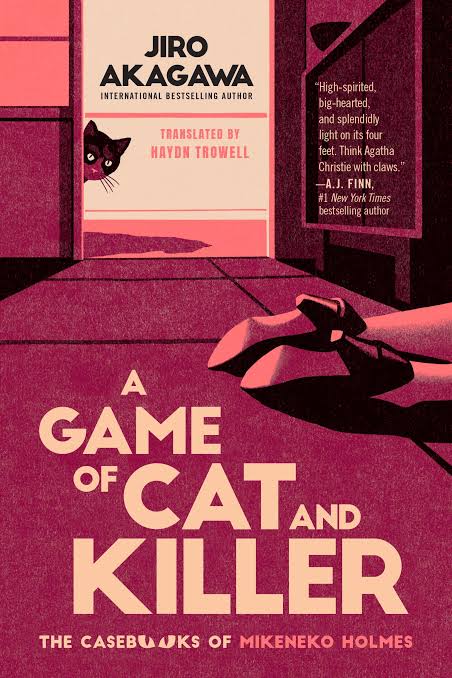
One of Japan’s most read novelists, Jiro Akagawa’s A Game of Cat and Killer is the first in his long-running series first published in Japan in 1978, and now translated into English for the first time.
The cat in question is named Holmes, and while he’s not a talking cat, the feline does have an unusual way of bringing clues to his owners’ attention. After reluctantly adopting Holmes, Detective Yoshitaro Katayama takes a while to realize how Holmes can help him, but once he figures it out, he accepts the cat will be a welcome helper.
Katayama is a shy man with many fears, and it’s only his good instincts and dogged attention to detail that allows him to solve crimes. In this first in the series, he’s called to a woman’s college to investigate when a young female student is found murdered.
Soon he’s mired in more than one investigation, and while his aunt distracts him with matchaking, he’s drawn to a comely student instead.
The writig is sharp, with sprightly dialogue, while the plot is nicely twisted. It’s a heartwarming read from a multiple literary award winner, with sales of his books making him the highest of any Japanese author.
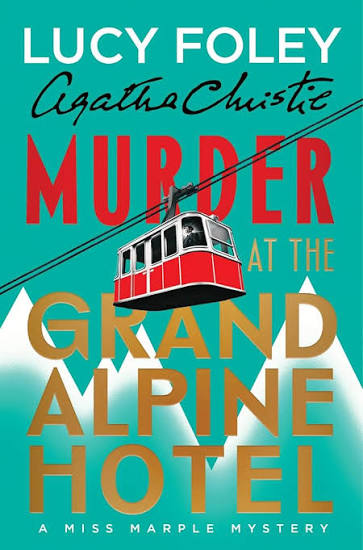
Fans of Miss Marple, take notice! As the Christie estate authorized author Sophie Hannah to write new Poirot mysteries, they have now authorized a new novel featuring the elderly spinster sleuth. Lucy Foley’s own bestselling books (The Guest List, The Paris Apartment, et al) make her the perfect author to bring readers her rich storyteling in Murder at the Alpine Hotel. As a huge Christie aficionado, she makes certain to adhere to the spirit of the Miss Marple we know and love, creating a unique bridge from the original novels to engage us with new stories.
Chrisite fans will appreciate Foley including Mrs. Dolly Bantry (1942’s The Body in the Library) as Miss Marple’s traveling companion when the two women, along with Dolly’s paid companion, travel in the winter of 1950 to the Swiss Alps to the glamorous resort that will give them a winter holiday amongst an interesting mix of guests.
But the holiday feel is soon jeopardized when a huge snowstorm isolates them in the Grand Alpine Hotel, just as a guest’s dead body is found inside the hotel’s mountain gondola. A sealed environment with a cast of suspects makes the perfect setting for the investigation Miss Marple carefully undertakes after volunteering to assist a French detective staying at the resort.
Soon several guests who were associated with the dead man come under the careful scrutiny of Miss Marple as more bodies pile up, with a most surprising climax that has several twists at the end. The post-war setting has its tendrils in the plot, and Foley gets the feel of the time in this European setting just right.
There are scenes from several suspects’ points of view, adding psychological depth to the story that is Foley’s specialty of strong women. There are nuns, a Hollywood actress, an MP and his wife, as well as an Irish Wolfhound, all bound up in a morally complex plot.
At first Miss Marple appears frail and hesitates to become involved, but once she’s in full swing, knitting away while bringing her comparisons of village life to the forefront, the beloved character rises again with her acute observations, and we are satisfied and happy to read the first Miss Marple mystery since Christie’s Sleeping Murder in 1976, the same year Christie died. The British Library is mounting an exhibit on the 50th anniversary of her death. Christie’s books are still outsold only by the Bible and Shakespeare.
Nothing misses the eagle eye of Miss Marple. Readers will agree when Foley has Dolly Bantry tell Marple, “Jane . . . I hope you won’t mind my saying this, but it is almost uncanny, your ability to think yourself into the mind of a murderer.”
Delicious and entertaining, grab this milestone book now.
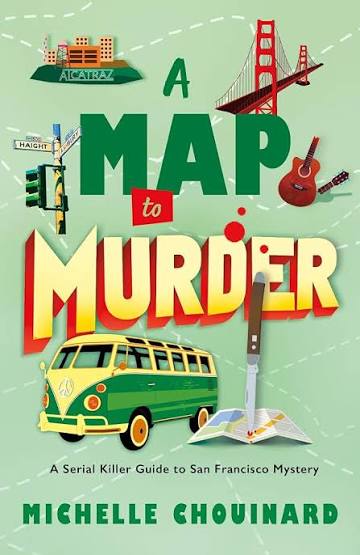
Chouinard’s subtitle to her tour guide Capril Sanzio series is “A Serial Killer Guide to San Francisco Mystery” and she’s back this time centering on San Fran’s Summer of Love.
Using the true crime stories that hit the Haight-Ashbury area during what was supposed to be a time of love and peace as the basis of this particular tour, Capri highlights the hippy vibe and music of the era. She contrasts that lightness against the darkness of killers like Charles Manson and the Suitcase Killer.
But she’s taken aback when one of her tour guests asks to meet privately and begs for her help. Haley thinks her mother, who came out to San Franciso trying to solve the murder of her sister years ago, has also been murdered.
Capri sees her own young daughter, Morgan, in Haley, and agrees to help her. That sets up an investigation that will have farther reaching secrets than either woman have in mind, which soon turn deadly when old secrets are unveiled. Along the way she adds the search to her podcast series, to bring focus to the case and her exploration of what has really happened to these sisters.
One of the highlights of this series is the way Chouinard gives readers a real sense of of the history she uses in her tours. When she shows Capri in her investigative mode, she does extensive research not unlike that of an investigative journalist. We have subplots of Capri’s family and close friends, and her developing relationship with a San Fran detective that is a warm addition to the series.
With quirky recurring characters and a setting that comes alive, the nicely twisted plot leads to a logical conclusion, at times chilling, at others hearwarming, that add up to a highly readable series any mystery afficonado will gobble up.
Brittney’s 7th installment in her Mayfair 100 series, set in London during World War 1, brings the same attention to historical detail as the rest of this fascinating collection of stories that encompass a murder investigation while examining the societal constraints and mores of the era.
With a special task force set up to include women, DCI Peter Beech, invalided out with an injured leg, leads the team that includes two other policemen, Sgt. Arthur Tillman who has come out to retirement to help, and invalided constable, Billy Rigby. The competent women who assist them are Women’s Hospital physician Caroline; Pharmacist Mabel; and solicitor Victoria, who is qualified but unable to practice law as a woman. They are aided by Billy’s mother and aunt, while the team is headquartered in Victoria’s mother’s house. Lady Maud Winterbourne has allowed her Mayfair home to be the center for the team, whileher society connections often prove invaluable.
It’s February of 1916 and The Military Service Act has been passed, which in the US would be called the draft, making military service compulsory for single men between 18-41. The first victim, which Victoria had encountered shortly before her murder, is a young woman who shamed a man for not signing up by handing him a white feather.
The White Feather League used these women to indicate they regarded the men as cowards. While often that was not true, as a man might have served and been invalided out, the league’s actions raise the ire of Victoria, already widowed, who fears her new love will be conscripted.
The dead girl is found with her throat cut in a distinctive way, and soon a young art student designing recruitment posters is murdered with the same unusual implement. When a third woman is attacked but wards her murderer off, there is hope she can identify her would-be killer, but at first she is kept in a medical coma, unable to be questioned. The Mayfair team is tasked with warning women involved in promoting this kind of propaganda, but the numbers are heady and the task difficult, while at the same time they search for details in each killing for leads.
Woven into the investigation, Caroline and Mabel are asked to inspect a factory contructing aircraft where women are falling ill, and there is a suspicion that the chemicals used in their process are causing permanent health damage to the workers. This fascinating subplot will capture readers attention as it leads to new restrictions.
Then the search for the killer ratchets up when one of the team disappears without a trace. Could the killer have taken their member off the street? The compelling story rises to a riveting and surprising climax.
The hallmark of the series is Brittney’s consistent and realistic historical detailing, reflecting the enormous research she must undertake in many areas to bring this kind of multi-layered story to readers.
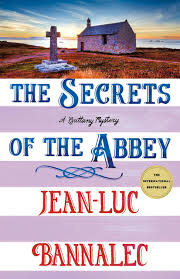
Bannalec’s Commissaire Geroges Dupin series brings readers to delightful Brittany, this time October, where the days are still sunny. I’ve known readers of this series who have traveled to some of Bannalec’s settings due to his descriptions.
This case hits close to home for Dupin and his team. After several supersititous omens of death, his second in command, Inspector Kadeg, has lost his aunt. The old abbey where the woman lived is the perfect yet tense setting when Kadeg visits and is seriously attacked.
Dupin brings his team to get to the bottom of the mystery at the beautiful abbey, filled with luscious gardens, a paradise of sorts, with it famous for its special apples. Only as the team scrape beneath the surface, they uncover secrets that belie the lovely setting, with family intrigue into the wealthy dead woman’s estate and secrets around those who will inherit.
Did Aunt Joelle die of natural causes, or was she helped along by someone desperate for their part in her estate? And what do rare birds have to do with it all?
It’s a classic Dupin mystery, with the glories of the region highlighted, and rich with character development.
The series is known for its love letter to the region, in this case, the Cote des Legendes region that springs to life under Bannalec’s talented pen with his team tracking down the truth. A most satisfying case with a lovely and tender ending awaits readers.
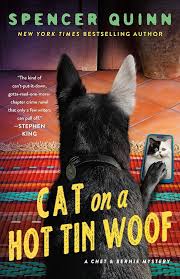
I’d forgotten how much I enjoy Quinn’s Chet and Bernie Mysteries until I opened the first page and was immediately sucked in.
It takes a master author to write an entire book—or should I say series, as this is the 17th in this creative series—in the voice and point of a view of a dog.
Now I hasten to add right up front that Chet is not just any ordinary dog, not at all, a point he makes repeatedly. He is one half of the Little Detective Agency, the other half being his owner, Bernie Little, veteran war hero and private investigator.
Together, in a finely tuned partnership, Chet reads Bernie’s signals, using his prodigious nose to scent things out in their cases, including where people have been, and who they’ve been in contact with—which makes this particular new case right up their alley.
The internet sensation Miss Kitty and her owner, young Bitty, are bereft when Miss Kitty disappears. Chet and Bernie are soon on the hunt to find her as her huge following and new sponsors demand more content featuring the suave cat who sits on a purple pillow. A house cat, has Miss Kitty escaped and found freedom intoxicating? Or is there a more sinister reason for her disappearance, namely, a catnapping . . .
With one witness a pig named Señor Piggy, and the human witnesses all as likely to tell a lie as the truth, Chet and Bernie have their work cut out for them. Along the way there will be a murder or two, a few Miss Kitty scents and sightings, and an undersheriff who at first suspects Bernie of at least one of the murders.
The plot is a classic kidnapping mystery, with characters all finely drawn, including a pair of cowgirls. One of my favorite scenes in the book is how Chet describes their relationship: “Sisters or not sisters? What that all about? . . . Maud and Tish did not smell like sisters. They both smell somewhat oldish, but with more than a little juiciness to them, which you usually don’t get with oldish types. They were both also nice to look at, although their faces were not alike. In fact the closer you looked the more unalike they got…Human love has a special scent. Did you know that? It was the air right now.”
Somehow, Quinn manages to sustain this humorous but often philosophical mental narration of Chet throughout the entire book. His examines human emotions, relationships, moods, and his observations are on point.
No wonder then that I’m smitten with Chet, and you will be, too. Stephen King calls this: “Without a doubt the most original mystery series currently available.”
Berry’s sixth Kate Hamilton mystery keeps the series fresh, utilizing Kate’s antiques expertise and that of her business partner, Ivor Tweedy, in a unique way. Being married to DI Tom Mallory means Kate has an above-average knowledge of murder investigations, too, and has helped Tom in the past.
When an extremely well-preserved body is found at an archeological dig, it’s determined to be from the 14th century, and Kate and Ivor are asked to examine and evaluate the grave goods found buried with the woman’s body, which include a huge, valuable pearl. They meet the team who found the body, composed of varied personalities and talents.
Additionally, Kate is tasked as part of her private investigators work by the wealthy landowner, whose property contains the dig, with unearthing the idenity of the buried woman, who was pregnant at the time of her death. His own wife went missing nine years ago, and a museum of the plague-ridden village was her project, one he has continued in her absence as he struggles with his grief.
Then the lead archeologist, Dr. Simon Sinclair, is found murdered on the site with pearls stuffed in his mouth, and Tom becomes involved while also trying to track a killer in an unrelated death. Sinclair’s murder has numerous suspects, and with Kate on site, Kate works in concert with Tom to obtain inside information that might not surface in a formal police interview.
Berry does a grand job of showing how Kate uses resources and ancient documents to track down the identity of the murdered woman in the midst of Tom’s investigation into the modern murder. Then another set of bones are found to ratchet up the tension. Throw in Kate’s pregnant friend, the local vet and vicar’s wife, and you have a nicely rounded plot with local threads.
The interspersion of the cold cases with the new murder unraveling give rising tension to a well-done climax that makes sense. Don’t miss Berry’s author’s note at the end about the real-life discovery of a medieval body that gave her the storyline idea.
After bringing Nicola Upson’s The Christmas Clue and Mandy Morton’s Six Tails at Midnight to your attention, I’m adding two new releases that would make great gifts for the readers on your list that are not set on Christmas but are delightful reads:
Richard Osman’s Thursday Murder Club is a favorite series of many readers with good reason. The vastly different foursome of Joyce, Elizabeth, Ron, and Ibrahim have spent the past year differently after the events of the last installment, The Last Devil to Die.
But with The Impossible Fortune, a wedding (Joyce’s daughter, Joanna, long-yearned for by Joyce) brings the group together for a happy occasion. Then a wedding guest, Nick Silver, who knows of Elizabeth’s history, asks for her help . . . and disappears soon after.
Hoping to grill his business partner, Holly Lewis, only leads to a devastating result, and soon the group are mired deeply in this investigation which revolves around an uncrackable code that leads to riches.
Joanna feels she should help as Nick is a pal of her new husband, and soon adds her help. Ron’s daughter, Suzi, needs help, too, in getting rid of her abusive thug of a husband, and soon her son Kendrick is added to the population. And Ibrahim’s client Connie, newly out of prison, is mentoring a young woman, Tia, in a highly unusual manner.
It’s a wild ride that manages to come together with startling results along the way. Intricately plotted, and with Osman’s trademark humor but clear-sighted view of human nature, this will please any reader on your list.
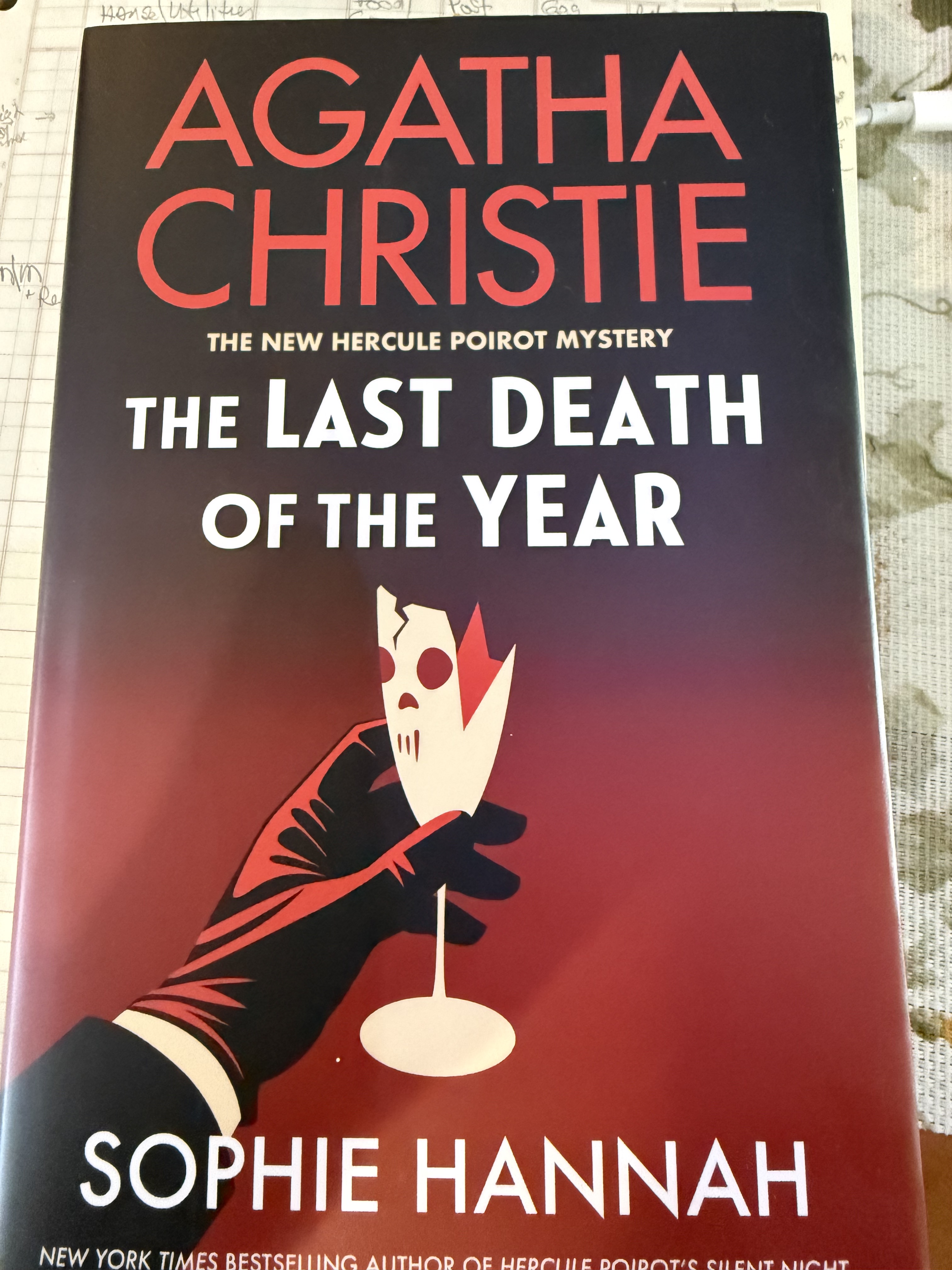
Sophie Hannah, the gifted author chosen by Agatha Christie’s family to resurrect Hercule Poirot, gives us a convoluted mystery, The Last Death of the Year, set on New Year’s Eve, 1932, when Poirot and his detective inspector cohort, Edward Catchpool, travel to a remote Greek Island at the the behest of the owner.
The island of Lamperos contains tiny horses, goats, and few buildings, but it does have an unusual house on Liakada Bay called Spiti Athanasiou, The House of Perpetural Welcome, set right on the sea, an attraction for Catchpool, who loves to swim at any time of year.
Their host, Nate Athanasiou, has opened his home to a phalanx of different supporters of the community project he and his good friend Matthew Fair are developing: a place where welcome and forgiveness are given to all who live there, without consideration for past actions.
While the premise seems optimistic, Nate’s nervous demeanor hints at the threat of danger as the reason he’s called for Poirot to attend. That becomes obvious when the game played after dinner, where each of the residents writes a New Year’s resolution that isn’t signed, includes one that there will be “the last and first death of the year.”
With this declaration hanging over them, it should be no surprise when it comes true . . .
A masterful look at the psychology of each character in a complicated classic mystery, where the drawing room has been replaced by a craggy house on a Greek isle.
Peter James’s long-running DCI Grace series, now on BritBox in a grand adaptation as Grace, has just published his 22nd in this series, The Hawk is Dead.
The backstory to this novel is fascinating: Her Majesty Queen Camilla, a huge Grace fan, asked him when she was Duchess of Cornwall in 2019 if he couldn’t see a way to bring Sussex-based Grace to London. After kicking the idea around for four years as he worked on other projects already under construction, James figured out a plot what would allow him to bring Grace and a few members of his team to the Palace.
And that kernel of an idea started when James read that the 775 rooms in Buckingham Palace were to undergo a major renovation, which would take place over the course of several years, not just for updating and modernization but for safety reasons. The Royal Collection consists of over a million very valuable art and objects held by The Crown, many in Buckingham Palace.
From that grew the idea for the entire novel, and the beginning of exhaustive research, which included James being given inside tours of the palace, and even learning how to drive a train! Always giving his realistic police procedurals a grand plot, James knocks it out of the park with this one, literally, by taking Grace from his Brighton territory to Buckingham Palace.
His team becomes involved when the Queen is traveling by train to visit hospices along the south coast. Her train must be evacuated after being derailed inside a tunnel. A harrowing scene from the train driver’s point of view brings the accident to life, and as the Queen and a trusted advisor exit the tunnel, shots ring out. While the Queen narrowly misses being assassinated, Sir Peregrine Greaves, Private Secretary to Their Majesties and one of the most senior members of their household, is killed.
Grace has a nagging feeling the Queen might not have been the intended target, and readers are treated to insights into the workings of the Royal Household, and its pecking order, as well as an extensive treatment of the glories contained within the huge building as the investigation ensues.
With attention turned to the household, when a diary Sir Peregrine kept in code, more matters come to light and soon Grace and his team, especially his long-term bagman DI Branson, must sift through Not-My-King protestors; territorial tiffs with the Met, who want to take over his investigation; and missing artifacts. Then a second body is found…
This was one of the most enjoyable Grace novels to date, and as usual, gives us a window into his home life, too. But James’s intricate plotting with its exploration of life within the royal household make this a gripping story.
I’m pleased and honored to call Cambridge partners and authors, Mandy Morton and Nicola Upson, my friends for over a decade, after email correspondence let to our first meeting while attending the memorial service for PD James, our friend and mentor. Their lovely Cornwall cottage, the last thatched cottage in the seaside town of Porthleven, will be the setting for the next Nora Tierney mystery when I get around to writing it!
I’m fascinated by the idea of living with another writer and how that dynamic works. Both of these talented women have new books releasing this fall and worked on them either at their Cambridge home or the Cornwall cottage: Mandy’s No. 2 Feline Detective Agency continues her engaging series set in a world of cats with Six Tails at Midnight. Nicola’s TheChristmas Clue leaves her Josephine Tey series temporarily as this stand-alone revolves around the couple who created the popular game Cluedo, which was adapted in the US as Clue.
They’ve just been hailed in a cover article (see above) in their local Cambridge Independent, which ran a long and detailed article about the duo. The two, who are very involved in the Cambridge Arts scene and often interview each other about their new books, have also curated a wonderful event together at literary festivals: Celebrating P. D. James: A Mind to Murder. They held their launch for both Christmas books at their local Waterstones with a surprise guest—more on that in a moment.
They gave me a glimpse into two very different books written in the same house, and their writing lives in general, telling me their tea-time discussions openly center around plots, creating murders, and being first readers for each other, as well as valued critique partners. They write in different areas of their homes, but come together to talk about their progress, and are deeply involved in each other’s work. For the writers out there, think about the advantage of living with your own private critique partner and reader!
Their works are distinctly different and equally creative despite them both writing mysteries. Mandy’s Six Tails at Midnight is set at Christmas in the Cambridgeshire Fens, and brought back happy memories for the musician and arts journalist of a series she produced years ago for BBC Radio.
“The Fens are shrouded in mystery and legend, with stories of ghosts and murderers, and in this book, I couldn’t resist tapping into some of that history.” Private detectives Hettie and Tilly, along with their friends Bruiser and the Butter Sisters, set out across the snowy fens to spend Christmas at The Fishgutter’s Arms and become snowed in. With no hope of rescue, they find they are soon sharing Christmas with five Christmas spirits who threaten to ruin the festivities.
With Hettie Bagshot and Tilly Jenkins in their feline world, Mandy notes her cats are much more human than many people she’s met. “My cat characters wear cardigans, run bakeries, and are very good at solving murders without any assistance from the likes of you and me! Cats can be spiteful, cruel, vicious, and downright nasty, but they can also be cute, loving, and mild-mannered—the perfect combination for a series of crime novels.”
Six Tails at Midnight is the fifteenth book in this popular series, but Mandy began her professional life as a musician, and was the lead singer for the folk rock group Srpiguns of Tolgus. She more recently worked as an arts journalist for national and local radio. Her books can be found at Farrago Books or on Amazon.co.uk and Amazon.com.
Nicola was researching for The Dead of Winter in her Josephine Tey series, when country house parties were popular in England. Two names she kept finding were Anthony and Elva Pratt, who in 1943 created the game Cluedo, still played today.
Deciding this intriguing couple deserved their own story, Nicola set to work crafting her book surrounding the couple who developed Cluedo on their dining room table in 1943 as a distraction from wartime worries. Motivated by Anthony’s love of detective novels and true crime, the game’s playful murderous premise was inspired by the murder mystery weekends he witnessed during his musician years. The Christmas Clue, set in a snowy country house, stars Anthony and Elva, who step in to detect when a mystery game goes horribly wrong.
“I’ve loved Cluedo since I was a child. It was the board game of choice in my family, and I still have the 1970s version I played then, complete with my mum and dad’s handwriting on the old detective notes, and my own workings-out, which seem to be nothing but question marks!”
She adds: “Not only did it give me hours of pleasure and lots of happy memories, but the game introduced me to crime fiction long before I read Agatha Christie and her contemporaries, and in particular the classic English detective story and its obsession for knowing—or concealing— who did what, where and how.”
That the pair enjoyed writing their Christmas mysteries together is obvious, and their joy increased when Nicola’s book received the stamp of approval from the Pratt’s daughter, Marcia Lewis, who appeared at their Cambridge book launch at the end of September and answered audience questions.
Nicola read English at Downing College, Cambridge. Her first Josephine Tey novel was dramatized for BBC Radio 4, with several listed for the CWA Gold Dagger and Historical Daggers. She is a member of the Detection Club, and in 2024 curated the acclaimed exhibit Murder by the Book: A Celebration of 20th Century British Crime Fiction at the Cambridge University Library. Her books are available from Faber & Faber, or on Amazon.co.uk or Amazon.com.
I hope readers will enjoy discovering these talented authors. Each of these books would make lovely Christmas gifts for the readers on your list~