Triss Stein: The Erica Donato Mysteries and Brooklyn Secrets Sunday, Dec 20 2015 

Please welcome Triss Stein, who’s talking today about the importance of setting, something Auntie M always starts with and the newest in her series, Brooklyn Secrets:

Brooklyn Secrets Cover

Choosing a Setting

A mystery series where the place is part of the story is great fun to read and to write. My fascination with Brooklyn, where the diverse neighborhoods often seem like a collection of small (well, small-ish), towns has lasted a long time. Since change is the only constant in any big city, I don’t think that fascination will go away before I run out of stories to tell.

Choosing the exact setting for each book takes some thought, or perhaps a flash of inspiration. The neighborhood, now, is where and when the story takes place, but my heroine, Erica Donato, is a graduate student in urban history and so there is always a mystery from the past, too. The neighborhood setting needs to have scope for both.

Brooklyn Bones, the first in the series, was easy. I just looked outside my front door. Park Slope, where I live, is a lively and beautiful corner of Brooklyn which has gone through a couple of decades of steady gentrification, (for good or ill). However, it was not always the center of chic it has become (Seriously! They think this in Paris!) and I was here just as it was changing. It was not hard to find a story from that darker time.

Brooklyn Graves was directly inspired by a place, beautiful and historic Green-Wood Cemetery, and a series of news stories about priceless stained glass windows being stolen from now neglected, but once affluent, churches and mausoleums. I think any mystery writer, especially one of with a taste for history, would clip those articles. And ponder.

The setting of the new book, Brooklyn Secrets, has raised more questions. It is Brownsville, a remote corner of Brooklyn that is now, and always was, unlovely, uninspiring, and poor. It was built as an extension of the overcrowded, immigrant Manhattan neighborhood the Lower East Side. The shoddy housing of years ago has been long replaced by projects, perhaps equally shoddy; the color of the skin and the accents of the immigrants is now different and guns have changed the nature of everyday crime, but in many ways it is not different at all. Crime, boxing and education remain the roads out and often, the best choice is not even clear.

I started with Erica writing a chapter of her dissertation about crime in Brownsville’s history. In mid-20th century America, it became famous as the home of Murder, Inc, enforcers for organized crime in its heyday. She sort of overlooked the point that in writing about how neighborhoods change, she would also have to deal with Brownsville now. I overlooked it, too, for a while. The challenge became finding a reason for Erica to continue to be involved in the present day mystery I was trying to create.

Did I solve it? Did I weave together the parallel stories of how young people, now and back then, try to find their way when there is no way? Did I write about a place as an outsider and get it right?

Readers, your thoughts will be most welcome.

photo15
Triss Stein is a small–town girl from New York farm country who has spent most of her adult life in New York the city. This gives her the useful double vision of a stranger and a resident for writing mysteries about Brooklyn neighborhoods in her ever-fascinating, ever-changing, ever-challenging adopted home. In the new book, Brooklyn Secrets,s Erica find herself immersed in the old and new stories of tough Brownsville, and the choices its young people make.

Kate Charles on The Detection Club Wednesday, Dec 16 2015 

The wonderful Kate Charles, mover and shaker with Eileen Roberts at St. Hilda’s Mystery and Crime Conference each year, brings readers a view inside the glorified Detection Club. Here is her report on their latest meeting:

I was immensely privileged, in mid-November, to be present for an historic moment in the annals of crime fiction, when the eighth President of the prestigious Detection Club took over the capacious red robe of office – a robe which has been worn by G.K. Chesterton, Dorothy L. Sayers and Agatha Christie in their time, and most recently by Simon Brett.

The new President is Martin Edwards, a writer who is passionately interested in the history of the Detection Club, serving as its archivist for the past few years and recently publishing a non-fiction book on the subject, The Golden Age of Murder.DC 7Martin Edwards with Simon Brett: the torch and the red robe is passed.

As Martin would tell us, the Detection Club was founded in 1930 (or perhaps 1932!) as a dining club for the prominent crime writers of the Golden Age. Its rituals, including an arcane initiation rite, date from those early days, and were once cloaked in secrecy.

Now, though, in this age of openness (and Wikipedia!), anyone with a bit of curiosity can delve into its mysteries. I don’t think I’ll be struck off as a member for revealing that, in a solemn candle-lit ceremony, new initiates promise that their detectives will not resort to ‘Divine Revelation, Excessive Sanguinity, Lucky Guesses, Mumbo Jumbo, Jiggery Pokery, Coincidence or Act of God’, and that they swear their loyalty to the club on Eric the Skull, with ‘terrible penalties’ threatened for breaking their oath.Kate Charles with Eric the skullKate at her initiation with Eric the Skull.

Members of the Detection Club gather three times a year for congenial dinners in London, as the club continues to fulfil its original function of providing a social outlet for solitary crime writers. These days, though, the writers are far more diverse than those of the Golden Age, as the genre has expanded beyond its cosy beginnings.

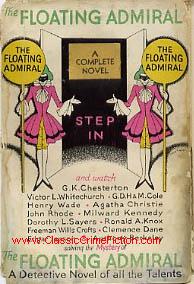
This diversity presented a challenge recently, when the club embarked on a project of creating a serial novel in the grand tradition of the original Detection Club’s The Floating Admiral. As in the original project, fourteen writers contributed, and a good time was had by all. Having read (and loved) The Floating Admiral in my youth, I felt it a huge privilege to be involved in this. The Sinking Admiral (inevitably!) will be published in 2016 – another milestone in the ongoing history of a fascinating institution.floatingadmiral

Kate-Charles
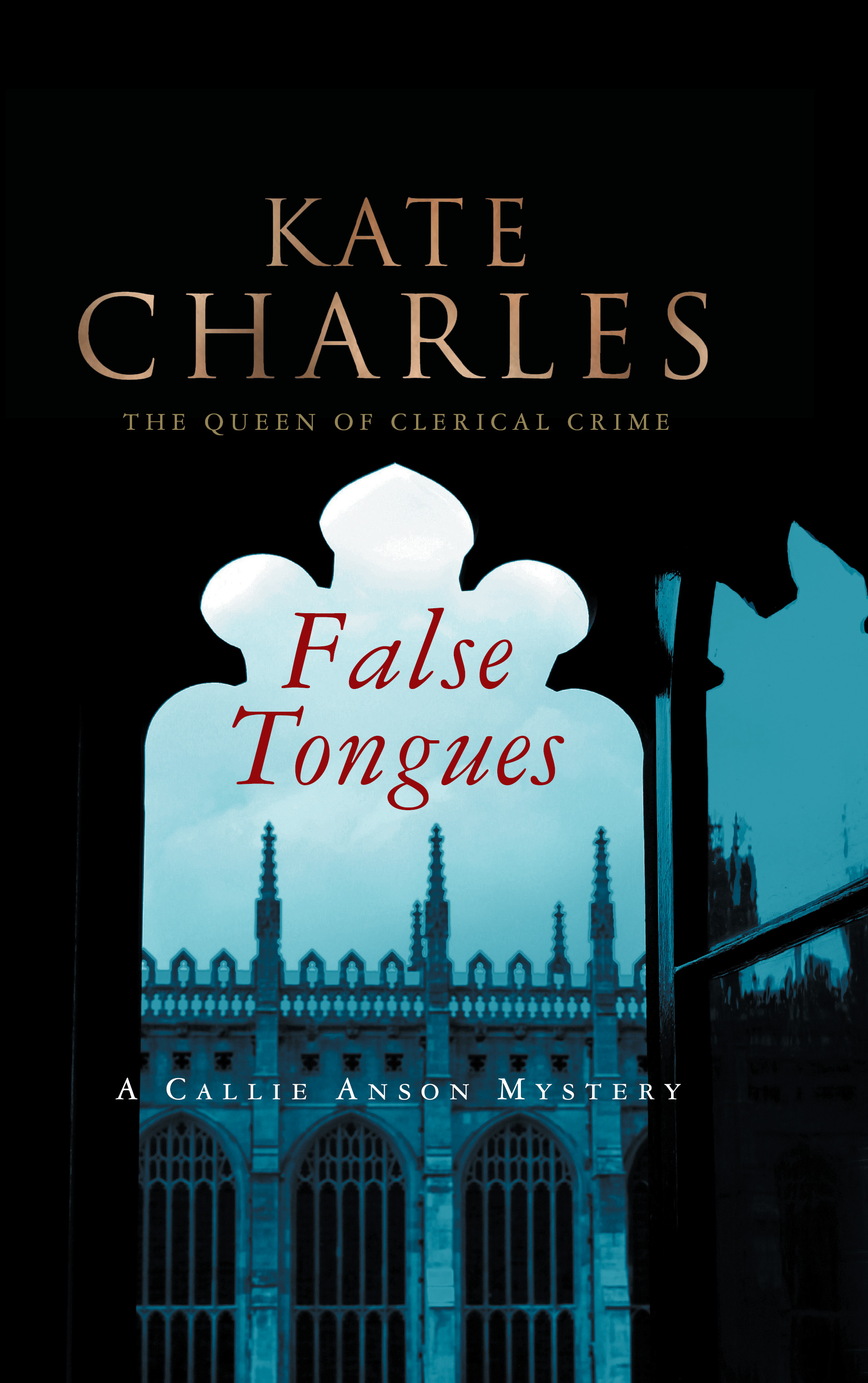
Kate Charles is best known for her ecclesiastical mysteries. These include the Book of Psalms series and the Callie Anson series. Her latest book is False Tongues. False-Tongues-cover
She is a former Chairman of the Crime Writers’ Association and the Barbara Pym Society.

Leslie Budewitz: Guilty as Cinnamon Monday, Dec 14 2015 

Auntie M had the pleasure of meeting Leslie Budewitz at NE Crimebake recently. Leslie is the current President of Sisters in Crime, too, and has a wonderful sense of humor. Welcome her as she talks about what led to her new mystery, Guilty as Cinnamon, Book Two in her Spice Shop Mysteries.

Untitled-5

In 1968, “Here Come the Brides” made TV stars of Bobby Sherman and David Soul—and the city of Seattle. Sherman, Soul, and Robert Brown (I admit, I had to look him up) play three brothers who run a logging company and import potential brides to keep their lumberjacks happy. It’s loosely based on the movie Seven Brides for Seven Brothers, and inspired by the real-life story of pioneer Asa Mercer and his “Mercer Girls.” I loved it. I even believed the theme song: “The bluest skies you’ve ever seen are in Seattle, and the hills the greenest green are in Seattle.”
Ten years later when I left Montana for Seattle University, my first few days on the campus were bright and sunny. And then, those famous rains began. About six months later, when the rain stopped and I was still there, I counted myself a true Seattleite. I’d learned. You pull on your rain coat, leave the umbrella your mother gave you in the closet, and go on doing whatever it is you want to do.
And when the sun comes out—well, those are the days the songwriter was talking about.
I remember watching Richard Dreyfus and Marsha Mason in The Goodbye Girl, in a huge theater in downtown Seattle. Dreyfus is packing for a trip to Seattle, where he’s been promised a part in a play. He’ll be back, he promises, and she struggles to believe him. “Do you know they have wolves out there?” he asks, and the whole theater erupted in howls of laughter.
I’d already moved back to Montana when Sleepless in Seattle came out in 1993. Tom Hanks’ houseboat, right? That’s what you remember about Seattle: the gigantic glass windows, the dark, shimmering lake waters, the sparkling lights. And the wonderful connection between Hanks and Meg Ryan, and the cute kid, and all the romantic comedy repartee that makes us feel warm and fuzzy.
These images and more—the Space Needle, Pike Place Market, Mount Rainier, the Seahawks’ offensive line—scrolled through my mind as I created Seattle on the page in my Spice Shop Mysteries. These are the pictures readers who’ve never lived in the Northwest hold of the Emerald City. They’re iconic. They provide a framework for how we view the place, much as the Empire State Building, the Macy’s Thanksgiving Day Parade, and Central Park pop into mind when we picture New York City.

Cities are so much more, of course, but I loved calling on those images and the fond memories they evoke when picturing Pepper, my main character, and her friends and staff going about their days under blue skies and gray. Her friend Laurel’s houseboat isn’t Tom Hanks’ houseboat, but I hope a reader who remembers the movie will smile in recognition when the Flick Chicks gather on the roof for dinner, then settle in to the cozy sunken living room to watch a movie. I hope they’ll think of Richard Dreyfus worrying about wolves, and remember that while Seattle is urban, it’s also nestled between wild waters and wild mountains. And I hope they’ll think of those blue skies and white peaks, those green trees and steep hills, when they follow Pepper through the Market to Pioneer Square and back again.

Because a city comes alive on the page when the author creates a place we can see and feel, and our memories of a place—whether we’ve been there or not—are part of the equation.

Do you have a fond memory of Seattle—on the page, the screen, or on a visit?


GUILTY AS CINNAMON (Spice Shop Mystery #2, December 1, Berkley Prime Crime)
Pepper Reece knows that fiery flavors are the spice of life. But when a customer dies of a chili overdose, she finds herself in hot pursuit of a murderer…

From the cover …

Murder heats up Seattle’s Pike Place Market in the next Spice Shop mystery from the national bestselling author of Assault and Pepper.

Springtime in Seattle’s Pike Place Market means tasty foods and wide-eyed tourists, and Pepper’s Seattle Spice Shop is ready for the crowds. With flavorful combinations and a fresh approach, she’s sure to win over the public. Even better, she’s working with several local restaurants as their chief herb and spice supplier. Business is cooking, until one of Pepper’s potential clients, a young chef named Tamara Langston, is found dead, her life extinguished by the dangerously hot ghost chili—a spice Pepper carries in her shop.

Now stuck in the middle of a heated police investigation, Pepper must use all her senses to find out who wanted to keep Tamara’s new café from opening—before someone else gets burned…

Leslie-WEB-Color

Leslie Budewitz is the author of the Food Lovers’ Village Mysteries and the Spice Shop Mysteries—and the first author to win Agatha Awards for both fiction and nonfiction. She fell in love with the Pike Place Market as a college student in Seattle, and still makes regular pilgrimages. The president of Sisters in Crime, she lives in northwest Montana with her husband, a musician and doctor of natural medicine, and their cat Ruff, a cover model and avid bird-watcher. Connect with her through her website and blog, http://www.LeslieBudewitz.com, or on Facebook, http://www.Facebook.com/LeslieBudewitzAuthor

Series: Spice Shop Mysteries (Book 2)
Mass Market Paperback: 304 pages
Publisher: Berkley (December 1, 2015)
ISBN-10: 042527179X
ISBN-13: 978-0425271797

Fall Humor: Ashley Weaver and Tonya Kappes Sunday, Dec 13 2015 

DeathWearsMask
Ashley Weaver’s first Amory Ames mystery, Murder at the Brightwell, was nominated for an Edgar and introduced the wealthy amateur sleuth and her charming and dashing Milo. That first entry is now out in paperback for anyone who missed it.

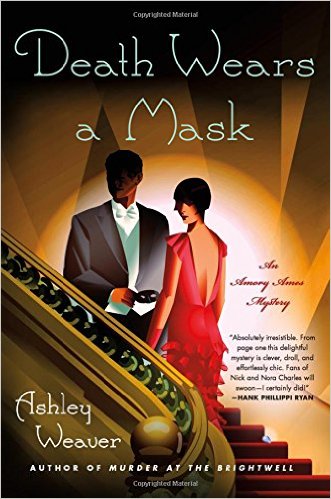
She returns with Death Wears a Mask, with Amory relaxing in reconciliation at their London flat with Milo, until she turns to full-sleuth mode when high-society marvel Serena Barrington needs her to find who has stolen jewels from her London flat.

There’s an upcoming masked ball and while the host is terribly sexy Viscount Dunmore, Serena’s idea is to have Amory bait a trap for the thief with a copy of Barrington’s jewels to be heisted.

But things to awry when Serena’s nephew becomes a victim and with the help of DI Jones, Amory works her way through the suspect list. Despite Milo’s photo and that of a French film star distracting her and making the advances of the Viscount seem terribly attractive, Amory puts her personal grievances aside to gain Milo’s help in finding a killer–and saving her marriage.

Weaver’s humor reminds readers of Nick and Nora Charles, if they’d been set in 1930’s British society.

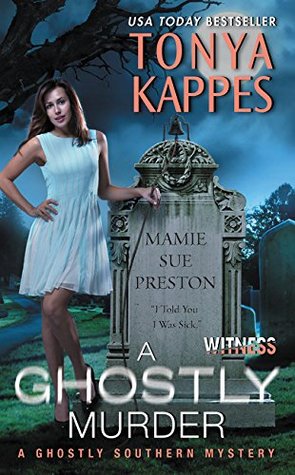
GhostlyDemise AGhostlyMurder

Tonya Kappes’ Ghostly Southern Mystery series features Emma Lee Raines, the Eternal Slumber funeral home director who sees dead people. The next two installments in the series have the same hilarious humor that Auntie M’s mum calls “brain candy.”

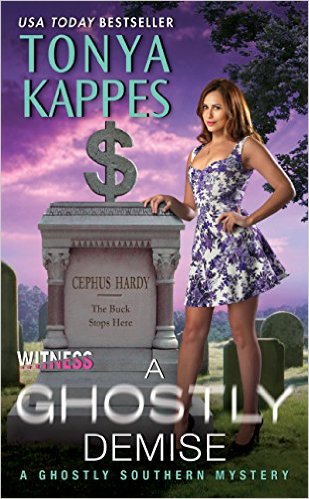
In A Ghostly Demise, Emma Lee is surprised to find Gephus Hardy at the local deli. The father of her friend, Mary Hanna Hardy, hasn’t been seen in Sleepy Hollow, Kentucky for the past five years and that’s because he was murdered. The town drunk was thought to have disappeared, but Gephus has heard in the spirit world of Emma Lee’s propinquity for helping lost souls move on and her enlists her help.

The request comes at the worst possible time for Emma Lee, as her granny’s mayoral campaign is running in high gear. With a carnival keeping Emma Lee’s boyfriend, the Sheriff, busy in a most humorous way, she’s forced to figure out the connection between the carnival and and a killer.

A Ghostly Murder brings Emma Lee into more of a professional situation when a ghost appears to her in the form of the town’s worst hypochondriac, Mamie Sue Preston. Also one of the richest women in town, Mamie Sue was buried by Emma Lee’s rival, Burns Funeral Home, making her investigation into who killed Mamie even more difficult.

With “I Told You I was Sick” inscribed on her tombstone, Mamie Sue insists she was done in for her fortune. And too many people have benefited from her will to give up their inheritance easily.

Now Emma Lee’s granny is in the frame for murder, and it will take all of her wiles to convince boyfriend sheriff Jack Henry to help her figure out who really did away with Mamie Sue.

More Holiday Joy: The US edition Wednesday, Dec 9 2015 

Auntie M divided her recommendations into Holiday Joy for other sites across the pond on Dec, 8th, and this version where the settings are all in the US. While you’re shopping for the readers on your list, don’t forget you deserve one, too!

Up first is a thriller writer Auntie M met at Thrillerfest a few years when she was meeting favorite UK author Peter James. “Come and meet my tennis friend,” James said, and I was introduced to the tall and charming Simon Toyne, whose Santus trilogy Auntie M has previously reviewed.

Searcher

Readers familiar with that Trilogy will be more than pleased with his new thriller, The Searcher, set in Arizona this time, the first in his new Solomon Creed series. The white-haired albino is just the kind of Jason Bourne-like character who can sustain several books with ease.

A funeral in the town of Redemption is interrupted by a plane crash, and the man running away from the site not only has no shoes, he has no memory of how he got there–or who he is. His clothes provide minimal clues and his name: Solomon Creed.

Creed understands he’s in Redemption for a reason, and his questions will lead him to the town’s secrets, filled with people who have something to hide. There are lines drawn between good and evil and a touch of the supernatural. Two main points of view of Creed and the town’s founder in the form of diary entries allow the story to keep the reader knowing more than Creed. A strong start to a new series with a complex character, great images, and a vivid story.
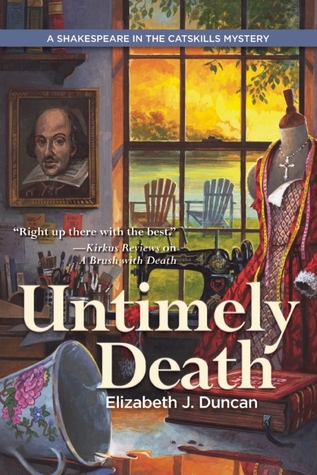
UntimelyDeath

Canadian author Elizabeth Duncan’s Penny Brannigan series, set in the North Welsh countryside, have been previously reviewed by Auntie M. Now Duncan’s turned to a new setting to debut the first in her second series, the Shakespeare in the Catskills Mysteries, kicking it off with Untimely Death.

Duncan takes readers to a Catskill resort, the Jacobs Grand Hotel, whose production of Romeo and Juliet starts off with a bad turn when the leading lady is poisoned. Lauren Richmond is later stabbed and it seems there are far too many suspects who would have wanted the thespian out of their way.

At the center is Charlotte Fairfax, the costume designer who was formerly mistress for the Royal Shakespeare Company and whose shears have been used to commit the murder. The Catskills may not be London, but Charlotte remains Queen of her domain and inserts herself into the lives of her cast and crew as the investigation commences.

There is a nephew of the owner of the hotel who has fingers pointed at him. The aging actor who was the victim’s lover has his own near-death experience, and it turns out he was Charlotte’s former fiancee. Lots of reasons for her to find herself pushed into the middle of the muddle, not the least of which is that she is dating the Chief of Police. An interesting setup for future installments.

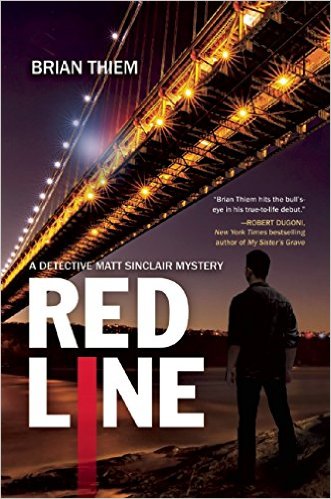
RedLine
At NE Crimebake this year, Auntie M took a police class from Brian Thiem, a former Oakland Homicide Detective Commander with years of Army experience, too. So it was a pleasure after listening to his expertise, designed for writers to ‘get it right’ about police actions, guns, and forensics, to come home and read his debut crime novel featuring Detective Matt Sinclair, Red Line.

RED LINE is an excellent police procedural with an engaging main character who comes across as real, someone readers can identify with and will want to follow, and that extends to his new partner, Cathy Braddock. Catching his first case after desk duty for a series of incidents that have stained his reputation, Sinclair needs a good case to get back into action.

A teenage boy has been found dead at a bus stop outside a hospital, the son of surgeon at that hospital who lives in an affluent neighborhood. Then a second body is dumped at the same bus stop, and Sinclair and Braddock try to find the connection between the victims.

It doesn’t help that the cases bring back an old case of Sinclair’s from two years ago, when two girls were left at that same bus stop. One in a dazed state wandered into the line of traffic and died as a result of being hit by cars. Sinclair realizes he was too deep into his alcoholism at the time to devote as much time to the case as he should have and works even harder to do them justice.

The daily routine of police work is recreated in perfect detail: the interviews, the reports, the way small bits of information come together to build a case. And as Sinclair works this case he must deal with superiors who want to force him out of homicide.

With a girl friend who is a television reporter whose job often puts them in conflict, readers will come to understand the grueling long hours and high stress of a murder investigation, all as Sincalir struggles with his desire to take to the bottle again. Chapters from the murderer’s point of view add to the well-plotted mystery. A strong debut which will leave readers looking for a sequel, from someone who knows the drill inside out.

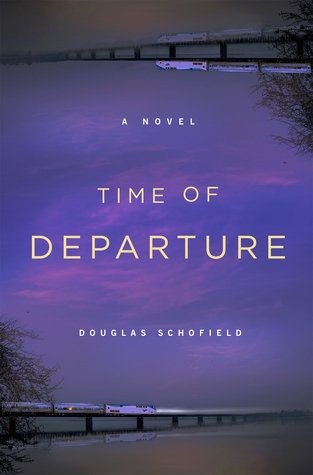
TimeDeparture
Douglas Schofield has crafted a most unusual police procedural in Time of Departure. Drawing on his own legal experience, he introduces Claire Talbot, a Florida State prosecutor trying to prove herself to her colleagues in her new post a head of their Felony Division.

The action kicks off when a highway construction crew find two skeletons sharing a grave, and Claire is forced to reopen a cold case investigation into a series of abductions. Perusing the case file, she comes across retired fellow cop Marc Hastings, who becomes too close for comfort with some aspects of Claire’s life and this case.

Is his interest more than affection? And what does Hastings know about Claire’s life that she doesn’t?

A compelling debut that shows a clever mind behind it all, mixing genre expectations.

Lies
Linda Lovely takes readers to her hometown of Keokuk, Iowa, in the year 1938 for Lies. Using real landmarks and historical happenings mixed with her fictional story and elements, this is a strong showing from a great storyteller. The period leading up to WWII comes alive under Lovely’s talented hand.

Catherine Reedy Black knows she needs to leave her abusive husband, a swindler and con man, in order to have a reasonable future for her two-year old son, Jay. With her family’s support, she just might be able to do it, too, until Dirk Black’s corpse is pulled out of the river, and Cat becomes the prime suspect.

New to the police department, Ed Nelson knows Cat from school, and remembers the bright girl he was attracted to. But he’s hiding his own secrets, and even as he tries his best to help clear Cat, he’s fighting the corrupt police chief who wants nothing more than to see Cat convicted of murder.

With the annual Street Fair in town, the glitzy lights and rides will prove a scary setting as Cat tries to clear her name and almost dies in the effort. It seems there are many in town who are hiding secrets, and among them is the killer with a motive Cat needs to unearth.

A perfect mix of compelling mystery and love story in a well-drawn setting. And a great gift for any reader who enjoys this period.

WhatYouSee
Multi-award winner Hank Phillipi Ryan returns with her fourth Jane Ryland thriller, What You See.

The journalist and her detective boyfriend, Jake Brogan, are in the midst of still trying to figure out how to handle their conflicts of interest in their jobs. She’s interviewing with a new channel, and rushes to the site of a big story: the stabbing death of a man at historic Faneuil Hall–and it’s Jake’s case.

You would think with multiple tourists capturing the murder on their cell phones that this would be one case that’s an easy solve, but Jake and his partner Paul find this investigation isn’t at all what they’d predicted. There’s an injured man in addition to the victim to consider, too.

In the midst of this, Jane’s sister is about to be married, what should be a joyous occasion–until her fiancé’s daughter, the young flower girl, is abducted by her stepfather. Nine-year-old Gracie’s disappearance is just the tip of the iceberg as this story overlaps with the case Jake is following, with fingers leading to dark places.

It gets more and more complicated. Neither the murder victim or the injured man in the alley have any ID on them, making motive and solving the case difficult. Jane is juggling with trying to establish a new place at Channel 2 when her family situation takes precedence. Jake is finding that a murder in broad daylight in front multiple witnesses is full of challenges and directions of interest that have far reaching connections and consequences.

It all places Jake and Jane in a position to test their loyalties to each other and to their jobs.

Ryan does a bang-up job of showing how even in this digital age, looks can still deceive. Filled with family secrets, merciless ambition, and deceitful maneuverings. JT Ellison says, “This is Ryan at the top of her game.” A perfect mix of mystery and romance.
Silent City
Carrie Smith’s first Manhattan police procedural, Silent City, features protagonist Claire Codella, a detective just back on the case after grueling chemotherapy for an aggressive lymphoma. Still dealing with its after-effects, which Smith details accurately, Codella’ first murder case turns out to a well-liked school principal. And Codella must prove to her colleagues, and to herself, that she’s up to the task.

Hector Sanchez’s murder investigation hands Codella a new partner to break in, newly promoted Eduardo Munoz. They, along with Codella’s former partner, Brian Haggerty, follow numerous leads in their search for Sanchez’s killer. The staging of his body makes it appear that his murder is connected to his job as principal at PS 777 and the three investigators quickly learn there are far too many suspects with a motive to kill him.

Codella is an intelligent detective who follows where the evidence leads her, and whose new boss is not exactly her biggest fan. Yet despite his attempts to undermine her authority, Codella relentlessly pursues all the of the leads in the case, despite battling her cancer treatment’s side effects.

Munoz and Haggerty, also excellent investigators, know they must be loyal to Codella. Munoz must also prove himself worthy of his promotion; Haggerty and Codella are trying to put to bed an old rift that came between them.

This mystery has an engaging storyline and appealing characters. With plenty of suspects, no clear cut motive for the crime and stunning plot twists, Carrie Smith skillfully conceals the killer’s identity until the novel’s climax. A strong series debut.

ManWashingMachine
Susan Cox won Minotaur Books/Mystery Writers of America First Crime Novel award. The Man on the Washing Machine is a delightful mix of humor and murder, taking place in San Francisco, and introducing a most unusual sleuth, former party girl and society photographer Theophania Bogart, who hides her own family secrets.

Theo unfortunately sees her neighbor, Tim Callahan, fall from his apartment window, plunging her right into the middle of his murder investigation. Her already complicated new life comes under intense scrutiny. Surrounded by neighbors and friends, Theo is the owner of a small bath and body shop as well as the building housing it, but she is constantly afraid her sordid past will be unearthed.

What will a police investigation do to her carefully crafted identity?

When the police detective suspects murder, not suicide, she lists the entire neighborhood as suspects and that includes Theo. Then another body with direct ties to Theo turns up, making her the number one suspect.

Filled with eccentric characters, this fast-paced mystery is filled with humor and action. A perfect gift for those readers who enjoy a dose of humor with their mystery.

That’s it for the gift listing, folks. Remember that books make wonderful presents for anyone on your holiday list. And enjoy yours, with a few for your stocking as well~

Holiday Joy: Books that make grand gifts~ Tuesday, Dec 8 2015 

Every year at this time Auntie M likes to give readers a listing of great suggestions for the readers on your gift list. Auntie M has saved some of her favorite recent reads for this year’s list and there’s something for every type of reader. Several have received Auntie M’s coveted “Highly recommended,” which she doesn’t hand out to many over the course of the year, so you know these are special reads she’s been saving for you when you see them here.

And don’t forget to pick one up for yourself. Reading a good book is one of the nicest things you can do for yourself. Reading takes us on travels, teaches us things we didn’t know before, shows us other cultures, all wrapped up in a good story. So look over these and find something for everyone. And enjoy whatever holiday you celebrate!

recipes
Sally Andrew’s first Tannie Maria Mystery, Recipes for Love and Murder, is one of the most original and interesting mysteries Auntie M has read this fall. And when she was done reading, she was already looking for the next installment, like you would like for an old, wise friend.

Set in contemporary South Africa, the Klein Karoo landscape, nature, food, language and habits of the area come alive through the eyes of Tannie (Auntie) Maria, a widow who happens to be a brillant cook. Mevrou van Harten knows that her food works magic in people’s hearts, not just their stomachs.

Her recipe column is a staple in the local paper until she’s forced to add an advice column to it, and of course, food figures heavily as she fights her own loneliness and tries to help others through food. But when she receives a set of letters from a woman being abused by her husband, they bring painful echoes of Tannie Maria’s own abuse at the hands of her dead husband and underscore her lonely existence.

Then that woman is murdered, and Tannie and her young reporter colleague forge into the murder investigation in indignation and outrage. There will be a host of characters as viable suspects and others who just muddy the waters, but all respond to Tannie Maria’s food and wisdom. There are laugh-out-loud characters and others who bring a quiet grace. And then there’s Detective Lieutenant Henk Kannemeyer, who brings his own sage wisdom to Tannie Maria’s life.

You will learn Afrikaan words and phrases, and yes, there are recipes at the end that you will find yourself looking for as you read the descriptions of the food. A wise woman and a wise book. Highly recommended.
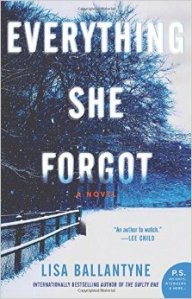
forgot
Lisa Ballantyne’s The Guilty One was one of Auntie M’s favorite reads last year and she makes the list again with Everything She Forgot, as different from her first as it is just as special.

With a creative, original premise, Ballantyne introduces readers to Margaret Holloway, a working mom with a full plate, who is distracted on a traffic-filled road when she’s caught up in a horrific accident. When her car erupts in flames she narrowly escapes death, freed in the nick of time by a good samaritan who is not as fortunate and winds up in hospital hanging onto his life.

Despite what are externally minor injuries, Margaret’s core has been shaken and she can’t concentrate or relax, nor can she forget her rescuer and finally makes attempts to find out who he is. At the same time, an alternate storyline tells of the kidnapping of a young girl in 1985 and the days she spends with her captor, time that gradually has moments of enjoyment as the two learn about each other, until that part of the story ends dramatically.

But in the present Margaret struggles, feeling disconnected from her life, her husband and her children, as she tries to return to normalcy after the accident. Once she finds him, she’s drawn to the hospital to visit the man who saved her life, as she starts having flashbacks of memories long buried from her childhood.

Ballantyne masterfully connects the two threads–and the reader senses this before Margaret does–as she comes to see that the answers to her buried past have come full circle. Highly recommended.

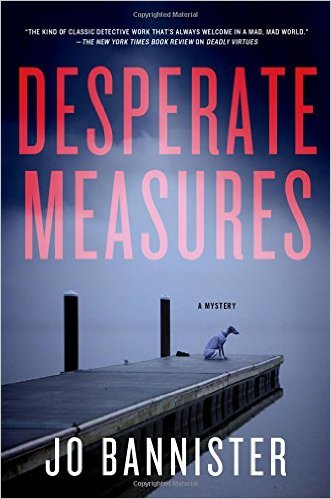
DespMeasures

Jo Bannister’s previous two crime novels featuring policewoman Hazel Best and her friend Gabriel Ash and his dog, Patience, have been two of Auntie M’s favorite reads, so she was anxious to read the third installment, Desperate Measures. Four years ago Ash’s wife and two sons were kidnapped by Somali pirates, and when Hazel Best came across him, he had left his job and struggled to maintain his sanity, not knowing if his family were alive or dead. With Hazel’s help, progress was made, along with her own situation at the police station taking a sharp turn.

The book opens with Gabriel’s knowledge that his wife is alive giving him hope and despair at once. Will he be able to save her? Are their sons still alive? And then the demands of the pirates for his family’s safe return seem impossible to fulfill, an horrific act of online sacrifice.

Once this demand is met, Gabriel’s wife and two sons are returned to England, but Hazel is left bereft and grieving, until she’s forced to pull her own life together, and in doing so, finds that all is not as it seems and once again she must be there to pick up the pieces for the young man she mentors.

There’s more here than meets the eye on several levels. At one point the reader will be as angry with Bannister for the events that unfold as Hazel is, but no one will be more hurt than Gabriel when he learns who he has to blame for the breakup of his family. The plot is complicated and it would be difficult to describe more without spoilers, so full stop here. Just get yourself a copy for a bloody good read.

A terse unusual police procedural that’s filled with suspense, Bannister’s characters leap off the page and demand your attention and devotion. Even Patience, the most unusual dog to be written on the page, comes across with her own personality. Highly recommended.

Jane Casey, After the Fire

Jane Casey’s Maeve Kerrigan series gets stronger with each entry. After the Fire follows Maeve and her irascible DI Josh Derwent as they investigate a fire at Murchison House, part of the Maudling Estate, a London tower block that has a bad association for Maeve, who is already having a difficult time trying to find a way to expose her stalker, Chris Swain.

The fire takes the lives of two victims trapped in one of the units and severely injures a young girl, left fighting for her life. But there’s another victim, the reason Maeve’s team has been called in by DCI Una Burt, who is not Maeve’s favorite superior. MP Geoff Armstrong’s body has been found shattered, lying on top of a wheelie bin. The question is: did he jump to avoid the fire or was he pushed?

The motives for Armstrong even being on this estate are suspect. A controversial right wing politician with strong views that put most people off, his presence on the kind of estate that houses the culturally diverse and deprived people he despised surely bears examining.

All of the families living on the floor of the fire will have to be investigated, and the menace grows in far too many areas as the pair go about their work, all the time aware the Maeve’s every movement is being monitored by her stalker–and it’s time for her to get her life back.

The twisted plot will surprise readers as there are threads that come together that make this ending a heart-pounding climax. And just when you think it’s over, there’s even more for Maeve to deal with. Addictive and highly recommended.

HideSeek
And while you’re reading Jane Casey, if you have any younger readers on your list, her newest YA Jess Tennant Mystery is a perfect choice. Hide and Seek follows Jess when her classmate is apparently kidnapped shortly before Christmas in the small town of Port Sentinel where Jess lives now with her mom.

It should be a magical time, with fairy lights and even a mini-ice rink at the Christmas market, until Gilly Poynter disappears. Is this a case of an unhappy teen running away from home, or a more sinister kidnapping?

Casey’s teens are realistic: self-centered at times, helpful at others, always with a sense that they are just this little bit away from leaping off the page and leaving their dirty dishes in your living room. Jess will find there are secrets that have been harbored for years that will affect her relationship with boyfriend Will, too, and her own future. A satisfying read for any YA reader without reservations, and for adults, too. Auntie M is giving this book to her 15 year old grand-daughter for Christmas, but don’t tell her please.
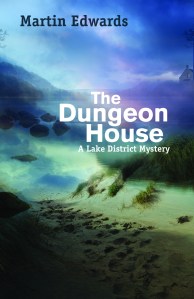
The-Dungeon-House-cover
Martin Edwards, newly-inducted head of The Detection Club (congratulations, Martin!), has a new Lake District Mystery out, The Dungeon House. For followers of the series, Detective Hannah Scarlett and historian Daniel Kind have had a complicated relationship in the past that just may be smoothing itself out. His father, Ben Kind, was Hannah’s mentor as a young detective, and Ben’s presence is felt in this mystery that takes Hannah’s Cold Case team back to the recent past and then even further back than she’d thought possible.

The book opens twenty years ago in the remote west coast area of Cumbria. The Dungeon House is a mansion with extravagant gardens overlooking the fells, a nuclear plant, and boasting its own small quarry. It’s been home to Malcolm Whiteley, his attractive wife, Lysette, and their teenaged daughter, Amber.

But this is not a case of Happy Families, as Malcolm’s drinking is out of control over financial pressures. He assumes his wife is having an affair and sinks into despondency and then alcoholic rages. After a yearly barbecue at Dungeon House, where Malcolm’s erratic behavior sets tongues wagging, Lysette finally tells Malcolm she’s leaving him. But before she can, tragedy occurs when Malcolm shoots and kills her. His body is found next to Amber’s broken body at the bottom of the quarry, an apparent suicide. Did Amber hear him shoot her mother and run from him in terror, falling over the unrailed edge to the quarry’s bottom? Or was she pushed during an argument with her father, who then committed suicide?

The case worried Ben Kind and becomes handed down to Hannah twenty years later when she’s asked to look into a three year-old case of the disappearance of Lily Elstone, daughter of Malcolm’s longtime accountant. Another teen has just disappeared, related to Malcolm through his brother’s son, Nigel. It’s Nigel’s daughter, Shona, who has disappeared, and coincidentally, Nigel now owns and lives in Dungeon House, which he’s renamed Ravenglass Knoll.

Hannah’s investigation will take her to dig up a long-ago car accident that had disastrous effects for those involved, just as one of the survivors shows up in town, bringing everyone’s secrets to the forefront. There will be few happy endings when it all falls out, but Hannah is determined to get to the bottom of it all, and with Daniel’s help, she just might get there.

resortmurder
Martin Edwards also edited the anthology Resorting to Murder: Holiday Mysteries. This is part of the British Library Crime Classics brought out by Poisoned Pen Press in the US which all have distinctive and delightful cover art. For any reader on your list who enjoys vintage stories, these fourteen mysteries will give them holidays without ever leaving home. Each story is introduced by Edwards, who describes the author’s life and background. There are some familiar names here–Conan Doyle and Chesterton, for example–but also pearls that are seldom seen in print, by writers such as Phyllis Bentley, Helen Simpson, and one of Agatha Christie’s favorite plotters, Anthony Berkeley. A real delight.

RiotUncouth
Lord Byron as detective? Daniel Friedman’s Byron believes his skills as a poet make him a perfect detective in the humorous and beguiling Riot Most Uncouth. The young student Byron, supposedly studying at Cambridge with his pet bear, decides to solve the gruesome murder of a young woman, one of the few females he hasn’t tried to bed.

His detecting skills are soon proven lacking by private investigate Archibald Knifing. When the bodies keep piling up, a second investigator, Fielding Dingle, becomes involved and the killings escalate. For the egotistic student detective, the challenge becomes throwing aside his assumption a vampire is running around Cambridge and settling down long enough to unmask a killer. Totally original and perfect for fans of historic mysteries who enjoy sly humor.
blackriver
Auntie M met Tom Harper at one of St. Hilda’s Mystery and Crime Conferences, where his papers and talks proved him to be a charming, erudite young man with a great love of history. He brings that intelligent perspective to his new thriller, Black River, and he knows how to tell a story with a great sense of setting, too, having been there.

This one’s for the reader on your list who enjoys action that never stops, as Harper introduces the happily married Dr. Kel MacDonald, a man who realizes he needs one great adventure and finds it handed to him in the lure of using his medical expertise. He’s given a chance to journey to find a lost medical expedition on their way to the fabled lost city of Paititi in the Amazon jungle.

The fact that Kel has absolutely no surivial skills doesn’t stop him from joining expedition of Anton’s crew with five men and two women– but does make him totally reliant on the others in the group.

There will be encounters with natural dangers, medical issues, and guerrillas, and Kel soon finds himself not knowing whom he can trust, but knowing his life hangs in the balance. And that’s if he makes it back to civilization. Peter James calls Harper “… a master storyteller.”
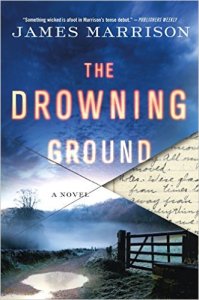
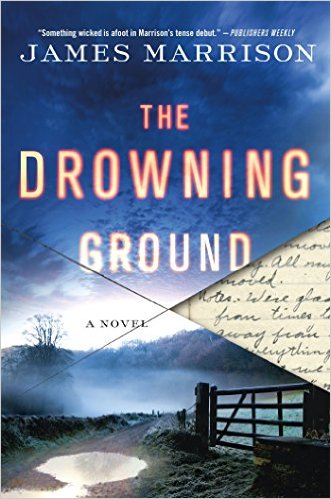
drowning ground
It might be a Cotswold setting, but this is no Miss Marple in James Marrison’s strong debut The Drowning Ground.

The fish out of water this time is native Argentinian Chief Inspector Guillermo Downes, who carried his grief across the pond to head up the police department. When a witness tells him he’s not from here, meaning Englnad, Downes tells the reader: “I get this a lot.” By having Downe’s point of view in first person, the reader becomes close to the detective and how his mind works, filled with memories of Argentina, suffused with the contrast of the two places he’s lived.

History haunts Downes. When two young girls go missing within days of each other, Downes made it his mission to find out what had happened, promising the second child’s mother he would find her daughter. In describing the case to his new sergeant, Downes tries to explain how much worse a child vanishing can be than murder: “Because the family never know, you see. There’s hope, but such hope is worse than despair. It’s poison.”

Years elapse with no progress on the case. Then a local man is found dead dead. Downes recalls his wife’s drowning, and that many in the small town felt Frank Hurst had murdered this second wife. In thinking about Hurst after looking at his corpse, killed in a most horrific way, Downes muses:
“His whole life would now be defined by this moment. You were remembered if you were murdered.”

So when a connection between Hurst and the missing girls seems likely, Downes jumps at at the chance to keep his promise.
Downes has a new Sergeant to break in, too, and as he and Graves get used to each other, the nuances of two very different men become apparent.

Marrison fills the book with visual and sensory details. With a keen eye to the life of a small English town, Marrison gets inside the head of his characters so well, your reader will be asking for the next in the series to follow the brooding Downes. A well done debut.
November-Rain-1_r1_c1
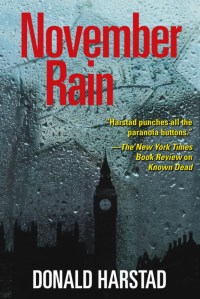
Many years ago when Auntie M was taking a class at the University of Iowa’s Summer Writing Festival, she wandered into Prairie Lights, the town’s premier independent bookshop with a strong literary history. It happened that a local radio station was doing their live broadcast of writers reading from their works that evening, and the guest was the debut mystery by a deputy sheriff of Clayton County, Iowa. Donald Harstad read from that first book, Eleven Days, a Carl Houseman mystery.

Now retired, Harstad’s sixth Houseman mystery hits all the right notes in November Rain. This time, though, Houseman leaves his beat in rural Iowa and steps unwittingly into the world of international intrigue.

With his daughter studying in the UK, Houseman steps up when Jane’s best friend, Emma, is kidnapped. Wanting to protect his daughter, he agrees to become a consultant to Scotland Yard. Soon he finds himself embroiled in the activities of Emma’s ex-lover, a former professor whose activism for a pair of Muslim political prisoners has had severe side effects that now extend to Houseman.

The Iowa sheriff becomes involved with Special Branch members. The use of time at scene headings keeps the reader oriented to place and to feel the pressure Houseman feels as the case unravels. Told in the first person from Houseman’s point of view, a tense procedural.

Third Sin
Auntie M is a huge fan of Aline Templeton’s Marjory Fleming series. The Third Sin explores what happens to a group who call themselves the Cyreniacs, espousing sex, drugs and pleasure as their main principle. After one young woman dies from an overdose, it appears a second commits suicide, and the group disbands.

Then a body turns up two years later in a wrecked car on the Solway mud flats. And while this man is definitely now dead, it’s a very recent death, and he couldn’t have committed suicide two years ago.

Then another death tragically occurs just as a young woman out of the country for years returns. What do they have in common? And how do they tie in to the man’s death?

With DI Fleming and her team on the investigation, she finds new cross-sectional rules sound good on paper, but cooperation from her opposite is truly absent. She faces hostility and downright obstruction as the cases cross counties. It will take all of her smarts and detecting instincts of Fleming and her team to figure out how to piece together the reality of the situation.

One of the charms of this series is following the growth of Fleming’s family: her sheep farmer husband and son and daughter, now grown and finding their way. This edition gives readers enough balance of that life for Marjory to feel fully developed and someone they can, and should, admire. Another strong entry in a great series.

Look for the next installment of Holiday Joy, where the settings will be in the US~

G. M. Malliet: The Haunted Season, A Max Tudor Mystery Sunday, Dec 6 2015 

Auntie M had the pleasure at this year’s Raleigh Bouchercon to spend time with G. M. Malliet and talk about her Max Tudor series and the ending of her newest, The Haunted Season, as well as what else she has in the works:

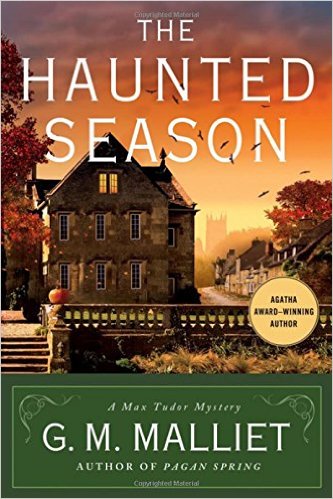
HauntedSeason

Auntie M: This book had a decidedly different feel, from trailing the antagonist to the darker ending. Care to say what’s in store for Max without giving any spoilers?

G. M. Malliet: Max definitely has a lot on his mind, with a new baby and his clerical work. But chasing the bad guys has given him a taste of what he was once very good at, working with MI5. So while he’s still going to be a vicar and be based where he is, I wouldn’t discount him becoming involved with his old MI5 cronies down the road . . .

AM: Wonderful! And a way to provide new interest for readers. So while Max is busy, what else do you have percolating?

GMM: I’m working on a stand alone, also set in England, what I call a domestic noir with a female protagonist. I’m doing it in first person and finding that’s a real challenge I’m enjoying.

AM: Readers will look forward to that for certain. Do you have any plans to do more in your award-winning St. Just series?

GMM: I hear from readers all the time that they’d like to read more of that series. I would pick it up if I can find an agent who’s interested in selling more.

AM: You’d have an easy sell there, for sure. The satire in those rang so true and were done so well. Who are you reading right now when you find you have a few minutes of down time?

GMM: I’m working my way through Tana French’s series, take the books to the gym and get some reading in. Enjoying those and her plotting. Broken Harbour has been my favorite so far.

AM: I enjoy those, too, and her newest, The Secret Place, was amazing for her ability to keep interest going through an entire book that takes place in one day. So what’s the best writing advice you’ve ever received that you’d like to share?

GMM: People used to say ‘write what you know’ but I’ve found that can be interpreted to mean “write what you’re interested in” because it gives you the passion you need. In my case, I’m fascinated by English villages and the life we find there.

AM: Me, too! Now on to the review:

G. M Malliet’s fifth Max Tudor mystery may be her best one yet. The Haunted Season finds the hunky vicar enjoying his role as husband and father to infant Owen. It’s a pastoral setting with dog Thea completing the little family, and the only things of worry at this point are funds for St. Ewold’s organ pipes, and a parishioner whose crush on the vicar becomes worrisome.

Balancing this out is his new curate, the Rev. Destiny Chatsworth, who will help to take some of his workload on her shoulders and seems to have the built-in empathy required for the job. Then a murder occurs too close to home to be ignored, bringing Max under the Bishop’s radar once again.

The manor house of Nether Monkslip is Totleigh Hall, mostly unoccupied with the Lord and Lady spending time in Spain, yet at present the entire family is in attendance: Lord Baaden-Boomethistle and his very attractive second wife; son Peregrine and daughter Rosamund, college students who are at war with each other constantly; and the Dowager Vicountess, “Crazy Caroline,” who writes steamy romance novels.

There are petty squabbles at meals between the members that hint at the underlying tensions in the household, until the rather ghastly murder of the Lord occurs, and Father Max is once again pressed into service for help to find a killer.

Malliet’s wry humor, sprinkled throughout the mystery, adds a touch of whimsy to the investigation headed by DCI Cotton. With the entire family under suspicion, it soon becomes clear that Max has his work cut out for him.

There will be interviews with previous nannies, and much delving into the family’s background. Max finds himself recalling Josephine Tey’s Brat Farrar, and has dreams that seem designed to point him in the right direction.

What sets this episode apart is the darker tone the story takes near its end once the murder is solved, and the thread that hints at a new direction in the next chapter. Readers will be anxiously awaiting the next installment to see where Max Tudor goes next.

John Bainbridge: A Seaside Mourning Friday, Dec 4 2015 

John Bainbridge and his wife Anne are historians and researchers extraordinaire who use their own history in the Inspector Abbs mysteries. Here’s the story of the background to A Seaside Mourning
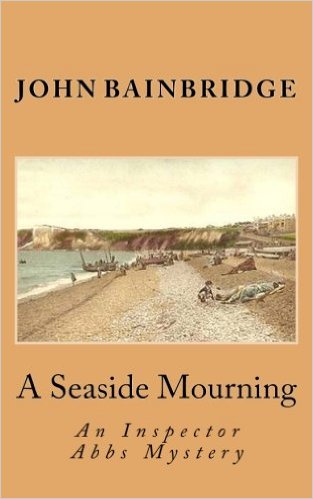
Seaside

The Background to A Seaside Mourning
Our Victorian murder mystery is set in the fictional town of Seaborough, a small resort in Devon. The plan was to think hard about coming up with a suitable name. However around the same time we were researching John’s family history. When we found that one of his ancestors had the unusual first name of Seaborough, it seemed exactly right.

In the novel Seaborough is in East Devon, an area often overlooked by holiday-makers who travel to the better-known parts of the English Riviera and the South Hams. It is a timeless landscape of rounded hills, old hedgerows, meadows and heaths; villages with thatched cottages and a few quiet seaside resorts. Their railway stations and branch lines are long gone.

The unspoilt coastline has red sandstone, zig-zag cliffs gradually fading to chalk near the county border. Together with the neighbouring county of Dorset, they make up the Jurassic Coast, Britain’s first Unesco natural world heritage site. We know the area well from walking the old footpaths and exploring the villages of my forebears. One of my ancestors was a Victorian police constable, probably much like the ones in the story.

Walk through the streets of any British seaside town, trace back the architecture and you’ll most likely find the beginning was a fishing village. The rise of the seaside resort – offering buildings and entertainment designed to attract tourists – gradually began in the eighteenth century. At that time the concept of an annual holiday for the masses didn’t exist. The wealthy tended to travel abroad on the classical Grand Tour or over-winter on the Continent. Working people had neither the money nor paid leisure to explore new places.

From the mid-1700s physicians began questioning whether sea-water might have healing properties similar to those of spa water. An enterprising Sussex physician Dr. Richard Russell set up a house for patients in the fishing village of Brighthelmstone in 1753. ‘Taking the waters’ at inland spa resorts was fashionable and money was to be made from rich invalids – and hypochondriacs – so there may have been some self-interest involved!

Dr. Russell published works on the rejuvenating powers of sea-bathing and drinking salt water, claiming his treatments cured enlarged glands and all manner of ailments. As well as swimming, his patients were immersed in baths of salt water and encouraged to ‘promenade’ in the sea air. This quickly became prevalent medical opinion.

Just as today, landowners and speculative builders were quick to spot a business opportunity. Scarborough on the coast of Yorkshire had the best of both worlds. Mineral water had been discovered there in the early seventeenth century and they had a flourishing spa by the beach. Wheel out the bathing-machines and the town was well-placed to develop into England’s earliest seaside resort.

Villages along the south coast in particular offered a mild climate and an easier journey from the capital. They began to throw up lodgings suitable for well-to-do visitors. Theatres and assembly rooms were built, promenades and sea-front gardens laid out. New resorts advertised their picturesque scenery, carriage tours and health-giving benefits.

Jane Austen satirised this new enthusiasm in her last unfinished novel, Sanditon. Interestingly Reginald Hill did a witty take on Sanditon – one of his lovely literary jokes – in his Dalziel and Pascoe novel A Cure For All Diseases. Sidmouth in East Devon is a possible contender for Austen’s Sanditon, though several resorts also fit the clues. It’s most likely that Jane Austen was thinking of more than one place. The Austens enjoyed holidaying along the Channel coast. Their stays at Lyme Regis in 1803 and 04 famously inspired part of the setting of Persuasion.

Fashion played a part in putting a watering-hole on the map. When George III’s physicians recommended he try the sea cure in 1788, he chose the village of Weymouth on the Dorset coast. Liking its sheltered sandy bay, he returned many times, making Weymouth one of England’s oldest seaside resorts.

His son, later the Prince Regent, vastly preferred Brighthelmstone, nearer London. Under his patronage it expanded rapidly to cater for his younger and wilder set. It has never lost its stylish and racy reputation. The spelling changed to suit its pronunciation and a new saying became widespread. The wealthy patient often tried the cure of Doctor Brighton.

Some towns started out as the vision of a single developer. In the 1780s a wealthy merchant called Sir Richard Hotham bought up land around the Sussex fishing village of Bognor. He intended to design a purpose-built resort modestly named Hothampton and entice the King away from Weymouth, making himself a second fortune. George III never obliged and the town reverted to Bognor soon after Sir Richard’s death. He did leave the townspeople several fine terraces and a splendid park.

New resorts received a boost to their fortunes when the Napoleonic wars closed the Continent to travellers. Prosperous invalids and people living in seclusion often settled by the sea in smart new villas for the gentry. Lady Nelson came to live at Exmouth in East Devon, after Nelson’s association with Lady Emma Hamilton became public knowledge.

Hunstanton in Norfolk came about as the scheme of one man, though much later. In 1846 Henry Le Strange, an architect and local landowner built a hotel on an empty headland as the flagship of his new town. A typically enthusiastic Victorian ‘entrepreneur’, he gathered investors to fund a railway line from King’s Lynn to his planned site, which was named after the nearby village of Old Hunstanton. It took another 16 years before the railway arrived and further building work began.

Many resorts can date their growth to the arrival of the railway. It became the custom for middle-class Victorian families to send their children to the seaside with nannies and nursery-maids. The first pleasure pier had been constructed at Ryde on the Isle of Wight, as early as 1814. Almost a hundred more followed, mostly in England and Wales. The Bank Holiday Act of 1871 gave workers four days off – five in Scotland. On Whit Monday and in August, railway companies laid on ‘Bank Holiday Specials’ for the day-trippers pouring into popular resorts. At last accessible for the pleasure of ordinary working people, the seaside resort as we know it today had arrived.

In A Seaside Mourning, Seaborough is expanding. It is autumn 1873 and the town has its railway branch line. New houses are going up and some businessmen are keen for a pier and other amenities to be developed.

Many of the characters are on the make, jostling for more money and social position. Some are fighting for security in a precarious society shadowed by the workhouse. Even Inspector Josiah Abbs is not safe. This was an age when policemen were not considered gentlemen. A detective was treated as a distasteful necessity, an embarrassment who should call at the tradesmen’s entrance.

Abbs cannot summon suspects to interview if they are his social ‘betters’ and he must catch a murderer without making enemies. Dismissal without a character is always a threat. He and his young side-kick Sergeant Reeve are both outsiders in Devon. They don’t quite know what to make of one another yet but they’re determined to solve the case somehow…

Our novel “A Seaside Mourning” is now available in paperback and on most eBook readers. Just click on the link below for more information:

And with Christmas on the way, If you enjoy curling up by the fireside with a seasonal mystery, you might like to try our Inspector Abbs novella A Christmas Malice. Set in 1873 during a Victorian country Christmas in Norfolk, our introspective sleuth has a dark puzzle to be solved. As is traditional at this time of year, there will be hope and a happy ending of a sort.

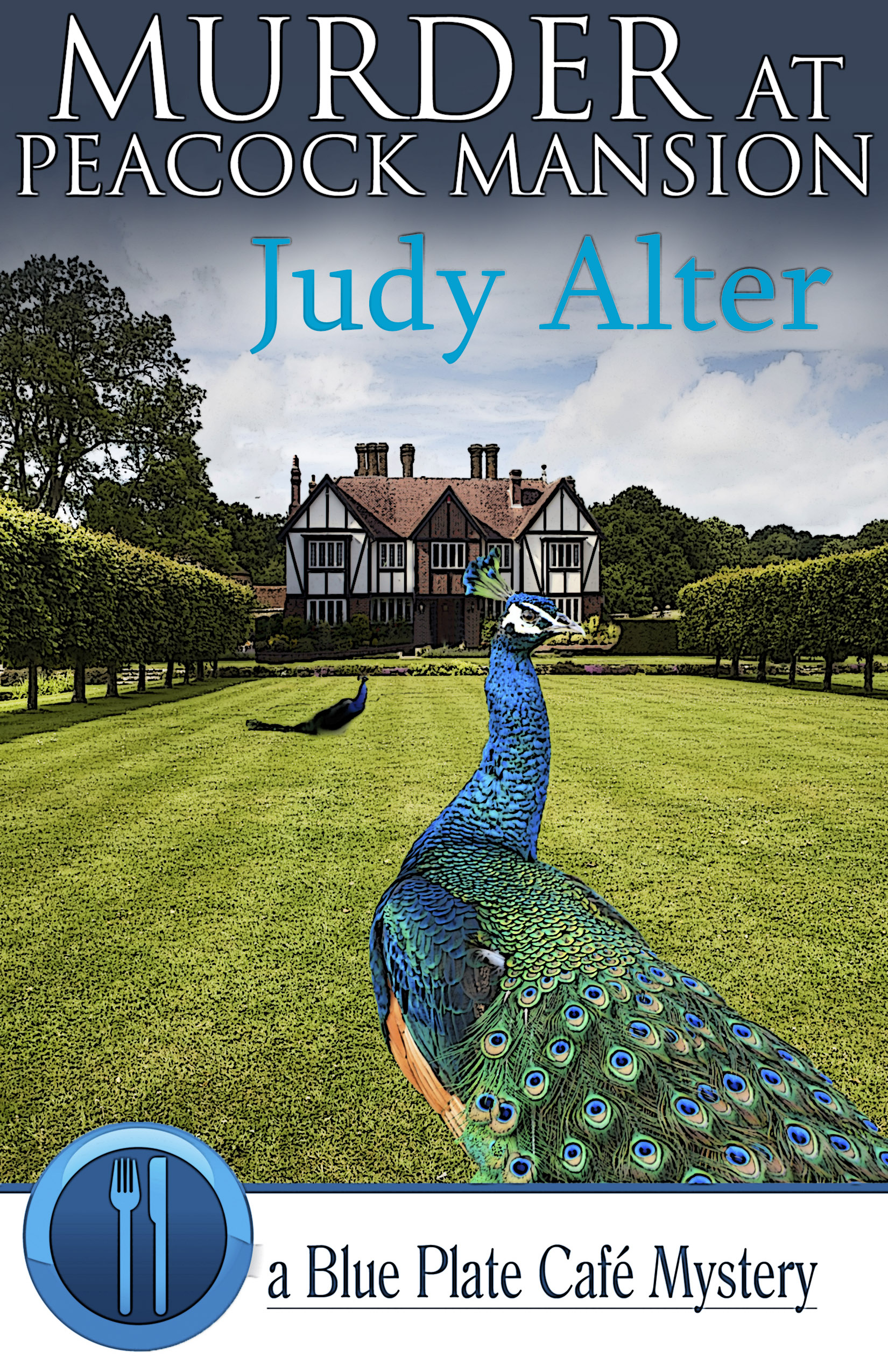
Judy Alter: Murder at Peacock Mansion Wednesday, Dec 2 2015 

Auntie M loves to hear writers talk about their process. Judy’s a wickedly busy author, and her newest, Murder at Peacock Mansion, continues her intriguing mysteries that have won her multiple awards. Here’s Judy Alter to discuss the “Dilemma of the Cozy Heroine:”
3Peacock Mansion -darker top
The Dilemma of the Cozy Heroine

When my first mystery, Skeleton in a Dead Space, came out five years ago, a mystery reviewer gave it a strong review, to my delight.

Six months later when the second one came out, I sent it to him with optimism only to have him pan it and write me requesting that I send no future books. It seems his problem was that my heroine was too passive, didn’t initiate action, didn’t rise to the position of heroically taking action and thereby solving the murders of old women in her neighborhood (No Neighborhood for Old Women).

Since Kelly O’Connell was the same person in each book and since she did unravel the mystery, reveal the killer, and nearly lose her life in the process, I disagreed with his assessment. Maybe it just caught him on a bad day? Maybe it was a gender thing?

At any rate, I’ve never sent him any of the seven mysteries I’ve since published in two series—Kelly O’Connell Mysteries and Blue Plate Café plus the so-far stand-alone, The Perfect Coed.

But that criticism has lingered in my mind because it poses a dilemma. Traditionally, the cozy heroine is an amateur sleuth, usually involved in some other calling—mine are a realtor/renovation expert and a café owner, but caterers and craft shop owners abound along with dozens of other callings. How tough are these women supposed to be?

For thrillers, the answer is clear. The female is often conditioned by training, experience or both to risk and danger. But what about Kelly O’Connell, a single mother of two daughters who spends her days looking for Craftsman houses to renovate in an inner city neighborhood?

Like most of us in our daily lives, she has never been exposed to crime, violence, and danger. Yet once she becomes involved in murders, she fights (literally and physically) for her life, dodges bullets, rescues kidnap victims—all because circumstances force her to. Should we expect her to become an instant Superwoman? I think not.

Besides, her boyfriend/husband Police Officer Mike Shandy keeps telling her to stay out of police business. . .

neighborhood_rev2_MD (2)

And that brings up the second dilemma—why is she involved anyway? Does the cozy heroine say to herself, “Oh, good—a murder. I can solve it.”? Again, I think not.

She has to have a valid reason for involvement—sometimes, for Kelly, it’s a threat to her daughters, or an abused child, or the “accidental” death of an elderly neighbor that turns out to be homicide. Sometimes it’s a desire to preserve and protect her beloved historical neighborhood in Fort Worth.

So how tough is your heroine? And how is she drawn into sleuthing? Sure, mysteries, like much literature, require the “willing suspension of disbelief,” but at the same time they have to be real to a certain extent. The cozy authors I admire—and they are many—have a firm hand on their fictional world and a clear understanding of their characters’ strengths, weakness, and motivation. It’s not just a walk in the park.

judy
About Judy
An award-winning novelist, Judy Alter is the author of six books in the Kelly O’Connell Mystery series: Skeleton in a Dead Space, No Neighborhood for Old Women, Trouble in a Big Box, Danger Comes Home, Deception in Strange Places, and Desperate for Death.

She also writes the Blue Plate Café Mysteries:Murder at the Blue Plate Café, Murder at the Tremont House and the current Murder at Peacock Mansion.

Finally, with 2014’s The Perfect Coed, she introduced the Oak Grove Mysteries.

Her work has been recognized with awards from the Western Writers of America, the Texas Institute of Letters, and the National Cowboy Museum and Hall of Fame. She has been honored with the Owen Wister Award for Lifetime Achievement by WWA and inducted into the Texas Literary Hall of Fame and the WWA Hall of Fame.

Judy is retired as director of TCU Press, the mother of four grown children and the grandmother of seven. She and her dog, Sophie, live in Fort Worth, Texas.

D. E. Ireland: Move Your Blooming Corpse Sunday, Nov 29 2015 

MoveBloomingCorpse
D. E. Ireland burst upon the scene with last year’s witty Wouldn’t It Be Deadly, bringing Eliza Doolittle, Henry Higgins and the cast familiar to readers from Pygmalion and My Fair Lady to life. The sequel, Move Your Blooming Corpse is every bit as charming and witty, taking readers to Royal Ascot and into the world of horse racing.

It’s also the time of the Suffragette movement, with emotions running high, a key element in the mystery when a young woman’s body is found murdered in one of the stables. That she is part owner of Donegal Dancer, the same racehorse that Eliza’s father owns a part of, brings out Eliza’s worst fears: Is her father in over his head and now in jeopardy? Or was the victim, a married woman known to be having affairs with at least two other owners of the race horse, responsible for her own death?

Eliza and Higgins join forces with her Scotland Yard cousin Jack to investigate before another murder takes place. But will they be soon enough? There will be jealous spouses and a young man mad with grief; there will be more races, boating regattas and picnics as the duo race against time to try to keep not only Alfred Doolittle safe, but to find the real culprit just as Eliza becomes embroiled in the Suffragette movement and finds herself learning jujitsu moves>

The writing team get the period details just right, from a the clothing down to the food to the way Society and it mores affected behavior at a time when the world was changing and not everyone appreciated the change. And they keep the characters we’ve come to love true to their nature and their actions, with their dialogue recalling the originals. Take a loverly step back in time with Eliza and Henry Higgins and the crew.

« Previous PageNext Page »