John Bainbridge: A Seaside Mourning Friday, Dec 4 2015 

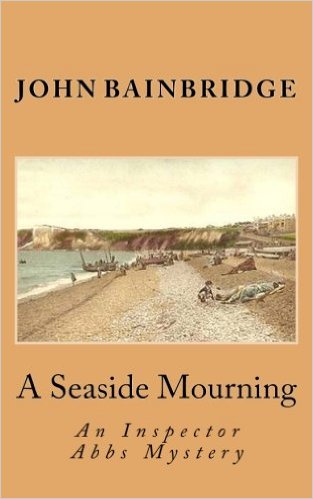
John Bainbridge and his wife Anne are historians and researchers extraordinaire who use their own history in the Inspector Abbs mysteries. Here’s the story of the background to A Seaside Mourning
Seaside

The Background to A Seaside Mourning
Our Victorian murder mystery is set in the fictional town of Seaborough, a small resort in Devon. The plan was to think hard about coming up with a suitable name. However around the same time we were researching John’s family history. When we found that one of his ancestors had the unusual first name of Seaborough, it seemed exactly right.

In the novel Seaborough is in East Devon, an area often overlooked by holiday-makers who travel to the better-known parts of the English Riviera and the South Hams. It is a timeless landscape of rounded hills, old hedgerows, meadows and heaths; villages with thatched cottages and a few quiet seaside resorts. Their railway stations and branch lines are long gone.

The unspoilt coastline has red sandstone, zig-zag cliffs gradually fading to chalk near the county border. Together with the neighbouring county of Dorset, they make up the Jurassic Coast, Britain’s first Unesco natural world heritage site. We know the area well from walking the old footpaths and exploring the villages of my forebears. One of my ancestors was a Victorian police constable, probably much like the ones in the story.

Walk through the streets of any British seaside town, trace back the architecture and you’ll most likely find the beginning was a fishing village. The rise of the seaside resort – offering buildings and entertainment designed to attract tourists – gradually began in the eighteenth century. At that time the concept of an annual holiday for the masses didn’t exist. The wealthy tended to travel abroad on the classical Grand Tour or over-winter on the Continent. Working people had neither the money nor paid leisure to explore new places.

From the mid-1700s physicians began questioning whether sea-water might have healing properties similar to those of spa water. An enterprising Sussex physician Dr. Richard Russell set up a house for patients in the fishing village of Brighthelmstone in 1753. ‘Taking the waters’ at inland spa resorts was fashionable and money was to be made from rich invalids – and hypochondriacs – so there may have been some self-interest involved!

Dr. Russell published works on the rejuvenating powers of sea-bathing and drinking salt water, claiming his treatments cured enlarged glands and all manner of ailments. As well as swimming, his patients were immersed in baths of salt water and encouraged to ‘promenade’ in the sea air. This quickly became prevalent medical opinion.

Just as today, landowners and speculative builders were quick to spot a business opportunity. Scarborough on the coast of Yorkshire had the best of both worlds. Mineral water had been discovered there in the early seventeenth century and they had a flourishing spa by the beach. Wheel out the bathing-machines and the town was well-placed to develop into England’s earliest seaside resort.

Villages along the south coast in particular offered a mild climate and an easier journey from the capital. They began to throw up lodgings suitable for well-to-do visitors. Theatres and assembly rooms were built, promenades and sea-front gardens laid out. New resorts advertised their picturesque scenery, carriage tours and health-giving benefits.

Jane Austen satirised this new enthusiasm in her last unfinished novel, Sanditon. Interestingly Reginald Hill did a witty take on Sanditon – one of his lovely literary jokes – in his Dalziel and Pascoe novel A Cure For All Diseases. Sidmouth in East Devon is a possible contender for Austen’s Sanditon, though several resorts also fit the clues. It’s most likely that Jane Austen was thinking of more than one place. The Austens enjoyed holidaying along the Channel coast. Their stays at Lyme Regis in 1803 and 04 famously inspired part of the setting of Persuasion.

Fashion played a part in putting a watering-hole on the map. When George III’s physicians recommended he try the sea cure in 1788, he chose the village of Weymouth on the Dorset coast. Liking its sheltered sandy bay, he returned many times, making Weymouth one of England’s oldest seaside resorts.

His son, later the Prince Regent, vastly preferred Brighthelmstone, nearer London. Under his patronage it expanded rapidly to cater for his younger and wilder set. It has never lost its stylish and racy reputation. The spelling changed to suit its pronunciation and a new saying became widespread. The wealthy patient often tried the cure of Doctor Brighton.

Some towns started out as the vision of a single developer. In the 1780s a wealthy merchant called Sir Richard Hotham bought up land around the Sussex fishing village of Bognor. He intended to design a purpose-built resort modestly named Hothampton and entice the King away from Weymouth, making himself a second fortune. George III never obliged and the town reverted to Bognor soon after Sir Richard’s death. He did leave the townspeople several fine terraces and a splendid park.

New resorts received a boost to their fortunes when the Napoleonic wars closed the Continent to travellers. Prosperous invalids and people living in seclusion often settled by the sea in smart new villas for the gentry. Lady Nelson came to live at Exmouth in East Devon, after Nelson’s association with Lady Emma Hamilton became public knowledge.

Hunstanton in Norfolk came about as the scheme of one man, though much later. In 1846 Henry Le Strange, an architect and local landowner built a hotel on an empty headland as the flagship of his new town. A typically enthusiastic Victorian ‘entrepreneur’, he gathered investors to fund a railway line from King’s Lynn to his planned site, which was named after the nearby village of Old Hunstanton. It took another 16 years before the railway arrived and further building work began.

Many resorts can date their growth to the arrival of the railway. It became the custom for middle-class Victorian families to send their children to the seaside with nannies and nursery-maids. The first pleasure pier had been constructed at Ryde on the Isle of Wight, as early as 1814. Almost a hundred more followed, mostly in England and Wales. The Bank Holiday Act of 1871 gave workers four days off – five in Scotland. On Whit Monday and in August, railway companies laid on ‘Bank Holiday Specials’ for the day-trippers pouring into popular resorts. At last accessible for the pleasure of ordinary working people, the seaside resort as we know it today had arrived.

In A Seaside Mourning, Seaborough is expanding. It is autumn 1873 and the town has its railway branch line. New houses are going up and some businessmen are keen for a pier and other amenities to be developed.

Many of the characters are on the make, jostling for more money and social position. Some are fighting for security in a precarious society shadowed by the workhouse. Even Inspector Josiah Abbs is not safe. This was an age when policemen were not considered gentlemen. A detective was treated as a distasteful necessity, an embarrassment who should call at the tradesmen’s entrance.

Abbs cannot summon suspects to interview if they are his social ‘betters’ and he must catch a murderer without making enemies. Dismissal without a character is always a threat. He and his young side-kick Sergeant Reeve are both outsiders in Devon. They don’t quite know what to make of one another yet but they’re determined to solve the case somehow…

Our novel “A Seaside Mourning” is now available in paperback and on most eBook readers. Just click on the link below for more information:

And with Christmas on the way, If you enjoy curling up by the fireside with a seasonal mystery, you might like to try our Inspector Abbs novella A Christmas Malice. Set in 1873 during a Victorian country Christmas in Norfolk, our introspective sleuth has a dark puzzle to be solved. As is traditional at this time of year, there will be hope and a happy ending of a sort.
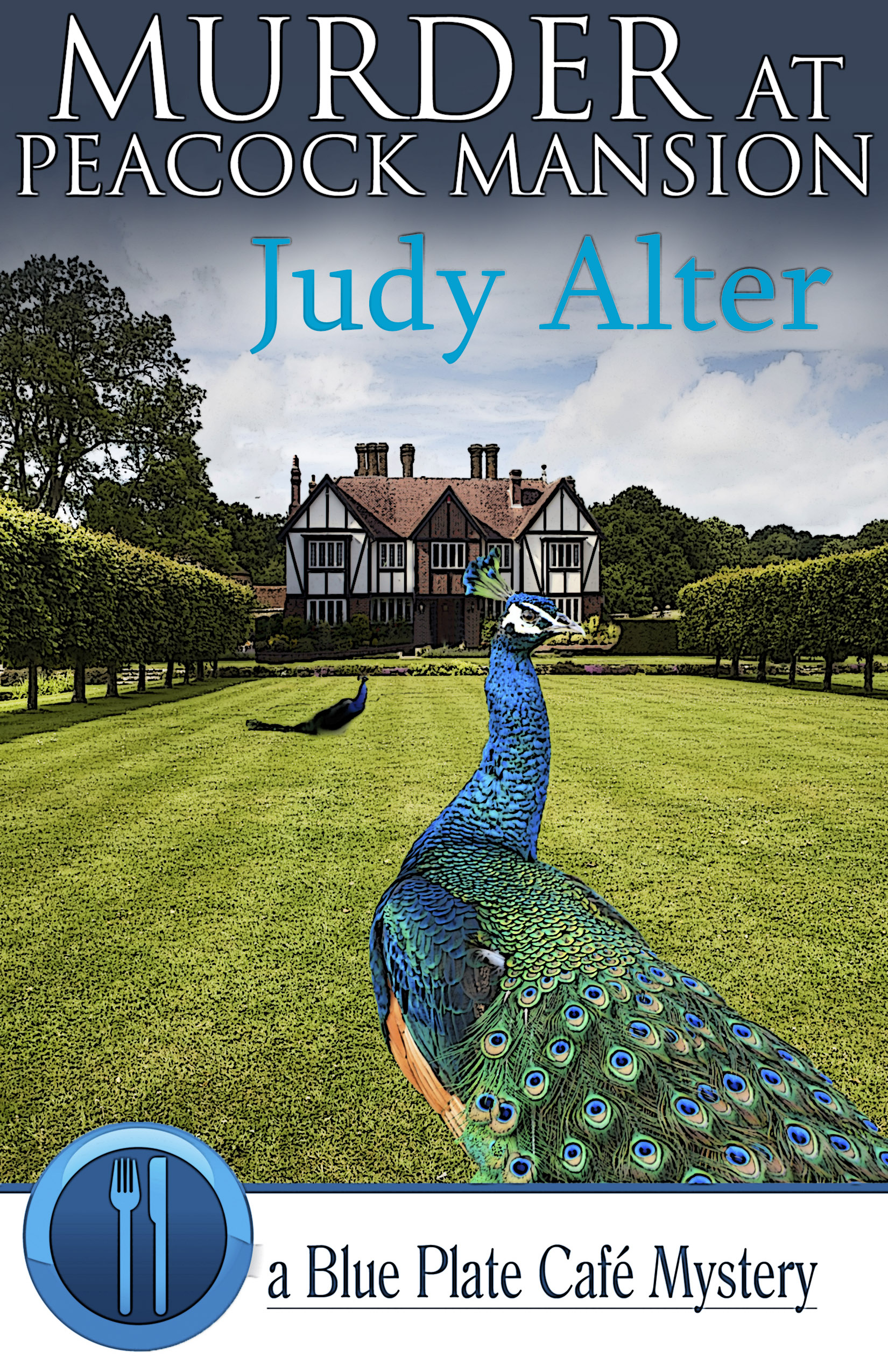

Judy Alter: Murder at Peacock Mansion Wednesday, Dec 2 2015 

Auntie M loves to hear writers talk about their process. Judy’s a wickedly busy author, and her newest, Murder at Peacock Mansion, continues her intriguing mysteries that have won her multiple awards. Here’s Judy Alter to discuss the “Dilemma of the Cozy Heroine:”
3Peacock Mansion -darker top
The Dilemma of the Cozy Heroine

When my first mystery, Skeleton in a Dead Space, came out five years ago, a mystery reviewer gave it a strong review, to my delight.

Six months later when the second one came out, I sent it to him with optimism only to have him pan it and write me requesting that I send no future books. It seems his problem was that my heroine was too passive, didn’t initiate action, didn’t rise to the position of heroically taking action and thereby solving the murders of old women in her neighborhood (No Neighborhood for Old Women).

Since Kelly O’Connell was the same person in each book and since she did unravel the mystery, reveal the killer, and nearly lose her life in the process, I disagreed with his assessment. Maybe it just caught him on a bad day? Maybe it was a gender thing?

At any rate, I’ve never sent him any of the seven mysteries I’ve since published in two series—Kelly O’Connell Mysteries and Blue Plate Café plus the so-far stand-alone, The Perfect Coed.

But that criticism has lingered in my mind because it poses a dilemma. Traditionally, the cozy heroine is an amateur sleuth, usually involved in some other calling—mine are a realtor/renovation expert and a café owner, but caterers and craft shop owners abound along with dozens of other callings. How tough are these women supposed to be?

For thrillers, the answer is clear. The female is often conditioned by training, experience or both to risk and danger. But what about Kelly O’Connell, a single mother of two daughters who spends her days looking for Craftsman houses to renovate in an inner city neighborhood?

Like most of us in our daily lives, she has never been exposed to crime, violence, and danger. Yet once she becomes involved in murders, she fights (literally and physically) for her life, dodges bullets, rescues kidnap victims—all because circumstances force her to. Should we expect her to become an instant Superwoman? I think not.

Besides, her boyfriend/husband Police Officer Mike Shandy keeps telling her to stay out of police business. . .

neighborhood_rev2_MD (2)

And that brings up the second dilemma—why is she involved anyway? Does the cozy heroine say to herself, “Oh, good—a murder. I can solve it.”? Again, I think not.

She has to have a valid reason for involvement—sometimes, for Kelly, it’s a threat to her daughters, or an abused child, or the “accidental” death of an elderly neighbor that turns out to be homicide. Sometimes it’s a desire to preserve and protect her beloved historical neighborhood in Fort Worth.

So how tough is your heroine? And how is she drawn into sleuthing? Sure, mysteries, like much literature, require the “willing suspension of disbelief,” but at the same time they have to be real to a certain extent. The cozy authors I admire—and they are many—have a firm hand on their fictional world and a clear understanding of their characters’ strengths, weakness, and motivation. It’s not just a walk in the park.

judy
About Judy
An award-winning novelist, Judy Alter is the author of six books in the Kelly O’Connell Mystery series: Skeleton in a Dead Space, No Neighborhood for Old Women, Trouble in a Big Box, Danger Comes Home, Deception in Strange Places, and Desperate for Death.

She also writes the Blue Plate Café Mysteries:Murder at the Blue Plate Café, Murder at the Tremont House and the current Murder at Peacock Mansion.

Finally, with 2014’s The Perfect Coed, she introduced the Oak Grove Mysteries.

Her work has been recognized with awards from the Western Writers of America, the Texas Institute of Letters, and the National Cowboy Museum and Hall of Fame. She has been honored with the Owen Wister Award for Lifetime Achievement by WWA and inducted into the Texas Literary Hall of Fame and the WWA Hall of Fame.

Judy is retired as director of TCU Press, the mother of four grown children and the grandmother of seven. She and her dog, Sophie, live in Fort Worth, Texas.

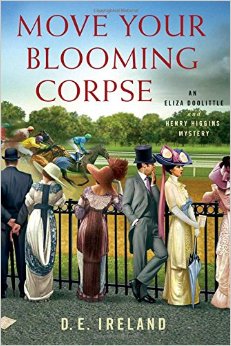
D. E. Ireland: Move Your Blooming Corpse Sunday, Nov 29 2015 

MoveBloomingCorpse
D. E. Ireland burst upon the scene with last year’s witty Wouldn’t It Be Deadly, bringing Eliza Doolittle, Henry Higgins and the cast familiar to readers from Pygmalion and My Fair Lady to life. The sequel, Move Your Blooming Corpse is every bit as charming and witty, taking readers to Royal Ascot and into the world of horse racing.

It’s also the time of the Suffragette movement, with emotions running high, a key element in the mystery when a young woman’s body is found murdered in one of the stables. That she is part owner of Donegal Dancer, the same racehorse that Eliza’s father owns a part of, brings out Eliza’s worst fears: Is her father in over his head and now in jeopardy? Or was the victim, a married woman known to be having affairs with at least two other owners of the race horse, responsible for her own death?

Eliza and Higgins join forces with her Scotland Yard cousin Jack to investigate before another murder takes place. But will they be soon enough? There will be jealous spouses and a young man mad with grief; there will be more races, boating regattas and picnics as the duo race against time to try to keep not only Alfred Doolittle safe, but to find the real culprit just as Eliza becomes embroiled in the Suffragette movement and finds herself learning jujitsu moves>

The writing team get the period details just right, from a the clothing down to the food to the way Society and it mores affected behavior at a time when the world was changing and not everyone appreciated the change. And they keep the characters we’ve come to love true to their nature and their actions, with their dialogue recalling the originals. Take a loverly step back in time with Eliza and Henry Higgins and the crew.

Elizabeth George: Banquet of Consequences Sunday, Nov 15 2015 

Auntie M had the distinct pleasure of taking a Masters Class in Beginnings with Elizabeth George last week at New England Crimebake. One of her favorite authors, George’s class was succinct and helpful. The diminutive wordsmith, who claims she is introverted, nevertheless charmed the entire audience over the three days she was there teaching, on panels, doing interviews and just being herself. She is an animal lover, another hit with Auntie M, and the two compared notes on her adorable Wire-haired Dachshund, Lucy, and Auntie M’s Italian Spinone, Radar, two opposite ends of the dog spectrum in size but not in jolly goodness.

George was generous with describing her writing process, which starts with the germ of an idea and victim as she explores her setting. Then she peoples that person’s world with other characters, creating long histories that in Auntie M’s screenwriting days were called “bibles.” Her plot unfolds from this and she’s off and writing a book for the satisfaction of readers, ones that have won her a deservedly huge following. Her newest is destined to keep her readers flipping pages.

BanquetConsequences
Elizabeth George’s 19th Lynley mystery, despite its size, lives up to the best of her work, with Lynley and Havers back on the case in Banquet of Consequences, a most apt title upon reflection.

George takes her time introducing the players: The Goldacre family consists of William and his girlfriend Lily; his brother Charlie and wife India, his mother Caroline, and her second husband, Alastair MacKerron. Their interaction is key to the events that take place some months leading up to William’s suicide, an event that precipitates extraordinary fallout, some of which overlaps into a case of poisoning in Cambridge that handed to Lynleys’ DS Barbara Havers manages to get herself assigned to investigate.

Still smarting from her hasty actions in the last book, Just One Evil Act, which took Havers and Lynley to Italy to the chagrin of Det. Superintendant Isabelle Ardery, Havers has a sword of Damocles hanging over her head: a signed transfer request Ardery has no intention of tearing up if it means Havers toes the line.

Chafing at the bit and hating the restrictions placed on her detecting, Havers begs Lynley to go to bat for her and have the poisoning case assigned to her. That he has to go around Ardery to do it doesn’t improve either of their positions with the Super. Havers is allowed to investigate with a reluctant DS Winston Nkata at her side, yet the duo end up working their investigative magic as the case comes together in a most unexpected way.

The plot is complex, as are the personalities of the characters involved. The dead boy’s mother in particular is a pushy drama queen who never fails to keep the attention on her. There are side affairs, past secrets held and revealed, marriages fractured. There will be time for Lynley to ponder and pursue his relationship with the veterinarian, Daidre, and even a little dog, Arlo, who captures everyone’s heart except that of the Superintendent. One interesting subplot has Ardery’s secretary, the well-put-togehter Dee Harriman, deciding to take Havers under her wing and give her something of a life outside her work.

The final twist falls to the reader, one that will leave them pondering what is true justice and if it has been well served. An intriguing mystery with more than its share of tension and revelations. Highly recommended.

Lesley A. Diehl: The Eve Appel Mysteries Sunday, Oct 4 2015 

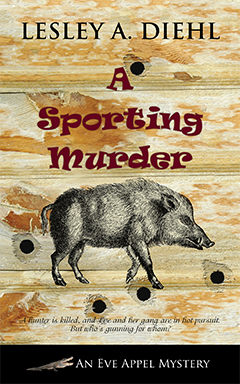
sporting_murder

Two of My Favorite Things

Lesley A. Diehl

How to put together two of my favorite things: a good laugh and a great bargain?

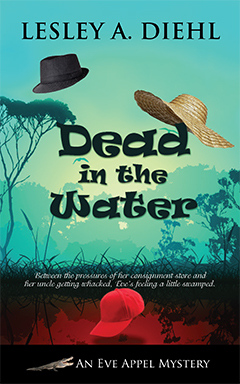
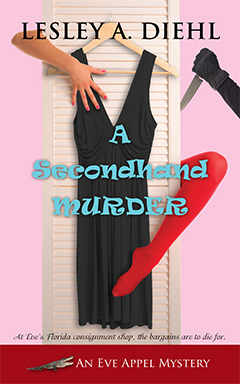
I think I’ve managed to do both in my Eve Appel mysteries: A Secondhand Murder, Dead in the Water, and A Sporting Murder.
dead_water
Eve, a fashionista from Connecticut, and her best friend, Madeleine, own a high-end consignment shop in rural Florida and, with Eve’s nose for being nosey, the gals get themselves into improbable situations.

In A Sporting Murder, Eve, Madeleine and a host of other characters including her grandmother, a hunky PI, a hunkier Miccosukee Indian, a mob boss, some cowboys and a lot of swamp denizens are at it again, this time involved in a favorite pastime of rural Floridians—hunting.

I plunge Eve into the midst of a game reserve where the quarry is not quite legal and sometimes horribly exotic. First a sportsman is found dead on the hunting ranch and a friend of Eve’s is accused of the murder. Then her Miccosukee friend Sammy’s nephew is found dead.
secondhand_murder

Eve suspects the hunting ranch owner is involved, but before she and Sammy can uncover evidence pointing to the guilty party, Sammy disappears. The authorities want to believe Sammy is just another Indian off on a drinking binge, but Eve knows better and, in her attempt to find him, she becomes the hunted.

Eve’s not finished being snoopy, however. Her fourth adventure chasing the bad guys and wearing designer shoes in the swamps of Florida will appear in 2016. Look for it! And my other books and short stories at my website: http://www.lesleyadiehl.com.

Buy A Sporting Murder at http://www.amazon.com/s/ref=nb_sb_ss_c_0_17?url=search-alias%3Dstripbooks&field-keywords=a+sporting+murder&sprefix=A+Sporting+Murder%2Caps%2C505
3578

About Lesley: Lesley retired from her life as a professor of psychology and reclaimed her country roots by moving to a small cottage in the Butternut River Valley in upstate New York. In the winter she migrates to old Florida—cowboys, scrub palmetto, and open fields of grazing cattle, a place where spurs still jingle in the post office, and gators make golf a contact sport. Back north, the shy ghost inhabiting the cottage serves as her literary muse. When not writing, she gardens, cooks and renovates the 1874 cottage with the help of her husband, two cats and, of course, Fred the ghost, who gives artistic direction to their work.
She is the author of a number of mystery series (Microbrewing Series, Big Lake Mystery Series, Eve Appel Mystery Series and the Laura Murphy Mysteries), a standalone mystery (Angel Sleuth) and numerous short stories.

Visit her on her website: http://www.lesleyadiehl.com

Maia Chance: Come Hell or Highball Thursday, Sep 24 2015 

While Auntie M is off on the first leg of a book tour for DEATH UNSCRIPTED (now available from Bridle Path Press or on Amazon, soon to be Kindle), please welcome author Maia Chance and her third mystery: Come Hell or Highball, to talk about forcing creativity. And be ready for a treat, folks–this is cute!

Come Hell or Highball

On Not Reinventing the Wheel

When I was in elementary school and junior high, I enjoyed competing (oh so nerdily) in something called Odyssey of the Mind, a sort of team-oriented creativity Olympics for kids. One of the coolest things I learned from O. M. w
as that you can deliberately mobilize or even, under pressure, force yourself to be creative.

Sounds so . . . inartistic, doesn’t it? I mean, what about the fairylike muse and her feelings?

Forget her. When you have work to do, creative work, and if you’ve got deadlines looming, you need tools, not temperamental pixies.

What I took away from all my time in Odyssey of the Mind (which is evidently still going strong) is that if you can’t think of a new idea, you can sort of smush two things together, and if you push hard enough, voilà!, there’s your fresh new idea. It’s like plate tectonics creating new mountains ranges.

For instance:

Random thing 1: DOG
Random thing 2: CHOPSTICKS

New idea: OMG! A children’s picture book about a King Charles Spaniel food critic. And his fatal flaw is dipping his ears in his soup. (I swear I just thought of that right now. I kind of like it. . . .)

It’s mash-up. Pastiche. Synthesis. Synergy. And this is, at its heart, what I think the creative process really is. Although our culture clings to a fantasy of an independent genius who is capable of reinventing the wheel (and isn’t that the Apple company’s whole shtick?), older ways of Making Stuff were more communal.

Fairy tales, for instance, rarely have a single author but are instead the culmination (still going on today!) of long traditions. Some historians even think that Homer was (is?) really an amalgamation of an oral tradition. And really, anyone working inside a genre is simply building upon and tweaking the ever-changing conventions and reader expectations of their genre. Cozy mystery writers like me have Agatha Christie omnipresent, hovering over our writing desks like the North Star.

Pablo Picasso said, “Good artists copy, great artists steal.” First of all, if that’s how PICASSO worked, then by gum, it’s good enough for me. Second, let’s unpack this. To me, this quote means:

Borrowing is kind of . . . wimpy. Borrowing is tentative and all “I PROMISE I’ll give it back and I won’t rip it or stain it. You’ll never even notice it’s gone!” Borrowing results in things like those Sweet Valley High books, all written by different people but with Created by Francine Pascal stamped on their covers. Ugh.

On the other hand, stealing means you take it and make it your own, with audacity and aplomb. You don’t give it back because you can’t give it back, because by the time you’ve had your way with it, it’s unrecognizable.

Speaking purely for myself, I am wholly incapable of producing anything, and I mean anything, out of thin air. Instead, I absorb, fragment, synthesize, and repeat. Over and over. Until I have something to work with.

MChance_Photo2_150px_72dpi

Maia Chance writes historical mystery novels that are rife with absurd predicaments and romantic adventure. She is the author of the Fairy Tale Fatal and The Discreet Retrieval Agency series. Her first mystery, Snow White Red-Handed, was a national bestseller and her latest releases are Cinderella Six Feet Under and Come Hell or Highball.

Oh, a creative influences include P. G. Wodehouse, Janet Evanovich, Are You Being Served?, Agatha Christie, Nathaniel Hawthorne, M. C. Beaton, The Real Housewives of Orange County, and F. Scott Fitzgerald.

Visit Maia on the web at:

maiachance.com
https://www.facebook.com/MaiaChance?ref=aymt_homepage_panel
https://www.goodreads.com/author/show/8127322.Maia_Chance

COME HELL OR HIGHBALL

31-year-old society matron Lola Woodby has survived her loveless marriage with an unholy mixture of highballs, detective novels, and chocolate layer cake, until her husband dies suddenly, leaving her his fortune…or so Lola thought. As it turns out, all she inherits from Alfie is a big pile of debt. Pretty soon, Lola and her stalwart Swedish cook, Berta, are reduced to hiding out in the secret love nest Alfie kept in New York City. But when rent comes due, Lola and Berta have no choice but to accept an offer made by one of Alfie’s girls-on-the-side: in exchange for a handsome sum of money, the girl wants Lola to retrieve a mysterious reel of film for her. It sounds like an easy enough way to earn the rent money. But Lola and Berta realize they’re in way over their heads when, before they can retrieve it, the man currently in possession of the film reel is murdered, and the reel disappears. On a quest to retrieve the reel and solve the murder before the killer comes after them next, Lola and Berta find themselves navigating one wacky situation after another in high style and low company.

Fine Crime Fiction for Fall Reading Monday, Sep 21 2015 

Auntie M has been reading up a storm this summer and brings you some of the finest crime novels out there for your perusal. These have things in common, which is why these particular novels are grouped together: darn fine stories supported by great writing. Enjoy~

ToyTaker
Luke Delany’s third DI Sean Corrigan police procedural will grab you from its creepy opening. The Toy Taker starts out strong and never lets up, with Corrigan’s team at Scotland Yard covering the sickest criminals that roam the metropolitan mecca.

Delany’s experience as a former CID investigator serves him well and makes the story jolt into reality when a young boy is discovered missing from his bed one morning in a tony London suburb. There’s no sign of an intruder and no alarms were tripped; there are no signs of a struggle. Corrigan has a knack of being able to put himself into the mind of the criminal he’s seeking, a device that seems to have left him in this installment, frustrating him, his wife, and his colleagues.

The action doesn’t let up, even when another child is taken. What is the hold this predator has over the children who appear to have gone willingly with a stranger? Tautl written and gGuaranteed to keep you up late at night.

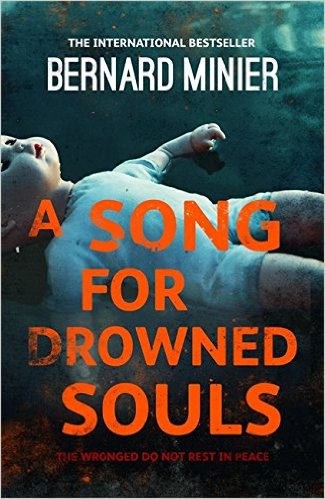
SongDrownedSouls
After the huge success of Bernard Minier’s The Frozen Dead, Auntie M was not the only reader looking forward to the sequel featuring Commandant Martin Servaz of the Toulouse Crime Squad. A Song for Drowned Souls
is the kind of crime novel that presents a fascinating look at the lives of the perpetrator and of the team on the hunt.

A young man is found, stunned, sitting by a swimming pool where dolls float on its surface. He’s discovered his teacher, drowned in her bath in a horrific manner, and is arrested for her murder. Servaz is called by his former college lover, Marianne, and immediately rushes over and takes over the investigation. The arrested boy is her son and she implores Servaz to clear Hugo.

To do so, he must reopen old wounds of his time at the Marsac school in the Pyrenees at the elite school where the victim taught. He will run into former students now teaching there during the case and find a former friend and competitor for Marianne’s affections figures in the case. Servaz’s daughter has just started in the prep division there and her presence will provide both a distraction and a boon to his investigation as it soon becomes apparent there are ties between students at the school and the murdered woman.

Miner examines the way the past haunts our present in a way that is chilling and highly believable.

Even if you’ve never visited the area, Minier will have you breathing in the scent of the trees in this evocative thriller that takes police procedurals to a new height. Highly recommended.

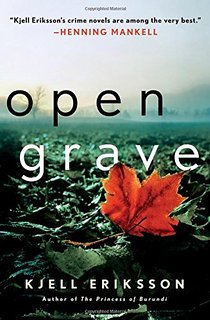
Open Grave
Kjell Eriksson’s Ann Lindell series continues with an unusual installment, not your usual hurried murder investigation at all, in Open Grave. The idea here is one more of a series of incidents that may or may not lead to murder. And the tension is palpable.

An aging professor has just won the Nobel Prize for Medicine, yet instead of rejoicing, the announcement brings problems to the doctor’s upper-class neighborhood. There are jealousies amongst his colleagues, some who are his neighbors, and even his housekeeper of decades seems to be on on the verge of leaving. What is there about the man that causes this reason for celebration to bring out the worst in people?

Eriksson spools out the story of the participants by delving into their pasts as unusual incidents start to happen. When Inspector Ann Lindell tries to sort out what is happening, her own past rears its head into the carefully arranged present she’s trying to fashion. And the expected outcome is far from the ending twist. The author knows human nature and describes it well in this psychological study that is subtle and character-driven.

run you down

Julia Dahl’s first crime novel, Invisible City, garnered multiple award nominations and is still nominated for more. It was a highly rated debut for Auntie M last year so she was looking forward to its newest, run you down, featuring young reporter Rebekah Roberts.

Rebekah’s ties to the Hasidic community started in the first book, her interested piqued by trying to find the mother she doesn’t know after Aviva Kagan abandoned her as a baby to be raised by her Christian father. Not sure she’s ready to meet the woman she’s finally found, Rebekah is drawn into Aviva’s community in Roseville, NY, by a man who contacts her about his young wife’s mysterious death.

Pessie Goldin’s body was found in her bathtub, an apparent accident or unmentionable suicide–but her husband believes she was murdered. As she investigates, Rebekah will find others like her mother who left the ultra-conservative sect and formed their own group. Some rage about the restraints they were forced to live under in their old community. And others find themselves inexplicably mixed up with groups who would kill without a clear thought for the lives and beliefs of others.

Dahl does a lovely job of letting Rebekah tell readers her story from her point of view as an outsider to a culture she’s trying to understand, while developing a wallop of a story that is its own mystery. One aspect Auntie M particularly enjoyed was seeing the protagonist’s growth and maturity in her job and in her personal life, which adds to the compelling aspect of the mystery. Don’t miss this one.

Slaughter Man
Auntie M enjoyed UK author Tony Parson’s foray into crime novels with The Murder Man, which introduced DI Max Wolfe, his daughter Scout, and their personable dog, Stan. With The Slaughter Man,
Max returns to investigate a heinous crime that jumps off the page from the Prologue describing the horrific slaughter of an entire family, except for the youngest child, apparently kidnapped.

It’s New Year’s Day when this occurs and the day after this wealthy family is found inside their gated-community home, all dead from a most unusual method: a cattle gun, used to stun cattle before butchering. When Max visits Scotland Yard’s Black Museum for background, he comes across a murderer who used just this method three decades ago and was dubbed The Slaughter Man by the press. Could the man, now released from prison, be on a murdering rampage? And why this particular family?

The happy family included two teens and parents who were former Olympians. There’s history here and Max is determined to find out how the past of the parents has led to this slaughter, always aware that as time goes by, his chances of finding the kidnapped boy alive grow dimmer.

Auntie M marveled at Max’s ability to withstand physical punishment, but Parsons does a good job illustrating his physical prowess and workouts at a local boxing club to balance what could be seen as super-human. For Max is definitely a very human detective, devoted to his daughter and her safely and happiness, and this makes him a very real character who leaps off the page and who readers will follow anywhere he takes them. Highly recommended.

GameFamily
<a
Sophie Hannah seems to be everywhere, and Auntie M says this with all due respect and admiration. Last year's The Telling Error has been published in the US recently under the title Woman with a Secret and was previously reviewed on this blog on February 1st. It’s the tale of a woman keeping a secret and brings back the unusual husband-and-wife detective duo of Simon Waterhouse and Charlie Zailer, an interesting and intriguing pair, and if you haven’t made their acquaintance yet, now’s the time to do it.

Hannah was also the author of the new Hercule Poirot novel authorized by Agatha Christie’s estate, The Monogram Murders, notable for her outstanding voice of Poirot, which so many readers miss. Now she has a standalone in A Game For All The Family, which shows her deft hand at psychological thrillers, as well as her ability to create an intriguing story from the most seemingly innocuous bits of people’s lives that somehow escalate before the reader’s eyes into full-blown terror.

Justine Merrison is moving with her family to escape London and her high pressure job to the lovely Devon countryside, home to Dame Agatha, by the way. She has huge plans to do nothing at all, at least for a while, but the family is no sooner moved in than teen daughter Ellen withdraws and changes personality.

It seems Ellen has written a story that describes a grisly murder set in the family’s gorgeous new home and just happened to name a character after herself. What starts out as a school assignment morphs into the story of someone else’s family. Her good friend is expelled from school for a trifle and when Justine goes to the school to ask the head to reconsider, she’s told the student doesn’t exist and that he never attended the school. Who is going crazy–Ellen or the school? And then the anonymous calls start, and Justine finds herself accused of sharing a murderous past with the caller whose voice she doesn’t recognize.

How this falls out is part of the fun of reading the unique novel where Justine must find out just whom she’s supposed to be in order to stop the threat to her family. Twisted and entertaining.

M. C. Beaton: Dishing the Dirt Sunday, Sep 13 2015 

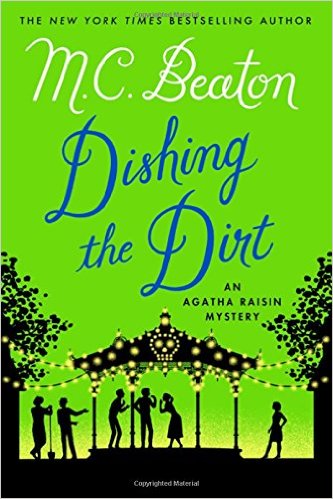
dishing dirt
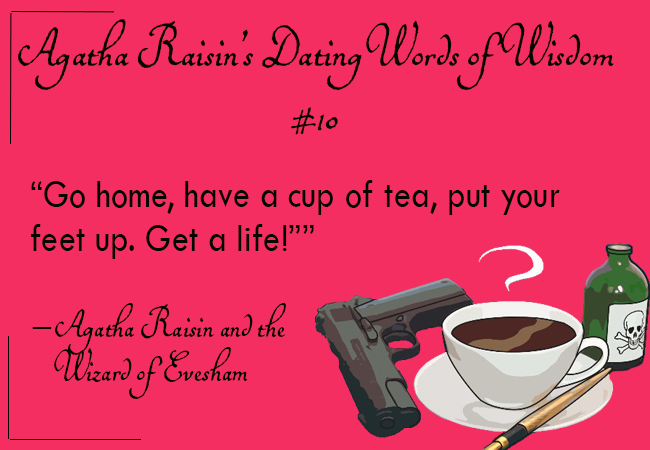
Agatha Raisin is back and this may be her most unusual case yet–and this time she’s dishing the dirt in more ways than one, including giving out sage dating advice:
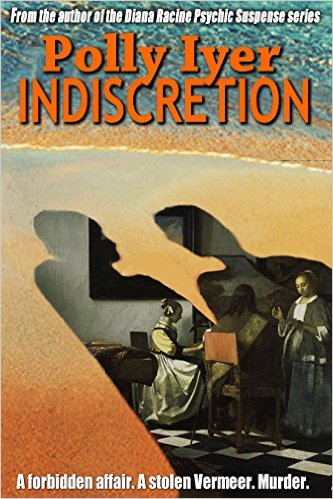
Iyer Indiscretion

It’s spring time in the Cotswolds and Agatha should be in a great mood, but the book opens with a grumpy Raisin after one elderly woman, Victoria Bannister, manages to goad Agatha by reminding her of her humble beginnings. Aware of her encroaching middle age, this is a touchy subject for Agatha.

Agatha's Dating Tip 2

With her ex-husband, travel writer James, living next door, and her good friend, Sir Charles Fraith the only ones who know of her Birmingham slum days, Agatha is convinced it must be the therapist, Jill Davent, whom James has been seen with lately. She’s even taken it so far as to visit the therapist, but when Agatha poured out a sanitized version of her background, the therapist had the temerity to accuse her of lying! Even though she was . . .

Agatha's Dating Tip 3

Things are rarely simple for Agatha. Jill also sees Gwen Simple as a patient, and Agatha is convinced the woman assisted her son in grisly murders in the past, although she hasn’t been able to provide proof. That doesn’t stop Agatha from telling anyone and everyone that Jill the therapist is incompetent, a charlatan better off dead. Then Jill moves her office and Agatha breathes a short-loved sigh of relief.

Agatha's Dating Tip 6

Unfortunately, Agatha meets a PI Jill hired to investigate her roots, and goes off as only Agatha can do, yelling into the Randolph bar “I’ll kill her!”, overheard by scores of witnesses. And she drives to Jill’s office, with it’s open windows, and repeats her threat.

Agatha's Dating Tip 7

And we’re off and running, when two days later Jill is found strangled in her office–and this time it’s Agatha who’s in the hot seat. She must use her wits and her team to prove her own innocence while bringing the real murderer to justice on a wild ride that takes her all the way to Venice. Vintage Agatha~

Agatha's Dating Tip 10

Sarah Hilary: No Other Darkness Sunday, Sep 6 2015 

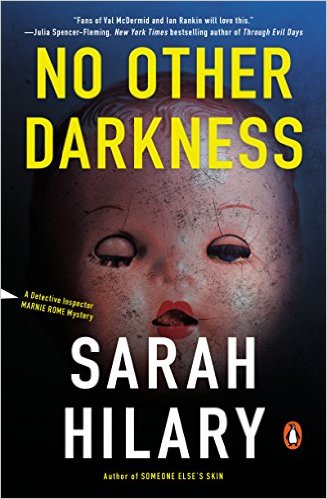
No Other Darkness
Sarah Hilary introduced DI Marni Rome in Someone Else’s Skin. Now she’s back with its sequel, No Other Darkness, as strong an entry as the first, a fast page-turner chock full of unforeseen events.

Auntie M should note that it’s weird reading about a main character who shares her nickname, but casting that aside, Marnie Rome is an interesting character to drive this series. She’s in a relationship with Victim Care Officer Ed Belloc, who understands the pressures of her job and helps to soothe her ragged past. And she’s proud of the team she’s put together, including her DS Noah Jake.

A particularly awful case has them in its grip: two young boys have been found dead in a bunker hidden under the garden of a young family. The Doyle’s have two little children, foster a teen, Clancy, and are expecting their third child when gardener and father Terry unearths a manhole cover and the grisly contents of the bunker it serves.

Clancy reminds Marnie of her own foster brother, serving time for the murder of her parents, and the threads of the two cases seem to overlap to her frazzled nerves. Her past interrupts on more levels than she can cope with in the form of a reporter Marnie knows from her past.

With no known identity for the boys, Marnie’s team tries to identify the two lads, probably brothers who appear to have been left in the bunker with tins of food, a bed and a bucket, until they died of starvation and exposure. Was this the work of a prepper, someone who carried apocalyptic preparations to the extreme?

Once the boys identities are known, things shift horribly: their mother had reported their drowning death years before, and that of their infant sister, although only the sister’s body had been found. She’s been in prison after confessing to the murders, a victim of postpartum psychosis. But now she’s close to being released on parole with a new identity.

How those boys came to be in the Doyle’s bunker, how Clancy figures in, along with several neighbors who appear to not be what they seem, will all cloud Marnie’s investigation as things turn on a dime when the Doyle’s young children go missing.

This is a a briskly-paced police procedural where the stakes are high and the terror never far from the next page. Competently done and filled with surprising twists and creative characters who are complex and real.

H. Scott Butler: Night Journey and Voice From the Shadows Sunday, Aug 30 2015 

Please welcome author H. Scott Butler, who will answer some questions about becoming a writer later in life, something Auntie M can identify with~

H. Scott Butler grew up in Baton Rouge, Louisiana. He graduated from LSU, went on to earn a doctorate in English at Duke University, and taught literature and film at a community college in eastern Virginia for many years.

Since his early retirement he has devoted his time to writing and to participating in a grassroots effort to preserve Fort Monroe, a former Army post of deep historic significance. He and his wife, Susan, currently live in Blacksburg, Virginia.

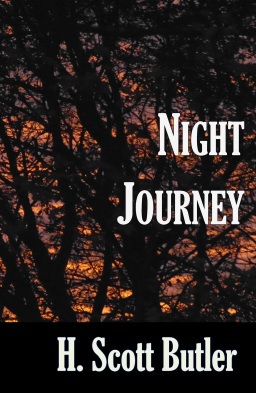
Night Journey

What have you written? Three novels, the first unpublished, as should be. The other two–Night Journey and Voice from the Shadows–are mystery thrillers about a female sheriff’s investigator in Northern Virginia. My heroine, Cynthia Westbrook, is a tall thirty-something with a serious interest in literature.

Why a woman for your main character?
Not sure. Although in retrospect, I’ve found it a sort of freeing thing to do. In Night Journey, Cynthia has never dealt with a profoundly traumatic event in her childhood, so in much of the novel she’s a little detached from herself. If she were a man with the same problem, the usual macho baggage would dictate, by my lights, a less cathartic outcome.

Also, I’m drawn to underdogs, and in America as in most countries women aren’t treated as equals.

Is Night Journey, then, primarily about a detective solving a crime or someone with a personal issue?
The two are intertwined. Cynthia’s evasion of her past interferes with her ability to interpret the evidence. She can’t solve the mystery until she confronts herself.

As a reader of mysteries I’m always more interested in the personality of the detective than in the crime, and I wanted to reflect that inclination in my mystery–without, of course, neglecting the crime-solving element.

You said Cynthia’s a serious reader. Why did you emphasize that about her?

Literature has always been important to me. I’m a retired English and film teacher. I spent my working life trying to help students see that art, as Hamlet says, holds the mirror up to nature. It’s a way of understanding ourselves and the world.

So I wanted Cynthia to have that sort of appreciation of literature. And in Night Journey, a poem by Robert Frost becomes in fact both an emotional touchstone for her and a significant clue.

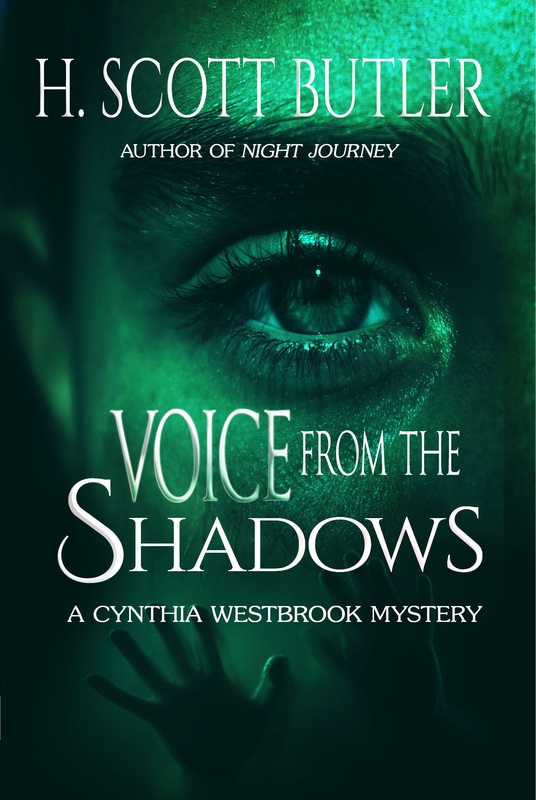
Does literature also play a role in Voice from the Shadows? Voice cover

Yes. There it isn’t a clue but a means of self-understanding. Cynthia feels compelled to confront the traumatic event in her past, a still unsolved murder, by returning to her Alabama hometown and doing her own investigation. For something to read she takes along, not really by accident, as she comes to see, The Scarlet Letter.

You said you were retired. Is writing fiction a recent or a long-time ambition?

I’ve always wanted to do it, but I lacked both the time and impetus–the impetus being, in my case, the sense of time growing short. To quote Andrew Marvel: But at my back I always hear/Time’s winged chariot hurrying near.

How does becoming a writer at your age make you feel?

Young. ………….. H. Scott Butler

Night Journey and Voice from the Shadows, by H. Scott Butler, published by High Tide Publications, are both available from Amazon.

Night Journey.jpgVoice cover.jpgH. Scott Butler.jpgSelf Interview.doc

« Previous PageNext Page »