Fine Crime Fiction for Fall Reading Monday, Sep 21 2015 

Auntie M has been reading up a storm this summer and brings you some of the finest crime novels out there for your perusal. These have things in common, which is why these particular novels are grouped together: darn fine stories supported by great writing. Enjoy~

ToyTaker
Luke Delany’s third DI Sean Corrigan police procedural will grab you from its creepy opening. The Toy Taker starts out strong and never lets up, with Corrigan’s team at Scotland Yard covering the sickest criminals that roam the metropolitan mecca.

Delany’s experience as a former CID investigator serves him well and makes the story jolt into reality when a young boy is discovered missing from his bed one morning in a tony London suburb. There’s no sign of an intruder and no alarms were tripped; there are no signs of a struggle. Corrigan has a knack of being able to put himself into the mind of the criminal he’s seeking, a device that seems to have left him in this installment, frustrating him, his wife, and his colleagues.

The action doesn’t let up, even when another child is taken. What is the hold this predator has over the children who appear to have gone willingly with a stranger? Tautl written and gGuaranteed to keep you up late at night.

SongDrownedSouls
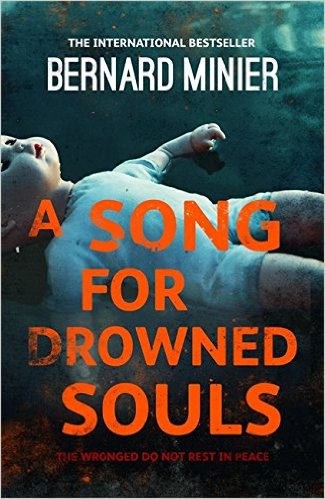
After the huge success of Bernard Minier’s The Frozen Dead, Auntie M was not the only reader looking forward to the sequel featuring Commandant Martin Servaz of the Toulouse Crime Squad. A Song for Drowned Souls
is the kind of crime novel that presents a fascinating look at the lives of the perpetrator and of the team on the hunt.

A young man is found, stunned, sitting by a swimming pool where dolls float on its surface. He’s discovered his teacher, drowned in her bath in a horrific manner, and is arrested for her murder. Servaz is called by his former college lover, Marianne, and immediately rushes over and takes over the investigation. The arrested boy is her son and she implores Servaz to clear Hugo.

To do so, he must reopen old wounds of his time at the Marsac school in the Pyrenees at the elite school where the victim taught. He will run into former students now teaching there during the case and find a former friend and competitor for Marianne’s affections figures in the case. Servaz’s daughter has just started in the prep division there and her presence will provide both a distraction and a boon to his investigation as it soon becomes apparent there are ties between students at the school and the murdered woman.

Miner examines the way the past haunts our present in a way that is chilling and highly believable.

Even if you’ve never visited the area, Minier will have you breathing in the scent of the trees in this evocative thriller that takes police procedurals to a new height. Highly recommended.
Open Grave
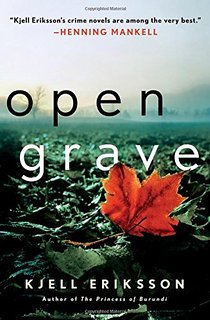
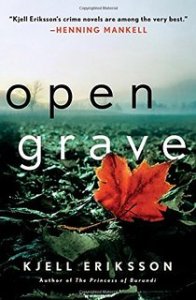
Kjell Eriksson’s Ann Lindell series continues with an unusual installment, not your usual hurried murder investigation at all, in Open Grave. The idea here is one more of a series of incidents that may or may not lead to murder. And the tension is palpable.

An aging professor has just won the Nobel Prize for Medicine, yet instead of rejoicing, the announcement brings problems to the doctor’s upper-class neighborhood. There are jealousies amongst his colleagues, some who are his neighbors, and even his housekeeper of decades seems to be on on the verge of leaving. What is there about the man that causes this reason for celebration to bring out the worst in people?

Eriksson spools out the story of the participants by delving into their pasts as unusual incidents start to happen. When Inspector Ann Lindell tries to sort out what is happening, her own past rears its head into the carefully arranged present she’s trying to fashion. And the expected outcome is far from the ending twist. The author knows human nature and describes it well in this psychological study that is subtle and character-driven.
run you down

Julia Dahl’s first crime novel, Invisible City, garnered multiple award nominations and is still nominated for more. It was a highly rated debut for Auntie M last year so she was looking forward to its newest, run you down, featuring young reporter Rebekah Roberts.

Rebekah’s ties to the Hasidic community started in the first book, her interested piqued by trying to find the mother she doesn’t know after Aviva Kagan abandoned her as a baby to be raised by her Christian father. Not sure she’s ready to meet the woman she’s finally found, Rebekah is drawn into Aviva’s community in Roseville, NY, by a man who contacts her about his young wife’s mysterious death.

Pessie Goldin’s body was found in her bathtub, an apparent accident or unmentionable suicide–but her husband believes she was murdered. As she investigates, Rebekah will find others like her mother who left the ultra-conservative sect and formed their own group. Some rage about the restraints they were forced to live under in their old community. And others find themselves inexplicably mixed up with groups who would kill without a clear thought for the lives and beliefs of others.

Dahl does a lovely job of letting Rebekah tell readers her story from her point of view as an outsider to a culture she’s trying to understand, while developing a wallop of a story that is its own mystery. One aspect Auntie M particularly enjoyed was seeing the protagonist’s growth and maturity in her job and in her personal life, which adds to the compelling aspect of the mystery. Don’t miss this one.
Slaughter Man
Auntie M enjoyed UK author Tony Parson’s foray into crime novels with The Murder Man, which introduced DI Max Wolfe, his daughter Scout, and their personable dog, Stan. With The Slaughter Man,
Max returns to investigate a heinous crime that jumps off the page from the Prologue describing the horrific slaughter of an entire family, except for the youngest child, apparently kidnapped.

It’s New Year’s Day when this occurs and the day after this wealthy family is found inside their gated-community home, all dead from a most unusual method: a cattle gun, used to stun cattle before butchering. When Max visits Scotland Yard’s Black Museum for background, he comes across a murderer who used just this method three decades ago and was dubbed The Slaughter Man by the press. Could the man, now released from prison, be on a murdering rampage? And why this particular family?

The happy family included two teens and parents who were former Olympians. There’s history here and Max is determined to find out how the past of the parents has led to this slaughter, always aware that as time goes by, his chances of finding the kidnapped boy alive grow dimmer.

Auntie M marveled at Max’s ability to withstand physical punishment, but Parsons does a good job illustrating his physical prowess and workouts at a local boxing club to balance what could be seen as super-human. For Max is definitely a very human detective, devoted to his daughter and her safely and happiness, and this makes him a very real character who leaps off the page and who readers will follow anywhere he takes them. Highly recommended.
GameFamily
<a
Sophie Hannah seems to be everywhere, and Auntie M says this with all due respect and admiration. Last year's The Telling Error has been published in the US recently under the title Woman with a Secret and was previously reviewed on this blog on February 1st. It’s the tale of a woman keeping a secret and brings back the unusual husband-and-wife detective duo of Simon Waterhouse and Charlie Zailer, an interesting and intriguing pair, and if you haven’t made their acquaintance yet, now’s the time to do it.

Hannah was also the author of the new Hercule Poirot novel authorized by Agatha Christie’s estate, The Monogram Murders, notable for her outstanding voice of Poirot, which so many readers miss. Now she has a standalone in A Game For All The Family, which shows her deft hand at psychological thrillers, as well as her ability to create an intriguing story from the most seemingly innocuous bits of people’s lives that somehow escalate before the reader’s eyes into full-blown terror.

Justine Merrison is moving with her family to escape London and her high pressure job to the lovely Devon countryside, home to Dame Agatha, by the way. She has huge plans to do nothing at all, at least for a while, but the family is no sooner moved in than teen daughter Ellen withdraws and changes personality.

It seems Ellen has written a story that describes a grisly murder set in the family’s gorgeous new home and just happened to name a character after herself. What starts out as a school assignment morphs into the story of someone else’s family. Her good friend is expelled from school for a trifle and when Justine goes to the school to ask the head to reconsider, she’s told the student doesn’t exist and that he never attended the school. Who is going crazy–Ellen or the school? And then the anonymous calls start, and Justine finds herself accused of sharing a murderous past with the caller whose voice she doesn’t recognize.

How this falls out is part of the fun of reading the unique novel where Justine must find out just whom she’s supposed to be in order to stop the threat to her family. Twisted and entertaining.

M. C. Beaton: Dishing the Dirt Sunday, Sep 13 2015 

dishing dirt
Agatha Raisin is back and this may be her most unusual case yet–and this time she’s dishing the dirt in more ways than one, including giving out sage dating advice:
Iyer Indiscretion

It’s spring time in the Cotswolds and Agatha should be in a great mood, but the book opens with a grumpy Raisin after one elderly woman, Victoria Bannister, manages to goad Agatha by reminding her of her humble beginnings. Aware of her encroaching middle age, this is a touchy subject for Agatha.

Agatha's Dating Tip 2

With her ex-husband, travel writer James, living next door, and her good friend, Sir Charles Fraith the only ones who know of her Birmingham slum days, Agatha is convinced it must be the therapist, Jill Davent, whom James has been seen with lately. She’s even taken it so far as to visit the therapist, but when Agatha poured out a sanitized version of her background, the therapist had the temerity to accuse her of lying! Even though she was . . .

Agatha's Dating Tip 3

Things are rarely simple for Agatha. Jill also sees Gwen Simple as a patient, and Agatha is convinced the woman assisted her son in grisly murders in the past, although she hasn’t been able to provide proof. That doesn’t stop Agatha from telling anyone and everyone that Jill the therapist is incompetent, a charlatan better off dead. Then Jill moves her office and Agatha breathes a short-loved sigh of relief.

Agatha's Dating Tip 6

Unfortunately, Agatha meets a PI Jill hired to investigate her roots, and goes off as only Agatha can do, yelling into the Randolph bar “I’ll kill her!”, overheard by scores of witnesses. And she drives to Jill’s office, with it’s open windows, and repeats her threat.

Agatha's Dating Tip 7

And we’re off and running, when two days later Jill is found strangled in her office–and this time it’s Agatha who’s in the hot seat. She must use her wits and her team to prove her own innocence while bringing the real murderer to justice on a wild ride that takes her all the way to Venice. Vintage Agatha~

Agatha's Dating Tip 10

Sarah Hilary: No Other Darkness Sunday, Sep 6 2015 

No Other Darkness
Sarah Hilary introduced DI Marni Rome in Someone Else’s Skin. Now she’s back with its sequel, No Other Darkness, as strong an entry as the first, a fast page-turner chock full of unforeseen events.

Auntie M should note that it’s weird reading about a main character who shares her nickname, but casting that aside, Marnie Rome is an interesting character to drive this series. She’s in a relationship with Victim Care Officer Ed Belloc, who understands the pressures of her job and helps to soothe her ragged past. And she’s proud of the team she’s put together, including her DS Noah Jake.

A particularly awful case has them in its grip: two young boys have been found dead in a bunker hidden under the garden of a young family. The Doyle’s have two little children, foster a teen, Clancy, and are expecting their third child when gardener and father Terry unearths a manhole cover and the grisly contents of the bunker it serves.

Clancy reminds Marnie of her own foster brother, serving time for the murder of her parents, and the threads of the two cases seem to overlap to her frazzled nerves. Her past interrupts on more levels than she can cope with in the form of a reporter Marnie knows from her past.

With no known identity for the boys, Marnie’s team tries to identify the two lads, probably brothers who appear to have been left in the bunker with tins of food, a bed and a bucket, until they died of starvation and exposure. Was this the work of a prepper, someone who carried apocalyptic preparations to the extreme?

Once the boys identities are known, things shift horribly: their mother had reported their drowning death years before, and that of their infant sister, although only the sister’s body had been found. She’s been in prison after confessing to the murders, a victim of postpartum psychosis. But now she’s close to being released on parole with a new identity.

How those boys came to be in the Doyle’s bunker, how Clancy figures in, along with several neighbors who appear to not be what they seem, will all cloud Marnie’s investigation as things turn on a dime when the Doyle’s young children go missing.

This is a a briskly-paced police procedural where the stakes are high and the terror never far from the next page. Competently done and filled with surprising twists and creative characters who are complex and real.

John Farrow: The Storm Murders Monday, Aug 31 2015 

StormMurders

Auntie M had been intrigued to read about Farrow’s creation, Emile Cinq-Mars, compared to Louise Penny’s Inspt. Gamache and to Christie’s Hercule Poirot, for the lyrical passages written inside Emile’s mind, and for the use of his little grey cells in solving crime.

So she was excited to crack open the first page of The Storm Murders and plunge in and she was not disappointed, from the chilling opening, through the suspenseful twists and turns to a most surprising ending.

It’s brilliantly cold in the countryside outside Montreal after a blizzard, where the former Sergeant-Detective is badly adjusting to his new life of retirement and trying to help his wife, Sandra, with her horse business. He has a painful back and is just recovering from fractured ribs broken during a fall off a ladder with subsequent pneumonia and wondering where his future lies.

Then his longtime partner, Bill Mathers, who has inherited Emile’s job, calls to ask if he can visit.But this is not any visit.

Mathers wants to bring an FBI agent along, and to have Emile consult on a series of crimes that have escalated to encompass a married couple found dead in their home not far from where Emile lives. Despite the tension in his marriage, Emile agrees.

Two police called to the scene have been found dead at the scene of the murders. And here’s the thing that has everyone on high alert: there were no other tire tracks or footprints in the freshly fallen snow than those of the two officers found dead inside the house.

Emile will bring Sandra with him to New Orleans to follow a lead, half-vacation, half-investigation, when the unthinkable happens: after being mugged in their room, Sandra is kidnaped. And that’s just the tip of Emile’s iceberg in this twisted and compelling plot.

There are interesting side characters readers meet along the way, including New Orleans detective Pascal Dupree, one of Auntie M’s favorites. Each character is drawn distinctly and imagined well. That adds to the tension that alternates between passages of Emile’s thoughts with action-packed scenes that will have readers flipping pages to find the resolution.

Farrow writes this crime series under a pen name. He is literary novelist and playwright Trevor Ferguson, and his background and expertise, as well as his love of language, shows on every page. This is the kind of brilliant writing that creeps up on you and leaves you pondering the book and its characters long after the last page. Highly recommended.

H. Scott Butler: Night Journey and Voice From the Shadows Sunday, Aug 30 2015 

Please welcome author H. Scott Butler, who will answer some questions about becoming a writer later in life, something Auntie M can identify with~

H. Scott Butler grew up in Baton Rouge, Louisiana. He graduated from LSU, went on to earn a doctorate in English at Duke University, and taught literature and film at a community college in eastern Virginia for many years.

Since his early retirement he has devoted his time to writing and to participating in a grassroots effort to preserve Fort Monroe, a former Army post of deep historic significance. He and his wife, Susan, currently live in Blacksburg, Virginia.

Night Journey

What have you written? Three novels, the first unpublished, as should be. The other two–Night Journey and Voice from the Shadows–are mystery thrillers about a female sheriff’s investigator in Northern Virginia. My heroine, Cynthia Westbrook, is a tall thirty-something with a serious interest in literature.

Why a woman for your main character?
Not sure. Although in retrospect, I’ve found it a sort of freeing thing to do. In Night Journey, Cynthia has never dealt with a profoundly traumatic event in her childhood, so in much of the novel she’s a little detached from herself. If she were a man with the same problem, the usual macho baggage would dictate, by my lights, a less cathartic outcome.

Also, I’m drawn to underdogs, and in America as in most countries women aren’t treated as equals.

Is Night Journey, then, primarily about a detective solving a crime or someone with a personal issue?
The two are intertwined. Cynthia’s evasion of her past interferes with her ability to interpret the evidence. She can’t solve the mystery until she confronts herself.

As a reader of mysteries I’m always more interested in the personality of the detective than in the crime, and I wanted to reflect that inclination in my mystery–without, of course, neglecting the crime-solving element.

You said Cynthia’s a serious reader. Why did you emphasize that about her?

Literature has always been important to me. I’m a retired English and film teacher. I spent my working life trying to help students see that art, as Hamlet says, holds the mirror up to nature. It’s a way of understanding ourselves and the world.

So I wanted Cynthia to have that sort of appreciation of literature. And in Night Journey, a poem by Robert Frost becomes in fact both an emotional touchstone for her and a significant clue.

Does literature also play a role in Voice from the Shadows? Voice cover

Yes. There it isn’t a clue but a means of self-understanding. Cynthia feels compelled to confront the traumatic event in her past, a still unsolved murder, by returning to her Alabama hometown and doing her own investigation. For something to read she takes along, not really by accident, as she comes to see, The Scarlet Letter.

You said you were retired. Is writing fiction a recent or a long-time ambition?

I’ve always wanted to do it, but I lacked both the time and impetus–the impetus being, in my case, the sense of time growing short. To quote Andrew Marvel: But at my back I always hear/Time’s winged chariot hurrying near.

How does becoming a writer at your age make you feel?

Young. ………….. H. Scott Butler

Night Journey and Voice from the Shadows, by H. Scott Butler, published by High Tide Publications, are both available from Amazon.

Night Journey.jpgVoice cover.jpgH. Scott Butler.jpgSelf Interview.doc

Louise Penny: The Nature of the Beast Tuesday, Aug 25 2015 

Nature Beast
Readers of this blog know that Auntie M is a huge fan of Louise Penny’s series. She thinks if he were real she could marry Inspector Gamache, even in his retirement!

But is retirement really for Gamache or his wife, Reine-Marie? That’s the question the two are asking themselves as they enjoy their home in Three Pines. They spend their days involved in the rhythm of the village, enjoying Myrna’s bookstore, helping Clara with her grief, eating at the Bistro. There is a play being cast amongst the villagers, and the stories that 9 yr-old Laurent Lepage tells whomever who will listen, big whoppers of walking trees and alien invasions.

So it’s not a huge surprise that when the small boy with the big imagination he runs into the bistro with his story of a giant monster and an even bigger weapon hidden in the woods, that his story is passed off as one more day of the antics of the boy who cried wolf. Until Laurent disappears…

His body is found in the woods, a victim of an apparent biking accident. But something about the death appears off, and Inspt. Gamache finds himself asked to consult on the case after he insists the boy was murdered.

With his son-in-law Jean Guy Beauvoir on the case and a surprising new head of the Surete’, Gamache will assist them as they stumble deeply into the woods on the hunt of a murderer–and come upon a secret so surprising that it will turn the village on its head.

This secret will draw outsiders to the village as an old crime becomes the reason for the new one–and then there is a second murder, and Inspt. Gamache knows that the secrets of the past have come back to haunt those still living in Three Pines.

Penny consistently writes an absorbing book, and this entry is no exception. Her characters are always many-layered, complex individuals, and her writing style allows readers to see the story from many points of view.

Tackling an unusual subject, readers will be transported back to the village and its inhabitants as they do battle with secrets held and kept for far too many years. Highly recommended.

Across the Pond Winners: Casey, Donoghue, Robinson, Williams Saturday, Aug 22 2015 

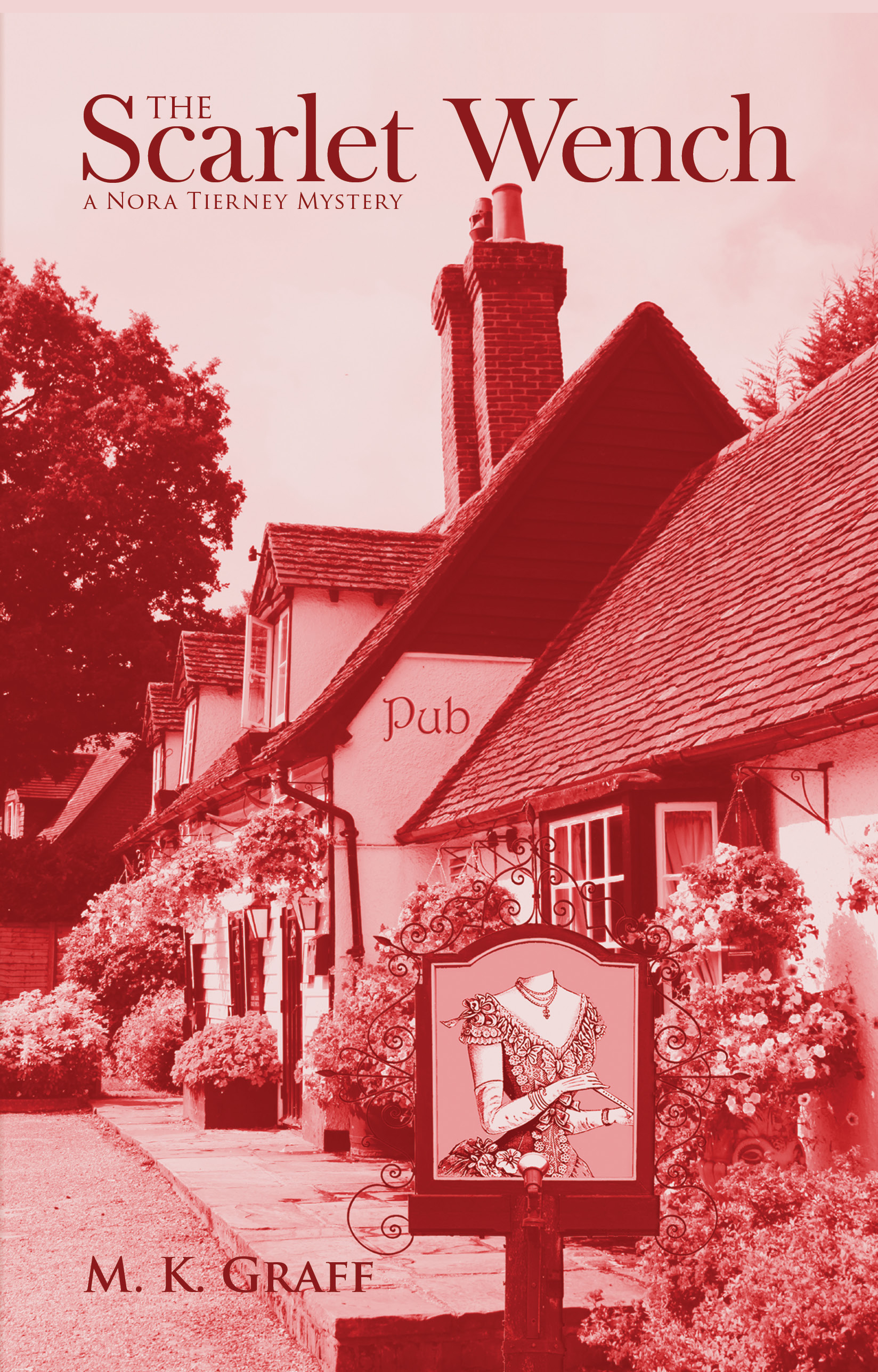
Auntie M would like to mention that her second Nora Tierney Mystery, THE GREEN REMAINS, has won First Place in the Mystery and Mayhem Awards given by Chanticleer Media for BEST CLASSIC BRITISH COZY. Auntie M doesn’t use the term cozy herself: she describes hers as a mix of amateur sleuth and police procedural. But there’s no question her murders are set in small communities and that the puzzle is the highlight, not gore and violence. She’s not writing about psychopaths or serial killers (although she does enjoy reads that do), but rather she’s interested in what motive would allow an otherwise reasonable person to feel it’s reasonable to take another life.

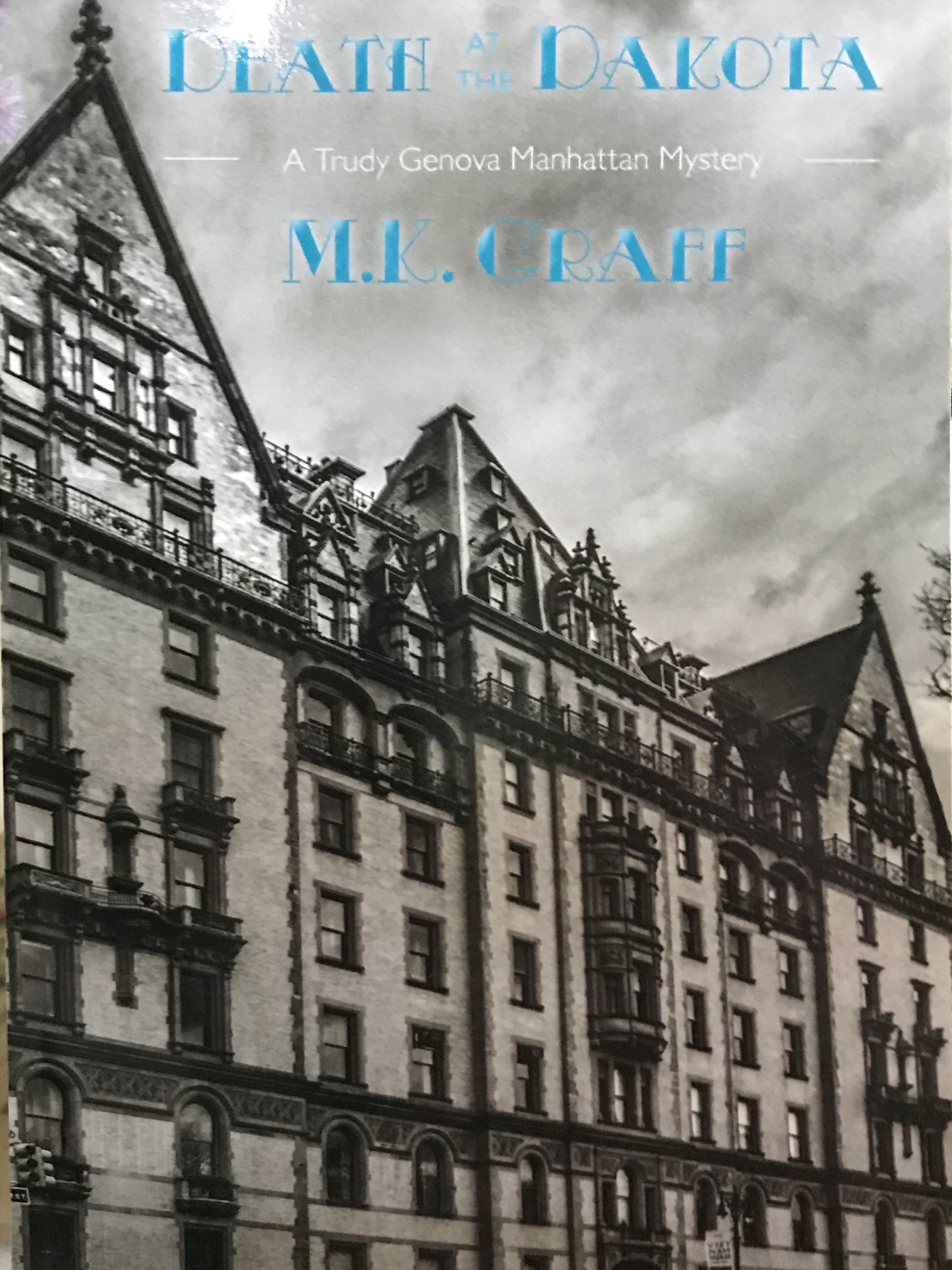
In a related note, she’s also debuting her second series this month. The first Trudy Genova Manhattan Mystery, DEATH UNSCRIPTED, will be in print shortly in hard copy and ebook. Here’s a peek at the cover:
Death Unscripted cover

Frequent readers of this blog know that the Nora Tierney’s are set in England, Auntie M features a host of authors from across the pond. Part of this is because she enjoys reading these books and they keep her mind in the UK when she’s writing. But even more is her desire to turn American readers on to great crime fiction they may be missing by not knowing of these authors.

Here are a few of her recent favorite reads:
The Kill

The Kill is Jane Casey’s fifth Maeve Kerrigan mystery and these procedurals keep getting stronger and stronger.

A wedding reception for a colleague is interrupted when Maeve and her Detective Inspector Josh Derwent are called back to London for a most unusual case: the murder of a fellow policeman in a park, in what could only be called a compromising position.

One of the highlights of the series is the abrasive Derwent and how Maeve handles and defends him. The two are surprised at the reaction of the victim’s wife and even his daughter when told the news. They have the feeling they are keeping things back from the investigators, and as their case heats up, they soon realize they are not the only ones with secrets to hide.

And Maeve find herself torn with the secret she knows about her boss, Superintendent Godley, whom she once admired. Things will come to a head in that direction in this taut and complex mystery that won’t disappoint.

no place to die

Darker and grittier is the second offering from Claire Donoghue in No Place to Die.

This second mystery featuring DS Jane Bennett opens where Never Look Back left off, and things are still in upheaval after the lousy end of that case for Jane and her boss, Mike Lockyer. Feeling the rift between them, his inability to concentrate on the work in hand heavily impact them both when their friend, retired police, goes missing.

Some of the creepiest scenes are set in the underground tombs that are found after a young woman’s body is found one, apparently buried alive and watched by a camera feed.

Once the woman is identified, other tombs are discovered and the threads appear to lead to a local college and its psychology department. And then another young woman is taken and may still be alive, but can Jane and Lockyer find her in time to save her? And who is behind this?

Surprising and shocking at the end, Donoguhe is one who readers should add to their reading lists.

Dark Places
Peter Robinson’s Inspector Banks are repeat favorites and this 22nd outing is no exception with In the Dark Places
, also Abattoir Blues in the UK version. It boggles the mind to think of an author who can consistently write creative and entertaining mysteries time after time, yet Robinson never disappoints.

An ex-soldier walking his dog, recovering from injuries that leave him limping, is annoyed when his dog goes under a fence and disappears inside an abandoned hanger. When the dog refuses to return and barks consistently, Terry Gilchrist has not choice but to find his way inside and see what’s troubling Peaches.

He finds the dog circling and sniffing and barking around a stain that can only be blood.

In a seemingly unrelated incident, a missing van leads Banks and his team into the countryside. Then a delivery truck falls over a cliff during bad weather and uncover the driver, killed on impact… and his grisly cargo: in addition to the dead animals he was tasked with collecting they find another body, dead before the crash.

Banks will have one of his toughest cases to crack in this repeat winner. Annie Cabot is back, and a nice side story features DS Winsome Jackson.

Black Valley

Black Valley is Charlotte Williams’ followup to The House on the Cliff, which introduced Welsh psychologist Jessica Mayhew.

In this outing Jessica is separated from her husband as they try to decide if their marriage is over. She feels strangely numb to emotions and feelings as she listens all day long to her patients personal drama. So she’s when surprised shortly after said husband confesses to having a relationship with a younger newsreader, that she’s attracted to a stranger she meets at an art exhibit.

That she’s there at all is down to the exhibit’s connection to her newest patient, artist Elinor Powell. Elinor presents with a bad bout of claustrophobia that hits her after her mother is murdered in Elinor’s art studio. A twin, she also is developing paranoid ideation about her sister and brother-in-law, an art dealer whose business may not quite be as above board as she’d like the public to believe.

The issue revolves around a reclusive artist who seems to be the next big thing in the art world. Refusing to give interviews, the unschooled young man nevertheless has captured his share of attention with his huge, brooding canvasses that echo the miners and their broken lives.

The hills of Wales outside Cardiff come alive under Williams skillful retelling, the countryside, lovely and nature-filled during the day, turns bleak and uncompromising at night, filled with caves and towers that haunt the landscape–and figure in the rushing climax as Jessica tries to find the truth about the ghosts who haunt Elinor Powell.

The writing is skillful and the psychological aspect well-handled. Therefore, it comes as a painful surprise to learn that shortly after finishing the first draft of this novel, Williams was diagnosed with breast cancer and died at the age of 59. Sadly, there will be no more Jessica Mayhew thrillers, but the two that are in print are worth readers’ time and investigation.

Late Scholar

And just to remind readers of last year’s terrific Lord Peter Wimsey/Harriet Vane mystery by Jill Paton Walsh, The Late Scholar is now available in paperback. This installment finds the duo adjusting after World War II and to the growth of their two boys when they are called to Peter’s alma mater, St. Severin’s at Oxford, to unravel a perplexing situation: the faculty and its warden have been unable to agree on selling a rare manuscript to keep St. Severin’s open, and now the warden has vanished. Paton Walsh captures the tone and language of the time and of these two sparkling characters and does Sayers proud.

5 Great Reads from Other Eras~ Wednesday, Aug 19 2015 

Auntie M has a stack of great reads written in other eras, so here’s a wealth of resources for those of you who prefer your crime to be set in other than contemporary times.

Reaching back into time is Laura Lebow’s The Figaro Murders, which brings 1786 Vienna to life.Figaro

Venetian Lorenzo Da Ponte has lived in Vienna for five years but still misses Venice. As court librettist, his current job for Emperor Joseph II is to finish the libretto for a revised version of Mozart’s The Marriage of Figaro , to please the Emperor, before its premiere the following week. It’s a tense situation as his previous libretto for a Salieri opera in the recent past closed after just one performance. The job is not as glamorous nor as well paid as it sounds, and a morning trip to his barber will change Lorenzo’s life.

The barber, Vogel, is on his way to debtor’s prison for a year, unable to pay the loan he used to open his shop, and begs Lorenzo to visit his fiancee, Marianne. He gives Lorenzo a box he’s found hidden in the closet of his recently-deceased mother–who told him shortly before her death that he had been adopted. Convinced his real family is one of noble origins and as a way to get him out of prison, Vogel expects that Lorenzo will aid Marianne to unearth his real family connections and save him and his marriage.

The box contains three innocuous items as Lorenzo’s only clues: a white fur ladies muff, a French grammar book, and a small ring, perhaps a betrothal ring. These three things will turn out to be the only link left to Lorenzo, and at first glance they appear to be of little value.

Lorenzo has an unusual visit to the Palais Gabler, home to a well-placed diplomat, where Marianne is employed. And then the unthinkable happens: he is arrested for a murder that apparently occurred during his visit to the Gabler home. Now the only way to clear his name is to undercover and find the real murderer, or be hanged for a crime he didn’t commit.

Filled with characters like Mozart and Salieri, the music matters of the Court and the time spring to life in this perspective of a certain period. A solid historical mystery.

JuneOrdinaryMurders
We switch to Dublin in 1887 for Conor Brady’s intriguing debut, A June of Ordinary Murders. The former editor of The Irish Times has written of the time in Victorian Dublin when crimes were classified as either “special” or “ordinary.” Special was for political crimes; murder was deemed ordinary.

The city readies for its celebration of Queen Victoria’s Golden Jubilee during an oppressive heatwave that everyone suffers under, just as they are under the threat of growing nationalist violence and a rising underworld of master criminals.

Enter DS Joe Swallow, tasked with investigating two murders when the mutilated bodies of an adult and a young boy are found in Phoenix Park. As he digs deeper, he learns he must be politically correct as he delves into the upper reaches of Dublin society. With his own success rooted in the past, Swallow his been a copper long enough to have enemies in the press and in his own department, and he needs to get this one right.

It seems the two deaths are connected, and then a woman’s body is found floating in the Grand Canal, and as the body count rises, so does the pressure on Swallow to effect an end to the string of killings.

Brady’s vivid descriptions bring this time of long ago to life, from the land wars to the country readying itself for the Queen’s visit during the heat, adding to the sense of languidness everyone involved feels. And Swallow has his own dark life to contemplate.

There are plenty of layers and different nuances as the police investigation unfolds. An interesting side component is to see the ‘forensics’ of 1887. Fans of The Murdoch Mysteries will eat this one up.

Dead Assassin
Vaughn Entwhistle introduced “the paranormal casebooks of Sir Arthur Conan Doyle” in last year’s The Revenant of Thraxton Hall. This second installment, set in 1895, brings back Doyle and his good friend Oscar Wilde as characters, to the readers delight, in The Dead Assassin.

The atmosphere is tense in London, with bombs detonating and causing anyone of a foreign nature to be suspected of being an anarchist.
Doyle’s dinner out is interrupted when a senior member of the government is brutally murdered, as is his assassin. One of the detectives recognizes the assassin as a pickpocket and petty thief, Higginbotham, who’s lived a life of low level crime. Then it turns out this same man couldn’t be the assassin–he was hanged two weeks ago. So how did he appear to be able to carry off the murder from his grave?

This obvious attempt at obfuscation brings Doyle and Wilde into the midst of a bizarre investigation with so many lives in peril readers will be surprised at how far the tendrils reach. This sequel is heavier and darker than the debut, especially once it’s established that the ongoing killings appear to be committed by criminals who are already dead.

Frankenstein meets Holmes, or in this case, Doyle, in this look at dark Victorian times–what can only be expected from an author who once ran a business that sculpted gargoyles.

suicideclub0205-2
Andrew Williams takes readers to 1917 Britain with a spy thriller based on real events in The Suicide Club
, a convincing and atmospheric mystery that is as well written as it is well researched.

Passchendaele is a nightmare, and Captain Alexander Innes of the Cameron Highlanders, badly wounded at the Somme, is taken off the front lines and seconded to the Secret Service, working in Belgium with the Resistance.

When he’s recalled to London to General Haig’s headquarters, his new assignment as a spy is to ascertain if the intelligence being delivered to the High Command is reliable.

What he learns is that the intelligence is suspect, and with the leaders using Innes for their own devices, the political tension–and the stakes for the outcome–rise sharply. Innes will find himself send back to Belgium, where the book’s action heats up even more.

The horrors of war are not glossed over, nor are the terrible outcomes for many devoted Resistance members of an occupied country. Fair to its real life characters, even Innes’ love affair feels grounded in reality.

Written with a deft hand, perfect for fans of John LeCarre’ and Alan Furst.

A Woman Unknown
It’s 1920’s England in Frances Brody’s fourth Kate Shackleton mystery, A Woman Unknown.

The accidental private investigator is first called on to uncover where a young woman goes when she tells her husband she is visiting her ill mum.
Cyril Fitzpatrick is concerned about his wife, Deirdre, and wants to know just where his wife really disappears to. Kate is wary of the job–she has come across Deirdre Fitzpatrick before.

When Chief Inspector Marcus Charles of Scotland Yard, Kate’s presumptive love, asks her to meet him at the Hotel Metropole, it’s to identify a man known to Kate who has been found by a chambermaid, dead in bed and not from natural causes. Everett Runcie, a banker facing ruin and disgrace by devious dealings faced divorce from his American heiress wife, tired of his infidelities. But Everett Runcie had not been alone when he checked into the hotel, so who, was his companion?

Could these seemingly unrelated events be connected? As she investigates, Kate recalls an accidental shooting at the start of the grouse season a few weeks back, and begins to wonder if there could be a tie to these cases. The more she delves, the more convoluted and sinister do matters appear. Can Kate untangle the complex threads and get to the truth?

Cleverly plotted, the story is told by Kate in the first person, and by third person narratives from Kate’s assistant Sykes and Deirdre Fitzpatrick. Brody weaves an intriguing set of events for the reader to unravel, which also highlights the difficult divorce laws of the time. The period details add much to the texture of this satisfying entry in the series. Don’t miss this entertaining series if you haven’t found Brody yet.

Linda Castillo: After the Storm Tuesday, Aug 18 2015 

After the Storm

Linda Castillo’s Kate Burkholder series is a consistent favorite with readers for compelling thrillers featuring the ex-Amish midwestern Chief of Police. After the Storm, continues in the same vein, where the beauty of the area almost heightens the ugly crimes Kate faces.

The tension quickly builds with a tornado heading through Painters Mill, and in the ugly aftermath as Boy Scout help with clean up efforts, human remains are discovered.

Kate must determine the identity and cause of death, which is gruesome indeed, and will have far-reaching consequences for Kate as well as the tight-knit community.

Kate’s personal life is a continues to evolve across the books. Her relationship with State Agent John Tomasetti has reached a new level – and new hurdles are put in their path as they adjust to living together. Kate’s supporting cast is solid and dedicated to their Chief, while Kate’s personal conflicts between the community she was raised in and the world she now lives in provide a great secondary story line.

Meanwhile, a killer waits in the shadows to protect family secrets.

Castillo’s use of details bring the Amish settings, culture and language to life. The series is driven as much by the characters as by the cases Kate must solve. Another strong entry in a consistently strong series.

Michael Wallace: Not Death, But Love Sunday, Aug 16 2015 

While Auntie M is attending St Hilda’s Mystery and Crime Conference in Oxford, please welcome California author Michael Wallace, who will describe the genesis of his third mystery, Not Death, But Love:
Not Death,But Love

The Book That Wanted to Be Written

Most authors, I’m guessing, are carrying around several unwritten books in their heads. Typically we have an idea of which one will get written next, but sometimes one of the stories insists on muscling its way from the back of the queue to the front.

Something rather like that took place with my third Quill Gordon mystery, Not Death, But Love, which was published on Amazon May 27. This wasn’t originally going to be the third book in the series, but things happened.

In 2012 I was hired by a family foundation to write the family’s history. It’s one of the best jobs I’ve ever had, because it paid generously and the work was fascinating. By the end of it, I felt the long-deceased family members had come alive inside my head and that I was able to convey a reasonably good sense of them to the readers.

In the course of that work, I came across several things that were a surprise to the people who hired me. There were no terrible scandals, but there were lawsuits and family schisms they hadn’t known about until I started digging. At the time, I was simultaneously working on my second mystery, Wash Her Guilt Away, and at some point it occurred to me that a family history with a deep secret — one worth killing to keep — could make the basis for a good mystery.

One of my plans for a future book had been a story centering on a controversial land-use plan, something that would make use of the knowledge I picked up working as a consultant for Wells Fargo Bank and The Home Depot more than a decade ago. That one had been on the back burner, but I decided to combine ideas to make the land development part of the family history, and was off to the races.

When I was working on the real family history, I often lamented that none of the family members had kept journals (at least none that had survived). I decided to give my murder victim, a retired English teacher named Charlotte London, a journal. It was originally supposed to provide a set of clues to complement those in the family history, but it ended up being much more than that.

Simply put, in the course of creating the journal sections, I discovered that Charlotte had come to life most vividly, and, surprisingly to me, became one of the most dominant and complex characters in the book. Not to be gooey, but I got to be rather fond of her, and I’m hoping the book’s readers will, too.

The history aspect carried through the rest of the book as well. I found myself wondering about, and inventing, histories of various elements of the book. These included the lake, the Italian restaurant where the characters ate dinner, the Rotary Club, where community and political alliances were cemented, and the town where the story was set. Such details, I feel, are what add richness to a book. They can often be what a reader remembers long after he or she has forgotten whodunit.
book cover 2 first proof revised

MikeWallaceJPG

MICHAEL WALLACE is a native and lifelong resident of California. He received an A.B. degree in English Literature from the University of California, Santa Cruz, worked for 19 years as a daily newspaper reporter and editor, and has had a long second career as a public relations and publications consultant. He has been an avid reader of mysteries since childhood and a fly fisherman for more than three decades. He lives in the Monterey Bay area with his wife, Linda Ogren, a university lecturer in biology. Their son, Nick, is in the army.

cover_ebook
LINKS The McHenry Inheritance Book: http://www.amazon.com/dp/B008OAODZ6 Video: http://youtu.be/qeUj3R4mf_Y Wash Her Guilt Away Book: http://www.amazon.com/dp/B00K1DOV56 Video: http://youtu.be/m1Hqg11YJ0o Not Death, But Love Book: http://www.amazon.com/dp/B00U5LEFHS Video: In production Website: http://www.quillgordonmystery.com Blog: http://www.outofglendale.blogspot.com Twitter: @Qgordonnovel Facebook: http://www.facebook.com/MikeWallaceMysteryWriter

« Previous PageNext Page »