Duncan Simpson: The History of Things to Come Sunday, Aug 23 2015 

Author Duncan Simpson will tell readers of the interesting story behind his novel, the first in a planned DARK HORIZON trilogy:HOTTC-Book-Cover-(Web)

THE HISTORY OF THINGS TO COME

My novel THE HISTORY OF THINGS TO COME was inspired by a true but little-known fact about the celebrated scientist Isaac Newton.

More than any other person, Newton’s extraordinary contributions in the field of science have laid the foundations for the modern study of optics, mathematics, gravity and motion. However, far from being the ultimate rationalist, the scientist was obsessed with unlocking the secrets hidden within Holy Scripture.

It has been estimated that out of Newton’s surviving writings, 700,000 words are concerned with scientific research, 600,000 words relate to alchemy and 1,700,000 relate to his biblical research. Certain of its accuracy, Newton described biblical prophecy as a ‘history of things to come’.

According to John Maynard Keynes, Newton regarded “the universe as a cryptogram set by the Almighty”; through his intellect and incredible ability to focus on a problem, Newton’s mission was to decode it.

Convinced that encoded in the design of Solomon’s first temple was some divine hidden knowledge, Newton became consumed with recreating the floor plan of the Temple from descriptions contained within the Book of Ezekiel. He even learned Hebrew so that he could read the original Old Testament books.

In some ways, Newton perceived himself as the new Solomon and believed that it was his God-given purpose in life to unlock the secrets of Nature.

As a physics graduate with a keen interest in comparative faiths, I have always been fascinated by Newton and the myths surrounding the man. THE HISTORY OF THINGS TO COME interweaves a fast-paced, modern-day thriller with gripping extracts from a fictional Newton notebook. The story centers upon the search for a shocking biblical secret discovered by Newton and kept hidden for over 300 years.

THE HISTORY OF THINGS TO COME is the first book in the Dark Horizon trilogy. I am currently working hard on the second instalment. For more information and updates on new releases, please come and join my mailing list at: http://www.duncansimpsonauthor.com

HOTTC-3d-Book-Covers-(Web)

Read a synopsis of Duncan’s book: The mind of a genius can hold the darkest of secrets.

A Bosnian gangster is gunned down in a packed London restaurant. In his possession is a notebook once belonging to Isaac Newton. This is just the latest in a series of shocking crimes connected to objects once belonging to the famous scientist. The police are stumped and the pressure for an arrest is mounting.
Enter Vincent Blake, London’s leading stolen-art investigator. As Blake sets out to solve the case, a series of devastating events threaten to destroy everything he holds dear. Broken but undeterred, he comes upon a shocking discovery: within the coded pages of a mysterious crimson book, annotated in Newton’s own handwriting, is an explosive revelation. Possessing this secret knowledge turns Blake into a marked man.
Caught in the crosshairs of two sadistic hitmen, Blake is propelled into a breathtaking race through London and its dark historical secrets.
With time running out, will Blake solve Newton’s deadly puzzle before the world is plunged into a catastrophe of biblical proportions?

Set in the murky world of stolen and forged manuscripts, The History of Things to come combines threads of well-researched historical fact with undercurrents of the supernatural and ancient legend. The celebrated scientist Sir Isaac Newton himself once wrote, biblical prophecy is, indeed, ‘the history of things to come’.

‘Taut, razor-sharp, and clever crime fiction.’
‘An endlessly twisting, multi-layered supernatural thriller.’
‘Perfect for fans of Dan Brown’

Duncan-Simpson---Headshot-(Web)-(72dpi)

Thriller writer, Duncan Simpson spent his childhood in Cornwall, England. As a teenager he gained experience in a variety of jobs: from working in a mine, to doing shifts as a security guard in an American airport. After graduating from the University of Leeds with a physics degree, he spent a year backpacking around the world. On returning to the UK, he embarked on a successful career in business. Along the way, he became the finance director for a technology company and a partner in a leading management consultancy firm.

His debut novel, The History of Things to Come was born out of his lifelong fascination with the relationship between science and religion. A keen student of the history of London, he loves exploring the ancient stories and myths surrounding the city. When he’s not writing or consulting, you’ll find him: playing guitar in a rock band, running by the Thames, or drinking tea with his wife and three children in their home in Berkshire, England.

Website & Blog: http://www.duncansimpsonauthor.com
Twitter: http://www.twitter.com/dsimpsonauthor
Facebook: http://www.facebook.com/duncansimpsonauthor

Across the Pond Winners: Casey, Donoghue, Robinson, Williams Saturday, Aug 22 2015 

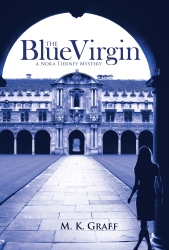
Auntie M would like to mention that her second Nora Tierney Mystery, THE GREEN REMAINS, has won First Place in the Mystery and Mayhem Awards given by Chanticleer Media for BEST CLASSIC BRITISH COZY. Auntie M doesn’t use the term cozy herself: she describes hers as a mix of amateur sleuth and police procedural. But there’s no question her murders are set in small communities and that the puzzle is the highlight, not gore and violence. She’s not writing about psychopaths or serial killers (although she does enjoy reads that do), but rather she’s interested in what motive would allow an otherwise reasonable person to feel it’s reasonable to take another life.

In a related note, she’s also debuting her second series this month. The first Trudy Genova Manhattan Mystery, DEATH UNSCRIPTED, will be in print shortly in hard copy and ebook. Here’s a peek at the cover:
Death Unscripted cover

Frequent readers of this blog know that the Nora Tierney’s are set in England, Auntie M features a host of authors from across the pond. Part of this is because she enjoys reading these books and they keep her mind in the UK when she’s writing. But even more is her desire to turn American readers on to great crime fiction they may be missing by not knowing of these authors.

Here are a few of her recent favorite reads:
The Kill

The Kill is Jane Casey’s fifth Maeve Kerrigan mystery and these procedurals keep getting stronger and stronger.

A wedding reception for a colleague is interrupted when Maeve and her Detective Inspector Josh Derwent are called back to London for a most unusual case: the murder of a fellow policeman in a park, in what could only be called a compromising position.

One of the highlights of the series is the abrasive Derwent and how Maeve handles and defends him. The two are surprised at the reaction of the victim’s wife and even his daughter when told the news. They have the feeling they are keeping things back from the investigators, and as their case heats up, they soon realize they are not the only ones with secrets to hide.

And Maeve find herself torn with the secret she knows about her boss, Superintendent Godley, whom she once admired. Things will come to a head in that direction in this taut and complex mystery that won’t disappoint.

no place to die

Darker and grittier is the second offering from Claire Donoghue in No Place to Die.

This second mystery featuring DS Jane Bennett opens where Never Look Back left off, and things are still in upheaval after the lousy end of that case for Jane and her boss, Mike Lockyer. Feeling the rift between them, his inability to concentrate on the work in hand heavily impact them both when their friend, retired police, goes missing.

Some of the creepiest scenes are set in the underground tombs that are found after a young woman’s body is found one, apparently buried alive and watched by a camera feed.

Once the woman is identified, other tombs are discovered and the threads appear to lead to a local college and its psychology department. And then another young woman is taken and may still be alive, but can Jane and Lockyer find her in time to save her? And who is behind this?

Surprising and shocking at the end, Donoguhe is one who readers should add to their reading lists.

Dark Places
Peter Robinson’s Inspector Banks are repeat favorites and this 22nd outing is no exception with In the Dark Places
, also Abattoir Blues in the UK version. It boggles the mind to think of an author who can consistently write creative and entertaining mysteries time after time, yet Robinson never disappoints.

An ex-soldier walking his dog, recovering from injuries that leave him limping, is annoyed when his dog goes under a fence and disappears inside an abandoned hanger. When the dog refuses to return and barks consistently, Terry Gilchrist has not choice but to find his way inside and see what’s troubling Peaches.

He finds the dog circling and sniffing and barking around a stain that can only be blood.

In a seemingly unrelated incident, a missing van leads Banks and his team into the countryside. Then a delivery truck falls over a cliff during bad weather and uncover the driver, killed on impact… and his grisly cargo: in addition to the dead animals he was tasked with collecting they find another body, dead before the crash.

Banks will have one of his toughest cases to crack in this repeat winner. Annie Cabot is back, and a nice side story features DS Winsome Jackson.

Black Valley

Black Valley is Charlotte Williams’ followup to The House on the Cliff, which introduced Welsh psychologist Jessica Mayhew.

In this outing Jessica is separated from her husband as they try to decide if their marriage is over. She feels strangely numb to emotions and feelings as she listens all day long to her patients personal drama. So she’s when surprised shortly after said husband confesses to having a relationship with a younger newsreader, that she’s attracted to a stranger she meets at an art exhibit.

That she’s there at all is down to the exhibit’s connection to her newest patient, artist Elinor Powell. Elinor presents with a bad bout of claustrophobia that hits her after her mother is murdered in Elinor’s art studio. A twin, she also is developing paranoid ideation about her sister and brother-in-law, an art dealer whose business may not quite be as above board as she’d like the public to believe.

The issue revolves around a reclusive artist who seems to be the next big thing in the art world. Refusing to give interviews, the unschooled young man nevertheless has captured his share of attention with his huge, brooding canvasses that echo the miners and their broken lives.

The hills of Wales outside Cardiff come alive under Williams skillful retelling, the countryside, lovely and nature-filled during the day, turns bleak and uncompromising at night, filled with caves and towers that haunt the landscape–and figure in the rushing climax as Jessica tries to find the truth about the ghosts who haunt Elinor Powell.

The writing is skillful and the psychological aspect well-handled. Therefore, it comes as a painful surprise to learn that shortly after finishing the first draft of this novel, Williams was diagnosed with breast cancer and died at the age of 59. Sadly, there will be no more Jessica Mayhew thrillers, but the two that are in print are worth readers’ time and investigation.

Late Scholar

And just to remind readers of last year’s terrific Lord Peter Wimsey/Harriet Vane mystery by Jill Paton Walsh, The Late Scholar is now available in paperback. This installment finds the duo adjusting after World War II and to the growth of their two boys when they are called to Peter’s alma mater, St. Severin’s at Oxford, to unravel a perplexing situation: the faculty and its warden have been unable to agree on selling a rare manuscript to keep St. Severin’s open, and now the warden has vanished. Paton Walsh captures the tone and language of the time and of these two sparkling characters and does Sayers proud.

5 Great Reads from Other Eras~ Wednesday, Aug 19 2015 

Auntie M has a stack of great reads written in other eras, so here’s a wealth of resources for those of you who prefer your crime to be set in other than contemporary times.

Reaching back into time is Laura Lebow’s The Figaro Murders, which brings 1786 Vienna to life.Figaro

Venetian Lorenzo Da Ponte has lived in Vienna for five years but still misses Venice. As court librettist, his current job for Emperor Joseph II is to finish the libretto for a revised version of Mozart’s The Marriage of Figaro , to please the Emperor, before its premiere the following week. It’s a tense situation as his previous libretto for a Salieri opera in the recent past closed after just one performance. The job is not as glamorous nor as well paid as it sounds, and a morning trip to his barber will change Lorenzo’s life.

The barber, Vogel, is on his way to debtor’s prison for a year, unable to pay the loan he used to open his shop, and begs Lorenzo to visit his fiancee, Marianne. He gives Lorenzo a box he’s found hidden in the closet of his recently-deceased mother–who told him shortly before her death that he had been adopted. Convinced his real family is one of noble origins and as a way to get him out of prison, Vogel expects that Lorenzo will aid Marianne to unearth his real family connections and save him and his marriage.

The box contains three innocuous items as Lorenzo’s only clues: a white fur ladies muff, a French grammar book, and a small ring, perhaps a betrothal ring. These three things will turn out to be the only link left to Lorenzo, and at first glance they appear to be of little value.

Lorenzo has an unusual visit to the Palais Gabler, home to a well-placed diplomat, where Marianne is employed. And then the unthinkable happens: he is arrested for a murder that apparently occurred during his visit to the Gabler home. Now the only way to clear his name is to undercover and find the real murderer, or be hanged for a crime he didn’t commit.

Filled with characters like Mozart and Salieri, the music matters of the Court and the time spring to life in this perspective of a certain period. A solid historical mystery.

JuneOrdinaryMurders
We switch to Dublin in 1887 for Conor Brady’s intriguing debut, A June of Ordinary Murders. The former editor of The Irish Times has written of the time in Victorian Dublin when crimes were classified as either “special” or “ordinary.” Special was for political crimes; murder was deemed ordinary.

The city readies for its celebration of Queen Victoria’s Golden Jubilee during an oppressive heatwave that everyone suffers under, just as they are under the threat of growing nationalist violence and a rising underworld of master criminals.

Enter DS Joe Swallow, tasked with investigating two murders when the mutilated bodies of an adult and a young boy are found in Phoenix Park. As he digs deeper, he learns he must be politically correct as he delves into the upper reaches of Dublin society. With his own success rooted in the past, Swallow his been a copper long enough to have enemies in the press and in his own department, and he needs to get this one right.

It seems the two deaths are connected, and then a woman’s body is found floating in the Grand Canal, and as the body count rises, so does the pressure on Swallow to effect an end to the string of killings.

Brady’s vivid descriptions bring this time of long ago to life, from the land wars to the country readying itself for the Queen’s visit during the heat, adding to the sense of languidness everyone involved feels. And Swallow has his own dark life to contemplate.

There are plenty of layers and different nuances as the police investigation unfolds. An interesting side component is to see the ‘forensics’ of 1887. Fans of The Murdoch Mysteries will eat this one up.

Dead Assassin
Vaughn Entwhistle introduced “the paranormal casebooks of Sir Arthur Conan Doyle” in last year’s The Revenant of Thraxton Hall. This second installment, set in 1895, brings back Doyle and his good friend Oscar Wilde as characters, to the readers delight, in The Dead Assassin.

The atmosphere is tense in London, with bombs detonating and causing anyone of a foreign nature to be suspected of being an anarchist.
Doyle’s dinner out is interrupted when a senior member of the government is brutally murdered, as is his assassin. One of the detectives recognizes the assassin as a pickpocket and petty thief, Higginbotham, who’s lived a life of low level crime. Then it turns out this same man couldn’t be the assassin–he was hanged two weeks ago. So how did he appear to be able to carry off the murder from his grave?

This obvious attempt at obfuscation brings Doyle and Wilde into the midst of a bizarre investigation with so many lives in peril readers will be surprised at how far the tendrils reach. This sequel is heavier and darker than the debut, especially once it’s established that the ongoing killings appear to be committed by criminals who are already dead.

Frankenstein meets Holmes, or in this case, Doyle, in this look at dark Victorian times–what can only be expected from an author who once ran a business that sculpted gargoyles.

suicideclub0205-2
Andrew Williams takes readers to 1917 Britain with a spy thriller based on real events in The Suicide Club
, a convincing and atmospheric mystery that is as well written as it is well researched.

Passchendaele is a nightmare, and Captain Alexander Innes of the Cameron Highlanders, badly wounded at the Somme, is taken off the front lines and seconded to the Secret Service, working in Belgium with the Resistance.

When he’s recalled to London to General Haig’s headquarters, his new assignment as a spy is to ascertain if the intelligence being delivered to the High Command is reliable.

What he learns is that the intelligence is suspect, and with the leaders using Innes for their own devices, the political tension–and the stakes for the outcome–rise sharply. Innes will find himself send back to Belgium, where the book’s action heats up even more.

The horrors of war are not glossed over, nor are the terrible outcomes for many devoted Resistance members of an occupied country. Fair to its real life characters, even Innes’ love affair feels grounded in reality.

Written with a deft hand, perfect for fans of John LeCarre’ and Alan Furst.

A Woman Unknown
It’s 1920’s England in Frances Brody’s fourth Kate Shackleton mystery, A Woman Unknown.

The accidental private investigator is first called on to uncover where a young woman goes when she tells her husband she is visiting her ill mum.
Cyril Fitzpatrick is concerned about his wife, Deirdre, and wants to know just where his wife really disappears to. Kate is wary of the job–she has come across Deirdre Fitzpatrick before.

When Chief Inspector Marcus Charles of Scotland Yard, Kate’s presumptive love, asks her to meet him at the Hotel Metropole, it’s to identify a man known to Kate who has been found by a chambermaid, dead in bed and not from natural causes. Everett Runcie, a banker facing ruin and disgrace by devious dealings faced divorce from his American heiress wife, tired of his infidelities. But Everett Runcie had not been alone when he checked into the hotel, so who, was his companion?

Could these seemingly unrelated events be connected? As she investigates, Kate recalls an accidental shooting at the start of the grouse season a few weeks back, and begins to wonder if there could be a tie to these cases. The more she delves, the more convoluted and sinister do matters appear. Can Kate untangle the complex threads and get to the truth?

Cleverly plotted, the story is told by Kate in the first person, and by third person narratives from Kate’s assistant Sykes and Deirdre Fitzpatrick. Brody weaves an intriguing set of events for the reader to unravel, which also highlights the difficult divorce laws of the time. The period details add much to the texture of this satisfying entry in the series. Don’t miss this entertaining series if you haven’t found Brody yet.

Linda Castillo: After the Storm Tuesday, Aug 18 2015 

After the Storm

Linda Castillo’s Kate Burkholder series is a consistent favorite with readers for compelling thrillers featuring the ex-Amish midwestern Chief of Police. After the Storm, continues in the same vein, where the beauty of the area almost heightens the ugly crimes Kate faces.

The tension quickly builds with a tornado heading through Painters Mill, and in the ugly aftermath as Boy Scout help with clean up efforts, human remains are discovered.

Kate must determine the identity and cause of death, which is gruesome indeed, and will have far-reaching consequences for Kate as well as the tight-knit community.

Kate’s personal life is a continues to evolve across the books. Her relationship with State Agent John Tomasetti has reached a new level – and new hurdles are put in their path as they adjust to living together. Kate’s supporting cast is solid and dedicated to their Chief, while Kate’s personal conflicts between the community she was raised in and the world she now lives in provide a great secondary story line.

Meanwhile, a killer waits in the shadows to protect family secrets.

Castillo’s use of details bring the Amish settings, culture and language to life. The series is driven as much by the characters as by the cases Kate must solve. Another strong entry in a consistently strong series.

Michael Wallace: Not Death, But Love Sunday, Aug 16 2015 

While Auntie M is attending St Hilda’s Mystery and Crime Conference in Oxford, please welcome California author Michael Wallace, who will describe the genesis of his third mystery, Not Death, But Love:
Not Death,But Love

The Book That Wanted to Be Written

Most authors, I’m guessing, are carrying around several unwritten books in their heads. Typically we have an idea of which one will get written next, but sometimes one of the stories insists on muscling its way from the back of the queue to the front.

Something rather like that took place with my third Quill Gordon mystery, Not Death, But Love, which was published on Amazon May 27. This wasn’t originally going to be the third book in the series, but things happened.

In 2012 I was hired by a family foundation to write the family’s history. It’s one of the best jobs I’ve ever had, because it paid generously and the work was fascinating. By the end of it, I felt the long-deceased family members had come alive inside my head and that I was able to convey a reasonably good sense of them to the readers.

In the course of that work, I came across several things that were a surprise to the people who hired me. There were no terrible scandals, but there were lawsuits and family schisms they hadn’t known about until I started digging. At the time, I was simultaneously working on my second mystery, Wash Her Guilt Away, and at some point it occurred to me that a family history with a deep secret — one worth killing to keep — could make the basis for a good mystery.

One of my plans for a future book had been a story centering on a controversial land-use plan, something that would make use of the knowledge I picked up working as a consultant for Wells Fargo Bank and The Home Depot more than a decade ago. That one had been on the back burner, but I decided to combine ideas to make the land development part of the family history, and was off to the races.

When I was working on the real family history, I often lamented that none of the family members had kept journals (at least none that had survived). I decided to give my murder victim, a retired English teacher named Charlotte London, a journal. It was originally supposed to provide a set of clues to complement those in the family history, but it ended up being much more than that.

Simply put, in the course of creating the journal sections, I discovered that Charlotte had come to life most vividly, and, surprisingly to me, became one of the most dominant and complex characters in the book. Not to be gooey, but I got to be rather fond of her, and I’m hoping the book’s readers will, too.

The history aspect carried through the rest of the book as well. I found myself wondering about, and inventing, histories of various elements of the book. These included the lake, the Italian restaurant where the characters ate dinner, the Rotary Club, where community and political alliances were cemented, and the town where the story was set. Such details, I feel, are what add richness to a book. They can often be what a reader remembers long after he or she has forgotten whodunit.
book cover 2 first proof revised

MikeWallaceJPG

MICHAEL WALLACE is a native and lifelong resident of California. He received an A.B. degree in English Literature from the University of California, Santa Cruz, worked for 19 years as a daily newspaper reporter and editor, and has had a long second career as a public relations and publications consultant. He has been an avid reader of mysteries since childhood and a fly fisherman for more than three decades. He lives in the Monterey Bay area with his wife, Linda Ogren, a university lecturer in biology. Their son, Nick, is in the army.

cover_ebook
LINKS The McHenry Inheritance Book: http://www.amazon.com/dp/B008OAODZ6 Video: http://youtu.be/qeUj3R4mf_Y Wash Her Guilt Away Book: http://www.amazon.com/dp/B00K1DOV56 Video: http://youtu.be/m1Hqg11YJ0o Not Death, But Love Book: http://www.amazon.com/dp/B00U5LEFHS Video: In production Website: http://www.quillgordonmystery.com Blog: http://www.outofglendale.blogspot.com Twitter: @Qgordonnovel Facebook: http://www.facebook.com/MikeWallaceMysteryWriter

Steph Cha: Dead Soon Enough Friday, Aug 14 2015 

Dead Soon Enough

Steph Cha’s Juniper Song Mysteries feature the unusual Korean-American protagonist who is now a licensed private detective in Dead Soon Enough.

The series with a modern LA noir feel finds Song having her own cases at the newest PI for Lindley and Flores. When she’s hired by Dr. Rubina Gasparian, it’s for a most unique reason: Rubina wants Song to follow her cousin, Lusig, who is acting a surrogate for Rubina and her husband Van, a surgeon. Carrying their baby and remaining stress free and healthy should be Lusig’s primary job right now, as far a Rubina is concerned. For Lusig, that goal has been usurped by looking for her best friend, Nora, missing for a month now.

Lusig, Rubina and Nora are all linked by their Armenian roots. Rubina soon realizes that keeping Lusig safe means moving Song into her home for now and letting her look for Nora in the evenings when she is home to keep an eye on her cousin. Song’s investigative threads for the missing Nora revolve around Nora’s battle to allow a memorial honoring the Armenian genocide by the Turks to be installed.

A Turkish group has been fighting the installation, claiming that the genocide a hundred years ago that coined the term in the first place was a war. Heavily funded, Song suspects more and more that this group had something to do with Nora’s disappearance. Along the way she will visit a strip club, just one situation she finds herself in as she tries to find Nora.

This is a fast-paced mystery that allows Song to deliberate her own feelings about motherhood and where she sees her future heading. There is plenty of action but even more interesting to Auntie M is the way Song is constantly examining herself and her feelings–and just how far she’s prepared to compromise herself to catch a killer.

By the end, long-held secrets will be revealed and just when the reader thinks they know what’s happened, the story turns into itself and Song finds herself in jeopardy.

Cha has a nice way of getting into Song’s head and the series has a visual feel that would translate well to the big screen. Auntie M particularly liked the young lawyer Song comes across and hopes readers will see more of him in the next installment.

Jessica Barraco: The Butterfly Groove: A Mother’s Mystery, A Daughter’s Journey Wednesday, Aug 12 2015 

From time to time Auntie M sneaks off the crime fiction curve and brings you something different. This time it’s a mystery of sorts, revolving around a real life events belonging to journalist and former HarperCollins publicist Jessica Barraco, which she recounts in The Butterfly Groove:

51wM75Cm-ML._SX321_BO1,204,203,200_

The Reasoning Behind My Research for The Butterfly Groove: A Mother’s Mystery, A Daughter’s Journey
By Jessica Barraco

As a journalist, my training has revolved around knowing the truth. A lot of people like to say that journalists are too curious, that they like to expose people or situations, they can’t let sleeping dogs lie. A true journalist will counter: “But that is what life is about: facing the music.” If you are afraid to see reality, evolving as a person will prove to be very difficult.

My mother passed away when I was 12 years old after an almost 20-year long battle with cancer and its devastating complications. In her life, she was a very private person, and when she died, many rumors came up, mostly all negative about her childhood and teenage years. She wanted to be a writer, but never had the opportunity to receive a proper education. On so many levels: spiritually, emotionally and professionally, I felt it was only fair to my mom to find out the truth about her life; the life she had before she was sick. I was the only one in my family who was interested in learning my mother’s truths, and that made it a lonely journey. Until I researched, found and met all of the wonderfully open strangers who helped me create this book, and ultimately, to put the pieces together of the mystery that was my mom.

I did for my mom what I hope anyone would do for me. I chose to not believe whatever distorted memories and passed down information her relatives claimed to know about her. I chose not to believe anything at face value. Believing gossip is the easy thing to do. I chose the harder path – the path that leads to the truth.

I hope you’ll join me on my journey and get to know both me and my mom a little better in The Butterfly Groove.

Comments/questions? Interested in having your book club read my book? Feel free to reach me at thebutterflygroove@gmail.com and I will be happy to help in any way.

Amazon: http://www.amazon.com/The-Butterfly-Groove-Mothers-Daughters/dp/1631528009
B&N: http://www.barnesandnoble.com/w/the-butterfly-groove-jessica-barraco/1121116558?ean=9781631528002
Indie Bound is available too.

BIO
Journalist by heart, marketing professional by day, and writer by moonlight, Jessica Barraco is a graduate of the University of Colorado, Boulder’s School of Journalism and Mass Communication. She published her first newspaper article at nineteen years old, after which she wrote for 944 magazine and The Denver Post. She also spent three years working at HarperCollins Publishers across all of its imprints, working on both nonfiction and fiction books. A contributor to EliteDaily and marketing professional, Barraco resides in California.

Medieval Mysteries and Magic Tuesday, Aug 11 2015 

Here are great books for those readers who enjoy theirs set in far away times with the hint of mysterious fairy tale adventures–enjoy!

I-LOVED-A-ROGUE
Katherine Ashe’s third in her Prince Catchers series, I Loved a Rogue, has garnered enthusiastic reviews.

A soothsayer has foretold the future for one of three orphaned sisters: one will marry a prince. It’s the stuff of fairy tales for certain, as they await the mystery of their past to be revealed. Only the last sister can fulfill the prophecy, but it comes at a price: resisting the advances of a seductive rogue.

Eleanor Caulfield appears to be the perfect vicar’s daughter, yet she’s been in love with a gypsy, Taliesin, who broke her heart years ago. The only unmarried sister, Eleanor is fast approaching spinster hood. With the marriage of her father, she determines she must unravel the mystery of her parentage. Having almost died as a child, Eleanor’s sisters demand she have an experienced traveler be her guide.

With Taliesin appearing for her father’s wedding, the sisters suggest he accompany her, and Eleanor sets off with mixed feelings.
As they travel the countryside in search of clues to her parent’s identity, flashbacks show the duo’s history: the mixture of awe and devotion Taliesin feels for Eleanor; her fear and infatuation, under the impending doom of society’s disapproval.

Their challenging of each other is what strengthened Eleanor after her sickness and now galvanizes her on the quest for her parents. No spoiler alert here, but definitely an interesting ending to the series by a talented writer.

Auntie M had the pleasure of meeting Katherine Ashe at the Pamlico Writers Conference this year. She’s as charming as the heroines she writes about.
LampBlack
Paula Brackston’s novels of witches and spirits have a commanding following. She’s back with her fifth, Lamp Black, Wolf Grey
, set in Wales, and this time one of her characters is none other than Merlin himself.

Dual stories in different times both feature the legendary Merlin. Laura, a painter, has moved to the Welsh countryside with her husband to make a fresh start after years of infertility. They are looking to trade the noise and busy London lifestyle for the quiet, quaint wilds of the Welsh countryside, and choose an ancient home named Penlan.

Instead of solace and inspiration, Laura finds herself experiencing emotional longings and mysterious unexplained occurrences. Living in a centuries-old house in a remote area rich in lore and mystery, she feels echoes from the past. Her imagination runs wild with tales of Merlin the Magician having lived nearby in his pre Arthur days, and she tells herself it’s her imagination or else she’s losing her mind.

Interspersed throughout Laura and Dan’s story is that of Megan, a servant in the house of a wicked lord, and of her romance with the magician Merlin. This duality fleshes out the story in a nice mix that’s hallmark Brackston. Laura is a complex and likable heroine, with very relatable weaknesses. The mythical Merlin remains more enigmatic and mysterious. The historical parts are well done, yet readers will enjoy the the compelling contemporary plot line.

Dragon Handale
Cassandra Clark’s fifth Abbess of Hildegard mystery takes readers to 14th century England in The Dragon of Handale. Clark introduces the characters and their backgrounds so readers who have not read the previous novels can plunge right in.

Hildegard of York is a former nun, something of a sleuth, used to being in a position of authority, a woman who’s become ambivalent about whether she should re-enter a convent or continue on in secular life. Her former prioress suggests that she stay at the remote Handale Priory while she ponders her decision.

Yet once she’s settled at Handale, Hildegard begins to wonder if there was a hidden agenda involved in sending her there. Handale is a place for penitents – but in practice, it appears more a kind of prison for sinning nuns. Life there is harsh and unforgiving.

Everywhere she looks, Hildegard’s sharp and inquiring mind sees suspicious activity. There’s a strange rumor of a vicious ‘dragon’ outside the priory walls. Then a mason, one of a group hired to do work for the abbey, is brutally murdered. The woman in charge seems deliberately cruel. Young novices are desperate to escape. And what is a wealthy merchant doing within the walls?

Hildegard realizes that these strange incidents make it her job to get to the bottom of what’s really going on at Handale. Her investigation will range from small and personal injustices right up to high affairs of state and the politics of the realm. Intriguing to see a mystery and amateur sleuth in this kind of setting.

RedRose

Joanna Hicson’s Red Rose, White Rose takes readers to fifteenth century England in the time of the War of the Roses. This well-researched historical fiction is based on Cecily Neville, the wife of Richard Plantagenet of York and mother of Edward IV and Richard III. Cecily Neville is the youngest daughter of Ralph Neville, Earl of Westmorland, and her advantageous marriage with Richard, Duke of York, combines two of the most powerful families in the land.

But Cecily soon learns that being married to one of the richest men in the country is not without danger, and as she discovers that life so close to English royalty is fraught with both treachery and peril.

Beautifully researched, the story combines the best of both fact and fiction. Throughout the novel, readers learn Cecily’s perspective about her life; we see her maturing from a young and idealistic teenager to a mature woman with her own children and responsibilities for vast estates.

She’s a compelling protagonist, opinionated and controlling at times, but ultimately loyal to those she loves and respects. The co-narrator is Cuthbert, who is described as Cecily’s illegitimate half brother. This fictitious figure provides a much needed male perspective on what it was like to serve the Neville family. And as he gets tangled up in the politics and manoeuvrings of the scheming Plantagenets, we gain insight into the intrigue and deceptions that were so much a part of this deadly game of thrones.

Siege Winter
Ariana Franklin’s death in 2011 left readers clamoring for her unfinished manuscript, and her daughter Samantha Norman has done a grand job of stepping in to finish her mother’s final manuscript, leading many to feel she can more than inherit her mother’s legacy in The Siege Winter
.

Research on everyday medieval life brings real authenticity to the novel. During this era, England’s civil war between supporters of Stephen (grandson of William the Conqueror), and his cousin, the Empress Matilda, for the throne of England forced occupants of cathedrals as well as castles to take sides.

The fictional Kenniford Castle is a pivotal site because it is on a key Thames crossing. The castle’s mistress is 16-year-old Maud, a ward of King Stephen, forced to marry the much older, crass and barbaric John of Tewing, who arrived at the castle for the wedding with both his son and his mistress.

In alternate chapters, readers follow the fate of a young girl who had gone out to gather fuel with her family and was caught by a group of men, led by a sadistic rapist and killer monk with a penchant for red-headed children. Emma was left for dead but was found by Gwilherm de Vannes, a mercenary who had his horse stolen by the very men who ravaged Em.

Gwil nurses the girl back to health and she remembers nothing of the trauma that almost killed her, nor of her life before it. Gwil calls her Penda after a Pagan warlord. He cuts her hair to disguise her as a boy, and he teaches her to defend herself with a bow. The two travel through the countryside earning money by giving archery exhibitions. What Gwil doesn’t share with Penda is his determination to track down and destroy the monk who brutalized her. In addition, he suspects the monk may not be done yet with Penda, because when Gwil found her, she was clutching a valuable parchment that the monk needs to recover.

Events take a turn when Mathilda and two protectors, Alan and Christopher, stumble upon Gwil and Penda during a snowstorm, and take shelter with them. They beseech Gwil and Penda to help them get Mathilda to safety, and the five of them end up at Kenniford castle. Before long, the castle is besieged by the much larger and better armed forces of Stephen, and must survive a brutal winter while avoiding death and destruction.

A fascinating look at medieval times with a mystery within the rages of war.
Bitter-Greens-Thomas-Dunne-Books

Kate Forsyth is quickly becoming a name in historical fiction as she explores fairy tales. Her debut, Bitter Greens, won the Best Historical Fiction prize from the American Library Association.

It’s the time of the Sun King, Louis XIV, and novelist Charlotte-Rose de la Force has been banished from the Court of Versailles for behaving like a man in terms of her love life.

Running alongside Charlotte’s story is the thread of the fairy tale of Rapunzel, told to Charlotte by an old nun, which gives the story it’s interesting structure. The two story lines share themes as the female characters struggle for independence and the right to decide their own destinies.

This also echoes the life story of the witch who confined Rapunzel. For the first time we see her backstory and her fight for the freedom to make her own choices. This has her become a more sympathetic character than fairy tale readers recall, even though she remains a dark element in the Rapunzel story. The witch’s fears are common ones with which most people contend: the fear of aging and death. With its echoes of feminism, the themes apply to modern times and keep all the woman deeply human.

wildgirl_forsyth
With The Wild Girl
, another exploration of fairy tales, Kate Forsyth deals with the Brothers Grimm. This is a richly imagined tale of the woman who gave the Grimm brothers some of their best stories. History is very much part of the foreground, as the Napoleonic wars rage around the small kingdom of Hessen-Kassel. The book deals with how the lives of ordinary people, especially the poor or the marginalised, experience history as a material impact on their bodies and minds, and their everyday lives.

The romance between Wilhelm Grimm and Dortchen Wild unfolds slowly and deeply over many years. Dortchen is wild by nature, headstrong and curious. At the hands of her cruel and domineering father, she moves from innocence to experience, and the novel takes a hard turn. Its darkness is relieved by the meetings between the lovers, as she tells Wilhelm tales and they fall deeply into a forbidden love. There is real despair here, not a cliched romance, as the lovers are helpless in the face of circumstance.

Yet the romance becomes almost secondary to the sophisticated and thoughtful power of the stories. “Stories help make sense of things,” Dortchen tells Wilhelm. It’s long been known that many nursery rhymes and fairy tales were commentaries on the politics of their time. And in this novel we see the additional importance of stories in preserving a culture, in remembering history, and in connecting people in time as all good fairy tales do.

Kate Forsyth is a deft writer, her prose elegant and spare, almost Germanic in its precision and placement in this novel in contrast to the different language she uses in the French tale Bitter Greens, which has an almost baroque feel to her chosen words. So besides weaving talented tales and doing complex research of each time, this author manages to tailor her language to each novel’s setting. And the covers are gorgeous~

The Book of You: Claire Kendal Sunday, Aug 9 2015 

Book of You

If you read and enjoyed Elizabeth Haynes Into the Darkest Corner then you will definitely want to read Claire Kendal’s The Book of You.

University administrator Clarissa, getting used to a painful split from her partner, can’t wait for her jury duty to begin. She’s thrilled when she’s assigned to a case where she will have to be off work for at least seven weeks. Every day in the protected courtroom means a day out of sight of the man whose stalking is ruining her life and haunting her dreams on the rare nights she’s able to sleep.

Rafe is the academic who turned one night’s encounter with her into his obsession. An expert on fairy tales, especially those of a dark nature, Rafe uses these to add chilling texture to the terror that has become Clarissa’s life. She’s unable to walk home from the train station or leave her home without seeing his shadow. Even a walk in a nearby park becomes the stuff of nightmares until a stranger walking his dog interrupts what she increasingly fears could have been her murder, after researching Rafe’s personal history and learning that a young woman he’d stalked previously has disappeared.

He is ever present in her life, showing up at her house with gifts she must save as evidence of his stalking and harassment to go to the police with enough incidents that they will take her seriously. A talented sewer, Clarissa uses her this sideline to keep hold of her sanity, as her physical health deteriorates and she must detail the conversations and presence of this sick man in her life in a small black book she calls the Book of You.

Now as she takes solace in the jury room, making a few friends, attracted to a fireman in particular, Clarissa can’t help but notice the case they are trying of a young woman raped and brutalized mirrors her worst fears if Rafe should ever get in close contact with her again. The defendant’s grueling days on the witness stand point out that Rafe will try to twist her story around to his benefit, and Clarissa must have enough proof before going to the police of the seriousness of his intent.

The power of the book comes from illustrating how much psychological damage an obsessive like Rafe can incur simply by his continued and annoying presence. And when his threats escalate, so does the horror that Clarissa feels and what she ultimately faces.

This well-written thriller will have readers hearts beating as hard and fast as Clarissa’s does on a regular basis. A harrowing story of the ability to enact cruelty on another human being with Kendal’s knack bringing the reader right into Clarissa’s churning anxiety.

Summer Thrillers X 4: Meltzer, Hamilton, Kovacs, Freedland Friday, Aug 7 2015 

Here are four great summer thrillers for readers out right now, whether you’re at the beach or reading before bed. And if you missed Steve Berry’s The Lincoln Myth when it first came out, that one is now in paperback and ebook formats.

Meltzer_ThePresidentsShadow(HC)
Brad Meltzer’s Culper Ring Triology has captivated readers, who are waiting for this third installment. The President’s Shadow shows his love of the National Archives and his relationship with former US President George H. W. Bush and First Ladies Barbara and Laura Bush, who helped to inform the book, adding to the sense of reality that pervades the read.

The book opens with a wallop and never lets up, with First Lady Shona Wallace keeping her secret: she’s stolen a small section of the White House Rose Garden for her own flower garden. As she digs in the dirt early one morning, a persistent root finally gives way–and proves to have fingers attached to it.

That severed arm is only the start of trouble for Beecher White, erstwhile employee of the Nation Archives, who’s been visiting his mentor, Tot Westman, every day. Tot lies in a coma after brain surgery on the bullet wound in his frontal lobe.

The discovery of the arm immediately raises questions about security, the victim and the culprit. Beecher is called to a secret meeting of the Culper Ring, where President Wallace tells him that an item discovered with the arm links back to Beecher’s dead father.

That mystery surrounding what happened to his father has consumed Beecher, and this discovery might finally bring some answers. His membership in the secret organization that dates back to before George Washington became President holds the key, especially since the clue left was meant for Beecher alone.

Meltzer blends history with his fascinating story, mixed with that insider knowledge that lends authenticity to the conspiracy that is unveiled. This is great storytelling in an interesting and absorbing trilogy that blends fact with fiction in a compelling manner.

Past Crimes
Switching to a debut, Glen Erik Hamilton and Past Crimes
introduces Army Ranger Van Shaw, who has returned to his Seattle home after receiving a terse message from his grandfather after a decade apart. With flashbacks showing readers Van’s unusual childhood, the reason he joined the Rangers, Van Shaw promises to be an entertaining protagonist in this accomplished book.

Van finds his grandfather, Dono Shaw, bleeding from a gunshot wound to the head. With their complicated past and Dono Shaw’s shady life, Van knows he will be the prime suspect in the shooting and must clear his name. But the only way to do that is to plunge himself into the life he thought he’d left behind when he joined the Rangers.

There will be an enormous diamond theft to handle as Van hunts for the shooter, using the skills he’s learned in his Ranger training, combined with his sharp wit to find the assailant as he works with the team Dono put together for his big jobs and realizes he can trust no one.

Filled with action sequences, the book’s visuality and sharp dialogue will lend itself well to being filmed and Auntie M has no doubt this will be picked up by Hollywood if it hasn’t been already.

RussianBride
Best known for his Cliff St. James crime novels, author Ed Kovacs is debuting a new series in The Russian Bride.

His protagonist is an elite agent in military intelligence, working undercover in Moscow to find moles in the US Embassy. Major Kit Bennings suddenly finds himself and his family the targets of a former KGB general-turned-Mafia don in a complicated coercion scheme when mobster Viktor Popov has Kit’s mother killed in California.

Popov threatens to do the same to Kit’s sister, Staci, whom he has already kidnapped. To free his sister, Kit must agree to marry a Russian woman, Popov’s niece, Yulana Petkova, and take her to the U.S.

Desperate to save his sister, Kit reluctantly agrees to the marriage but soon learns what Popov really wants: Kit’s help in stealing an electromagnetic-pulse device that could disable the economic and intelligence infrastructure of a large percentage of the U.S. and open the door to massive cyber-theft opportunities.

Now Kit finds himself hunted by killers on both sides of the ocean and saddled with a new wife,\ as he tries to rescue Staci and stop Popov’s plans from coming to fruition. He will call on all of his talented action-oriented friends for help and there’s plenty of specialists who rise to the occasion. There’s so much going on at times readers will feel breathless at the fast pace.

3rd Woman
Jonathan Freedland’s unusual premise makes The 3rd Woman an intriguing read.

Picture an alternate world where US has borrowed more money from China than it can repay–not too hard to imagine–and is forced to allow them a permanent military presence on American soil. It’s the stuff of nightmares.

But to journalist Madison Webb, it’s her reality to live in this America of crisis in every quarter: economic, political and social.

Then the unthinkable happens: her own sister is murdered, and Madison refuses to accept the official line that Abigail’s death was an isolated crime. There are local political elections in process, with Maddy’s ex-boyfriend working for a candidate, and Abi’s murder soon becomes a hot political issue.

After Maddy uncovers evidence that points to Abi as actually being the third victim in a series of killings, she realizes the deaths are being hushed up as part of a major conspiracy. In the new US climate, there are shades of truth and reality.

Maddy will be forced to use all of her connections to get to the truth. The use of social media adds a nice touch as her own life comes into the line of fire.

This is a clever, fast-paced political thriller. Maddy is a strong and capable female lead with a realistic edge who readers will want to see in action again.

« Previous PageNext Page »